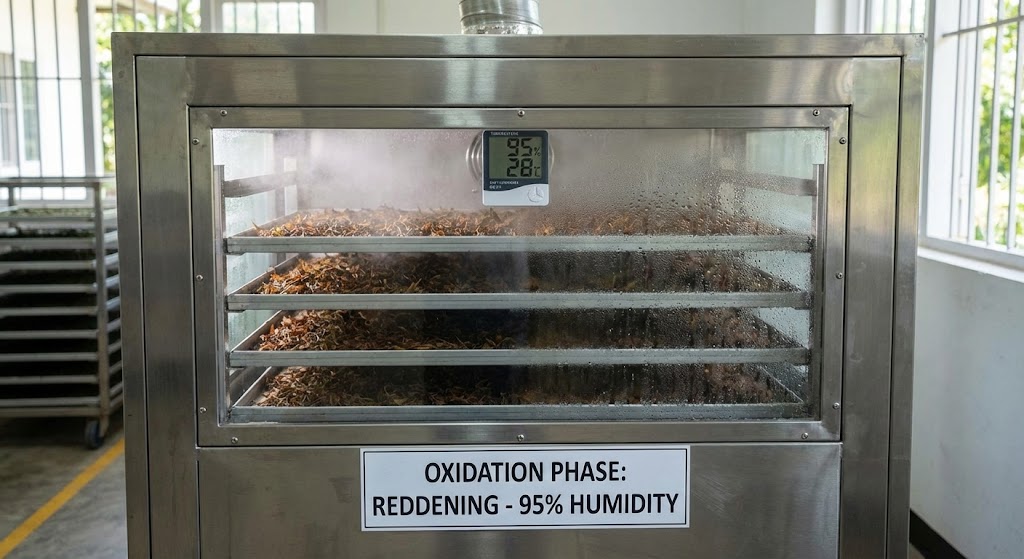
1. The Science of Oxidation: Why Black Tea Needs 95% Humidity
Oxidation vs. fermentation terminology: Tea industry uses "oxidation" and "fermentation" interchangeably (technically incorrect—oxidation = enzymatic browning, fermentation = microbial activity). True black tea processing = enzymatic oxidation (polyphenol oxidase enzyme converts catechins → theaflavins + thearubigins, creating characteristic browning and complex flavor). This requires specific environmental conditions: Temperature 25-30°C (optimal enzyme activity—too cold slows reaction like refrigerated tea degradation, too hot denatures enzymes), Humidity 85-95% (critical factor—leaves must stay moist for enzymatic reactions to continue, dry air halts oxidation mid-process creating incomplete transformation), Oxygen availability (aerobic process—needs constant air circulation unlike anaerobic GABA production).
Why humidity matters physiologically: Tea leaves post-rolling contain 60-70% moisture (cell walls bruised—internal juices exposed, enzymatic reactions accelerated). In low humidity environment (<50%), leaf surface dries rapidly (moisture evaporates faster than internal diffusion replaces it—creates moisture gradient), enzyme activity crashes (polyphenol oxidase requires aqueous medium—dry conditions = inactive enzyme, oxidation stops prematurely), result = partially oxidized tea (greenish-brown color not deep copper, grassy notes persist, astringency harsh like under-developed black tea sold commercially as "budget grade"). High humidity chamber maintains leaf moisture (prevents surface drying—enzymes stay active throughout oxidation period), allows complete transformation (80-95% catechin conversion—full theaflavin development, smooth malty-sweet flavor characteristic of proper builder's tea strength).
2. DIY Humidity Chamber: The Cooler Method
Budget-friendly approach (£10-20 materials): Equipment needed = Styrofoam cooler/insulated box (10-20 liter capacity—hardware store £5-10, maintains stable temperature + humidity), wire cooling rack (elevates tea above water—prevents direct contact, £3-5), shallow tray/dish (holds water—humidity source), oven thermometer + hygrometer (monitors conditions—£5-10 combined, essential for control). Setup advantages: Portable (move anywhere—kitchen counter, garage, basement), inexpensive (reuses items or cheap purchases—accessible for home tea enthusiasts), effective (maintains 85-95% humidity if sealed properly—rivals commercial chambers for small batches).
Assembly instructions: Step 1: Place shallow tray in cooler bottom, fill with warm water 2-3cm deep (warm water evaporates faster—generates humidity quickly, 30-40°C ideal not boiling which steams leaves). Step 2: Position wire rack above water (minimum 5cm clearance—prevents tea touching water which causes over-wetting, elevates leaves into humid air zone). Step 3: Spread rolled tea leaves on rack (single layer 2-3cm thick—allows air circulation between leaves, too thick = uneven oxidation like stacked roasting problems). Step 4: Place thermometer + hygrometer visible through lid (monitor without opening—opening releases humidity, defeats purpose). Step 5: Close lid tightly (seal maintains micro-climate—humidity stays trapped, check seal quality like puerh storage containers).
Monitoring Oxidation Progress
Visual cues: Hour 0-1 = bright green-brown (initial browning—enzyme activation), Hour 1-2 = copper-brown (peak oxidation—theaflavin production), Hour 2-3 = dark brown-black (late oxidation—thearubigin dominance like color changes in roasting). Smell test: Fresh-cut grass smell fades → fruity-floral emerges → malty-sweet develops (aroma evolution signals progression—trust your nose like staleness detection). Taste tiny sample: Pinch leaf, brew 30 seconds—should taste smooth not astringent when ready (quality check before full batch drying).
3. Temperature Management: The 25-30°C Sweet Spot
Why temperature precision matters: Polyphenol oxidase enzyme has temperature-dependent activity curve (biochemistry standard—enzyme kinetics follow Arrhenius equation). Below 20°C: Sluggish oxidation (reaction rate slow—might take 8-12 hours instead of 2-3, produces weak flavor like cold-brew extraction inefficiency). 25-30°C optimal: Peak enzyme activity (maximum oxidation rate—2-3 hour complete transformation, develops full theaflavin complexity). Above 35°C: Enzyme begins denaturing (protein structure breaks down—loses catalytic function, creates "cooked" off-flavors rather than proper oxidation, similar to kill-green heat damage).
Maintaining temperature in cooler: Warm water method (described above) = Simplest approach (water thermal mass stabilizes temperature—slow cooling over hours, refill warm water if temperature drops below 25°C). Heating pad method (advanced): Place reptile heating pad under cooler (£10-15 pet store—thermostat-controlled maintains precise temps like GABA production temperature control), set to 28°C (perfect oxidation temp—"set and forget" reliability). Room temperature reliance (summer only): Warm ambient 25-28°C sufficient if house heated (winter processing risky—cold air infiltration drops chamber temp, unreliable without supplemental heat).
4. Oxidation Duration: 2-3 Hours for Full Black
Timeline of transformation: 0-30 minutes: Initial color change (green → greenish-brown—surface oxidation begins, enzymes activated by rolling bruising). 30-90 minutes: Peak theaflavin production (bright copper-brown—complex fruity flavors develop, this stage creates "premium black tea" character similar to First Flush Darjeeling's brightness). 90-150 minutes: Theaflavin → thearubigin conversion (darkening to brown-black—flavor shifts from bright-fruity to malty-robust, classic British builder's tea profile). 150-180 minutes: Complete oxidation (deep black—full-bodied malty sweetness, maximum transformation achieved). Beyond 3 hours: Diminishing returns (over-oxidation possible—dull flatness, musty notes emerge like stale tea degradation).
Stopping oxidation precisely: When leaves reach target color/aroma (typically 2-3 hours for full black tea), immediate heat treatment required (halt enzymatic activity—prevents over-oxidation during drying process). Method 1: Oven firing = Spread leaves on baking sheet, 110-120°C for 10-15 minutes (denatures enzymes—locks in oxidation state, begins drying process), then reduce to 80-90°C for final drying (complete moisture removal—proper drying prevents mold). Method 2: Pan firing = Wok/large pan high heat (traditional method—constant stirring 5-10 minutes until leaves smell toasted, enzyme deactivation + initial drying combined like roasting technique). Both methods achieve same goal: stop oxidation, begin preservation drying.
5. Humidity Control Troubleshooting
Too low humidity (<80%): Symptoms = Leaves drying at edges (curl inward—moisture loss visible), color stays greenish-brown (incomplete oxidation—enzyme deactivation from dryness), harsh astringent taste (under-developed tannins—not transformed to smooth theaflavins). Solutions: Add more water to tray (increase evaporation surface—raises humidity quickly), use hot water not warm (faster evaporation—emergency humidity boost), add damp towel over rack (creates localized high-humidity zone—extreme measure for stubborn cases), check cooler seal (gaps leak humidity—tape seams if needed like storage container sealing).
Too high humidity (>95%): Symptoms = Condensation on lid (water droplets form—sign of saturation), leaves waterlogged (surface wet/shiny—too much moisture causes anaerobic fermentation not oxidation), musty smell (bacterial growth—spoilage risk like fermentation contamination). Solutions: Remove some water from tray (reduce evaporation source—lowers humidity), increase ventilation slightly (crack lid 1-2mm with prop—allows some humidity escape, risky but necessary), add silica gel pack in corner away from leaves (absorbs excess moisture—balances extreme humidity), check water temperature (boiling water creates steam not humidity—use warm 30-40°C only).
| Chamber Type | Cost | Capacity | Humidity Control | Best For |
|---|---|---|---|---|
| Styrofoam Cooler | £10-20 | 200-500g leaves | Manual (water tray) | Beginners, small batches, budget processing |
| Plastic Storage Bin + Humidifier | £30-50 | 500-1000g | Semi-automated (USB humidifier) | Regular processors, consistent results |
| Modified Mini Fridge | £80-150 | 1-2kg | Automated (temp + humidity sensors) | Serious hobbyists, year-round processing |
| Commercial Tea Fermenter | £500-2000 | 5-20kg | Fully automated (digital controls) | Small-scale commercial, micro-estates |
6. Scaling Up: From 200g to 2kg Batches
Cooler size limitations: Standard cooler (20L) handles maximum 500g rolled leaves (single layer on rack—overcrowding prevents air circulation, creates uneven oxidation like stacked roasting problems). For larger batches need bigger chamber: Large storage bin (50-80L plastic tote—£15-25 hardware store) accommodates 1-2kg leaves (use multiple wire racks stacked—3-4 layers with 5cm spacing between each), USB ultrasonic humidifier (£20-30—generates consistent humidity without heating water, placed in corner of bin), Small fan (optional—gentle air circulation prevents stratification, ensures even humidity distribution).
Industrial-scale oxidation rooms: Commercial estates use dedicated climate-controlled rooms (5-10m² space—processes 50-200kg simultaneously, professional equipment like auction-grade production). Home equivalent impossible (humidity control expensive at room scale—thousands in HVAC equipment), but batch processing viable: Multiple coolers (4-5 coolers × 500g each = 2-2.5kg per oxidation run—parallel processing, manageable for home estate ambitions). Time efficiency: All coolers oxidize simultaneously (same 2-3 hour period—not sequential, effectively scales production without extending labor time).
7. Quality Assessment: Tasting Your Homemade Black Tea
Brew evaluation parameters: Appearance = Dry leaves should be uniformly black (not greenish patches—indicates complete oxidation), twisted/rolled shape retained (structural integrity—proper rolling + drying maintained form). Liquor color = Deep amber to reddish-brown (bright not murky—sign of theaflavin-rich oxidation, clear extraction), avoid greenish tint (under-oxidation—processing error) or overly dark/opaque (over-oxidation or contamination). Aroma = Malty-sweet dominant (caramel, honey, dried fruit notes—proper black tea character like First Flush complexity), no musty/sour smells (spoilage indicators—batch failed).
Flavor benchmarks: First sip = Smooth entry (not harsh—well-oxidized tea lacks green astringency, tannin balance achieved), malty-sweet mid-palate (theaflavin sweetness—hallmark of quality black tea). Finish = Clean aftertaste (no bitter linger—proper oxidation + drying prevents off-flavors, pleasant drinking without sugar compensation). Body = Medium to full (robust mouthfeel—CTC-style boldness if using coarse leaf, delicate if using fine tips). Comparison test: Brew your tea side-by-side with commercial black tea (Assam, Ceylon—purchase reference), note differences (homemade may be lighter or fruitier—varietal differences from seed propagation, not necessarily inferior just unique).
Common quality issues and fixes: Too astringent = Under-oxidation (next batch: extend oxidation 30-60 min, ensure humidity stayed >85% throughout). Flat/dull flavor = Over-oxidation (reduce time to 90-120 min, check for musty smell indicating bacterial interference). Grassy notes persist = Incomplete browning (increase temperature to 28-30°C range, verify enzyme wasn't deactivated by cold/dry conditions). Bitter/harsh = Drying temperature too high (reduced oven to 80-90°C max—prevents "cooked" bitterness like over-roasted tea). Keep detailed notes (timing, temperature, humidity readings—systematically improve each batch, learn processing nuances through repetition like any craft mastery).
Comments