1. Why Container Growing Works: Root Restriction Benefits
Tea plant natural growth: Wild tea trees (Camellia sinensis var. assamica) grow 10-15 meters tall (large tree form—deep taproot system, requires vast space), cultivated varieties (C. sinensis var. sinensis) managed as bushes 1-2 meters (pruning controls height—but still prefer unrestricted roots in ground cultivation). Container advantages = Root restriction mimics bonsai effect (limited root volume reduces plant size—keeps proportions manageable 30-60cm indoors), portability (move for optimal light—or bring inside during frost in zone 7-8 winters), soil control (customize acidity—see pH requirements, easier than amending ground soil).
Yield expectations (realistic targets): Ground-planted bush = 200-500g fresh leaves annually from mature 3-year bush (commercial viable—supports regular harvesting), large container (40-50L) = 100-200g annual yield (decent production—enough for personal weekly tea if processing efficiently), medium pot (15-25L) = 30-80g annually (supplemental harvest—occasional batches, aesthetics + learning value), small bonsai (<10L) = 10-30g annually (decorative primarily—token harvests, beautiful plant justifies minimal yield). Production timeline: Year 1 = no harvest (establishment only—root development priority), Year 2 = light picking (20-30% of mature yield—gentle first harvest builds strength), Year 3+ = full production (maximum sustainable harvest—plant fully established in container ecosystem).
2. Pot Sizing: Matching Container to Growth Stage
Starter pots (seedlings/cuttings): 1-2 liter pots (10-15cm diameter—sufficient for first 6-12 months), drainage critical (multiple holes—tea roots rot easily in waterlogged soil, excess water must escape freely), depth matters more than width (15-20cm deep minimum—taproot develops first, wide shallow pots less effective than narrow deep). Material considerations: Terracotta breathable (clay pores allow air exchange—healthier roots but dries faster, requires more frequent watering), plastic retains moisture (less watering—but monitor drainage closely to prevent sogginess), fabric grow bags excellent (air-pruning effect—roots stay healthy reaching edges, highly recommended for tea).
Intermediate pots (1-3 year plants): 10-20 liter pots (25-35cm diameter—accommodates spreading root system), upsize when roots circle pot bottom (check annually—lift plant to inspect, circling = rootbound needs bigger home), gradual increases better than jumping sizes (10L → 15L → 25L progression—less transplant shock than 10L → 40L sudden change). Transplanting protocol: Spring ideal timing (new growth begins—plant recovers quickly from root disturbance), score rootball lightly (knife cuts 1cm deep vertical slices—encourages outward growth into new soil, prevents continued circling), backfill with acidic potting mix (pH 4.5-5.5—see soil acidity guide, ericaceous compost + perlite drainage amendment).
Mature/production pots (3+ years): 30-50 liter containers (40-50cm diameter—final home for productive bush), heavy = stable (large plants top-heavy—lightweight pots tip over, ceramic/thick plastic provides ballast), dolly/wheels recommended (move for seasonal light—or relocate indoors/outdoors as needed without lifting 20kg+ pot). Root pruning alternative to upsizing: Every 3-4 years, remove plant from pot (spring timing—active growth), trim outer 5cm of rootball (sharp knife—removes circling roots), replant in same pot with fresh soil (rejuvenates plant—avoids increasingly large containers, commercial bonsai technique adapted for tea).
Preventing Rootbound Stress
Visual signs: Slow growth despite feeding (nutrient deficiency—roots can't expand to access food), water runs straight through (no soil absorption—root mass fills pot leaving no soil pockets), yellowing leaves (nitrogen deficiency—exhausted soil). Physical check: Lift plant carefully (spring inspection—annual routine), if roots densely matted at bottom = upsize immediately (or root prune if keeping same container). Prevention: Transplant before severe binding (proactive—easier on plant than emergency repotting), use fabric pots (air-prune naturally—delays rootbound issues vs. plastic).
3. Light Requirements: South-Facing Window vs. Grow Lights
Natural light needs: Tea plants = 4-6 hours direct sun daily minimum (bright light essential—photosynthesis drives growth + flavor compound synthesis), south-facing window ideal in Northern Hemisphere (maximum sun exposure—east/west acceptable but fewer hours, north-facing insufficient without supplemental lighting). Intensity matters more than duration (bright 4 hours > dim 8 hours—low-intensity light can't drive adequate photosynthesis, similar to shading effects on flavor). Seasonal challenges: Winter = short days (8-10 hours daylight—but often cloudy/weak sun, may need grow lights November-February in UK/Northern US), summer = long days (14+ hours—rotate pot weekly for even growth, one side shouldn't monopolize sun).
Grow light supplementation: When necessary = Northern latitudes (>50° latitude—weak winter sun insufficient, Scotland/Scandinavia/Canada need year-round supplementation), windowless rooms (basement/interior apartment—no natural light option), boosting growth (accelerate development—commercial nursery technique for faster maturity). Light type selection: Full-spectrum LED (most efficient—low heat + electricity, 20-40W adequate for single pot, £30-60 investment), fluorescent T5 (cheaper initial cost—£15-25, but higher running costs + bulb replacements), avoid incandescent (too hot—burns leaves if too close, inefficient energy spectrum).
Positioning and timing: Distance from plant = LED 15-30cm above canopy (manufacturer specs vary—too close causes bleaching, too far = insufficient intensity), adjust as plant grows (maintain consistent distance—raise light or lower plant), duration = 12-14 hours daily (timer automation recommended—consistent schedule critical, mimics long summer days optimal for growth). Combination strategy: Natural window light + supplemental grow light (morning sun 4 hours + evening LED 4 hours—totals 8 hours quality light, balances cost vs. all-artificial lighting).
| Container Size | Plant Age | Expected Yield | Watering Frequency | Best Use |
|---|---|---|---|---|
| 1-2L (Small) | 0-1 year | None (growing only) | Every 2-3 days | Seedling establishment, propagation |
| 10-20L (Medium) | 1-3 years | 30-80g annually | Every 3-4 days | Decorative bush, learning harvests |
| 30-50L (Large) | 3+ years | 100-200g annually | Every 4-5 days | Production plant, regular harvests |
| 5-8L (Bonsai) | Any (root-pruned) | 10-30g annually | Every 1-2 days | Aesthetic display, minimal harvest |
4. Humidity Management: Creating Indoor Microclimate
Tea's humidity preference: Natural habitat = 60-80% relative humidity (subtropical origin—Assam/Yunnan fog belts, high moisture air drives rapid growth), typical indoor air = 30-50% RH (especially winter heating—very dry, desert-like for tea plants), deficit stress symptoms = leaf edges brown/crispy (desiccation—cellular dehydration), slow growth (water stress inhibits cell expansion—stunted appearance), susceptible to spider mites (pests thrive in dry conditions—attack weakened plants).
Pebble tray method (simplest solution): Setup = Shallow tray 5-10cm larger than pot diameter (catches overflow water—protects furniture), fill with pebbles/gravel 2-3cm deep (elevates pot—roots don't sit in water), add water to just below pebble surface (evaporation raises local humidity—pot base stays dry preventing root rot). Effectiveness = Raises RH 5-10% in immediate vicinity (microclimate effect—not whole room, but enough for plant health within 30cm radius), refill weekly (evaporation constant—top up as needed, more frequent in winter heating season).
Grouping plants strategy: Multiple plants together (3-5 pots clustered—collective transpiration creates humid zone), combined water vapor release (each plant exhales moisture—synergistic humidity boost 10-15% RH in group center vs. isolated plant), aesthetic bonus (lush indoor garden feel—tea paired with ferns/peace lily shares humidity needs). Room humidifier option (whole-room solution—40-60% RH achievable, benefits humans too not just plants, £30-80 investment for bedroom-sized space, useful in dry winter climates).
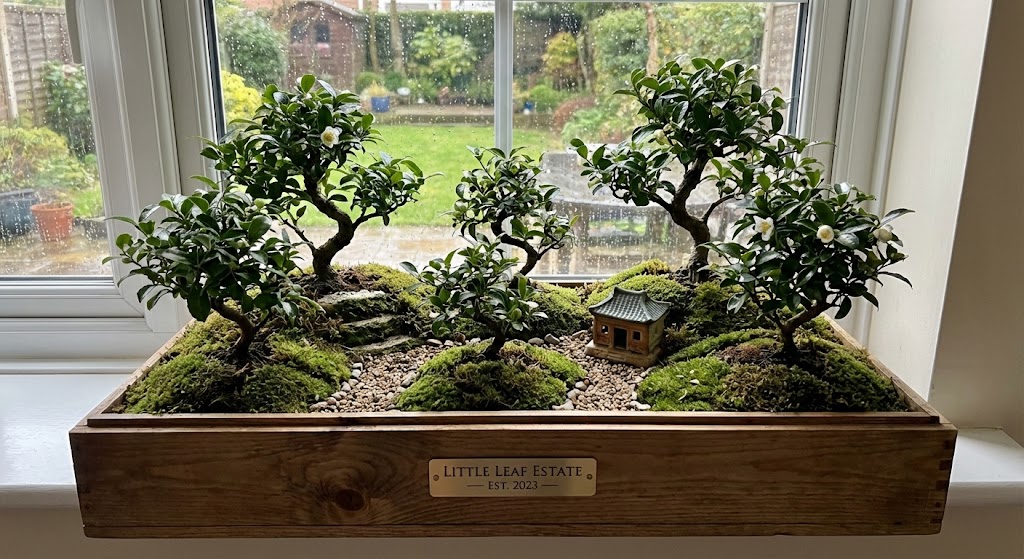
5. Bonsai Tea Plants: Aesthetic Miniaturization
Why tea suits bonsai technique: Naturally small leaves (2-5cm length—proportional at miniature scale, unlike large-leaf species that look awkward when dwarfed), responds well to pruning (vigorous regrowth—tolerates heavy shaping, recovers quickly from trimming), attractive flowers (white 2-3cm blooms—fragrant camellia-like, ornamental bonus beyond foliage), ancient cultivars available (gnarled trunks possible—see propagation from mature specimens, develop character faster than seedlings).
Bonsai training process: Year 1-2: Root restriction = Small pot (5-8L max—forces compact growth), root pruning annually (trim 30% of root mass—limits top growth proportionally, repot in same small container), trunk develops slowly (patience essential—bonsai mindset over years not months). Year 2-3: Branch shaping = Wire training (aluminum/copper wire wrapped around branches—bend to desired angles, creates asymmetric aesthetic, remove wire after 6 months when shape sets), selective pruning (remove inward-growing shoots—maintain open structure, pruning principles adapted for aesthetics not yield). Year 3+: Refinement = Ramification (encourage fine branch density—pinch new growth to promote branching, creates delicate canopy), leaf reduction (defoliation technique—forces smaller replacement leaves, advanced method requires experience).
Harvesting from bonsai tea: Compatible with shaping (harvest = pruning—serves dual purpose, plucking tips maintains compact form while yielding small leaf batches), spring flush priority (tender new growth—both quality tea + shapes plant, win-win), 10-30g annual yield realistic (enough for 3-5 experimental processing batches—see home processing, symbolic production supplements aesthetics). Display consideration: Shallow traditional bonsai trays possible (15-20cm deep—very constrained, requires daily watering + expert care), deeper pots easier (20-25cm depth—more forgiving for beginners, still achieves miniature aesthetic).
6. Fertilization and Soil Maintenance
Container soil depletion: Unlike ground cultivation (soil ecosystem replenishes—earthworms, decomposition, mineral cycling), pots are closed systems (nutrients finite—watering leaches minerals out drainage holes, plants exhaust available food), fertilization mandatory (not optional like some hardy ground plants—container tea starves without feeding). Deficiency symptoms: Nitrogen (pale yellow leaves—chlorophyll production impaired, slow growth), phosphorus (purple-tinged older leaves—rare in tea but possible), iron (interveinal chlorosis—yellowing between leaf veins while veins stay green, common in alkaline soil see pH issues).
Fertilizer selection: Ericaceous/acid-loving plant food (azalea/rhododendron formula—maintains low pH, prevents alkalinity creep from tap water), liquid feed easier than granules (even distribution in container—no concentrated pockets, adjustable strength for small pots), NPK ratio 3:1:2 ideal (nitrogen emphasis—supports leaf growth for harvesting, balanced not excessive). Organic options: Fish emulsion (nitrogen-rich—smelly indoors but effective, 5ml/L dilution), compost tea (gentle broad-spectrum—microbe benefits, see soil biology), avoid high-phosphorus bloom foods (rose/tomato formulas—wrong NPK for tea foliage production).
Feeding schedule: Growing season (April-September) = Every 2-3 weeks (active growth—high nutrient demand), half-strength dilution (manufacturer recommendation ÷ 2—containers accumulate salts, weaker frequent better than strong occasional), dormant period (October-March) = Monthly or none (minimal growth—little nutrient uptake, excess fertilizer salts damage roots). Soil refresh strategy: Top-dressing annually (remove top 5cm soil—replace with fresh ericaceous compost, adds organics + resets pH), complete repot every 3 years (see upsizing section—full soil change prevents long-term degradation).
7. Troubleshooting Indoor Tea Problems
Problem: Leaves dropping despite watering: Causes = Overwatering (root rot—soil stays soggy, anaerobic conditions kill roots), underwatering (drought stress—soil completely dries out between waterings), temperature shock (moved from warm to cold suddenly—drafts/AC blast), low humidity (<30% RH—chronic stress accumulation). Solutions: Check drainage (ensure holes open—bottom of pot draining freely), finger test soil moisture (top 2cm dry = water needed, deeper moisture = wait—don't water on fixed schedule but by soil check), avoid drafts (keep away from heaters/AC vents—stable temps 18-24°C ideal), increase humidity (pebble tray—see humidity section).
Problem: Pale yellow-green leaves (chlorosis): Causes = Iron deficiency (alkaline soil—pH >6.5 locks iron, see pH guide), nitrogen deficiency (old leaves yellow first—mobile nutrient redirected to new growth), insufficient light (weak photosynthesis—reduced chlorophyll production). Solutions: Acidify soil (water with dilute vinegar 1 tsp/L monthly—lowers pH, or use ericaceous fertilizer), iron chelate supplement (sequestered iron—immediately available even in slightly alkaline soil, spray foliar application for quick greening), increase light (move to brighter window—or add grow light, 6+ hours minimum).
Problem: Brown leaf edges/tips: Causes = Low humidity (<40% RH—desiccation damage), fluoride/chlorine in tap water (sensitive species—tea accumulates toxins at leaf margins), fertilizer burn (too strong concentration—salt damage), pot-bound roots (see rootbound section—water stress symptom). Solutions: Raise humidity (60%+ target—pebble tray/humidifier/grouping plants), use filtered/rainwater (avoid tap water if fluoridated—collect rainwater or use Brita filter), reduce fertilizer strength (quarter-strength—or flush soil with plain water to leach salts), upsize pot (if rootbound—check roots spring inspection).
Comments