1. Tea Cold Hardiness: Understanding Zone Limits
USDA Zone definitions: Zone 7 = -18°C to -12°C minimum (0-10°F—Southern England, Pacific Northwest, Virginia/Tennessee USA, Northern Spain), Zone 8 = -12°C to -7°C minimum (10-20°F—Ireland, Coastal UK, Seattle, Georgia/South Carolina USA, Northern Italy). Tea species comparison: Camellia sinensis var. sinensis (Chinese type) = Hardy to -15°C (zone 7b marginal—survives but may suffer dieback, recovers from roots in spring), C. sinensis var. assamica (Assam type) = Hardy only to -5°C (zone 9-10—unsuitable for zones 7-8 without greenhouse, tropical origins limit cold tolerance).
Realistic expectations for zones 7-8: Zone 8 (warmer) = Reliable outdoor cultivation (established bushes survive winters—occasional leaf damage in hard freezes but recovers, productive harvests like container growing but larger yields 200-500g annually), minimal winter protection needed (mulch adequate—see protection strategies section). Zone 7 (colder) = Possible but challenging (microclimate selection critical—south-facing slopes, sheltered spots only, expect 20-40% winter dieback in severe years), active protection recommended (fleece/cloches—or treat as container plant brought inside coldest months). Zone 6 and below = Container-only strategy (overwinter indoors—patio summer, garage/basement winter, or heated greenhouse year-round).
2. Microclimate Selection: Where to Plant in Your Garden
South-facing slopes ideal: Sun exposure maximized (winter sun low-angle—south slope captures more hours + intensity, north slopes stay frozen weeks longer), cold air drainage (dense cold air flows downhill—slope mid-height avoids frost pockets at bottom, hilltops too exposed to wind but mid-slope sweet spot), earlier spring warmth (faster thaw—extends growing season by 2-3 weeks vs. north aspects, matters for first flush timing). Measuring slope aspect: Compass app (phone—verify which direction slope faces, true south ±30° acceptable), observe winter sun (December-February—does location receive midday sun? If yes = good candidate site).
Wind protection essential: Wind chill effect = -10°C ambient + 30 mph wind = -20°C effective temp (desiccates leaves—winter burn damage, evergreen foliage vulnerable), sheltered spots survive (near walls/fences/hedges—creates wind-shadow zone, tea thrives while exposed areas struggle). Building heat-trap microclimates: South wall positioning (brick/stone wall—absorbs day heat radiates at night, creates +2-5°C warmer zone within 1-2 meters, turns zone 7 site into zone 8 equivalent microclimate), hedgerow shelter belt (evergreen barrier upwind—Leyland cypress/holly blocks wind, 3-4 meter tall hedge protects 10-15 meter downwind zone). Frost pocket avoidance: Bottom of valley = worst location (cold air pools—kills tea reliably, same issue for fruit growers see orchard placement), test site by observing frost patterns (spring mornings—which areas thaw last? Avoid those for tea).
Testing Your Microclimate
Trial plant strategy: Before investing in multiple tea plants, plant 2-3 specimens in different microclimate locations (south wall vs. open garden vs. sheltered corner—compare survival), monitor through first winter (note which survives best—leaf retention, dieback extent, spring recovery speed). Hardiness indicators: If plant retains >80% foliage through winter = excellent site (zone 8 equivalent), 50-80% retention = adequate site (zone 7b—productive but not ideal), <50% retention or dies to ground = poor site (try container cultivation instead). Record actual minimum temps with min/max thermometer at plant height (not weather station data—garden microclimates vary ±5°C from regional forecasts).
3. Variety Selection: Cold-Hardy Cultivars
Not all tea plants equal hardiness: Seed-grown plants = Variable genetics (each seedling different—some hardier than others, see seeds vs. cuttings, pro: genetic diversity may produce exceptionally hardy individuals, con: unpredictable until tested), named cultivars (vegetatively propagated) = Consistent hardiness (cuttings from proven parent—known cold tolerance, preferred for zone 7-8 where margins tight).
Recommended cold-hardy varieties: 'Benifuuki' (Japanese) = Hardy to -15°C reliably (methylated catechins—potential added health benefit, developed in Shizuoka for cooler regions), vigorous growth (recovers quickly from winter damage—suitable zone 7a), mildly astringent flavor (makes decent green tea—or black tea with character). Korean landrace cultivars = Extreme hardiness to -20°C (evolved in harsh continental climate—but rare in Western nurseries, specialty import required), smaller leaves (lower yields—but survival trumps production in zone 7). Georgian varieties = Soviet-bred cold tolerance (Kolkheti region cultivars—designed for Georgian highlands, -15°C minimum, occasionally available from Eastern European nurseries).
Sourcing cold-hardy plants: Avoid generic "tea plant" (likely tender Assam type—dies in zone 7-8 winters, nursery often doesn't specify variety), ask provenance questions ("Where was parent plant grown?"—UK-acclimated stock better than imported tropical, "Has this variety survived outdoors in your location?"—verify hardiness claims). UK specialist nurseries: Tregothnan Estate (Cornwall—sells estate-grown hardy cuttings, proven UK survival), Camellia specialists (often stock cold-hardy cultivars—crossover with ornamental camellia growers who prioritize hardiness). USA sources: Camellia Forest Nursery (North Carolina—zone 7b tested stock), Table Rock Tea Company (South Carolina—cold-hardy variety trials).
4. Winter Protection Strategies
Mulching (essential minimum): Organic mulch 10-15cm deep (wood chips/bark—insulates root zone, prevents freeze-thaw cycles damaging shallow roots), apply late autumn (November UK/USA—after first frost but before hard freezes, locks in soil warmth), keep mulch away from trunk (5cm gap—prevents rot, mice nesting against stem). Effectiveness = Protects roots to -20°C (even if top dies, roots survive—resprouts from base in spring like herbaceous perennial, 2-3 years rebuilds productive bush). Mulch materials: Pine needles excellent (acidic—benefits pH requirements, free from pine forests), shredded leaves adequate (free—but mat down less insulating than chips), avoid fresh grass clippings (compacts/rots—smothers roots).
Fleece wrapping (zones 7a-7b): Horticultural fleece (breathable fabric—Frost Protection Fleece 30-50gsm weight, garden centers stock autumn), wrap entire bush (drape over plant—secure base with stones/pins so wind can't unwrap), creates +4-6°C warmer microclimate (trapped air insulation—sufficient to prevent dieback in zone 7 winters). Installation timing: When forecasts predict <-10°C (not needed every night—only during hard freezes, December-February typical wrapping period UK), remove during mild spells (>5°C daytime—prevents overheating/fungal growth from excess humidity, rewrap when next freeze approaches). Multi-layer system: Two fleece layers (each adds +2-3°C—total +5-7°C protection, survives -15°C nights in zone 7a with south wall microclimate).
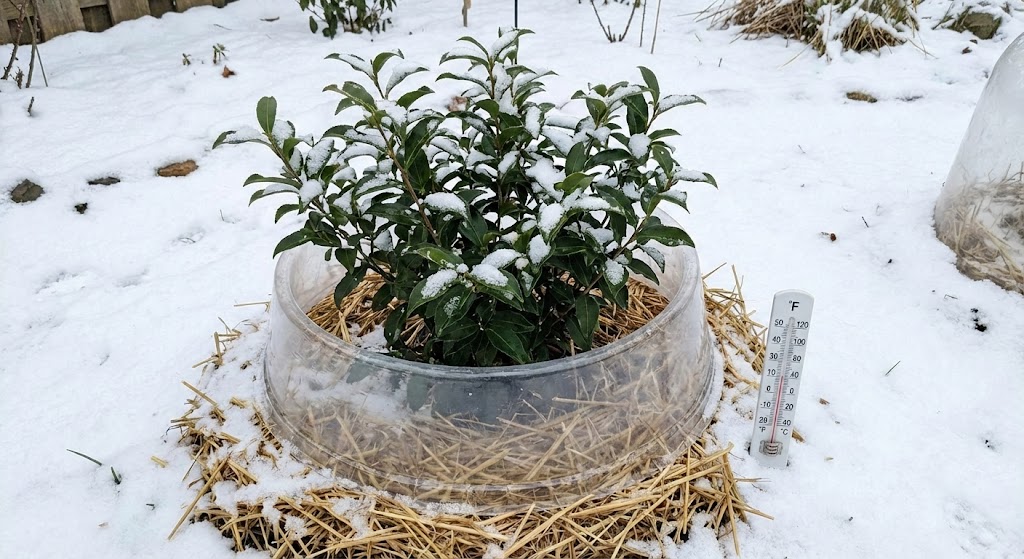
Cloche/cold frame (small-scale intensive): Glass/plastic cloche (Victorian bell jar style—individual plant protection, garden center £15-30), position over young plants (first 2-3 winters—establishes strong root system, mature plants too large for cloches), ventilation critical (crack open sunny days—prevents 30°C+ buildup killing plant via heat stress not cold). Cold frame alternative (hinged lid box—wooden frame + glass/polycarbonate top, DIY build or purchase £50-100), fits 3-5 small tea bushes (cluster planting—efficient protection, shared microclimate), heat sink addition (black-painted water jugs inside—absorbs day heat releases at night, +3-5°C boost like greenhouse thermal mass).
| Protection Method | Temp Boost | Cost | Effort | Best For |
|---|---|---|---|---|
| Mulch (10-15cm) | Root zone: +5-8°C | £0-20 (material) | LOW (annual application) | Zone 8, minimum protection |
| Fleece Wrap (single) | Foliage: +2-4°C | £5-15 (fleece roll) | MEDIUM (install/remove cycles) | Zone 7b, occasional freezes |
| Double Fleece | Foliage: +5-7°C | £10-25 (2 layers) | MEDIUM (seasonal wrapping) | Zone 7a, regular hard freezes |
| South Wall + Fleece | Combined: +7-10°C | £5-15 (fleece only) | LOW (wall permanent) | Zone 7a, maximizing microclimate |
| Cold Frame/Cloche | Plant: +8-12°C | £15-100 (structure) | HIGH (daily vent management) | Zone 6-7, young plants, intensive care |
5. UK-Specific Growing Regions and Success
Cornwall and Devon (zone 9-10): Tregothnan Estate (commercial tea farm—300+ acres, proves large-scale viability), mild maritime climate (rarely <-5°C—Gulf Stream moderation, high rainfall supports growth), commercial harvest timing (April-October—see harvest windows, 7-month productive season vs. 5-month in zone 7-8), home growers advantage (if in SW England—tea easier than London/Scotland, treat like hardy camellia ornamentals). Challenges: High humidity (fungal disease pressure—monitor for anthracnose leaf spots, good air circulation essential).
Southeast England/London (zone 8b-9a): Marginal but viable (urban heat island effect—London +2-3°C warmer than surrounding countryside, turns borderline site into reliable site), south-facing city gardens ideal (brick walls abundant—create heat-trap microclimates, balcony/patio container growing works well). Winter protection strategy: Mulch sufficient most years (occasional -10°C nights—fleece on standby for forecast freezes), spring recovery reliable (even with minor winter damage—vigorous regrowth April-May). Example growers: Chelsea Physic Garden (experimental tea plot—monitors hardiness data), private gardens Kew/Richmond area (hobbyist successes documented online forums).
Northern England/Scotland (zone 7-8): Challenging but achievable (requires microclimate optimization—can't plant randomly and expect success), Glasgow/Edinburgh zone 8 (coastal moderation—milder than expected for latitude, but short growing season April-September only 6 months), Yorkshire/Lancashire zone 7b-8a (valley microclimates—Pennine shelter creates pockets, exposed moorland unsuitable). Strategy for success: Walled kitchen gardens (historic estate walls—perfect tea sites, Victorian brick captures heat), polytunnel/greenhouse (unheated adequate—prevents winter desiccation wind, +5-8°C warmer than outside), container overwintering (move to unheated garage—protects from -15°C events, waters minimally through dormancy). Realistic yields: 50-150g annually (vs. 200-500g Cornwall—shorter season limits production, but achievable for hobbyist learning processing techniques).
6. USA-Specific Growing: South vs. Pacific Northwest
Southeastern USA (zone 7b-9): Ideal American tea region (humid subtropical—matches Chinese/Japanese origin climates, long growing season March-November), commercial farms emerging (Charleston Tea Garden South Carolina—oldest USA plantation, Great Mississippi Tea Company—expanding industry), home growing straightforward (treat like azaleas/camellias—ericaceous plants thrive in acidic Southern soil see soil acidity). Challenges: Summer heat stress (>35°C July-August—afternoon shade beneficial, drip irrigation critical during droughts), occasional hard freeze (zone 7b Atlanta/North Carolina—fleece protection for -12°C events, recovers spring).
Pacific Northwest (zone 8-9): Excellent potential (maritime climate—mild wet winters like UK Cornwall, Portland/Seattle rarely <-7°C), Sakuma Brothers farm (Washington State—experimental tea plots proving viability, YouTube documentation available), high rainfall advantage (1000-1500mm annually—irrigation rarely needed unlike California, natural humidity supports growth). Microclimate importance: Rain shadow areas (east of Cascade/Olympic ranges—drier sunnier, better than westside constant cloud for photosynthesis), urban cores warmer (Seattle/Portland downtown—vs. rural areas, +2-4°C winter lows). Growing season: April-October (7 months—comparable to UK Southeast, multiple flushes possible May + July + September).
California/Southwest (zone 8-10): Warm enough but drought challenges (LA/Bay Area winter-hardy—but summer water demands high, tea wants 1000mm annual rainfall vs. California 400mm without irrigation), coastal fog belt ideal (San Francisco peninsula—natural humidity + mild temps, less irrigation needed than inland valleys), avoid hot interior (Central Valley 40°C+ summers—tea scorches even with water, coastal/foothill regions only). Strategy: Drip irrigation mandatory (daily summer watering—expensive in drought areas, calculate water costs before planting), shade cloth 30-50% (reduces heat stress—filtered light prevents scorching, mimics tea shading but for temperature not flavor).
7. Troubleshooting Cold-Climate Problems
Problem: Winter dieback (plant looks dead spring): Diagnosis: Scratch bark on stems (green underneath = alive—will resprout, brown/dry = dead—prune away), check root crown (dig down to base—if firm + white roots visible = plant survived, mushy brown roots = total loss). Recovery protocol: Prune dead wood (cut to green tissue—see pruning guide, sterilize shears between cuts prevents disease spread), fertilize lightly (half-strength liquid feed April-May—supports regrowth, don't over-feed stressed plant), patience essential (new shoots emerge May-June—slower than undamaged plant, takes 2-3 years rebuild full canopy). Prevention next winter: Increase protection (add fleece layer—or relocate to better microclimate, if repeated dieback = site unsuitable try containers).
Problem: Brown leaf edges despite survival: Causes = Wind desiccation (winter wind strips moisture—evergreen leaves vulnerable when soil frozen can't replace water), insufficient hardening (warm autumn—plant didn't acclimate properly, sudden freeze shocks tissues), salt damage (road salt spray—de-icing contamination in urban areas). Solutions: Windbreak installation (see wind protection section—hedge/fence blocks drying winds), anti-desiccant spray (Wilt-Pruf/similar products—waxy coating reduces moisture loss, apply November before hard freezes), avoid roadside planting (salt splashes kill tea—minimum 5 meters from salted roads/paths). Damaged leaves recovery: Prune off brown foliage (improves appearance—plant generates fresh growth spring), or leave (still photosynthesizes—falls off naturally when replaced, aesthetic preference).
Problem: No growth after winter (stunted spring): Causes = Root damage (freeze penetrated past mulch—injured root system slow to recover), soil pH shifted (alkaline tap water over years—accumulated changing pH, locks nutrients), nitrogen deficiency (slow growth—depleted soil needs feeding), still dormant (tea breaks bud late—May-June not March-April, patience needed). Solutions: Check soil pH (test kit £5—if >6.0 add sulfur amendment, target 4.5-5.5 for optimal growth), fertilize (ericaceous formula—nitrogen boost stimulates growth, see fertilization guide), wait until June (if still no growth by midsummer—then investigate root damage, early May absence not concerning). Booster strategy: Foliar feed (spray leaves—bypasses root issues, quick greening response if nutrient deficiency causing problem).
Comments