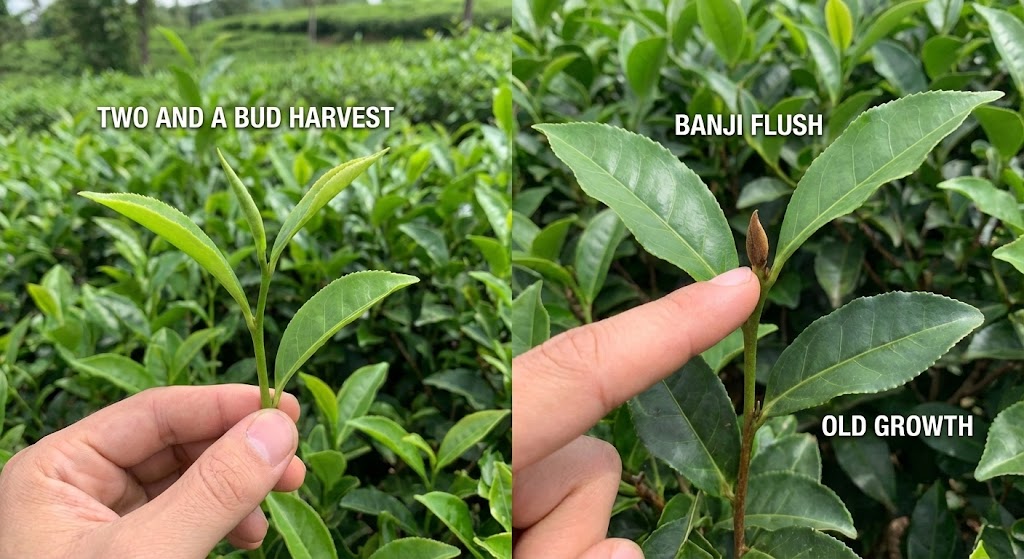
1. The "Two Leaves and a Bud" Standard: What and Why
Premium harvest definition: Bud (terminal unopened shoot—furled tip covered in white/silver hairs called "pekoe", highest concentration aromatic oils + amino acids like L-theanine), first leaf below bud (young tender—bright green, minimal cellulose so soft texture, sweet flavor compounds dominant), second leaf (slightly more mature—still tender but developing structure, balanced flavor contribution). Why this exact standard: Flavor peak (younger than this = insufficient leaf mass for processing—wasteful yields, older than this = increased bitterness from tannin accumulation—harsher cup), processing quality (uniform maturity—rolls evenly, oxidizes consistently, mixed maturity creates quality variation).
Grade implications: Bud + 1 leaf only = Imperial grades (FTGFOP1—"Finest Tippy Golden Flowery Orange Pekoe", premium Darjeeling, command 3-5× price vs. standard), bud + 2 leaves = Standard premium (TGFOP—commercial high-quality, most specialty tea uses this pluck), bud + 3-4 leaves = Medium grades (OP/Pekoe—acceptable quality, mass-market loose leaf like builder's tea base), mature leaves (5th+) = Low grades (Souchong—coarse flavor, suitable for smoked tea where processing overwhelms leaf subtlety). Home grower strategy: Focus on 2 leaves + bud (balance yield vs. quality—bud-only too low volume for hobbyist batches, 3-4 leaves sacrifices flavor unnecessarily).
2. Identifying the "Banji" (Plucking Table)
What is Banji: Flat horizontal surface created by consistent plucking height (imagine hedge top—all shoots harvested at same level season after season, bush naturally forms dense productive plane), professional plantation standard (India/Sri Lanka estates—pickers work along Banji taking flush systematically, efficient harvesting + quality control). Formation timeline: Year 1-2 (no Banji—young plant irregular growth, focus on establishing structure not harvest), Year 3-4 (Banji emerging—consistent plucking height creates plane, productivity increases as density develops), Year 5+ (mature Banji—fully formed, maximum yield efficiency like commercial bushes).
Creating your Banji: Choose plucking height (40-60cm from ground—comfortable standing/sitting picking height, lower = more vegetative vigor but bending required, higher = easier picking but reduced shoot density), first plucking season (Year 2-3—harvest every 2 leaves + bud at chosen height, don't vary up/down creates uneven surface), maintain consistency (every flush thereafter—pluck at same height religiously, Banji self-reinforces as lateral buds activate at cutting points creating dense productive layer). Visual goal: Bush develops flat top appearance (like topiary—contrast with wild tea's irregular canopy, signals proper harvest management). Productivity benefit: Mature Banji produces 2-3× more shoots per area than unpruned bush (concentrated growth—picking efficiency + yield maximized, commercial reason for standard).
Testing Leaf Maturity: The Snap Test
Perfect harvest maturity: Hold stem below 2nd leaf, bend gently (should snap cleanly—brittle fracture not bend, indicates tender growth stage optimal for quality). If bends without breaking = too mature (woody stem developing—increased cellulose, will process into harsh tea, let grow or use for coarse blending filler). If too soft to snap = too young (insufficient development—very low yield, wait 3-5 more days). Timing calibration: Check shoots daily during flush (rapid development—snap-ready today may be over-mature tomorrow, weather accelerates maturation in hot periods).
3. Seasonal Flush Timing: First, Second, Monsoon, Autumn
First flush (spring): Timing = March-April in Darjeeling/China (Northern Hemisphere subtropics—when dormancy breaks, logistics premium for earliest), May-June in UK/temperate zones (later spring—cooler climates delayed bud break), character = Light/delicate/floral (low tannins—astringency minimal, high amino acids—sweet umami notes, prized for green/white tea or light oxidation). Yield = Lowest annual flush (20-25% of total—plant investing energy in vegetative growth not just leaves, small tender shoots), market value highest (scarcity + quality—premium pricing for Darjeeling FF, sometimes 5-10× autumn tea).
Second flush (early summer): Timing = May-June in Darjeeling (post-first flush—bushes recover 4-6 weeks, new growth cycle), June-July in temperate zones (longer gap—cooler climates slower regrowth), character = Muscatel/fruity/full-bodied (optimal balance—developed flavor compounds + moderate tannins, ideal for black tea oxidation, produces classic Darjeeling muscatel notes). Yield = Moderate-high (40-50% annual total—vigorous summer growth, warm temps + long days drive productivity), quality peak for black tea (professional processors prefer second flush—complex flavor development, balanced strength).
Monsoon/summer flush (mid-late summer): Timing = July-September in India (rainy season—continuous rapid growth, bushes flush every 10-14 days vs. 21-30 days other seasons), character = Mild/plain/strong (high volume—rapid growth dilutes flavor concentration, suitable for commodity tea bags not specialty), astringency higher (rain stress—tannin production increases, less refined cup). Yield = Highest volume (30-40% annual—continuous picking, commercial estates rely on monsoon flush for bulk production), home grower approach (harvest for blending base—mix with premium flushes, or smoke/roast where processing masks plain flavor).
Autumn flush (fall): Timing = October-November in subtropics (cooling temps—slowing growth, final harvest before dormancy), September-October in temperate zones (earlier autumn—frost risk ends season), character = Mellow/smooth/less astringent (lower tannins—cooler temps reduce bitterness compounds, pleasant daily-drinking quality). Yield = Low-moderate (10-20% annual—plant preparing dormancy, reduced vigor), underrated quality (smooth character—excellent for green tea, less floral than spring but refined, good for learners due to forgiving processing).
| Flush Season | Timing (Temperate) | Character | Best Tea Type | Yield |
|---|---|---|---|---|
| First Flush | May-June | Delicate, floral, low tannin | Green, white, light oolong | LOW (20-25%) |
| Second Flush | June-July | Fruity, muscatel, full-bodied | Black tea (oxidized) | HIGH (40-50%) |
| Summer/Monsoon | July-Sept | Plain, strong, high tannin | Blending base, smoked tea | HIGH (30-40%) |
| Autumn Flush | Sept-Oct | Mellow, smooth, less astringent | Green tea, daily black | LOW (10-20%) |
4. Daily Timing: Morning vs. Afternoon Plucking
Morning harvest (6-10 AM): Moisture content optimal (overnight dew absorbed—leaves turgid + plump, easier rolling later due to pliability), lower temperature (cool air—less oxidation stress during picking, leaves stay fresher longer before processing begins), professional preference (commercial estates—start dawn, process by noon taking advantage of cool morning). Disadvantages: Excess surface moisture (dew on leaves—need brief drying before withering, adds processing step), early wake-up (hobbyist inconvenience—not practical for weekend growers).
Afternoon harvest (2-5 PM): Dry leaf surface (dew evaporated—proceed straight to withering, see processing workflow), warmer temps accelerate withering (faster initial processing—afternoon harvest + evening withering completes overnight, morning processing next day), practical timing (after work/school—suits hobbyist schedules, casual home growing). Disadvantages: Heat stress on leaves (hot afternoon sun—picked leaves degrade faster, must process promptly within 2-4 hours or refrigerate), increased oxidation (enzymatic activity higher—good for black tea but problematic for green tea where oxidation unwanted).
Optimal timing by tea type: Green tea = Morning harvest best (cool temps—minimal pre-processing oxidation, can delay kill-green 2-3 hours safely), Black tea = Afternoon acceptable (warmth initiates oxidation—head start on flavor development, enzymatic activity desired), Oolong = Late morning ideal (10-11 AM compromise—dew evaporated but heat not intense, controlled oxidation initiation). Weather considerations: Rainy days avoid (wet leaves—difficult processing, diluted flavor, wait for 24 hours dry weather), extreme heat days (>30°C—harvest early morning only, afternoon picking creates mush not tea).
5. Harvest Frequency: How Often to Pluck
Commercial picking intervals: Tropical estates (India/Sri Lanka—year-round growth) = 7-10 day intervals (continuous warm weather—shoots ready rapidly, pickers circuit through sections, return to same bush weekly), temperate climates (UK/Northern USA—seasonal growth) = 14-21 day intervals (cooler temps—slower shoot development, spring/summer only 5-6 harvests annually). Yield implications: Frequent plucking (every 7 days) = Higher total annual yield (encourages lateral bud break—more shoots per bush, but each individual shoot smaller/lighter), infrequent plucking (every 21+ days) = Larger individual shoots (more mature—heavier weight per pluck, but fewer total flushes annually).
Home grower strategy: Monitor shoot development (check bushes every 3-4 days—mark calendar when 2 leaves + bud standard reached, don't wait too long or over-mature), pick when ready not schedule (weather variability—hot week accelerates maturity, cool week delays, flexible observation better than fixed "every 14 days" rule). Partial bush harvesting (commercial technique adapted—pick sections in rotation, e.g., north side today, south side in 3 days as those shoots mature, spreads labor + processing over days not single exhausting session).
Bush health considerations: First year NO harvest (establishment priority—roots + structure development, any plucking weakens young plant), second year light harvest (20-30% of potential—one flush only, allows continued maturation), third year onward full production (mature bush—can sustain 4-6 flushes annually without stress). Signs of over-picking: Slow regrowth (shoots take >30 days—exhausted plant, skip 1-2 flushes to recover), yellowing leaves (nitrogen depletion—see fertilization needs, over-cropping drains nutrients), reduced shoot vigor (thin weak shoots—rest bush + feed, quality suffers when plant stressed).
6. Weather-Dependent Quality Variations
Drought stress effects: 2-3 weeks no rain (moderate stress—concentrates flavor compounds, can improve quality in moderation like wine terroir stress), amino acids increase (L-theanine rises—sweeter umami character, premium gyokuro-like), smaller leaves (reduced cell expansion—lower yield but intense flavor per gram). Severe drought >4 weeks (excessive stress—flavor turns harsh, tannin dominance overwhelms sweetness, irrigate to prevent damage). Post-drought flush (after rain breaks dry spell—"stress flush" prized by connoisseurs, complex concentrated character commands premium like drought-stressed Darjeeling).
Rainfall impact: Moderate consistent rain (weekly showers—ideal growing conditions, balanced flavor development + good yields), heavy monsoon rain (daily downpours—diluted flavor, see monsoon flush section, rapid growth + high water content = weak tea), timing matters (rain 1-2 days before harvest—leaves plump + easy picking, rain during withering—problematic humidity prevents moisture loss, delay processing). Hail damage (bruised leaves—unintentional oxidation, must process as black tea immediately can't make green, or discard damaged material).
Temperature effects on quality: Cool spring <15°C (slow growth—delicate refined flavors, first flush character enhanced, low tannins like champagne Darjeeling), warm optimal 18-25°C (balanced development—good flavor + reasonable yield, second flush sweet spot), hot >28°C (rapid growth—increased bitterness, tannin production rises with heat stress, coarser flavor less refined), extreme heat >35°C (stop harvesting—damaged leaf quality, wait for cooling or irrigate + shade cloth to reduce plant stress).
7. Troubleshooting Harvest Timing Issues
Problem: Missed optimal harvest window (over-mature shoots): Signs = 4-5 leaves beyond bud (instead of 2—stem hardened, snap test fails shows woody growth), dark green color (mature chlorophyll—young shoots lighter brighter green), tough texture (high cellulose—processing difficult). Salvage options: Harvest anyway for coarse tea (suitable for smoking/heavy roasting—strong processing masks leaf coarseness), blend with tender leaves (mix 30% mature + 70% proper harvest—dilutes harshness, blending technique), hard prune and wait (cut back to Banji level—forces new flush in 14-21 days, restart with proper timing). Prevention: Calendar reminders (check bushes every 3 days during growing season—don't rely on memory, peak window only 3-5 days long).
Problem: Too few shoots ready (sparse flush): Causes = Bush too young (year 1-2—insufficient maturity, patience required see development timeline), nutrient deficiency (nitrogen low—weak vegetative growth, fertilize see feeding guide), improper pruning (uneven Banji—scattered shoot development, requires structural correction), pest damage (aphids/thrips—stunt shoot tips, treat with neem oil/insecticidal soap). Solutions: Fertilize monthly (growing season—high-nitrogen ericaceous feed, boosts shoot production 30-50% within 6 weeks), corrective pruning (establish proper Banji—takes 1-2 seasons but increases flush density permanently), patience if young (year 3 typically adequate production—don't expect commercial yields from immature bush).
Problem: Inconsistent maturity across bush: Causes = Uneven sun exposure (one side shaded—shoots mature at different rates, south side ready while north side lagging), microclimate variation (wind-exposed side slower—vs. sheltered side faster growth), previous picking inconsistency (some areas over-picked—weakened shoots, others under-picked strong regrowth). Solutions: Selective harvesting (pick ready sections as mature—don't wait for whole bush uniformity, process small batches 50-100g vs. insisting on 500g single batch), improve light exposure (prune overhanging trees—even out sun access, rotate container plants weekly), systematic picking discipline (maintain Banji height strictly—over time bush synchronizes flush timing, takes 2-3 seasons consistency to achieve).
Comments