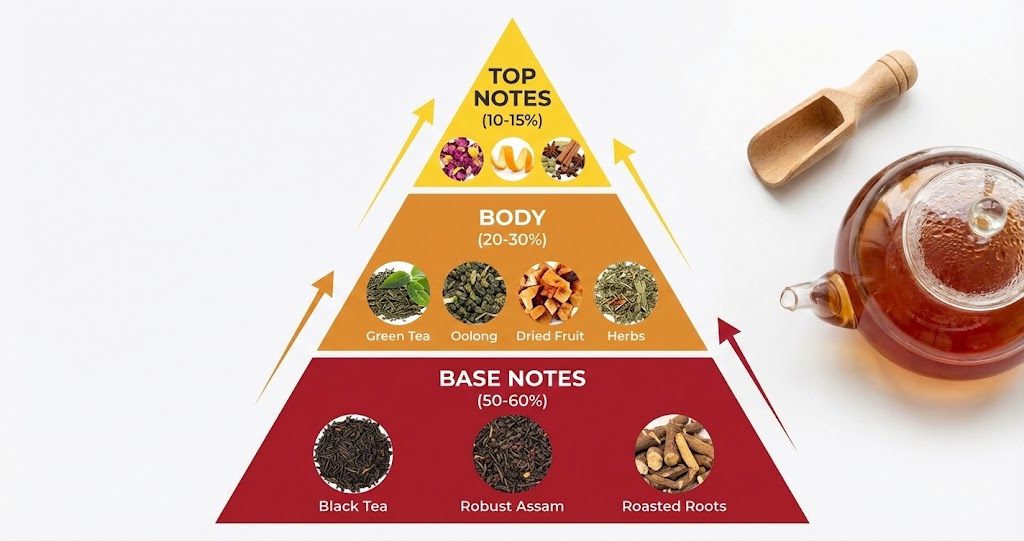
The Blending Pyramid: Understanding Base, Middle & Top Notes
Professional tea blending follows a hierarchical structure analogous to perfumery's base-middle-top note pyramid. The foundation (60-70%) provides body and strength, the middle layer (20-30%) adds briskness and color, while the top notes (5-10%) contribute aromatic complexity and character. This ratio architecture ensures economic viability whilst maintaining sensory appeal — blends can sell for £8-12/kg compared to £25-40/kg for single-origin Darjeeling, yet deliver consistent quality year-round that single estates cannot match.
The 60/25/10 ratio emerged in Victorian England when Twinings and Brooke Bond standardized breakfast blends. Indian Assam (malty, robust) formed the base, Kenya CTC (brisk, coppery) provided the middle punch, and Darjeeling or Ceylon tips (floral, nuanced) added top-note complexity. This formula persists because it balances cost (Assam £8-12/kg, Kenya £7-10/kg, Darjeeling £25-40/kg), flavor (complementary rather than clashing profiles), and brewing tolerance (robust blends withstand hard water and milk without collapsing).
Base Notes: The Foundation (60-70% of Blend)
Base notes provide structural backbone — malty sweetness, body thickness, and tannin strength. Assam CTC (Crush-Tear-Curl) dominates this category because its oxidation profile produces theaflavins (brisk astringency) and thearubigins (deep color, smooth mouthfeel) in balanced proportions. Assam's altitude (100-200m) and monsoon climate yield high-caffeine leaves (2.5-3.5% caffeine vs 2-3% for China types) with robust cellular structure that withstands aggressive CTC processing.
Ceylon OP (Orange Pekoe) offers an alternative base with brighter, less malty character. Grown at 600-1200m in Sri Lanka's Dimbula/Nuwara Eliya districts, Ceylon teas contribute citrus-honey notes rather than Assam's chocolate-malt. Professional blenders choose Ceylon when formulating lighter breakfast blends or afternoon blends where milk isn't expected. The cost differential is minimal (Assam £8-12/kg, Ceylon £10-15/kg), so base note selection depends on flavor target rather than economics.
| Base Tea | Flavor Profile | Cost/kg | Best For |
|---|---|---|---|
| Assam CTC | Malty, robust, chocolate notes | £8-12 | English/Irish Breakfast with milk |
| Ceylon OP | Bright, citrus-honey, crisp | £10-15 | Afternoon blends, black without milk |
| Yunnan Dian Hong | Sweet, caramel, low astringency | £15-20 | Smooth breakfast, gentle tannins |
Middle Notes: Briskness & Color (20-30% of Blend)
Middle notes add "snap" — the brisk astringency and bright copper color that signals quality in black tea. Kenya CTC monopolizes this category due to its unique terroir: equatorial altitude (1500-2700m), volcanic soil rich in iron/manganese, and year-round growing season produce high theaflavin content (2-3% vs 1.5-2% for Assam). Theaflavins create the mouth-puckering astringency and golden-copper liquor color prized in breakfast blends.
Kenya's contribution is proportional — too little (under 15%) and the blend tastes flat, too much (over 35%) and it becomes harshly astringent. The 20-30% sweet spot balances Assam's malty smoothness with Kenya's briskness. Professional blenders adjust this ratio seasonally: spring flush Kenya is milder so they use 25-30%, autumn flush is more aggressive so they reduce to 20-25%, maintaining consistent cup character despite harvest variation.
Top Notes: Aromatic Complexity (5-10% of Blend)
Top notes function like perfume's volatile top layer — they create first impression and aromatic complexity, but evaporate quickly during brewing. Darjeeling FTGFOP (Finest Tippy Golden Flowery Orange Pekoe) contributes muscatel grape, floral, and stone-fruit aromatics from its unique Chinese-varietal tea bushes (Camellia sinensis var. sinensis) grown at 2000m in Himalayan conditions. The high-altitude terroir produces abundant volatile terpenes (linalool, geraniol) that survive light oxidation.
Nilgiri FOP provides a cost-effective top-note alternative (£12-18/kg vs £25-40/kg for Darjeeling). Grown in South India's Blue Mountains at 1000-2500m, Nilgiri offers fruity-floral notes (citrus, stone fruit) without Darjeeling's intense muscatel. Professional blenders use Nilgiri when formulating mid-market blends where 5-10% Darjeeling would blow the cost budget. The flavor difference is detectable by connoisseurs but negligible to casual drinkers, especially when milk is added.
Top note percentage is critical — under 5% and the aromatics disappear entirely, over 12% and they overwhelm the base, creating a disjointed "perfumy" taste. The 5-10% zone provides perceptible complexity without dominating. Some blenders omit top notes entirely for robust Irish Breakfast or builder's tea formulas where milk/sugar mask nuance.
Professional Breakfast Blend Formulas
English Breakfast (Classic Formula): 65% Assam CTC (malty base), 25% Kenya CTC (briskness), 10% Ceylon OP (brightness). This balanced formula works with milk, tolerates hard water, and brews consistently at 3-5 minutes without bitterness. Total cost: approximately £10-12/kg wholesale, retails at £20-35/100g packaged.
Irish Breakfast (Strong Formula): 70% Assam CTC, 30% Kenya CTC, 0% top notes. More robust than English Breakfast, designed for very hard water and heavy milk. The absence of delicate top notes ensures nothing gets lost in the milk, while the increased Kenya percentage maintains briskness despite aggressive brewing. Cost: £8-10/kg wholesale.
Scottish Breakfast (Smooth Formula): 60% Assam CTC, 20% Kenya CTC, 15% Ceylon OP, 5% Yunnan Dian Hong. Smoother and slightly sweeter than English Breakfast, with Yunnan's caramel notes tempering the astringency. Popular for afternoon drinking without milk. Cost: £12-14/kg wholesale.
| Blend Name | Assam % | Kenya % | Ceylon % | Other % | Character |
|---|---|---|---|---|---|
| English Breakfast | 65% | 25% | 10% | - | Balanced, malty, bright |
| Irish Breakfast | 70% | 30% | - | - | Robust, strong, milk-ready |
| Scottish Breakfast | 60% | 20% | 15% | 5% Yunnan | Smooth, sweet, gentle |
The Economics of Blending: Why It's Cheaper Than Single-Origin
Blends exist because single-origin teas cannot deliver consistent quality year-round at accessible prices. A single-estate Darjeeling varies dramatically between first flush (March-April: floral, light, £30-50/kg), second flush (May-June: muscatel, £40-80/kg), and monsoon flush (July-September: flat, £15-25/kg). Consumers expect identical taste every purchase, which single estates cannot provide.
Blending solves this by combining cheap, consistent base teas (Assam/Kenya) with small amounts of expensive aromatics (Darjeeling). A 65/25/10 English Breakfast costs £11-13/kg wholesale (65% × £10 Assam + 25% × £8°Kenya + 10% × £30 Darjeeling = £11.50/kg), yet tastes complex enough to satisfy most drinkers. Compare this to pure Darjeeling at £40-80/kg — the blend delivers 70% of the flavor at 20% of the cost.
Professional blenders also arbitrage seasonal quality variations. When Assam second flush (June-July) is exceptionally strong, they reduce it to 60% and increase Ceylon to 15%. When Kenya autumn flush is harsh, they drop it to 20% and add more top notes. This constant micro-adjustment maintains consistent cup quality despite agricultural variability, something impossible with single-origin teas.
Consistency Techniques: Maintaining Identical Taste Year-Round
Large tea companies like Twinings and Typhoo employ professional tea tasters who "cup" 200-300 samples daily, adjusting blend ratios to match a reference standard. The reference is a physical sample (usually vacuum-sealed tea from the previous year's optimal batch) that tasters compare new batches against. If spring Assam tastes 10% lighter than reference, they increase it to 70% and reduce Kenya to 20%, compensating for the strength deficit.
Small-scale blenders can replicate this by maintaining a tasting journal. Brew 3g of each component tea at 3 minutes, note flavor intensity scores (1-10 scale for body, briskness, astringency, aromatics), then calculate ratios that hit your target profile. When component teas change seasonally, adjust ratios to maintain the same total flavor score. Example: Spring Assam scores 7/10 body, autumn Assam scores 9/10, so you'd reduce autumn Assam from 65% to 55% to prevent over-strength.
Reverse-Engineering Commercial Blends: The Tasting Method
You can deduce any blend's formula by tasting its components sequentially. Brew the commercial blend, note its dominant characteristics, then taste pure samples of suspected components (Assam, Kenya, Ceylon, Darjeeling). The blend's dominant trait reveals the base: malty-chocolate suggests Assam-dominant (60-70%), bright-citrus suggests Ceylon-dominant (50-60%). Secondary traits reveal middle notes: brisk astringency indicates 20-30% Kenya, smoothness suggests less Kenya or addition of Yunnan.
Example reverse-engineering: Twinings English Breakfast tastes malty-robust with bright finish and subtle floral top note. Dominant malt = 60-70% Assam. Bright finish = 20-25% Kenya. Floral top = 5-10% Ceylon/Darjeeling. Most likely formula: 65% Assam, 25% Kenya, 10% Ceylon. Brew a test batch at these ratios — if it's too malty, reduce Assam to 60% and increase Ceylon to 15%. If too harsh, reduce Kenya to 20%. Iterate until you match the reference.
DIY Blending Guide: Starting Your First Blend
Step 1: Source Component Teas (£30-40 initial investment)
Purchase 250g each of Assam CTC (£8-12/kg = £2-3 for 250g), Kenya CTC (£7-10/kg = £2-2.50), and Ceylon OP or Darjeeling (£10-30/kg = £2.50-7.50). Buy from wholesale suppliers like Tealyra, What-Cha, or TeaGschwendner rather than retail grocery brands — you need pure single-origin teas, not pre-blended "Assam" that's already a blend.
Step 2: Baseline Tasting (30-45 minutes)
Brew 3g of each component tea separately in identical cups at 95°C for 3 minutes. Taste without milk to identify each tea's character: Assam (malty, full-bodied), Kenya (brisk, astringent, bright color), Ceylon/Darjeeling (floral, aromatic, lighter body). Note intensity scores for body, briskness, astringency, sweetness, aromatics (1-10 scale).
Step 3: Start with Classic English Breakfast (60/25/10)
Weigh out 30g Assam + 15g Kenya + 6g Ceylon/Darjeeling = 51g total blend. Mix thoroughly in an airtight container, shaking 30 seconds. Let rest 24 hours for flavors to integrate (see marriage period chemistry).
Step 4: Iterative Adjustment
Brew 3g of your blend at 3 minutes, taste, and adjust: Too weak/flat? Increase Kenya to 30%. Too harsh? Reduce Kenya to 20%. Not malty enough? Increase Assam to 70%. Too aromatic/perfumy? Reduce top notes to 5%. Make one change at a time, re-blend, and re-taste until you hit your target profile.
Step 5: Scale Up & Store
Once satisfied, mix a larger batch (500g-1kg) and store in an opaque, airtight container away from light/heat. Blends stay fresh 12-18 months if properly stored. Label with blend date and ratio so you can replicate it.
Troubleshooting Common Blending Problems
Problem: Blend tastes flat or dull
Cause: Insufficient Kenya CTC (under 15%) or over-reliance on smooth base teas like Yunnan.
Fix: Increase Kenya to 25-30% for briskness, or add 5-10% Nilgiri for aromatics without altering base structure.
Problem: Blend tastes harsh or overly astringent
Cause: Excessive Kenya (over 35%) or using autumn-flush Kenya which is more aggressive.
Fix: Reduce Kenya to 20%, increase base Assam to 65-70%, or add 5-10% smooth Yunnan to buffer astringency.
Problem: Blend loses character when milk is added
Cause: Too many delicate top notes (over 15%) that get masked by milk proteins.
Fix: Reduce Darjeeling/Nilgiri to 5% or eliminate entirely, increase robust Assam to 70%, focus on body rather than aromatics.
Problem: Blend tastes different every batch
Cause: Component teas changing seasonally, but ratios staying fixed.
Fix: Maintain a sealed reference standard, taste-test each new component batch, adjust ratios to match the standard's flavor profile (see Consistency Techniques above).
Problem: Blend is too expensive for target market
Cause: Excessive use of premium teas like Darjeeling (£25-40/kg).
Fix: Replace Darjeeling with Nilgiri (£12-18/kg) for top notes, or eliminate top notes entirely for budget breakfast blends, relying on 70% Assam + 30% Kenya formula.
Conclusion: The Art & Science of Ratio Balancing
Tea blending is applied chemistry constrained by economics — the goal is maximum flavor complexity at minimum cost. The 60-70% base, 20-30% middle, 5-10% top pyramid emerged from a century of trial and error by Victorian tea merchants seeking to satisfy British palates whilst maintaining profit margins. Today's craft blenders can leverage this formula as a starting framework, then adjust based on their flavor targets, water hardness, milk usage, and cost constraints.
The key insight is that blends aren't inferior to single-origin teas — they're optimized for consistency, cost-efficiency, and broad appeal in ways single estates cannot match. A well-formulated breakfast blend will taste identical every morning for years, whereas single-estate teas swing wildly between flushes. For daily drinking, blending is engineering excellence, not compromise.
Further exploration: Learn about essential oil fixation for Earl Grey, traditional Russian blends, marriage period chemistry, and adding smoke character to blends.
Comments