Bergamot Oil Chemistry: What Makes Earl Grey Smell Like Earl Grey
Bergamot (Citrus bergamia) is a bitter orange hybrid grown almost exclusively in Calabria, Italy (97% of world production). The fruit is inedible, but its rind yields highly aromatic essential oil used in perfumery (original Eau de Cologne base) and tea flavoring.
Cold-pressed Calabrian bergamot oil composition:
- Limonene (40-50%): Bright citrus top note, volatile (evaporates quickly). Boiling point 176°C, but significant vapor pressure at room temp. This is why Earl Grey smells strongest when fresh.
- Linalyl acetate (20-30%): Sweet floral mid-note, more stable than limonene. Gives Earl Grey its distinctive "not-quite-orange" character. Ester compound (acetic acid + linalool).
- Linalool (8-15%): Lavender-like floral undertone. Alcohol compound, moderately volatile. Present in jasmine, lavender, coriander.
- Bergaptene (furocoumarin, 0.3-0.5%): Phototoxic compound causing skin sensitivity to UV light. Removed from commercial Earl Grey oil via distillation ("bergaptene-free" or "FCF" oil).
- γ-Terpinene, β-pinene, other terpenes (10-20%): Supporting citrus/pine notes, contribute complexity.
Synthetic bergamot substitutes: Many budget Earl Grey blends use pure linalool (£8-12/kg) instead of natural bergamot oil (£180-250/kg). Linalool-only blends smell one-dimensional—lavender-lemon cleaner rather than complex citrus-floral. They lack limonene's bright top note and linalyl acetate's sweetness.
Related: Jasmine tea scenting uses benzyl acetate + linalool (similar floral compounds), but from flowers via enfleurage, not essential oil spray.
Expert Tip: The Smell Test for Bergamot Quality
To identify natural vs. synthetic bergamot: Smell dry leaves, then hot tea, then cooled tea. Natural bergamot evolves: dry leaves smell bright citrus (limonene), hot tea smells sweet-floral (linalyl acetate), cooled tea retains gentle floral (linalool). Synthetic linalool-only blends smell identical at all three stages—flat lavender-citrus with no evolution. Also, crush a dry leaf and smell within 10 seconds: natural bergamot has complex layered aroma (citrus→floral→woody), synthetic is one-note lemon-cleaner.
The 2-3% Oil Ratio: Calculating Flavoring Percentage
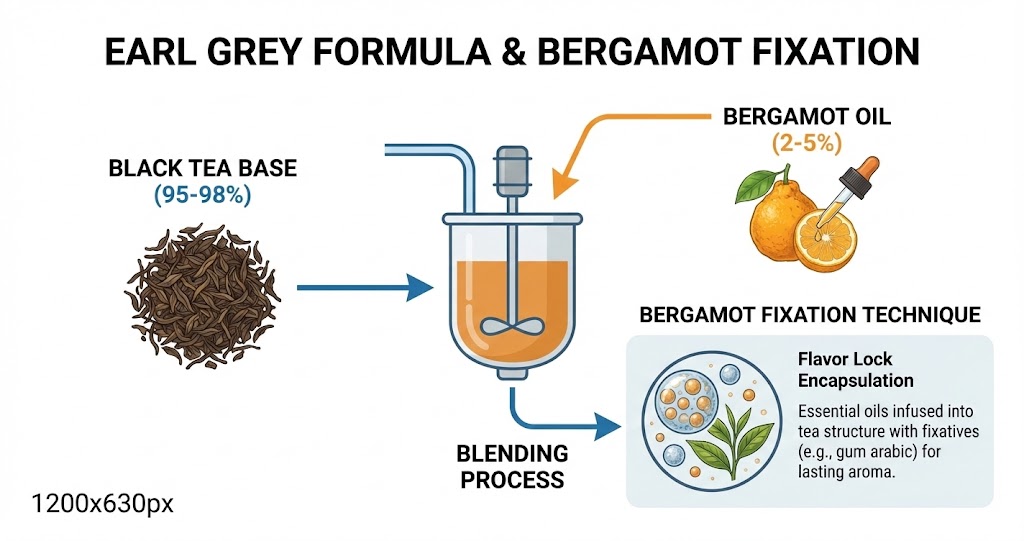
Professional Earl Grey formulation uses 2-3% bergamot oil by weight of finished tea. This ratio balances flavor intensity with cost and shelf stability.
Calculation for 1kg batch:
- 2% oil = 20ml (20g) bergamot oil per 1kg tea
- 2.5% oil = 25ml (25g) bergamot oil per 1kg tea (most common commercial ratio)
- 3% oil = 30ml (30g) bergamot oil per 1kg tea (premium/extra bergamot blends)
Why not more than 3%?
- Above 3%, oil pools on leaf surface instead of coating evenly—creates "wet" texture and soapy taste
- Excess oil drips to bottom of packaging, leaving top layers under-flavored, bottom layers over-flavored
- Bergamot's terpenes become overwhelming at 4-5%—tastes like drinking perfume, not tea
- Cost: At 3%, bergamot oil adds £5-7.50 per kg tea (using £250/kg oil). At 5%, cost increases to £12.50/kg with diminishing sensory returns.
Why not less than 2%?
- Below 2%, flavor is too subtle—barely distinguishable from plain black tea after brewing
- Volatility loss during storage means 1.5% oil becomes 0.8-1% after 6 months—imperceptible in cup
- Consumer expectations: Earl Grey should taste distinctly of bergamot. Under-flavored blends disappoint.
| Oil Percentage | Oil per 1kg Tea | Flavor Intensity | Cost Impact (£250/kg oil) | Common Use |
|---|---|---|---|---|
| 1.5% | 15ml (15g) | Weak, subtle hint | +£3.75/kg | Budget supermarket blends |
| 2% | 20ml (20g) | Mild but recognizable | +£5/kg | Standard commercial Earl Grey |
| 2.5% | 25ml (25g) | Balanced, classic strength | +£6.25/kg | Premium Earl Grey (most common) |
| 3% | 30ml (30g) | Strong, pronounced | +£7.50/kg | "Extra Bergamot" specialty blends |
| 4%+ | 40ml+ (40g+) | Overwhelming, soapy | +£10+/kg | Rarely used (over-flavored, poor quality) |
Fixation Science: Preventing Volatility Loss
Bergamot oil is volatile—meaning its compounds evaporate at room temperature. Without fixation, Earl Grey loses 50-70% potency in 3-6 months, leaving you with expensive plain black tea.
Why bergamot evaporates:
- Limonene boiling point: 176°C, but has significant vapor pressure at 20-25°C. It slowly evaporates even in sealed packaging.
- Linalyl acetate and linalool are slightly more stable (BP ~220°C), but still volatile over months.
- Tea packaging isn't hermetically sealed—microscopic air exchange occurs through bag seams, tin lids, even "airtight" zippers.
Fixatives extend shelf life by:
- Reducing vapor pressure: Fixative molecules bind to bergamot compounds, lowering their tendency to evaporate
- Increasing molecular weight: Heavier molecules evaporate more slowly (inversely proportional to molecular weight)
- Creating barrier layer: Some fixatives form a thin film on leaf surface, trapping volatiles underneath
Common fixatives in tea flavoring:
- Natural tocopherols (Vitamin E): Antioxidant that also acts as mild fixative. Extends shelf life 30-50%. Used in premium "all-natural" Earl Grey. Cost: £60-90/kg.
- Propylene glycol (PG): Synthetic carrier/fixative. Extends shelf life 60-80%. Generally Recognized As Safe (GRAS) by FDA. Effective but "not natural." Cost: £8-15/kg.
- Triacetin (glyceryl triacetate): Ester used in food industry. Good fixative properties, neutral taste. Cost: £20-35/kg.
- Benzyl benzoate: Natural compound (found in balsam resins) used in perfumery. Excellent fixative but expensive. Cost: £45-70/kg.
Typical Earl Grey formulation with fixative:
- 97.3% base tea (973g)
- 2.5% bergamot oil (25g/25ml)
- 0.2% tocopherol fixative (2g)
The small amount of fixative (0.2%) significantly extends shelf life without affecting taste. Compare: unfixed Earl Grey loses 60% potency in 6 months; fixed Earl Grey loses 20-30% in same period.
Expert Tip: Checking for Fixative in Commercial Blends
Check the ingredients list. Premium brands list "natural flavoring with tocopherol" or "bergamot oil (vitamin E preservative)". Budget brands often list just "natural bergamot flavor" (unfixed, will fade quickly) or "artificial flavor" (synthetic linalool, may or may not be fixed). If no fixative listed and blend is >6 months old, it's likely lost 50%+ of original flavor. Best practice: buy Earl Grey with manufacture date <3 months ago, or from vendors with high turnover ensuring fresh stock.
Application Method: Spray Atomization vs. Tumbling
Professional tea blenders use spray atomization in rotating drum to apply essential oils evenly. This differs from traditional flower scenting, which uses weeks of contact for oil penetration.
Industrial spray-flavoring process:
- Measure tea and oil: 50kg tea + 1.25kg (1.25L) bergamot oil for 2.5% blend
- Pre-heat tea (optional): Warm tea to 40-50°C in drum. Warmth opens tea's pores slightly, improves oil adhesion. Too hot (>60°C) = oil evaporates during application.
- Load drum tumbler: Horizontal rotating drum (like concrete mixer). Tea tumbles continuously during spray.
- Spray atomization: Oil pumped through fine-mist nozzle (50-100 micron droplets). Sprayed in 3-5 second bursts while drum rotates. Total spray time: 2-3 minutes for 50kg batch.
- Continued tumbling: After spray complete, drum continues rotating 5-10 minutes to distribute oil evenly and allow surface adhesion.
- Rest period: Tea rests 24 hours before packaging. Allows oil to fully absorb into leaf surface (doesn't penetrate deep like flower scenting, but does wick slightly into surface layers).
Why atomization matters: Fine mist (50-100 micron droplets) coats leaves evenly without pooling. If oil applied as liquid stream (no atomization), it pools in bottom of batch—top leaves under-flavored, bottom leaves over-flavored and greasy.
Home-scale adaptation (without industrial equipment):
- Use small spray bottle (cosmetic atomizer, £5-10) filled with bergamot oil
- Place 100-200g tea in large bowl or plastic bag
- Spray 2-3ml oil in fine mist while stirring/shaking tea
- Seal bag, shake vigorously 2-3 minutes to distribute
- Let rest 24 hours in sealed container before use
- Challenge: Without fixative, home-flavored tea loses potency faster (consume within 3-6 months)
Base Tea Selection: Why Keemun and Ceylon Work Best
Not all black teas accept bergamot oil equally well. The best base teas have mild flavor, medium body, and good surface texture for oil adhesion.
| Base Tea Type | Flavor Profile | Oil Absorption | Bergamot Compatibility | Common Use |
|---|---|---|---|---|
| Chinese Keemun | Mild, slightly sweet, low tannin | Excellent (twisted leaves, high surface area) | ★★★★★ Ideal | Premium Earl Grey (Twinings, Fortnum & Mason) |
| Ceylon (Sri Lanka) | Bright, crisp, citrus notes | Good (wiry leaves) | ★★★★☆ Very Good | Classic Earl Grey, complements bergamot citrus |
| Darjeeling | Delicate, muscatel, floral | Good | ★★★☆☆ Acceptable | "Lady Grey" style (lighter bergamot) |
| Assam CTC | Strong, malty, high tannin | Fair (small particles absorb well) | ★★☆☆☆ Poor | Budget blends (tannins overpower bergamot) |
| Green Tea (China/Japan) | Grassy, vegetal, delicate | Poor (smooth surface, oil beads up) | ★☆☆☆☆ Not Recommended | Rarely used ("Earl Green" novelty blends) |
Why Keemun is ideal: Keemun's twisted-leaf shape creates high surface area for oil adhesion. Its mild, slightly sweet flavor complements bergamot without competing. Low tannin means bergamot's floral notes come through clearly. Traditional Earl Grey (1830s origin) likely used Chinese black tea (Keemun/Lapsang region) since that's what was available in England at the time.
Why Assam struggles: Assam's strong malt and high tannins (astringency) overpower bergamot's delicate floral notes. CTC Assam is often used in budget Earl Grey for cost reasons (Assam £8-12/kg vs. Keemun £18-30/kg), but result is one-dimensional—you taste malt + lemon, not the complex citrus-floral character of premium blends.
Volatility Timeline: How Long Does Flavoring Last?
Bergamot oil degrades over time even with fixatives. Understanding volatility timeline helps with purchasing and storage decisions.
Unfixed bergamot Earl Grey (no preservative):
- Month 1-2: 100% potency. Smells intensely of bergamot, dry leaves and brewed tea equally aromatic.
- Month 3-4: 70-80% potency. Still good but noticeably weaker than when fresh.
- Month 6: 40-50% potency. Dry leaves smell faintly of bergamot; brewed tea barely distinguishable from plain black tea.
- Month 12: 10-20% potency. Essentially plain tea with ghost of bergamot.
Fixed bergamot Earl Grey (with tocopherol or PG):
- Month 1-6: 90-100% potency. Excellent freshness.
- Month 6-12: 70-80% potency. Still very good.
- Month 12-18: 50-60% potency. Acceptable but past peak.
- Month 24: 30-40% potency. Weak, consider replacing.
Storage improvements:
- Airtight metal tins: Reduce evaporation 40-50% vs. paper bags. See tin vs glass storage comparison.
- Refrigeration (controversial): Slows evaporation 2-3x, but condensation risk when opening cold tin in warm room. Only viable if container is truly airtight and you let it warm to room temp before opening.
- Vacuum sealing: Best option. Removes oxygen that facilitates bergamot degradation. Extends fixed Earl Grey to 24-30 months at 80%+ potency.
Expert Tip: Buy Small Quantities Fresh
For home consumption: Buy 50-100g Earl Grey at a time, use within 3-4 months. Don't stockpile 500g thinking you're saving money—by month 6, half the bergamot has evaporated and you're drinking expensive plain tea. Better to buy 100g four times a year at peak freshness than 400g once that degrades. Ask vendors for manufacture/flavoring date (not just "best by" date). Premium vendors flavor tea to order or maintain fresh stock turnover <30 days.
Other Essential Oil Flavored Teas
Bergamot isn't the only essential oil used in tea flavoring. Same principles apply to other blends:
- Lady Grey: Bergamot (1.5-2%) + orange oil (0.5%) + lemon oil (0.3%). Lighter, more citrus-forward than Earl Grey. Uses same fixation and application methods.
- Russian Caravan: Lapsang Souchong smoke + vanilla extract (0.5-1%). Vanilla is less volatile than bergamot, longer shelf life (18-24 months unfixed).
- Vanilla Rooibos: Rooibos base + vanilla oleoresin (1-2%). Oleoresin is thicker, less volatile than essential oil—better longevity.
- Mango/Passionfruit Black Tea: Synthetic fruit esters (1-2%). Highly volatile, often use PG fixative. Shelf life 6-12 months even when fixed.
- Peppermint Tea (flavored, not herbal): Green tea + peppermint oil (1-1.5%). Menthol is relatively stable, 12-18 months shelf life unfixed.
Contrast with naturally scented teas: Jasmine tea (flower layering, benzyl acetate penetrates leaves), Milk oolong (natural lactones or spray-flavored depending on authenticity), Osmanthus oolong (flower scenting). These use weeks of contact, not instant spray.
Quality Control: Professional vs. Budget Earl Grey
Price differences in Earl Grey reflect oil quality, base tea, and fixation:
Premium Earl Grey (£15-30/100g):
- Cold-pressed Calabrian bergamot oil (full spectrum: limonene + linalyl acetate + linalool)
- 2.5-3% oil percentage
- Natural tocopherol fixative
- Chinese Keemun or high-grade Ceylon base
- Spray atomized at 40-50°C
- Packaged fresh (<3 months from flavoring to retail)
- Smells: Complex citrus-floral evolving from dry→brewed→cooled
Budget Earl Grey (£2-4/100g):
- Synthetic linalool (one-dimensional lavender-lemon)
- 1.5-2% oil percentage (or less)
- No fixative or cheap PG carrier
- Assam CTC or generic black tea base
- Simple tumbling (no atomization = uneven distribution)
- Long shelf time (6-12 months warehouse/store before purchase)
- Smells: Flat lemon-cleaner, no evolution, often faded
The £12-26 price difference per 100g reflects: £1-2 for better base tea, £3-5 for natural bergamot oil vs. synthetic, £1-2 for fixative, £3-6 for fresher turnover and better processing. You're paying for chemistry and freshness, not just branding.
DIY Earl Grey: Home Blending Guide
For home blending (100g batch):
Ingredients:
- 97.5g Chinese Keemun or Ceylon black tea (loose leaf, not CTC)
- 2.5ml (2.5g) bergamot essential oil FCF (bergaptene-free, food-grade. Source: specialty tea suppliers or food-grade essential oil vendors, £20-35 per 30ml bottle)
- Optional: 0.2g natural tocopherol (Vitamin E oil, available at health food stores)
Equipment:
- Small cosmetic spray atomizer (£5-10)
- Large mixing bowl or resealable plastic bag
- Airtight storage tin
Method:
- Measure 97.5g tea into bowl or bag
- If using tocopherol: mix 2.5ml bergamot oil + 0.2g tocopherol in small container
- Pour oil mixture into spray atomizer
- Spray oil in fine mist over tea while stirring (if bowl) or shaking (if bag). Spray in 3-5 short bursts to distribute evenly.
- Seal bag and shake vigorously for 2-3 minutes, OR stir thoroughly in bowl for 3-4 minutes
- Transfer to airtight tin, let rest 24 hours before first use
- Consume within 3-6 months (unfixed) or 12-18 months (with tocopherol)
Cost analysis (100g batch):
- Keemun tea: £1.80-3 (at £18-30/kg)
- Bergamot oil: £2-3 (2.5ml from £20-35/30ml bottle)
- Tocopherol: £0.20 (negligible, optional)
- Total: £4-6 per 100g (vs. £15-30 for commercial premium Earl Grey)
Savings are substantial, but you sacrifice professional atomization equipment and economies of scale. Still, home-blended Earl Grey using good ingredients beats most commercial blends under £10/100g.
Conclusion: Chemistry Over Convenience
Earl Grey flavoring is volatile chemistry, not magic. The 2-3% bergamot oil ratio balances flavor intensity with shelf stability. Fixatives (tocopherols, carriers) prevent rapid evaporation that turns premium Earl Grey into plain tea within 6 months. Spray atomization ensures even coating; Keemun or Ceylon base teas provide the neutral canvas bergamot needs.
When buying Earl Grey: check for natural bergamot oil (not "natural flavor"), confirm fixative presence (tocopherol listed), ask about manufacture date (<3 months ideal), smell dry leaves for complex citrus-floral aroma (not flat lemon-cleaner). Price reflects chemistry: budget blends use synthetic linalool and skip fixatives; premium blends use cold-pressed Calabrian bergamot with proper preservation.
For related tea flavoring and processing techniques, see: jasmine flower scenting, milk oolong lactones, Lapsang Souchong smoking, professional blending ratios, and blend marriage period chemistry.
Comments