Jin Xuan Cultivar: The Origin of Natural "Milk" Flavor
Jin Xuan (金萱, "Golden Daylily") is a hybrid tea cultivar developed by Taiwan's Tea Research and Extension Station (TRES) in 1981. Designated TRES cultivar #12, it was bred by crossing Tai Nong #8 with an unknown hard-stem cultivar to create a high-yielding, pest-resistant plant with unique flavor characteristics.
The cultivar's defining feature: natural production of lactone compounds—specifically γ-decalactone (gamma-decalactone)—that create creamy, buttery, milk-like aroma notes when processed as oolong tea. This wasn't intentional. Breeders selected Jin Xuan for yield and hardiness. The milk aroma was an unexpected bonus discovered during early processing trials.
Jin Xuan grows optimally at 1000-1600 meters elevation in Taiwan's central mountain regions (Alishan, Lishan, Shanlinxi). Lower elevation = less pronounced milk character. Higher elevation = more complex cream notes but slower growth. The cultivar represents about 20% of Taiwan's oolong production—popular with processors because it's forgiving during oxidation and rolling.
Authentic Jin Xuan has recognizable leaf morphology: rounder leaves than Tieguanyin cultivar, thicker stems, lighter green color when fresh. When processed as oolong (20-30% oxidation), it produces golden-green liquor with natural cream notes. When over-oxidized (40%+), milk character diminishes and you get standard Dong Ding-style roasted flavor.
Expert Tip: Cultivar Verification
Ask vendors for cultivar certification when buying "Jin Xuan" labeled tea. Authentic Jin Xuan should specify: (1) TRES #12 cultivar, (2) Taiwan origin with specific mountain region, (3) elevation range 1000-1600m. If vendor can't provide these details, you're likely buying artificially flavored standard oolong marketed as "milk oolong." Legitimate producers proudly display cultivar pedigree.
Lactones Chemistry: The Science of "Milk" Aroma
γ-decalactone (gamma-decalactone, chemical formula C₁₀H₁₈O₂) is the primary compound responsible for Jin Xuan's creamy aroma. It's a lactone—a cyclic ester that occurs naturally in peaches, apricots, and dairy products. In tea, it's produced through enzymatic reactions during the withering and oxidation phases of oolong processing.
The formation pathway: fatty acid degradation during controlled oxidation. When tea leaves wither (12-18 hours for oolong), cell membranes break down and release lipase enzymes. These enzymes attack fatty acids in leaf tissue, creating intermediate compounds that cyclize into lactones. Jin Xuan cultivar has higher baseline fatty acid content than standard oolong cultivars—hence more lactone production under identical processing conditions.
Key variables affecting lactone development:
- Oxidation level: 20-30% optimal for max lactone expression. Below 20% = grassy, vegetal notes dominate. Above 35% = oxidized flavors (fruity, floral) mask cream character.
- Withering temperature: 22-26°C ideal. Too hot (>28°C) = rapid enzymatic activity destroys delicate lactones. Too cold (<20°C) = insufficient enzyme activation.
- Withering time: 14-16 hours for peak lactone accumulation. Rushed processing (8-10 hours) produces weak milk notes. Extended withering (20+ hours) over-oxidizes.
- Bruising intensity: Moderate leaf bruising during oxidation releases more enzymes. Too gentle = poor aroma development. Too aggressive = broken leaves and bitterness.
For comparison: δ-decalactone (delta-decalactone) produces coconut/peach notes, while γ-dodecalactone creates fruity aroma. Jin Xuan's γ-decalactone specifically triggers "creamy, buttery, milk-like" sensory perception. This is why natural Jin Xuan smells like cream, not like liquid milk—the compound mimics milk fat, not milk protein.
| Compound | Aroma Profile | Development Conditions | Concentration in Jin Xuan |
|---|---|---|---|
| γ-decalactone | Creamy, buttery, milk fat | 20-30% oxidation, 14-16hr wither | High (primary) |
| δ-decalactone | Coconut, peach, fruity | 30-40% oxidation, extended wither | Low (secondary) |
| γ-dodecalactone | Peach, apricot, fruity | High oxidation (40%+) | Trace (minimal) |
| Linalool | Floral, lavender, sweet | All oxidation levels (terpene) | Moderate (background) |
Artificial Flavoring Methods: Commercial Shortcuts
Most "milk oolong" sold globally is artificially flavored. Why? Jin Xuan cultivar is expensive, finicky to process, and produces subtle (not intense) milk notes. Commercial processors want bold, immediately recognizable milk aroma that justifies premium pricing to uninformed consumers. Solution: spray standard oolong with flavoring agents.
Method 1: Spray Application (Most Common)
After final drying, semi-finished oolong leaves are sprayed with food-grade flavoring: milk powder solution, butter extract, or synthetic milk flavor compounds (diacetyl, acetoin). The process:
- Standard oolong (any cultivar) processed to 25-35% oxidation
- After rolling and initial drying (to ~5% moisture), leaves transferred to tumbling drum
- Flavoring agent (liquid or powder dissolved in ethanol carrier) sprayed onto tumbling leaves for even coating
- Leaves air-dried 2-4 hours to evaporate carrier solvent, leaving flavor residue on surface
- Final packaging—flavoring continues to permeate leaf interior during storage
This produces intense buttery aroma detectable the moment you open the bag. The flavor is surface-level: first 2-3 infusions are heavily flavored, then it drops off dramatically by infusion 4-5. Natural Jin Xuan maintains consistent subtle cream notes across 6-8 infusions.
Method 2: Vacuum Infusion (Premium Artificial)
Some processors use vacuum chambers to force flavoring agents into leaf tissue rather than just coating the surface. Process:
- Semi-dried oolong placed in vacuum chamber with liquid flavoring (milk essence, butter oil)
- Vacuum pulled to ~0.3 atmospheres, creating negative pressure that opens leaf pores
- Pressure released, forcing flavoring liquid into leaf interior via atmospheric pressure differential
- Leaves re-dried to seal in flavoring
This creates more persistent artificial flavor (lasts 5-6 infusions instead of 2-3), but it's still detectable: the aroma is too uniform across all infusions, lacks the subtle evolution natural lactones produce as extraction temperature changes.
Method 3: Co-Firing with Milk Solids (Rare)
Traditional method used in some Taiwan workshops: during final firing (烘焙, hōng bèi), dried milk powder or butter is placed in the roasting chamber alongside tea leaves. The heat volatilizes milk fats, and tea leaves (being hygroscopic) absorb the vapors. This produces very subtle milk enhancement—more traditional than spray methods but still artificial flavoring.
Expert Tip: Detection Test
To identify artificially flavored "milk oolong": (1) Dry leaf smell test—intense buttery aroma before brewing = artificial. Natural Jin Xuan has subtle vegetal-floral smell when dry. (2) First rinse test—after rinsing leaves with hot water, check if milky film floats on surface or leaves feel greasy. Natural lactones are volatile (evaporate into aroma) not oily (leave residue). (3) Infusion consistency test—if milk flavor drops 70%+ from infusion 3 to infusion 5, it's artificial. Natural develops gradually and persists.
Quality Indicators: Authentic vs. Artificial
How to assess whether you're buying natural Jin Xuan or artificially flavored oolong:
| Quality Factor | Natural Jin Xuan | Artificially Flavored |
|---|---|---|
| Dry Leaf Aroma | Subtle vegetal-floral, cream notes emerge after warming | Intense buttery smell immediately upon opening bag |
| Leaf Appearance | Clean, no surface residue or powder | May show white powder (milk solids) or greasy feel |
| First Infusion | Gentle cream aroma, develops as tea cools | Overpowering butter smell, often tastes "soapy" |
| Infusion 5-6 | Consistent subtle cream notes, still present | Milk flavor mostly gone, tastes like generic oolong |
| Liquor Clarity | Crystal clear, golden-green color | May show slight cloudiness or milky film on surface |
| Price Range | £20-40/100g (high elevation), £15-25/100g (mid elevation) | £5-15/100g (regardless of claimed "premium" status) |
| Origin Specificity | States Taiwan origin + specific mountain (Alishan, Lishan, etc.) + elevation | Vague "Taiwan oolong" or no origin, generic "milk oolong" label |
| Aftertaste | Clean, sweet, lingering cream notes for 5-10 minutes | Artificial butter taste fades quickly, sometimes leaves chemical aftertaste |
Regulatory note: There's no legal requirement to disclose artificial flavoring on tea packaging in most markets. Vendors can label spray-flavored oolong as "Milk Oolong" without specifying "artificially flavored." Only way to verify: ask directly if it's Jin Xuan cultivar or request ingredient list. If vendor evades or says "trade secret," it's artificial.
Brewing Natural Jin Xuan for Maximum Lactone Expression
Natural Jin Xuan requires specific brewing parameters to coax out lactone aromatics without extracting excessive bitterness:
Water Temperature: 85-90°C (185-195°F) optimal. Too hot (95°C+) = rapid extraction of bitter polyphenols that mask delicate cream notes. Too cool (80°C) = insufficient lactone volatilization, tastes flat. For gongfu brewing, use lower end (85-87°C); for Western-style, use higher end (88-90°C).
Tea-to-Water Ratio: 5-6 grams per 100ml for gongfu (concentrated infusions), 3 grams per 150ml for Western method. Jin Xuan is forgiving—doesn't turn astringent easily—so you can use higher ratios than typical oolong without bitterness.
Infusion Time: Gongfu method: First infusion 30-40 seconds, increase by 10-15 seconds each subsequent infusion. Natural Jin Xuan typically yields 6-8 quality infusions. Western method: Single 3-4 minute infusion, or 2-minute first + 3-minute second.
Vessel Choice: Porcelain gaiwan or glass teapot preferred over Yixing clay. Why? Clay absorbs delicate lactone aromatics. You want neutral vessel that doesn't compete with or absorb the subtle cream notes. For similar reasons, avoid heavily seasoned clay pots used for aged puerh—residual flavors will overwhelm Jin Xuan's subtlety.
Aeration technique: After pouring, let tea sit 20-30 seconds before drinking. Lactones are volatile—they evaporate into headspace above the liquid. As tea cools from 85°C to 60-65°C, lactone volatilization increases and you get stronger cream aroma. This is opposite of Japanese greens which should be drunk immediately at peak temperature.
Expert Tip: Comparison Brewing
If you suspect your "milk oolong" is artificially flavored, brew it side-by-side with confirmed natural Jin Xuan. Use identical parameters: same water temp, same ratio, same vessel, same infusion time. The differences become obvious: artificial has intense first infusion that drops off rapidly; natural builds gradually and maintains consistency across 6+ infusions. Also compare spent leaves—artificial often shows greasy residue or powder clinging to surface.
Storage Considerations: Preserving Lactone Compounds
Lactones are volatile organic compounds—they evaporate over time, especially when exposed to heat, light, or oxygen. Natural Jin Xuan loses 30-50% of its cream aroma within 6 months if improperly stored. Optimal storage:
- Airtight containers: Metal tins preferred over glass (blocks 100% UV vs. 60-85%). Lactones are photosensitive—UV light degrades them.
- Temperature: 15-20°C ideal. Avoid freezing Jin Xuan—condensation during thawing can damage leaf structure and leach lactones.
- Vacuum sealing: For long-term storage (12+ months), vacuum-seal in mylar bags with oxygen absorbers. This preserves lactone concentration at 80-90% of original levels vs. 40-50% in standard airtight tins.
- Separate storage: Don't store Jin Xuan near smoked teas or scented teas—it absorbs external aromas easily, which masks delicate lactone notes.
Artificially flavored "milk oolong" also degrades, but differently: the synthetic flavor compounds (diacetyl, acetoin) are more stable than natural lactones. You'll notice artificial flavor becoming more chemical-tasting over time as volatile top notes evaporate, leaving behind heavier synthetic base notes. Natural Jin Xuan just becomes less creamy, reverting to standard oolong flavor profile.
Price Economics: Why Artificial Dominates the Market
Natural Jin Xuan represents <5% of global "milk oolong" sales despite consumer preference. Why? Economics:
Production costs: Jin Xuan cultivar requires specific altitude (1000-1600m), careful oxidation control (20-30% target is narrow window), and 14-16 hour withering (labor-intensive monitoring). Standard oolong cultivars grow at any elevation, tolerate wider oxidation range (25-40%), and wither in 8-12 hours. Result: Jin Xuan costs 2-3x more to produce per kilogram than standard oolong.
Flavor intensity: Natural Jin Xuan's subtle cream notes don't photograph well or translate to online descriptions. Vendors selling to consumers who can't taste before buying need bold, describable flavors. "Intense buttery aroma!" sells better than "subtle lactone undertones." Artificial flavoring solves this marketing problem.
Consistency: Natural Jin Xuan varies by harvest season (spring flush = strongest cream notes, winter flush = more floral), elevation, and processing skill. Artificial flavoring creates identical product every batch—easier for commercial blenders to maintain brand consistency.
Market reality: Most vendors selling "milk oolong" at £8-12/100g are using spray-flavored standard oolong and counting on consumer inability to verify cultivar authenticity. Only specialist vendors charging £20+/100g and specifying "Jin Xuan TRES #12" are likely selling authentic product. See tea auction dynamics for more on commodity vs. specialty pricing.
Related Processing Techniques
Jin Xuan's lactone development shares chemistry with other tea processing methods:
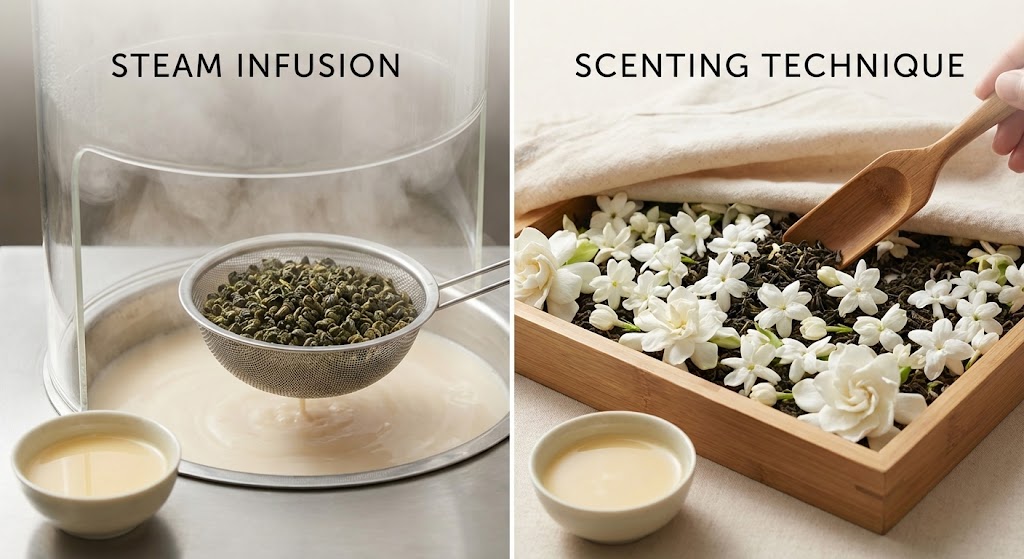
- Jasmine scenting: Also relies on volatile compound transfer, but uses external source (jasmine flowers) rather than cultivar-inherent aromatics.
- Dong Ding roasting: High roast (40%+ oxidation + charcoal firing) destroys lactones—why heavily roasted Jin Xuan loses milk character.
- Tieguanyin processing: Modern "green style" Tieguanyin (15-20% oxidation) also produces subtle cream notes from different lactone profile, though less pronounced than Jin Xuan.
- Home roasting: You can experiment with re-roasting Jin Xuan to adjust lactone expression—light roast enhances cream notes, medium roast balances cream + caramel, heavy roast eliminates milk character entirely.
Conclusion: Know What You're Buying
"Milk oolong" is a marketing category, not a quality designation. Authentic natural Jin Xuan cultivar produces subtle, sophisticated cream notes from lactone chemistry. Artificially flavored standard oolong produces intense, immediate butter aroma from spray-applied flavoring. Both are legitimate products—but only one should command premium pricing.
Ask vendors directly: "Is this Jin Xuan cultivar, or is it flavored?" Reputable sellers will answer honestly. Evasive responses ("proprietary processing," "traditional techniques," "secret blend") usually mean artificial. Your money, your choice—but make it an informed choice based on chemistry, not marketing.
For deeper understanding of oolong processing variables, see oxidation level control, withering science, and cultivar selection impact on flavor development.
Comments