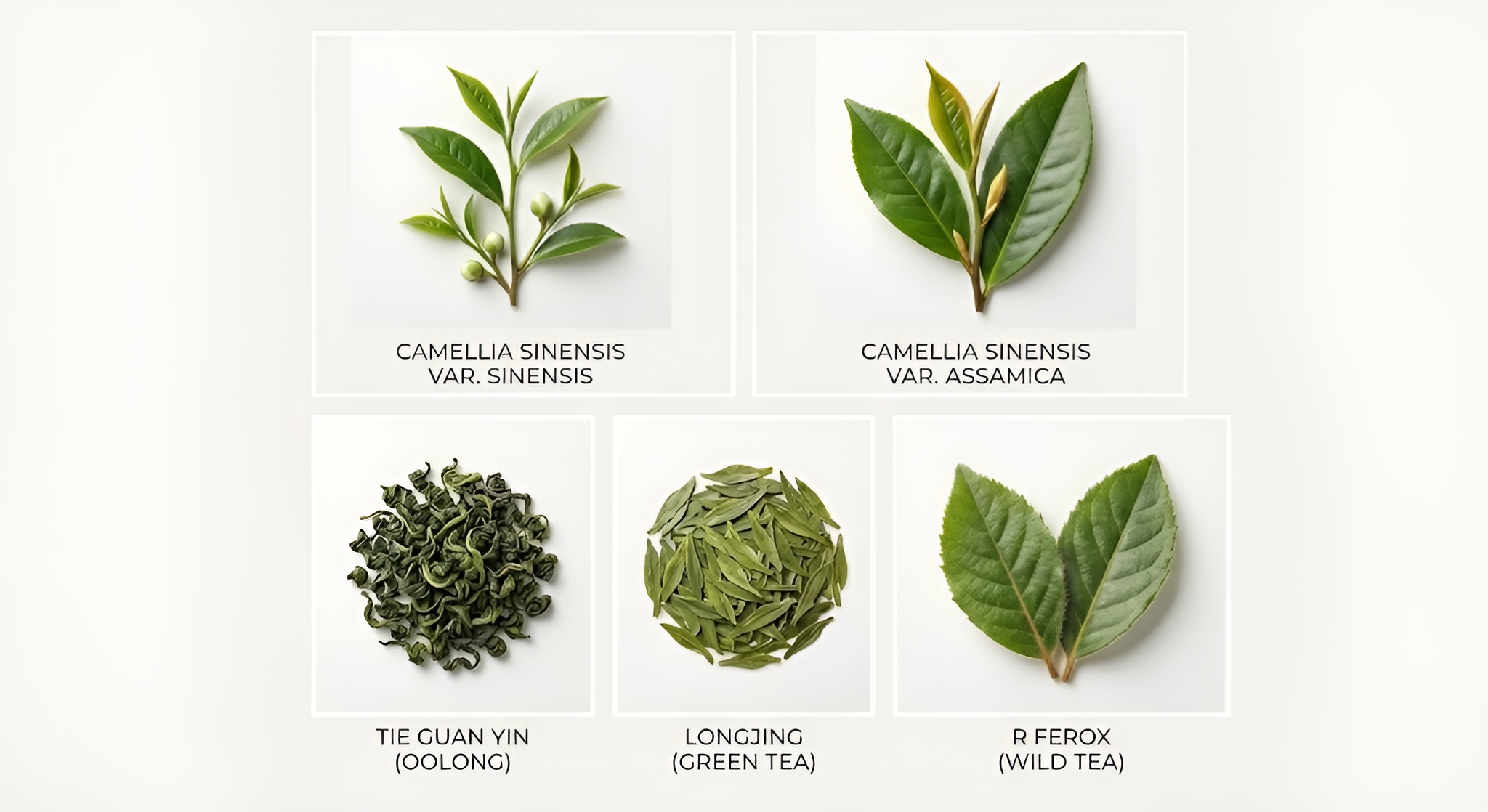
1. The Science of Breeding: Sexual vs. Asexual
Why do we clone tea plants?
Tea plants are like humans: if you grow them from seed (Sexual Propagation), every child is unique. The offspring might taste amazing, or it might taste terrible. This unpredictability is called "genetic drift."
Sexual Propagation (Seeds): Used for "Qun Ti Zhong" (Heirloom/Landrace) teas in China like West Lake Longjing. This creates a complex, multi-layered flavor because every bush in the field is slightly different. It is also essential for developing deep root systems in Gushu (Ancient Tree) Pu-erh.
Asexual Propagation (Clones): Used for modern agriculture. A branch is cut from a "Mother Bush" and planted. Every new plant is genetically identical. This guarantees that if you buy a Tie Guan Yin, it will always have that specific metallic orchid flavor.
2. How Cultivars are Named
Tea names can be poetic or robotic.
Poetic Names: Often based on legends or appearance. Tie Guan Yin (Iron Goddess), Da Hong Pao (Big Red Robe), Bai Hao (White Hair).
Numeric Names: Modern research institutes assign numbers during breeding trials.
Taiwan (TRES): #12 is Jin Xuan, #18 is Ruby.
China: Longjing #43 is the 43rd successful clone tested for early budding.
India: TV1 (Tocklai Vegetative 1) was the first clone released by the Tocklai Research Station in Assam.
The Master Cultivar Index
Click on any cultivar name to read the full deep-dive profile.
| Cultivar Name | Origin | Type | Signature Flavor / Molecule |
|---|---|---|---|
| Yabukita | Japan | Green (Sencha) | Fresh Grass / Umami High in Cis-3-Hexenol (Leaf Alcohol). The standard taste of Japan. |
| Saemidori | Japan | Green (Matcha) | Sweet / Bright Green Low tannins, high L-Theanine. A cross of Yabukita x Asatsuyu. |
| Ruby #18 (Red Jade) | Taiwan | Black | Wintergreen / Root Beer Extremely high in Methyl Salicylate. A hybrid of Burma Assam x Wild Taiwan Tea. |
| Qing Xin (Green Heart) | Taiwan | Oolong | Orchid / Forest The king of High Mountain Oolong. High in Linalool. Slow growing, low yield, high aroma. |
| Jin Xuan (Milk Oolong) | Taiwan | Oolong | Milk / Cream / Butter Natural milky lactones (often faked with flavoring). TRES #12. |
| Tie Guan Yin | China (Fujian) | Oolong | Metal / Orchid / Mineral Famous for its "Yin Rhyme" and high Indole/Nerolidol balance. |
| Fuding Da Bai | China (Fujian) | White | Soy Milk / Cucumber Used for Silver Needle due to its massive, hairy buds rich in amino acids. |
| Longjing #43 | China (Zhejiang) | Green | Chestnut / Bean An early-budding cultivar bred for the pre-Qingming harvest. |
| AV2 | India (Darjeeling) | Black | Muscatel / Rose A clonal variety famous for producing high Geraniol. The star of Second Flush. |
| Si Ji Chun (Four Seasons) | Taiwan | Oolong | Gardenia / Lilac A high-yield, intensely floral cultivar known as "The Working Class Hero." |
| Gokou | Japan (Uji) | Matcha / Gyokuro | Cream / Berry A shaded cultivar famous for a unique "milky" scent. |
| Rou Gui | China (Wuyi) | Rock Oolong | Cinnamon / Spice High in Cinnamaldehyde precursors. Famous for its sharp, spicy aroma. |
Region 1: Japan (The Land of Efficiency)
Japan has the most industrialized tea agriculture in the world. 90% of fields are clonal, and nearly 75% are Yabukita.
Yabukita was selected in 1908 by Sugiyama Hikosaburo. It is frost-resistant, high-yield, and has a strong "Green" aroma (Cis-3-Hexenol). However, it is bitter.
The Modern Shift: To cater to the Matcha boom, farmers are switching to "High-Amino" cultivars like Saemidori and Okumidori. These are bred for lower bitterness and higher L-Theanine content, making them naturally sweeter and greener.
Key Read: Saemidori vs. Okumidori: The Battle for Matcha.
Region 2: Taiwan (The Genetics Lab)
Taiwan is the "Silicon Valley" of tea genetics. The TRES (Tea Research and Extension Station) has spent 100 years breeding hybrids to create specific flavors.
The Masterpiece: Ruby #18. Released in 1999, it is a hybrid of a wild indigenous tea tree (Camellia formosensis) and a Burmese Assam. The result is a tea that tastes like mint and cinnamon—a flavor profile that exists nowhere else in nature due to high Methyl Salicylate.
The Standard: While hybrids are exciting, the old Qing Xin (Green Heart) cultivar remains the king of High Mountain Oolong. It is fragile and slow-growing, but produces the most complex floral aroma (Linalool).
Key Read: The Taiwan Tea Economy.
Region 3: China (The Wild West)
China is the birthplace of tea and has thousands of "Landrace" varieties (Zhong). These are often sexually propagated (grown from seed), meaning every bush is genetically unique.
However, famous teas rely on specific asexual cultivars:
1. Tie Guan Yin: This is not just a tea style; it is a specific bush. You cannot make true Iron Goddess tea from a different plant.
2. Da Hong Pao: The original 6 Mother Trees still exist on a cliff in Wuyi. However, nearly all commercial Da Hong Pao is made from cuttings of Bei Dou or Qi Dan, which are genetically related to the original trees.
3. Longjing #43: A triumph of modern Chinese science. It buds 7-10 days earlier than the traditional "Qun Ti" variety, allowing farmers to hit the lucrative Pre-Qingming market early.
Region 4: India & Africa (The Industrial Giants)
While East Asia focuses on delicate flavors, India and Africa focus on yield and polyphenol potency (strength).
India (Assam): The Tocklai Research Station released clones like TV1 and TRRF-1. These are large-leaf Assamica plants bred to ferment rapidly during the CTC process, creating the deep red color and maltiness (Isovaleraldehyde) needed for breakfast tea.
Kenya: The TRFK (Tea Research Foundation of Kenya) developed TRFK 306, the famous "Purple Tea." This cultivar is rich in anthocyanins (purple pigment) and was bred to withstand drought and pests without pesticides.
Darjeeling: The hills are a mix of old China seed and new clones. The AV2 (Ambari Vegetative 2) clone is the superstar. It is genetically prone to producing Geraniol, giving modern Darjeeling its intense rose/muscatel aroma.
Expert Tip: The Future is Resilient
Climate change is threatening traditional cultivars like Yabukita (which is sensitive to frost) and Qing Xin (which is sensitive to pests). The future of tea lies in new hybrids like Taiwan's TTES #23 and Japan's Sunrouge (high anthocyanin), which are bred to survive hotter, drier summers while maintaining unique flavor profiles.
Taste the Genetics
The best way to understand cultivars is to drink them side-by-side. We have curated a list of single-cultivar teas that show off their DNA clearly.
Shop Single Cultivars
Comments