1. History: The Legend of the White Tea Grandmother
Before 1857, tea in Fuding was made from "Small Leaf" varieties (Xiao Bai) that produced thin, scrawny buds.
Legend has it that a tea merchant named Chen Huan found a unique tea bush growing near the Taimu Mountain. It had buds as thick as a brush pen and was covered in silver fur. He propagated it, and it became known as Fuding Da Bai.
It revolutionized the region. Because the buds were so large and heavy, farmers could produce more tea with less labor. Today, it is one of China's "National Elite Cultivars" (Guo Jia Ji), spread across the country for its hardiness and yield.
2. Biology: The Science of Trichomes (Hao)
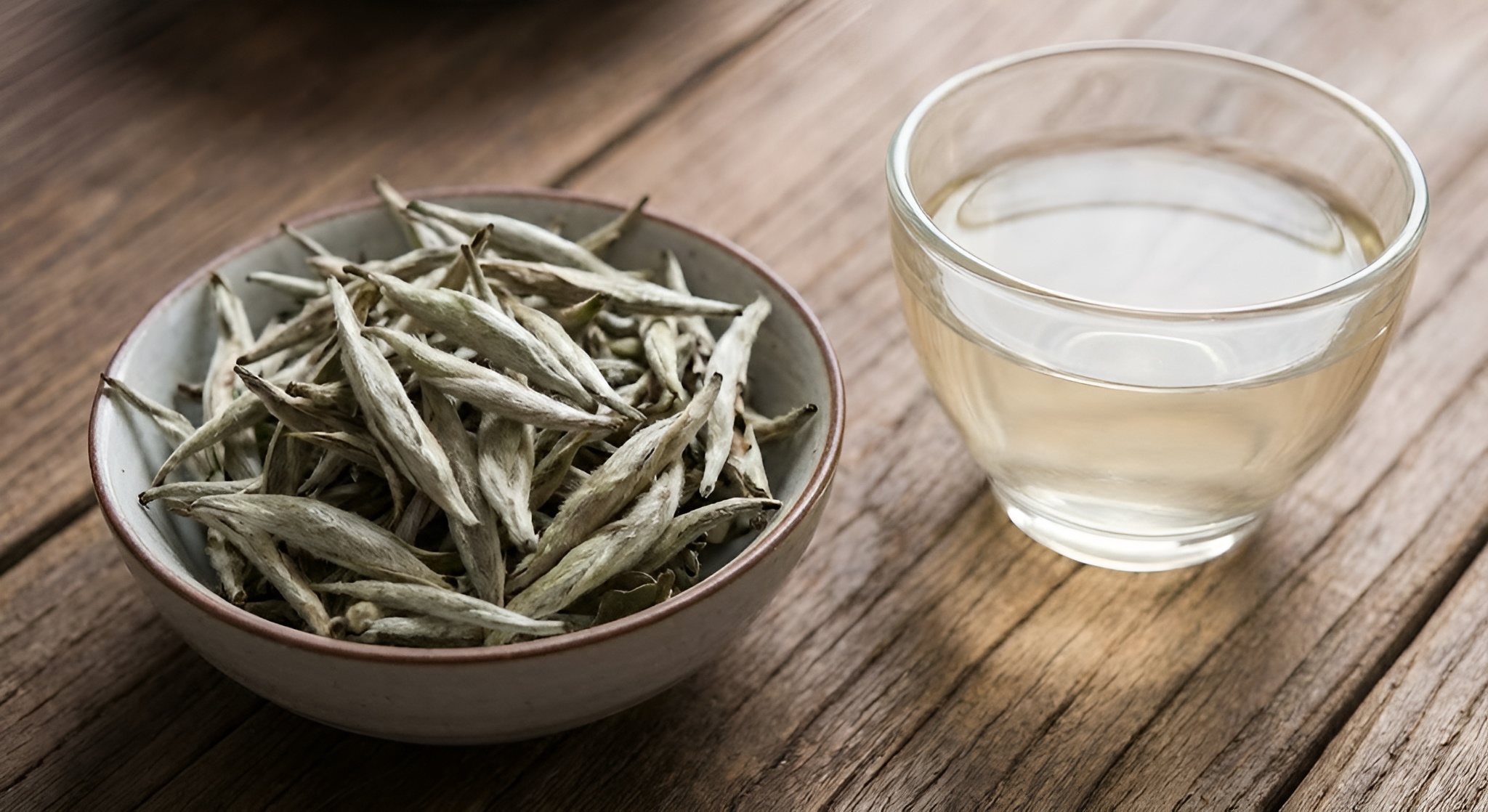
Why is the bud hairy?
Botanical Defense: The hairs (Trichomes) act as a physical barrier against small insects and reflect intense UV radiation.
Chemical Defense: The hairs are incredibly rich in caffeine (a natural pesticide). In fact, Silver Needle has more caffeine by weight than almost any other tea, although the effect is mitigated by high levels of L-Theanine.
Texture: When brewed, these hairs detach and float in the water. They are rich in soluble Pectin and oils. This creates a physical sensation of "fuzziness" or thickness on the tongue, often described as "Soy Milk Texture." If you filter out the hairs, the tea tastes noticeably thinner and sharper.
Expert Tip: The "Pekoe" confusion
The word "Pekoe" (used in Orange Pekoe) comes from the Chinese dialect for "White Hair" (Bai Hao). Originally, it referred to tea made from these hairy buds. The Fuding Da Bai cultivar is the ultimate expression of "Pekoe"—it is almost 100% hair by surface area.
3. Processing: The Art of Doing Nothing
Making White Tea from Fuding Da Bai sounds easy, but it is incredibly difficult.
The Process: 1. Pick -> 2. Wither (72+ hours) -> 3. Dry.
There is no "Kill Green" (steaming/firing) step to stop enzymes, and no "Rolling" step to break cells.
The Chemistry: During the long wither, the leaf slowly dehydrates. The enzymes (Polyphenol Oxidase) are slightly active, causing a very mild micro-fermentation. The starch in the leaf breaks down into simple sugars, and the proteins break down into amino acids. This creates the signature "Fresh Hay" and "Melon" flavor. If you wither too fast (hot day), it tastes grassy. If you wither too slow (rainy day), it tastes moldy. It requires perfect ambient control.
| Cultivar | Bud Size | Hair Density | Flavor Profile |
|---|---|---|---|
| Fuding Da Bai | Large, Fat | Very High (Silver) | Soy Milk, Cucumber, Fresh |
| Fuding Da Hao | Huge, Extra Fat | High (Gray-White) | Stronger, bolder, less delicate |
| Zhenghe Da Bai | Medium | Medium | Fuller body, sweeter, less fresh |
| Xiao Bai (Heirloom) | Small, Thin | Low | Nutty, Thin, "Old School" |
4. Brewing: Don't Baby It
There is a myth that you must use cool water for White Tea. This is false for high-grade Fuding Da Bai.
Because the buds are intact (unbroken) and covered in a dense layer of hydrophobic hairs, it is actually difficult for water to penetrate the leaf.
The Recommendation: Use water at 90°C - 95°C. Or even boiling.
Hot water is needed to push past the trichomes and extract the sweetness from the core of the bud. If you use 80°C water, the tea will taste watery and flavorless. The high level of Amino Acids (Theanine) buffers the bitterness, so it won't get astringent easily.
Taste the Pekoe
We have sourced the freshest, most trichome-rich Silver Needle (Bai Hao Yin Zhen) from the core region of Fuding. Experience the texture of true white tea.
Shop Silver Needle
Comments