1. History: The Migration from Anxi
Qing Xin originated in Anxi County, Fujian (the home of Tie Guan Yin). It was brought to Taiwan by immigrants in the late 19th century.
For decades, it was grown at lower altitudes (Dong Ding) and roasted heavily to cover up any flaws. But in the 1970s and 80s, as Taiwan's economy boomed, farmers pushed higher into the central mountain ranges (Alishan, Lishan, Shan Lin Xi).
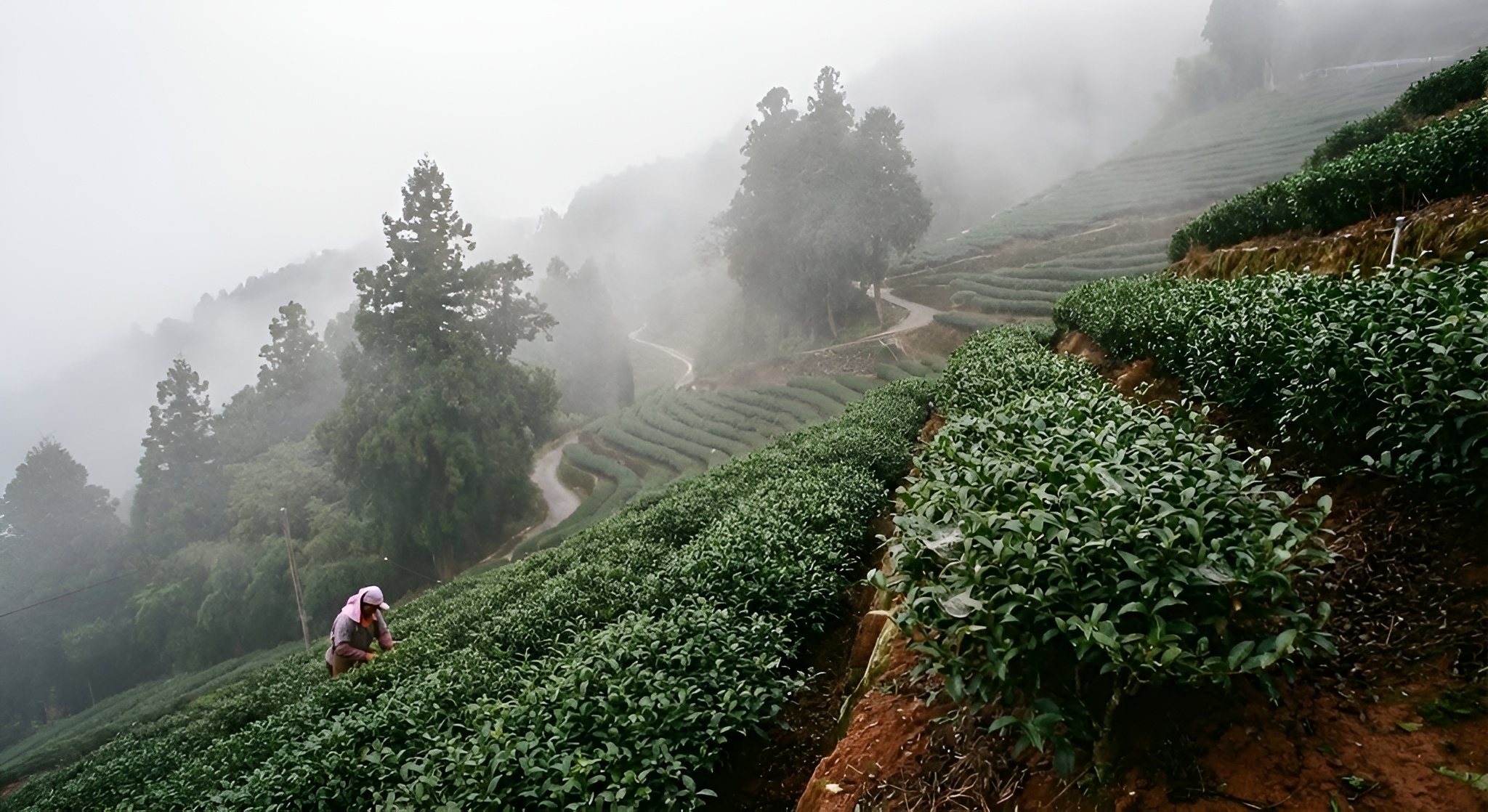
The Discovery: They found that when Qing Xin was grown above 1000 meters, something magical happened. The cold air thickened the leaves (increasing Pectin) and concentrated the aromatic oils. The heavy roasting was no longer needed. A new style was born: High Mountain Oolong—lightly oxidized, unroasted, and intensely floral.
2. The Chemistry: Linalool and The "Forest" Note
Why does Qing Xin smell like a flower shop?
Genetic analysis shows that Qing Xin is a super-producer of Linalool and its oxides. Linalool provides the "High Note"—the airy, sweet scent of orchids and lilies.
But Qing Xin isn't just floral. It has a heavy "Base Note" of Nerolidol. This sesquiterpene provides a woody, waxy depth that tea drinkers describe as "Forest Floor" or "Bamboo."
The Balance: This combination of High Floral + Deep Wood is what creates the "Rhythm" (Yun) that lingers in the throat long after swallowing.
Expert Tip: The "Stem" Test
To identify Qing Xin, look at the unfolded wet leaf. The angle between the leaf and the stem is usually quite sharp (around 45-60 degrees), and the veins are distinct. Compare this to Jin Xuan (Milk Oolong), which has rounder, broader leaves and a more obtuse stem angle.
3. Terroir: Why It Needs The Mountain
You can grow Qing Xin at sea level, but it won't taste like High Mountain Oolong.
The Stress Factor: At high altitudes (1000m+), the UV radiation is intense, but the air is cold. The plant produces amino acids (L-Theanine) to protect itself from freezing. The UV light triggers the production of aroma compounds.
The Slow Growth: In the cold, the tea grows slowly. This allows the leaf to accumulate higher density and soluble solids (Brix). A Qing Xin leaf from Dayuling (2500m) is noticeably thicker and more leathery than one from Mingjian (400m).
| Region | Altitude | Flavor Profile |
|---|---|---|
| Lishan / Dayuling | 2000m - 2600m | "Cold Mineral," Snow Water, Green Apple. |
| Shan Lin Xi | 1600m - 1800m | Cedar, Bamboo, Fir Tree (Woody). |
| Alishan | 1200m - 1600m | Sweet Floral, Creamy, Classic Orchid. |
| Dong Ding | 700m - 900m | Roasted Nuts, Sweet Potato (Traditionally Roasted). |
4. Qing Xin vs. Jin Xuan (The Rival)
If Qing Xin is the King, Jin Xuan (Milk Oolong) is the Prince.
Jin Xuan (TRES #12): Bred to be hardy, high-yield, and easy to grow at low altitudes. It has a natural "Milky" flavor but lacks the complex floral finish of Qing Xin.
Qing Xin: Hard to grow, low yield, but produces a superior aroma.
The Price Gap: Because Qing Xin is harder to farm and grows on expensive mountain land, it often costs 2x to 3x more than Jin Xuan. Unscrupulous vendors sometimes blend them.
Taste the Altitude
Authentic High Mountain Qing Xin is rare. We have vetted producers in Alishan and Lishan who process single-batch, hand-picked tea.
Shop Qing Xin Oolong
Comments