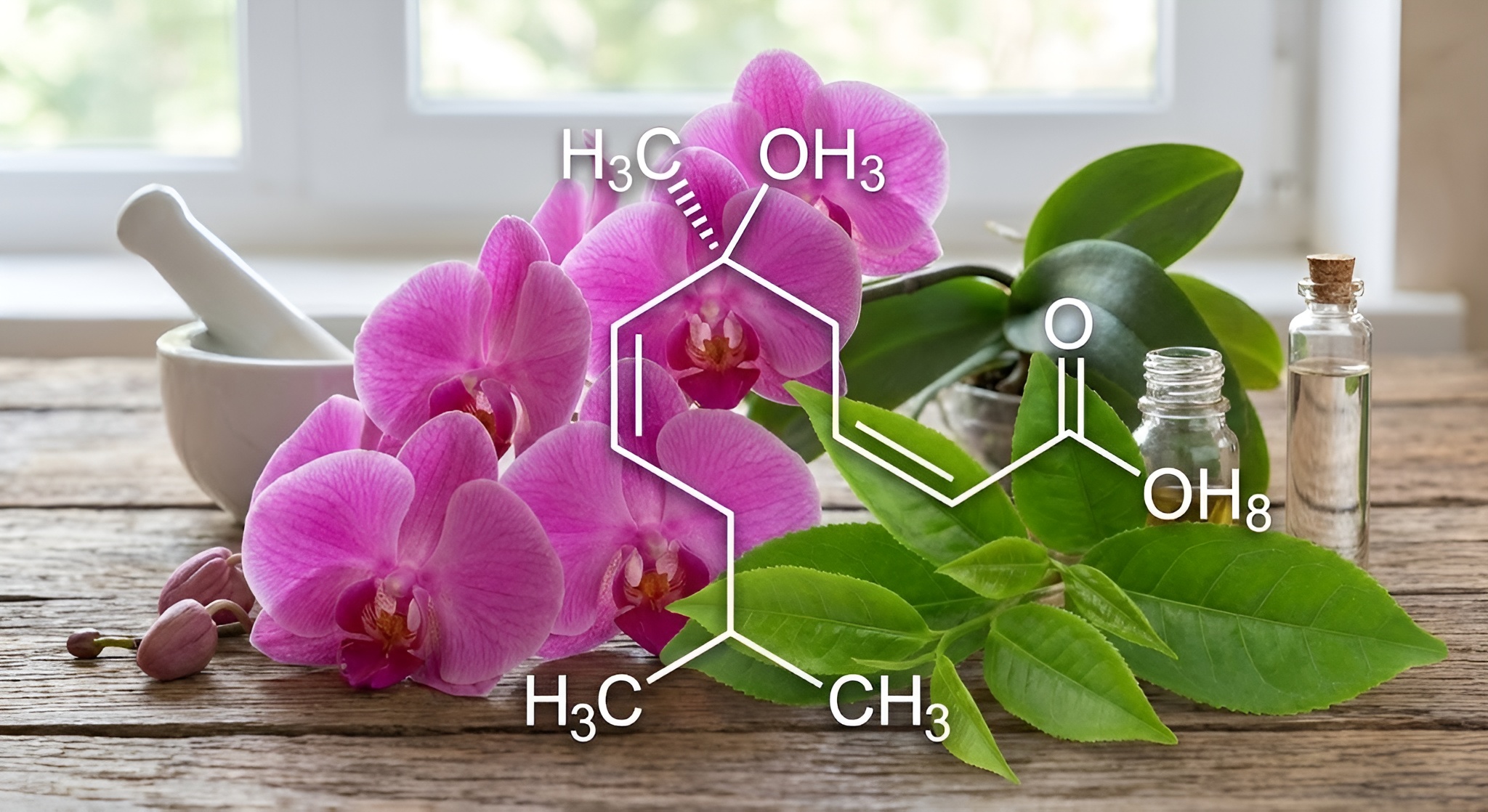
1. The Chemistry: Two Faces of One Molecule
Linalool is a chiral molecule, meaning it exists in two mirror-image forms (enantiomers). While they have the same chemical formula, your nose perceives them differently.
(S)-(+)-Linalool (Coriandrol): This isomer is dominant in coriander and, crucially, in Oolong Tea. It has a sweet, floral, petitgrain-like aroma that resembles orchids.
(R)-(-)-Linalool (Licareol): This isomer is dominant in lavender, basil, and ho wood. It has a sharper, woody, herbal scent.
In high-quality tea, specifically lightly oxidized Oolongs like Bao Zhong, the (S)-isomer dominates. This is why good Taiwanese tea smells like a flower shop, not a spice rack.
2. The "Bug Bitten" Effect: Nature's Chemical Warfare
Why would a plant smell like perfume? It's not for us. It's a cry for help.
When the Tea Green Leafhopper (Jacobiasca formosana) bites the tea leaf to suck the sap, the plant's defense system is triggered. It begins to synthesize phytoalexins and volatile terpenes, specifically Linalool and its oxides.
The Mechanism: The plant releases these aromatic compounds to attract the natural predators of the leafhopper (like spiders and wasps).
The Result for Humans: This stress response transforms the chemical composition of the leaf. Instead of tasting grassy or bitter, the leaf becomes intensely sweet and honey-floral. This is the secret behind Oriental Beauty (Dong Fang Mei Ren), one of the most expensive teas on earth.
Expert Tip: Why Organic Matters Here
You cannot produce high-Linalool "Bug Bitten" tea with pesticides. If you kill the leafhoppers, you kill the aroma mechanism. Therefore, authentic Oriental Beauty and Honey Black Tea must be grown without insecticides.
3. Where to Find Linalool (The Cultivars)
If you are chasing that orchid aroma, you need to buy specific cultivars. Genetic potential limits how much Linalool a plant can produce.
| Cultivar | Origin | Linalool Profile | Common Teas |
|---|---|---|---|
| Qing Xin | Taiwan | High (Orchid/Forest) | High Mountain Oolong, Dong Ding |
| Tie Guan Yin | Fujian, China | Medium (Lilac/Metal) | Iron Goddess Oolong |
| Dan Cong (Mi Lan Xiang) | Guangdong, China | Very High (Honey/Orchid) | Phoenix Oolong |
| AV2 Clonal | Darjeeling, India | High (Muscatel/Rose) | Second Flush Darjeeling |
4. Brewing Physics: How to Trap the Molecule
Linalool is a Volatile Organic Compound (VOC). This means it wants to turn into a gas. If you brew incorrectly, your kitchen will smell great, but your tea will taste flat.
The Temperature Rule: High heat (95°C+) drives Linalool out of the leaf quickly.
The Vessel Rule: You need a tall, narrow vessel to trap the rising gas. This is why the traditional Chinese Wen Xiang Bei (Aroma Cup) is shaped like a chimney. It concentrates the Linalool vapor so you can inhale it before drinking.
The Lid Rule: Keep the lid on your Gaiwan between pours. Condensation on the underside of the lid captures the Linalool. Smelling the hot lid is a crucial part of the Gongfu ceremony.
Taste the Science
Want to experience pure Linalool? The best example is a High Mountain Oolong from the Qing Xin cultivar. We have reviewed the best sources for authentic, unblended Taiwanese tea.
Find Qing Xin Oolong
Comments