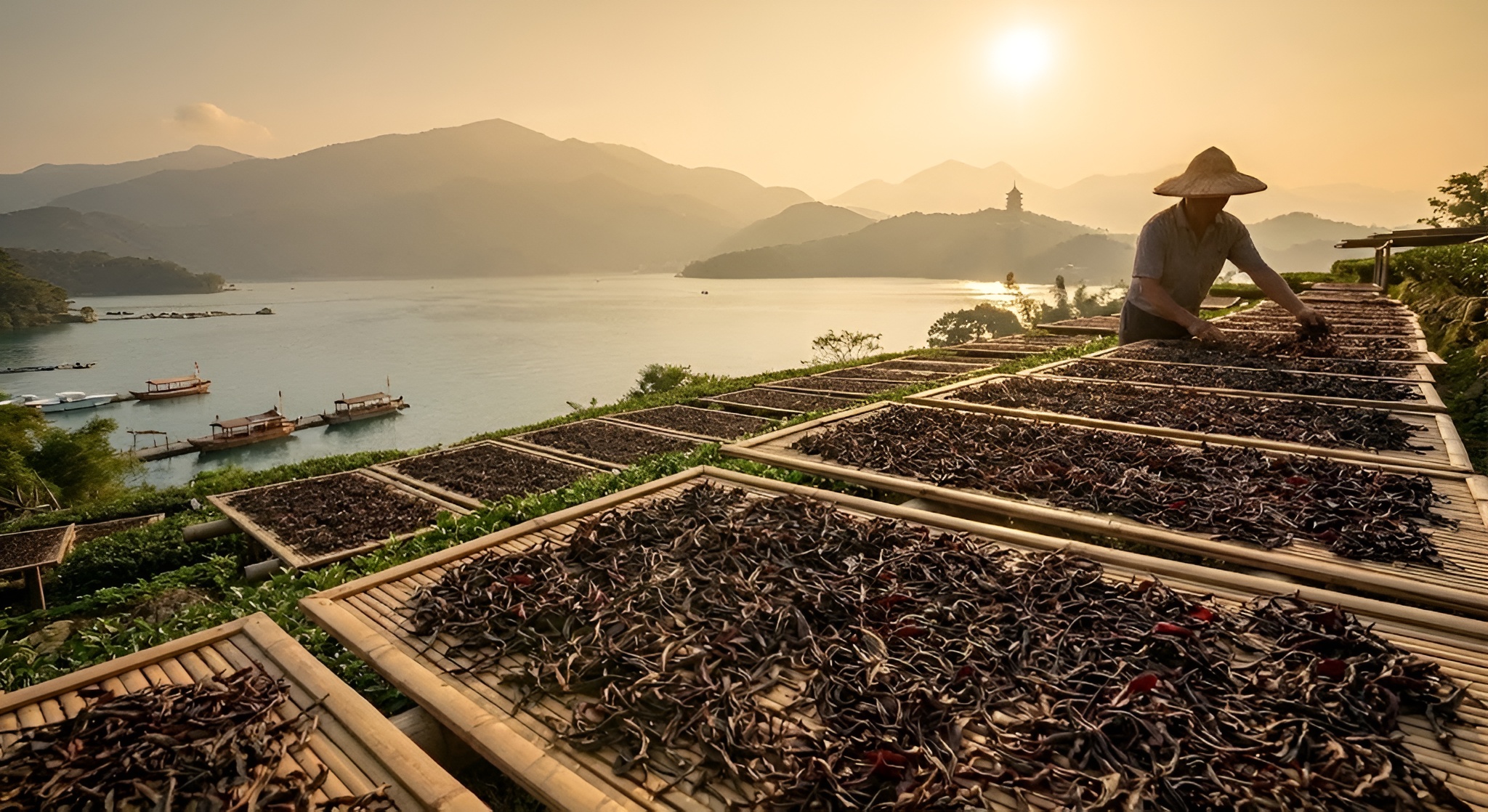
1. History: Project 4058 and the Quest for Red Gold
During the Japanese occupation of Taiwan (1895-1945), the Japanese established a black tea research station at Sun Moon Lake to compete with British India. They imported Assam plants (Camellia sinensis var. assamica) from India and planted them on the hillsides.
However, the tea was good, but not unique. It tasted like... Assam.
After WWII, the Taiwanese government (TRES) continued the breeding program. Their goal: Create a black tea that was distinctly Taiwanese.
The Breakthrough: In the 1950s, researchers crossed a high-yield Burmese Assam mother bush (Strain B-729) with a wild, spindly tea tree found growing in the Taiwanese mountains (Strain B-607). This wild plant was barely drinkable on its own—it was bitter and wild—but it had an incredible, piercing aroma of menthol and camphor.
The hybrid offspring, initially code-named Project 4058, spent 40 years in field trials before being officially released in 1999 as TTES No. 18. It was given the trade name "Red Jade" (Hong Yu) for the brilliant clarity of its red liquor.
2. The Chemistry: Why It Tastes Like Medicine (In a Good Way)
The defining characteristic of Ruby #18 is its high concentration of Methyl Salicylate.
This compound is an ester commonly used in "Deep Heat" muscle rubs and wintergreen gum. In most tea plants, it exists in trace amounts. In Ruby #18, it is a dominant volatile.
The Sensory Experience:
When you drink Ruby #18, you experience two things simultaneously:
1. Taste (Gustatory): Sweetness from sugars and Maltiness from the Assam parent (Isovaleraldehyde).
2. Sensation (Trigeminal): A physical cooling or tingling sensation on the gums and throat, caused by the Methyl Salicylate activating the TRPM8 channels (cold receptors).
This combination of "Warm Malt" and "Cool Mint" creates the sensation of drinking Root Beer or Sarsaparilla.
Expert Tip: Look for "Brandy" Notes
Top-quality Ruby #18 often develops notes of dried fruit (prunes, raisins) that resemble brandy or cognac. This comes from the interaction of the minty ester with Beta-Damascenone (honey aroma) produced during the full oxidation process.
3. The Variant: "Mi Xiang" (Honey Fragrance) Ruby 18
Just when you thought it couldn't get more complex, farmers introduced bugs.
Some Ruby #18 fields are managed organically to encourage the presence of the Tea Green Leafhopper (Jacobiasca formosana). When these tiny bugs bite the leaves, the plant releases stress compounds (terpenes) to attract predators.
This creates a chemical cocktail:
Standard Ruby 18: Mint + Cinnamon (Methyl Salicylate).
Bug-Bitten Ruby 18: Mint + Cinnamon + Honey.
The bug bites trigger the production of Geraniol and Linalool, adding a layer of floral honey sweetness that balances the sharp menthol. These "Mi Xiang" versions are rarer and more expensive.
4. Brewing Physics: How to Tame the Beast
Ruby #18 is a large-leaf variety (Assamica genetics). It has potent tannins and releases flavor quickly.
The Challenge: If you brew it too hot or too long, the astringency will overpower the delicate mint notes.
The Solution:
1. Temperature: 90°C (195°F). Slightly cooler than boiling preserves the volatile top notes.
2. Vessel: Porcelain or Glass. Avoid unglazed clay (Yixing) unless it is seasoned exclusively for black tea, as the clay can absorb the high-pitched menthol aroma, leaving only the heavy base.
| Tea Style | Dominant Flavor | Best Vessel | Water Temp |
|---|---|---|---|
| Ruby #18 (Standard) | Menthol, Cinnamon | Porcelain Gaiwan | 90°C |
| Ruby #18 (Mi Xiang) | Honey, Mint, Fruit | Porcelain / Glass | 85-90°C |
| Assam (Indian) | Malt, Earth, Leather | Ceramic Teapot | 100°C |
Taste the Red Jade
Authentic Ruby #18 from Sun Moon Lake is a revelation. We have curated a list of the best producers who process this tea by hand.
Shop Ruby #18
Comments