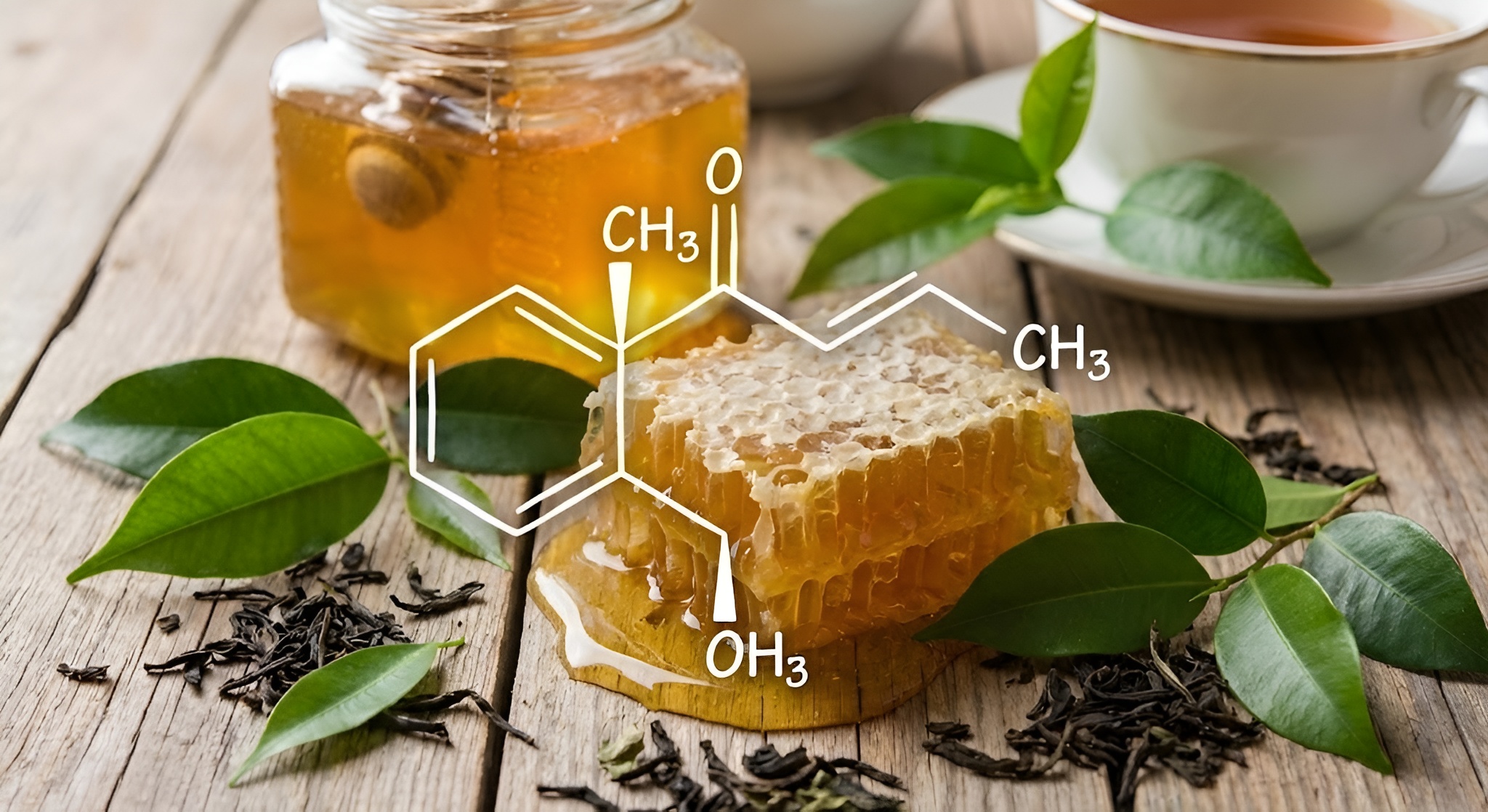
1. Biosynthesis: The Death of Chlorophyll
To understand Beta-Damascenone, you must understand what happens when a leaf dies (oxidizes).
A fresh tea leaf is full of Carotenoids (like Beta-Carotene and Lutein) and Chlorophyll. These pigments capture sunlight for photosynthesis. While the leaf is green and alive, these pigments are stable.
The Transformation: When the tea maker triggers oxidation by rolling the leaf, the Chlorophyll breaks down (the leaf turns brown), and the Carotenoids degrade via the Carotenoid Cleavage Dioxygenase (CCD) enzyme pathway.
This degradation splits the large pigment molecules into smaller, volatile fragments. One of these fragments is Beta-Damascenone. This is why Green Tea (which preserves Chlorophyll) tastes grassy, while Black Tea (which destroys it) tastes fruity.
Expert Tip: The "Sun Wither"
To maximize Beta-Damascenone, farmers often perform a "Sun Wither" (Sai Qing). Exposing the plucked leaves to gentle sunlight accelerates the breakdown of Carotenoids before the enzymes are killed. This is crucial for making Oriental Beauty.
2. The Threshold of Perception
Beta-Damascenone is unique because of its incredible potency.
Odor Threshold: 0.002 parts per billion (ppb) in water.
To put that in perspective, Linalool (the orchid smell) has a threshold of ~6 ppb. This means Beta-Damascenone is 3,000 times more potent than Linalool. You barely need any of it to perceive a rich, honeyed sweetness.
The "Perfume" Effect: In perfume chemistry, Beta-Damascenone is known as an "enhancer." Even at sub-threshold levels (where you can't smell it directly), it boosts the perception of other fruity esters. In tea, it acts as the "bass note" that amplifies the floral top notes of Geraniol and Linalool.
3. Where to Find It (The Cultivars)
If you crave that deep honey/dried fruit flavor, you need teas that have undergone significant oxidation or specific insect stress. For a deeper look at the plant genetics behind this, visit The Great Tea Cultivar Database.
| Tea / Cultivar | Origin | Aroma Profile | Why It's High |
|---|---|---|---|
| Keemun (Qimen) | Anhui, China | Rose, Wine, Dried Plum | Slow, low-temp oxidation of the local population (Zhu Ye Zhong). |
| Oriental Beauty | Taiwan | Honey, Spice | Bug bites + 70% Oxidation degrades carotenoids rapidly. |
| Second Flush Darjeeling | India | Muscatel, Toast | High solar radiation increases carotenoid levels in the leaf before harvest. |
| Black Tea (Generic) | Global | Malt, Sugar | Full oxidation converts nearly all pigments into aroma. |
Expert Tip: Aging Increases It
Beta-Damascenone concentrations can actually increase during storage. As tea ages (especially aged Oolong or Pu-erh), acid-catalyzed hydrolysis continues to break down remaining glycoside precursors. This is why aged Oolongs often lose their "green" edge and gain a "dried fruit/plum" note over 10-20 years.
4. Brewing: The Heat Requirement
Like Geraniol, Beta-Damascenone is a semi-volatile compound with a high boiling point. It requires energy to release from the leaf matrix and volatize into the aroma of your cup.
The Protocol (See our Brewing Guide for more):
1. Boiling Water: Do not use cooler water for Black Tea or Oriental Beauty. You need 95-100°C to extract the norisoprenoids.
2. The "Smell Cup": Use a narrow, deep cup. Because Beta-Damascenone is heavy, it lingers in the bottom of the cup after you have finished the liquid. This is the "Cold Cup Scents" (Leng Xiang) that connoisseurs prize.
3. Multiple Infusions: Because it is bound deeper in the leaf structure, the honey note often gets stronger in the 2nd and 3rd brew as the leaf opens up.
Taste the Honey
The best example of pure Beta-Damascenone aroma is a high-grade Oriental Beauty or a classic Keemun Mao Feng. We have sourced the best examples.
Shop Honey-Aroma Teas
Comments