1. What is Orthodox Tea? (The "Real" Leaf)
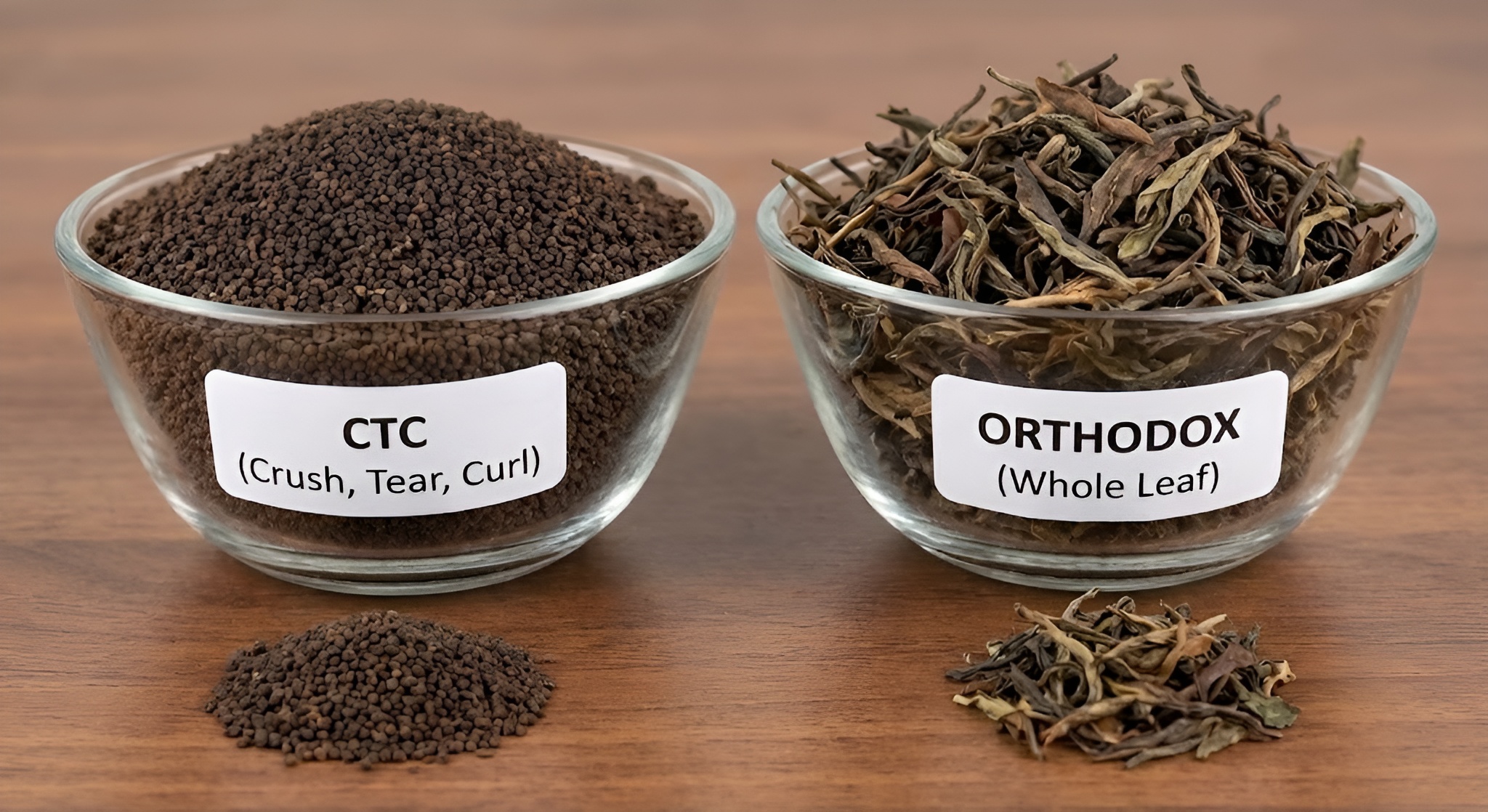
Orthodox manufacture is the traditional method of making tea. It seeks to keep the leaf as intact as possible. The goal is to rupture the cells to start oxidation without shredding the leaf structure entirely.
The Process: After withering, the leaves are rolled gently on large tables (or by hand) to twist them into tight wires or spirals. This rolling squeezes out essential oils to the surface but keeps the leaf whole.
The Flavor Profile: Because the leaf is whole, it releases flavor slowly. This creates a multi-layered experience—you might taste flowers first, then fruit, then a woody finish. It is delicate, complex, and rarely bitter if brewed correctly.
Expert Tip: Reading the Label
If you see a confusing string of letters like FTGFOP (Finest Tippy Golden Flowery Orange Pekoe), that is always Orthodox tea. CTC tea doesn't use these grades; it uses terms like "Dust" or "Fannings." Learn how to decode these letters in our guide: What Does FTGFOP Mean? →
2. What is CTC Tea? (The "Industrial" Pellet)
CTC stands for Crush, Tear, Curl. Invented in the 1930s, this method was designed for one purpose: Efficiency. It revolutionized the tea industry by allowing tea to be processed by machine, packed into tea bags, and shipped cheaply.
The Process: Instead of gentle rolling, withered leaves are fed into a machine with metal rollers that possess sharp teeth. These rollers crush the leaf, tear it apart, and curl it into tiny, hard pellets. It looks like instant coffee or peppercorns.
The Flavor Profile: Because the leaf is pulverized, it has a massive surface area. When hot water hits it, everything is released at once—flavor, tannin, color, and caffeine. The result is a bold, one-dimensional, "malty" punch.
Expert Tip: The Milk Factor
CTC tea is designed for milk. The intense tannins that make it bitter when black are exactly what allow it to cut through the fat of milk and sugar. If you drink your tea with milk, a high-quality CTC Assam is often better than a delicate Orthodox tea.
3. Head-to-Head Comparison: Pro's and Con's
| Feature | Orthodox (Whole Leaf) | CTC (Pellets) |
|---|---|---|
| Appearance | Twisted, wire-like whole leaves | Small, hard brown spheres |
| Brewing Time | Slow (3-5 minutes) | Fast (1-2 minutes) |
| Flavor | Complex, floral, multi-layered | Strong, bold, malty, linear |
| Best Served | Black (No Milk) | With Milk & Sugar |
| Cost | High (Hand-picked) | Low (Machine harvested) |
4. Regional Specialization: Who Uses What?
Assam: The King of CTC
The vast majority of tea from Assam is processed as CTC. Why? Because the Camellia sinensis var. assamica leaf is naturally large and thick. It is difficult to roll by hand but perfect for the CTC machines. This is why "Irish Breakfast" and "English Breakfast" blends rely on Assam CTC for their color and strength.
Looking for Strong Assam?
If you love a strong morning cup, don't buy blind. We reviewed the top blends to find the punchiest ones. Check out: The 10 Best Assam Tea Bags of 2025 →
Darjeeling: The Bastion of Orthodox
Conversely, Darjeeling almost exclusively uses Orthodox manufacture. The high-altitude var. sinensis leaves are small and delicate. Crushing them in a CTC machine would destroy the volatile oils responsible for the famous "Muscatel" and floral notes. Using a CTC machine on First Flush Darjeeling would be like making grape juice out of vintage Champagne grapes—a waste of potential.
The Caffeine Myth
It is a myth that CTC tea has more caffeine than Orthodox tea. The total chemical content is often similar. However, CTC releases its caffeine faster (in the first 30 seconds) because of the surface area. Orthodox tea releases it slowly over 5 minutes. This creates the illusion of a bigger "kick" from CTC.
5. The Masala Chai Connection
One beverage owes its entire existence to CTC tea: Masala Chai. Traditional Indian street Chai is made by boiling tea with spices, milk, and sugar. Orthodox tea is too delicate for this; its flavor would disappear under the ginger and cardamom.
CTC tea, with its granular structure, releases tannins quickly and creates a dark, thick liquor that acts as the perfect canvas for spices. You simply cannot make authentic Chai with whole-leaf Orthodox tea—it will taste like spicy milk water.
Making Chai at Home?
Don't use your expensive loose leaf for Chai. You need strong CTC pellets. Learn the history of this street drink here: The Story of Masala Chai →
6. Conclusion: Which is Better?
There is no "better," only "fit for purpose."
- Choose Orthodox if you want to drink tea black, appreciate nuances of flavor (floral, fruity, woody), and are willing to spend 5 minutes brewing it.
- Choose CTC if you want a strong wake-up call, if you add milk and sugar, or if you are making Masala Chai.
The snobbery against CTC is often misplaced. A high-quality Assam CTC is a magnificent feat of engineering that delivers a specific, robust experience that a delicate Orthodox tea simply cannot match.
Comments