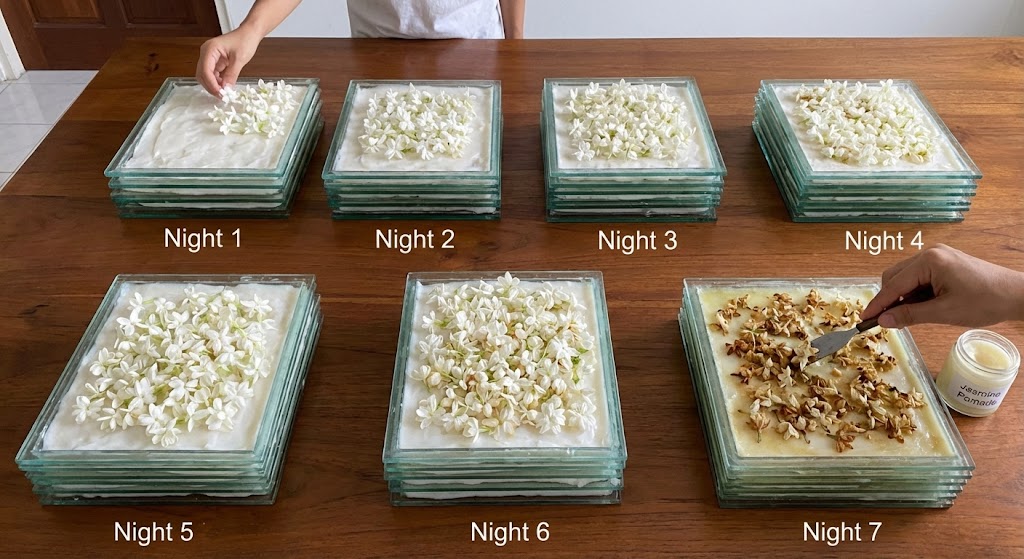
Jasmine Sambac: The Only Flower for Traditional Scenting
Traditional jasmine tea uses Jasminum sambac (Arabian jasmine, 茉莉花 mòlì huā)—not common jasmine (J. officinale) or other jasmine species. Why? Sambac produces the highest concentration of benzyl acetate (the primary "jasmine" aroma compound) and blooms predictably at night, making it suitable for controlled scenting cycles.
Sambac flowers are harvested at dusk (6-8 PM) when buds are closed but about to open. If picked too early (afternoon), flowers won't bloom fully. If picked after blooming starts, volatile oils have already begun evaporating into air rather than concentrating for tea absorption. The harvest window is 2-3 hours—one reason jasmine tea production is labor-intensive.
Fuzhou, Fujian (China's jasmine tea capital) grows sambac at scale specifically for tea scenting. The region's climate (warm, humid, 25-30°C average during summer harvest) supports year-round flowering, with peak season June-September producing the most aromatic blooms. Lower-quality jasmine tea often uses sambac grown in Thailand or Vietnam where labor costs are lower—but Fuzhou processors claim local terroir produces superior aroma intensity.
Alternative to sambac: Some low-grade jasmine teas use synthetic jasmine oil (benzyl acetate isolated in lab) sprayed onto tea leaves. This produces immediate strong smell but lacks the complexity of natural flower scenting—missing the 50+ minor volatile compounds (linalool, indole, methyl anthranilate) that create layered, evolving aroma in traditionally scented tea.
Expert Tip: Flower Quality Assessment
Premium jasmine tea uses "double-petaled" sambac (Moli Xiuqiu variety) with 12-18 petals per flower vs. common sambac's 5-8 petals. More petals = more surface area = higher volatile oil content. When buying jasmine tea, ask vendor about flower variety used. If they can't specify, it's likely standard sambac or—worse—synthetic flavoring. Legitimate Fuzhou producers proudly detail their sambac cultivar selection.
The Scenting Process: Temperature-Critical Layering
Traditional jasmine scenting follows a nightly cycle repeated 5-9 times depending on target quality grade:
Step 1: Base Tea Preparation (Day Before First Scenting)
Base tea—usually white tea, green tea, or lightly oxidized oolong—is dried to 3-5% moisture content. This is critical: tea must be dry enough to absorb flower volatiles via osmosis but not so dry it becomes brittle. Optimal moisture: 4%. Too wet (6%+) = tea can't absorb additional moisture from flowers, resulting in weak scenting. Too dry (2%) = tea becomes fragile and produces dusty texture.
Common base teas:
- Green tea: Most common. Mao Feng or pre-Qingming Longjing for premium jasmine pearls. Vegetal green notes complement jasmine floral character.
- White tea: Silver Needle or White Peony for top-grade jasmine. Delicate white tea doesn't compete with jasmine aroma, creating pure floral expression.
- Oolong: Rarely used, but some Taiwanese producers scent Baozhong oolong (10-15% oxidation) for complex floral-fruity profile.
Step 2: Evening Flower Layering (6-8 PM)
Fresh-harvested sambac flowers (still closed buds) are spread in alternating layers with tea leaves:
- Ratio: 100kg flowers : 100kg tea for premium grades (1:1 ratio). Basic grades use 50-70kg flowers : 100kg tea (0.5-0.7:1).
- Layer thickness: 5-8 cm tea layer, 3-5 cm flower layer, repeated in woven bamboo trays or stainless steel racks.
- Covering: Layers covered with breathable cloth (not plastic) to trap volatiles while allowing some air circulation. Too airtight = flowers ferment and produce sour smell. Too exposed = volatiles escape before tea absorption.
Step 3: Overnight Blooming (8 PM - 6 AM)
This is where the magic happens. Sambac flowers naturally bloom at night (peak bloom 10 PM - 2 AM), releasing maximum volatile oils. The scenting room is maintained at 30-35°C and 70-80% humidity—conditions that trigger full bloom and maximize volatile release.
Temperature control is critical:
- 28-30°C: Flowers bloom slowly, volatile release extends over 8-10 hours (good for gentle scenting).
- 30-33°C: Optimal. Flowers bloom fully in 4-6 hours, peak volatile concentration, ideal absorption rate into tea.
- 33-35°C: Rapid bloom, high intensity but shorter duration. Used for final scenting rounds to boost aroma.
- 35-38°C: Flowers wilt before fully blooming, produces weak scenting and potential off-flavors from premature decay.
- <28°C: Insufficient bloom, poor volatile release, requires extended scenting time (16+ hours) with diminishing returns.
During blooming, benzyl acetate (boiling point 213°C but volatile at room temp) evaporates from flower petals and condenses onto cooler tea leaf surfaces. Simultaneously, tea's hygroscopic nature draws moisture from flowers via osmosis, carrying dissolved aromatic compounds into leaf interior. By morning, tea moisture content rises from 4% to 6-7%, now infused with jasmine volatiles.
Step 4: Morning Separation (6-8 AM)
Flowers must be removed before they begin souring (typically 6-8 hours after full bloom). Wilted flowers produce indole and skatole compounds—responsible for "fecal" aroma in over-bloomed jasmine—which will transfer to tea if left too long.
Separation methods:
- Machine separation (basic grades): Tea/flower mix tumbled through screens that separate based on size. Fast but leaves 5-10% flower debris in tea. This is why cheap jasmine tea has visible brown bits (spent flowers).
- Hand separation (premium grades): Workers manually pick through tea to remove all flower debris. Labor-intensive (8-10 hours for 100kg batch) but produces clean finish. Premium jasmine pearls should have zero visible flower remnants.
Step 5: Re-Drying (8 AM - 12 PM)
After flower removal, tea (now at 6-7% moisture) is re-dried to 3-5% to prevent mold growth and prepare for next scenting round. Drying temperature: 80-90°C for 2-4 hours in industrial dryers. Too hot (>100°C) = volatile jasmine oils evaporate, wasting previous night's work. Too cool (<70°C) = insufficient drying, tea develops musty smell.
Step 6: Repeat Cycle
The entire process repeats nightly for 5-9 rounds depending on desired intensity:
- 1-2 rounds: "Single/Double Scented" — basic supermarket jasmine tea, subtle aroma, £3-8/100g
- 3-4 rounds: "Triple/Quadruple Scented" — mid-grade specialty tea, noticeable jasmine, £12-20/100g
- 5-7 rounds: "Premium Grade" — strong, complex jasmine with evolving notes, £25-40/100g
- 9-12 rounds: "Imperial Grade" — intense, persistent aroma lasting 8+ infusions, £50-80/100g
| Quality Grade | Scenting Rounds | Flower:Tea Ratio | Typical Price | Aroma Persistence |
|---|---|---|---|---|
| Basic/Commercial | 1-2 rounds | 0.5:1 (50kg:100kg) | £3-8/100g | 2-3 infusions |
| Mid-Grade/Specialty | 3-4 rounds | 0.7:1 (70kg:100kg) | £12-20/100g | 4-5 infusions |
| Premium/Traditional | 5-7 rounds | 1:1 (100kg:100kg) | £25-40/100g | 6-8 infusions |
| Imperial/Competition | 9-12 rounds | 1.2:1 (120kg:100kg) | £50-80/100g | 10+ infusions |
Benzyl Acetate Chemistry: The "Jasmine" Molecule
Benzyl acetate (C₉H₁₀O₂) is the primary compound humans perceive as "jasmine smell." It's an ester formed when benzyl alcohol reacts with acetic acid in the flower. Chemical properties:
- Boiling point: 213°C (but volatile at room temp due to vapor pressure)
- Solubility: Slightly water-soluble, more fat-soluble (why it absorbs well into tea's lipid components)
- Odor threshold: Detectable at 0.13 ppm in air—extremely low, meaning small amounts produce strong aroma
- Stability: Degrades slowly when exposed to UV light or high heat (>120°C), hence gentle drying requirement
Jasmine sambac flowers contain 0.2-0.3% benzyl acetate by weight at peak bloom. For perspective: 100kg fresh flowers yields ~200-300g pure benzyl acetate. When these flowers scent 100kg tea, the tea absorbs perhaps 150-200g benzyl acetate (some loss to evaporation). Final tea contains ~0.15-0.2% benzyl acetate—enough for strong jasmine aroma across multiple infusions.
Supporting compounds in jasmine create complexity beyond benzyl acetate alone:
- Linalool: Sweet, floral, lavender-like notes. Adds "roundness" to jasmine aroma.
- Indole: In low concentrations (<0.01%), adds "richness" and depth. In high concentrations (>0.05%), produces fecal smell—why spent flowers must be removed promptly.
- Methyl anthranilate: Fruity, grape-like undertones. More prominent in double-petaled sambac varieties.
- cis-Jasmone: Green, fresh, "live flower" aroma. Highly volatile, mostly lost during processing—why fresh jasmine flowers smell different from jasmine tea.
Synthetic jasmine oil typically contains 95%+ benzyl acetate with minimal supporting compounds—producing strong but one-dimensional "jasmine" smell lacking the complexity of natural scenting.
Expert Tip: Aroma Evolution Test
To verify traditional scenting vs. artificial flavoring: Brew jasmine tea gongfu style for 8+ infusions. Natural scenting produces aroma that evolves—first infusion is floral-forward, middle infusions develop sweetness, late infusions reveal base tea character with lingering jasmine. Artificial flavoring produces static aroma—smells identically "jasmine" across all infusions until it suddenly drops off completely around infusion 4-5. Evolution = natural. Static = artificial.
Quality Control: Fresh vs. Spent Flowers
Flower quality dramatically affects scenting results. Professional processors assess flowers at multiple stages:
Pre-Harvest Assessment (Afternoon Before Harvest):
- Bud tightness: Optimal buds are closed but show slight petal separation at tip. Completely tight = won't bloom tonight. Partially open = will bloom prematurely during harvest/transport.
- Bud size: Larger buds (>1.5cm diameter) contain more volatile oils. Small buds (<1cm) produce weak scenting even in premium grades.
- Color: White-green buds preferred. Yellowing indicates stress/disease. Fully white = ready but must be harvested within 2 hours.
Post-Bloom Assessment (Morning After Scenting):
- Petal color: Should be white-cream. Brown/yellow = over-bloomed, produced indole/skatole off-flavors. Must discard this batch.
- Petal texture: Soft but intact. Mushy/slimy = fermentation started, will sour the tea. Emergency separation required.
- Aroma: Spent flowers should smell faintly sweet-floral. Sour/vinegar smell = fermentation, batch contaminated.
Flower reuse: In basic-grade production, spent flowers are sometimes re-used for a second scenting round after first use (labeled "secondary scent"). This produces minimal aroma transfer (~20% of fresh flower intensity) and is considered poor practice. Premium processors never reuse flowers—each scenting round uses 100% fresh sambac harvested that evening.
Premium vs. Standard Quality: What You're Paying For
The price difference between £5/100g supermarket jasmine tea and £40/100g premium jasmine pearls reflects multiple quality factors:
| Quality Factor | Standard/Commercial | Premium/Traditional |
|---|---|---|
| Base Tea | Machine-harvested green tea, summer/autumn flush | Hand-picked pre-Qingming green or Silver Needle white |
| Flower Variety | Standard sambac (5-8 petals), may be imported from Vietnam/Thailand | Double-petaled Fuzhou sambac (12-18 petals), locally grown |
| Scenting Method | 1-2 rounds machine scenting, or spray-applied jasmine oil | 5-7+ rounds traditional layering, precise temp control |
| Flower Removal | Machine separation, 5-10% flower debris remains | Hand-picked, zero visible flower remnants |
| Drying Temperature | 100-120°C for speed (loses 30-40% volatiles) | 80-90°C gentle drying (retains 80-90% volatiles) |
| Labor Cost | 2-4 hours total labor per 100kg batch | 40-60 hours total labor per 100kg batch (hand separation, monitoring) |
| Flower Cost | £2-4/kg standard sambac | £8-15/kg double-petaled Fuzhou sambac |
| Total Production Cost | £1.50-3/100g | £15-25/100g |
Premium jasmine tea costs 8-15x more to produce than standard commercial grades. The retail price gap (£5 vs. £40) reflects this reality—plus vendor margins, packaging, and brand positioning.
Brewing Jasmine Tea: Maximizing Aroma Expression
Jasmine tea requires different parameters than unflavored Chinese green tea to properly express delicate floral notes:
Water Temperature: 80-85°C (175-185°F). Cooler than standard green tea (85-90°C) because jasmine volatiles evaporate at lower temps than catechins. Too hot (90°C+) = jasmine aroma flashes off immediately, leaving only base tea flavor. Too cool (75°C) = insufficient extraction, weak jasmine expression.
Tea-to-Water Ratio: 3-4 grams per 150ml for Western method, 5-6 grams per 100ml for gongfu. Jasmine tea can handle slightly higher ratios than unflavored green without bitterness because floral aromatics mask astringency.
Infusion Time: First infusion 45-60 seconds (Western) or 20-30 seconds (gongfu). Jasmine aroma peaks in first 2-3 infusions, then gradually transitions to base tea character. Premium grades maintain jasmine presence through 6-8 infusions; basic grades drop to pure base tea flavor by infusion 4.
Vessel: Glass or porcelain strongly preferred over Yixing clay. Clay absorbs jasmine volatiles, wasting the expensive scenting. Use neutral materials that don't compete with delicate florals. Avoid previously seasoned teaware used for smoked teas or aged puerh—residual flavors overwhelm jasmine.
Expert Tip: Nosing Technique
Jasmine tea's aroma is as important as taste. After pouring first infusion, immediately smell the empty brewing vessel—the concentrated steam carries peak jasmine volatiles. This is when benzyl acetate concentration is highest in air above the tea. Then smell the liquor itself, followed by tasting. Premium jasmine should produce three distinct aroma experiences: vessel aroma (most intense), liquor aroma (complex), and retronasal aroma during swallowing (lingering, sweet).
Storage: Preserving Volatile Aromatics
Jasmine tea loses aroma faster than unflavored tea because volatile compounds evaporate over time. Proper storage critical:
- Container: Airtight metal tins or vacuum-sealed mylar bags. Glass jars acceptable only if stored in dark cupboard (UV degrades benzyl acetate).
- Temperature: 15-20°C ideal. Avoid refrigeration/freezing for jasmine tea—condensation during thawing can cause moisture damage and clumping. Unlike Japanese greens, jasmine's aroma compounds are stable enough at room temp if sealed properly.
- Consumption timeline: Premium jasmine tea peaks 1-3 months after production, maintains 80% aroma for 6-8 months if well-stored, drops to 50% by 12 months. Don't age jasmine tea—unlike puerh or aged white, floral scented teas don't improve with time.
Related Scenting Techniques
Jasmine scenting principles apply to other flower-scented teas:
- Osmanthus scenting: Uses osmanthus (sweet olive) flowers instead of jasmine. Similar process but osmanthus blooms in autumn (vs. jasmine's summer), requires cooler temps (25-28°C).
- Rose tea: Traditional Yunnan rose-scented black tea uses same layering method. Rose petals contain geraniol instead of benzyl acetate, producing different aroma profile.
- Orchid oolong: Some Taiwan oolongs naturally develop orchid-like aroma during oxidation, but can be enhanced via orchid flower scenting similar to jasmine method.
- Milk oolong: Contrast example—most "milk oolong" is spray-flavored artificially, not traditionally scented. Shows difference between natural scenting (jasmine) vs. synthetic flavoring (commercial milk oolong).
Conclusion: Labor, Chemistry, and Tradition
Traditional jasmine scenting is one of tea's most labor-intensive processes: 5-9 consecutive nights of fresh flower harvest, temperature-controlled layering, morning separation, and gentle re-drying. The chemistry—benzyl acetate transfer via volatilization and osmosis—requires precise conditions. When done properly, results are incomparable: complex, evolving jasmine aroma that persists across 6-8 infusions.
When buying jasmine tea, ask: How many scenting rounds? What flower variety? Fresh scenting or oil spray? Hand or machine separated? Legitimate premium vendors answer these questions proudly. Evasive answers = likely artificial flavoring or low scenting rounds marketed as "premium." Your £30-50 should buy 5+ rounds of traditional Fuzhou sambac scenting—anything less isn't worth premium pricing.
For deeper understanding of tea processing, see oxidation chemistry, drying techniques, and moisture content management.
Comments