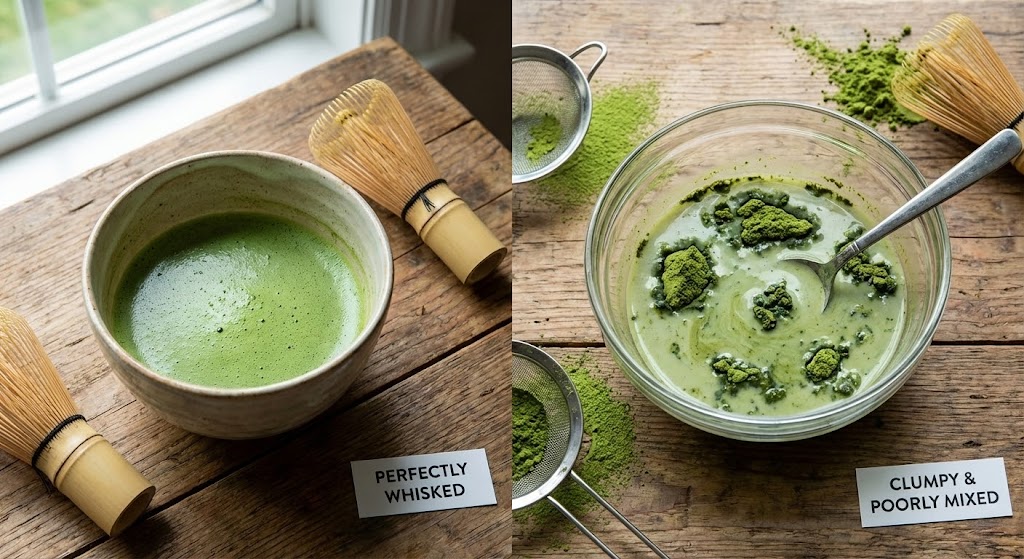
1. The Physics of Clumping: Why Good Matcha Misbehaves
To fix the problem, we must understand the material. Matcha is not instant coffee. Instant coffee is a freeze-dried crystal that is chemically designed to dissolve in water. Matcha is a stone-ground leaf. It is a physical particle—a solid—suspended in liquid.
The particles of Ceremonial Grade Matcha are incredibly small, typically ranging from 5 to 10 microns in diameter. To put that in perspective, a human hair is about 75 microns thick. When particles are this small, two forces take over:
Electrostatic Forces (Static Electricity)
During the stone-grinding process, friction generates a static charge. Even after packaging, the friction of the powder rubbing against itself inside the tin generates static electricity. This charge causes the tiny particles to attract one another, forming tight clusters or "agglomerates." These are the clumps you see.
Hygroscopy (Moisture Absorption)
Tea leaves are hygroscopic—they love water. Even in a sealed tin, matcha will try to absorb ambient humidity from the air once opened. When moisture hits the powder, it acts like a glue, bonding the particles together into hard little rocks. These rocks are hydrophobic on the outside; when you pour water on them, the outer layer gets wet and forms a seal, protecting the dry powder inside. This is why you can bite into a clump and find dry dust.
Buying the Right Matcha
Clumping is actually a sign of quality. Lower grade "Culinary" matcha has larger, coarser particles (15+ microns) that don't clump as easily but taste gritty. If your matcha clumps, it's likely ground fine enough to be ceremonial.
Review: Best Ceremonial Matcha Brands2. The Solution vs. Suspension Myth
A critical mental shift for beginners is realizing that matcha never dissolves. Sugar dissolves. Salt dissolves. Matcha creates a Suspension.
In a suspension, solid particles float in the liquid. If left alone, gravity will eventually pull them down (sedimentation). Your goal as the brewer is to create a mixture so uniform and aerated that the particles stay suspended for as long as possible. If you start with clumps, you are starting with heavy rocks that will sink immediately. You cannot "stir" a clump away once it is in a full bowl of water; the water simply flows around it.
3. The Non-Negotiable Step: Sifting (Furui)
There is one tool that separates the amateur from the tea master: the Sieve (Furui). In the Japanese Tea Ceremony (Chanoyu), the host will often sift the matcha into the tea caddy (Natsume) before the guests even arrive. This is not for show; it is functional.
Why Sifting Works: Pushing the matcha through a fine mesh creates mechanical shear force. This force breaks the electrostatic bonds holding the clumps together. It resets the powder back to its individual 5-micron state. When water hits these individual particles, it can surround the entire surface area of the leaf instantly, creating a smooth foam.
The Tool: You do not need an expensive Japanese sieve. A simple, small stainless steel baking sieve or tea strainer works perfectly. Place it over your bowl (Chawan) and push the powder through with a spoon or ladle. See our Guide to Tea Wares for recommendations.
4. The Paste Method: Hydration Control
Even with sifting, dumping 80ml of water onto the powder can result in lumps. The hydrophobic nature of the fine powder means it resists getting wet. To overcome this, use the "Paste Method" (similar to making a roux in cooking).
- Step 1: Sift 2g (two scoops) of matcha into the bowl.
- Step 2: Add only a tiny splash of cool water (approx 10ml).
- Step 3: Use your whisk to gently knead the powder and water together. Do not whisk yet; just press and mix until you have a dark green, smooth paste with the consistency of melted chocolate.
- Step 4: Once the paste is perfectly smooth and clump-free, add the rest of your hot water (70ml).
This ensures that every single particle is hydrated before you try to suspend it in the bulk liquid. This is the secret to a lump-free Iced Matcha Latte.
5. The Whisking Technique: The "W" vs. The Circle
The tool you use matters. A spoon will never work. A fork will never work. You need something that introduces shear force and air.
The Bamboo Whisk (Chasen)
The traditional Chasen is an engineering marvel. It is carved from a single piece of bamboo, split into 80, 100, or 120 flexible tines. These tines are curved to create turbulence. Why about 100 tines is the sweet spot for everyday thin matcha, and what to look for in a whole set, is covered in our matcha whisk set review.
The Motion: Do not whisk in a circle (like stirring soup). This just pushes the liquid around the bowl. You must whisk in a rapid "W" or "M" shape (zigzag) using your wrist, not your arm. This motion forces the water back and forth through the tines, shearing the liquid and forcing air bubbles into the mixture. This aeration is what creates the "crema" or foam.
The Speed: It is a sprint, not a marathon. Whisk vigorously for 15-20 seconds until a foam develops, then slow down to break the large bubbles on the surface.
The Electric Frother (The Modern Hack)
If you don't have a Chasen, a handheld electric milk frother is an acceptable substitute for lattes. However, it can be too aggressive for traditional thin tea (Usucha), creating large soapy bubbles rather than micro-foam. If using a frother, submerge the head fully before turning it on to avoid a green dust cloud.
For recipes like Matcha Lemonade, a cocktail shaker is actually superior to a frother, as the ice acts as an agitator to break up clumps.
6. Temperature: The Gelatinization Trap
Water temperature plays a role in texture, not just taste. Matcha contains starch and fiber. If you use boiling water (100°C), you risk "gelatinizing" the starches on the surface of the powder clumps. This cooks the outside of the lump into a hard shell, making it impossible to break apart, no matter how hard you whisk.
The Sweet Spot: Always use water between 70°C and 80°C (158°F - 176°F). This is hot enough to extract the sweet amino acids (L-Theanine) and foam well, but cool enough to prevent scalding the leaf and cooking the clumps. Learn more about L-Theanine and temperature here.
The Freezer Clump
Many people store matcha in the fridge or freezer to preserve freshness. This is good practice, but it causes condensation. If you open a cold tin in a warm room, water droplets condense on the cold powder immediately. This moisture causes the worst kind of clumping—hard, oxidized lumps. Solution: Let your tin come to room temperature (sit on the counter for 30 mins) before you open it. Read our Tea storage Guide.
Troubleshooting: Why is it STILL Clumpy?
| Issue | Likely Cause | The Fix |
|---|---|---|
| Hard, dark green rocks | Moisture contamination | Your tin wasn't sealed or had condensation. Sift twice, but the tea may be spoiled. |
| Gritty mouthfeel | Low Quality (Culinary Grade) | The particle size is too large (coarse grind). Upgrade to Ceremonial. |
| Dry powder bombs | Skipped Sifting | Always sift. No exceptions. |
| Sludge at bottom | Drank too slowly | This is normal sedimentation. Swirl your bowl before the last sip to resuspend. |
Try Cooking With It
If you have a batch of matcha that is just too clumpy or gritty for drinking, don't throw it away. It is perfect for baking, where the flour and sugar will help break up the lumps during the mixing process.
Recipe: Matcha Cookies


Comments