The Marriage Period: Essential Oil Integration Chemistry
Fresh tea blends taste disjointed — the base tea flavor and added aromatics (bergamot oil in Earl Grey, jasmine scent in jasmine tea, spices in masala chai) register as separate components rather than unified flavor. Professional tea blenders solve this by implementing a "marriage period" — 10-14 days of aging during which essential oils penetrate leaf cellulose structure via capillary action, transforming surface-coating into deep integration. The result: flavored teas that taste naturally infused rather than artificially perfumed.
The physics underlying this transformation is capillary action — the same mechanism that draws water up a plant stem against gravity. Tea leaves contain microscopic tubular channels (xylem vessels, stomatal cavities, intercellular spaces) ranging 3-7 micrometers in diameter. When essential oils contact the leaf surface, surface tension creates a pressure gradient that pulls oil molecules into these channels. Migration speed depends on oil viscosity (thinner oils penetrate faster), leaf porosity (orthodox-grade leaves absorb better than compact CTC), and temperature (18-22°C optimal — too cold slows diffusion, too hot accelerates staling).
Flavor Evolution Timeline: Fresh vs Aged Blends
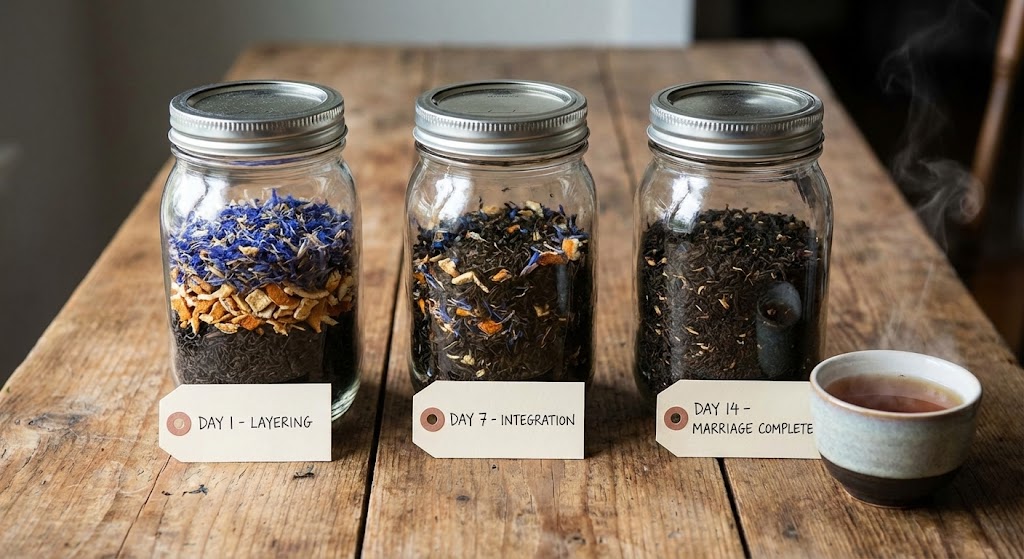
Day 1 (Fresh Blend): Essential oils coat the exterior leaf surface without penetration. Brewing releases oils immediately in the first 30 seconds, creating intense, one-dimensional aroma that fades quickly. The base tea flavor arrives later (90-120 seconds extraction time), resulting in temporal separation — you taste bergamot first, then black tea, rather than integrated Earl Grey flavor. Professional tasters describe this as "disjointed," "artificial," or "perfumy."
Day 7 (Partial Integration): Approximately 50% of essential oils have migrated into leaf channels (measured via gas chromatography oil content analysis before/after aging). The blend now releases oils gradually during brewing rather than all at once, creating more balanced flavor extraction. The base tea and aromatics start to overlap temporally, but the flavor still lacks depth. Tasters describe this as "mellowing" but not yet "married."
Day 14 (Full Marriage): 90%+ of essential oils have penetrated cellular structure. Brewing now releases oils at the same rate as base tea compounds (polyphenols, amino acids), creating true flavor integration. The aromatics feel like intrinsic part of the tea rather than added perfume. This is the target state for commercial blends — professional blenders won't release Earl Grey or jasmine tea until this integration is achieved.
| Aging Day | Oil Penetration | Taste Character | Aroma Release |
|---|---|---|---|
| Day 1 | 0-10% | Disjointed, artificial, perfumy | Intense burst first 30 sec, then fades |
| Day 7 | 40-60% | Mellowing, less artificial | More gradual release, better balance |
| Day 14 | 90%+ | Integrated, natural, unified | Steady extraction matching base tea |
| Day 21+ | 95%+ | Peak integration (minimal further change) | Optimal balance achieved |
Earl Grey Case Study: Bergamot Oil Migration
Earl Grey provides the clearest demonstration of marriage period effects because bergamot oil is intensely aromatic and easily detected. A fresh Earl Grey blend (2-3% bergamot oil by weight on Keemun or Ceylon base) tastes harshly perfumed on day 1 — the citrus-floral bergamot dominates to the point of masking the base tea entirely. Professional Earl Grey blenders describe this as "undrinkable" despite being technically correct in oil dosage.
After 14 days aging in sealed containers at 20°C, the same blend transforms. The bergamot becomes a subtle background note that enhances rather than overwhelms the base tea. You taste black tea WITH bergamot character, not bergamot-flavored tea. This shift occurs because oil migration into leaf cellulose slows the release rate during brewing — instead of all oil extracting in 30 seconds (day 1), it extracts gradually over 3-5 minutes (day 14), matching the tannin and amino acid extraction curve of the base tea.
Quantitative analysis via gas chromatography confirms this: fresh Earl Grey loses 80-90% of bergamot oil in the first infusion (oils on surface extract instantly), while aged Earl Grey retains 40-50% for second/third infusions (oils trapped in cellulose extract slowly). This is why aged Earl Grey can be re-steeped successfully whilst fresh blends become flavorless after one brewing.
Jasmine Tea Scenting: Traditional vs Modern Aging
Traditional jasmine tea (Phoenix Eyes, Yin Hao) uses live flower scenting — fresh jasmine blossoms are layered with green tea, allowed to release fragrance overnight (8-12 hours), then flowers are removed. This process repeats 3-7 times over 2-3 weeks. The extended timeline isn't just for scent intensity — it's for marriage. Each scenting session deposits volatile compounds (benzyl acetate, linalool, indole) on leaf surface, then the resting period between sessions allows capillary migration into leaf structure.
Modern jasmine tea often uses spray-on jasmine absolute (concentrated oil extract) for speed and consistency. However, producers who spray and immediately package produce inferior tea — the jasmine tastes artificial because it hasn't married. Quality producers who use jasmine oil still implement a 10-14 day post-spray aging period to allow oil penetration, mimicking the integration that happens naturally during multi-night traditional scenting.
The chemistry is identical whether scent source is fresh flowers or oil — volatile organic compounds migrate from surface to interior via capillary action. Traditional method achieves this gradually over weeks, modern method achieves it via concentrated oil + deliberate aging. The end result is chemically indistinguishable if aging time is respected.
Dry-Ingredient Blends: Shorter Marriage Periods
Blends containing solid ingredients (masala chai with cinnamon/cardamom/ginger, herbal blends with fruit pieces) require shorter marriage periods (3-7 days) because the flavor compounds are less volatile and migrate slower. Cinnamaldehyde (cinnamon's flavor molecule) has lower vapor pressure than bergamot oil, so surface evaporation is minimal — most flavor stays trapped in the cinnamon bark until hot water extracts it during brewing.
However, even solid-ingredient blends benefit from aging because mechanical abrasion during mixing/storage creates flavor dust. When whole cinnamon sticks rub against tea leaves in a container, tiny particles of cinnamon (microscopic bark fragments) transfer to leaf surface and lodge in crevices. Over 3-7 days, these particles hydrate slightly from ambient moisture (tea's hygroscopic nature), causing flavor compounds to leach out and adhere to leaf surface. The result is gentle background spice flavor even before brewing.
Professional masala chai blenders exploit this by intentionally over-mixing blends — aggressive tumbling in rotating drums for 30-60 minutes creates maximum spice dust transfer. Then they age 7 days to allow dust particles to "glue" themselves to leaves via moisture absorption. This creates chai that tastes integrated rather than "tea with spices floating in it."
Professional Blender Aging Protocols
Large tea companies like Twinings, Harney & Sons, and Fortnum & Mason implement standardized aging protocols to ensure consistent quality. After blending (mixing base tea + essential oils/spices in industrial tumblers), batches are transferred to airtight containers (typically food-grade HDPE buckets or lined fiber drums) and stored in temperature-controlled warehouses at 18-22°C, 60-65% relative humidity.
Every 3-4 days, workers rotate/agitate containers to redistribute oils evenly (oils are less dense than tea leaves, so they tend to migrate to the top if left static). At day 7, quality control tasters cup a sample against the reference standard (the ideal target blend). If flavor integration is below target, aging continues to day 10-11 with another taste test. Most batches reach optimal integration by day 14.
Some premium blenders extend aging to 21-28 days for ultra-high-oil blends (strong Earl Grey with 4-5% bergamot, or intense jasmine with multiple scentings). The extended timeline doesn't improve integration beyond day 14 (oil migration is 95%+ complete), but it allows volatile top-notes to dissipate slightly, creating smoother flavor. This is analogous to whiskey aging — not all changes are chemical integration, some are controlled evaporation of harsh volatile compounds.
| Blend Type | Minimum Aging | Optimal Aging | Storage Conditions |
|---|---|---|---|
| Earl Grey (2-3% oil) | 10 days | 14 days | 20°C, airtight, dark |
| Jasmine (spray oil) | 10 days | 14 days | 18°C, airtight, dark |
| Masala Chai (whole spices) | 5 days | 7 days | 20°C, airtight |
| Russian Caravan (smoke + base) | 7 days | 10 days | 20°C, airtight, dark |
| Breakfast Blend (no oils) | 0 days | 1-2 days (settling) | Room temp, airtight |
Storage Conditions During Marriage Period
Airtight Containers Mandatory: Essential oils are volatile — they evaporate rapidly in open air. A fresh Earl Grey blend stored in an unsealed container loses 30-40% of bergamot oil to evaporation within 7 days (measured by weight loss). Use food-grade HDPE containers with rubber-seal lids, glass jars with clamp lids, or vacuum-sealed bags. Avoid cardboard boxes or cloth bags during aging — they leak volatiles.
Temperature Control 18-22°C: Capillary migration speed is temperature-dependent. Below 15°C, oil viscosity increases and migration slows (14-day aging may require 21 days in cold storage). Above 25°C, staling reactions accelerate — polyphenols oxidize faster, creating stale/cardboard off-flavors that compete with the aromatics you're trying to integrate. Professional blenders target 20°C ± 2°C for optimal marriage without staling.
Darkness Prevents Photo-Oxidation: Light (especially UV) catalyzes oxidation of both tea polyphenols and essential oils. Store aging blends in opaque containers or dark cupboards. Clear glass jars are acceptable if stored in a dark cabinet, but avoid windowsills or lighted display areas during the marriage period.
Gentle Agitation Every 3 Days: Oils are less dense than tea leaves (bergamot oil density 0.88 g/mL, tea leaf bulk density 0.3-0.4 g/mL), so oils migrate upward in static containers. Without agitation, top layers receive excess oil while bottom layers remain under-flavored. Roll/shake containers gently for 30 seconds every 3 days to redistribute. Professional blenders use rotating drum systems that agitate continuously at 2-3 RPM.
When Aging Is Unnecessary: Pure Tea Blends
Not all blends require marriage periods. Pure tea blends without added oils or aromatics (English Breakfast, Irish Breakfast, Afternoon Blend) can be consumed immediately after mixing because there are no volatile compounds requiring integration. The component teas (Assam + Kenya + Ceylon) have similar cellular structure and extraction rates, so they brew together harmoniously without aging.
However, even pure tea blends benefit from 1-2 days "settling" — the mechanical mixing process generates fine dust particles that make fresh blends slightly cloudy when brewed. Allowing 24-48 hours for dust to settle results in clearer liquor. This isn't chemical marriage, it's physical settling, but it improves visual quality.
Roasted tea blends (Hojicha, heavily roasted oolongs) also skip aging because roasting reduces leaf porosity. The high heat (180-200°C) collapses cellular structures, creating denser leaves with fewer capillary channels. If you blend roasted tea with essential oils, the oils remain on the surface indefinitely — they cannot penetrate. This is why most roasted teas are sold unflavored, and flavored versions (vanilla Hojicha, etc.) taste perpetually artificial regardless of aging time.
DIY Blend Aging: Home-Scale Protocol
Step 1: Blend Preparation
Mix your tea blend thoroughly (base tea + oils/spices) in a large bowl. For oil-based blends, add oils gradually while stirring continuously to ensure even distribution (don't dump all oil in one spot, it won't spread properly). For spice blends, tumble mix in a sealed container for 5 minutes, shaking vigorously every 30 seconds.
Step 2: Container Selection
Transfer blend to an airtight container sized appropriately (container should be 80-90% full to minimize air space, but with enough headroom for agitation). Good options: glass clamp jars (Kilner-style), food-grade HDPE buckets with gamma lids (for large batches 500g+), or vacuum-seal bags (best for maximum freshness).
Step 3: Initial Aging (7 Days)
Store container in dark cupboard at room temperature (18-22°C ideal). Agitate gently every 2-3 days by rolling container or inverting 10-15 times. Avoid vigorous shaking which can break leaves.
Step 4: Mid-Point Taste Test (Day 7)
Brew a small sample (3g) at standard parameters (95°C, 3 minutes). Evaluate integration: Does it taste artificial/disjointed (oils on surface), or balanced/natural (oils integrated)? If still disjointed, continue aging to day 10-14.
Step 5: Final Aging & Verification (Day 14)
Taste-test again. Most oil-based blends reach optimal integration by day 14. If flavor is balanced and natural, the blend is ready for consumption or packaging. If still slightly artificial, extend aging to day 17-21.
Step 6: Long-Term Storage
Once marriage is complete, transfer to long-term storage containers (opaque tins, vacuum-sealed bags, or UV-blocking glass). Properly married blends stay integrated for 12-18 months if stored correctly (airtight, dark, cool). The flavor won't improve further beyond day 14-21, but it won't deteriorate either if volatile loss is prevented.
Troubleshooting Marriage Period Problems
Problem: Blend still tastes artificial after 14 days
Cause: Oil dosage too high (over 5% by weight), or leaf type incompatible (CTC leaves have low porosity and resist oil penetration).
Fix: Reduce oil dosage to 2-3% for next batch. If using CTC base tea, switch to orthodox-grade (full-leaf) which has better oil absorption. Alternatively, extend aging to 21-28 days for very high-oil blends.
Problem: Flavor fading during aging
Cause: Container isn't airtight, allowing volatile oils to evaporate.
Fix: Transfer to better container (glass clamp jar, vacuum-seal bag). Weigh container before/after 7 days — if weight drops by more than 0.5%, you have a leak. Re-seal or replace container.
Problem: Uneven flavor (some scoops taste strong, others weak)
Cause: Insufficient agitation during aging, causing oil stratification (oils floating to top).
Fix: Mix entire batch thoroughly with a spoon, then continue aging with daily agitation for 3-4 more days. For large batches (1kg+), use a rotating container or tumble in a sealed bag to ensure even distribution.
Problem: Stale/cardboard off-flavors developing during aging
Cause: Storage temperature too high (above 25°C) or exposure to light, causing photo-oxidation.
Fix: Move container to cooler, darker location (18-22°C ideal). If staleness has already developed, it cannot be reversed — reduce aging time to 7-10 days for future batches to prevent recurrence.
Problem: Oils separating out and pooling at bottom of container
Cause: Oil was added as a concentrated glob rather than sprayed/distributed during mixing.
Fix: Re-mix the entire batch thoroughly. For best results, dilute oils in a carrier (food-grade alcohol like vodka, 1:3 oil:alcohol ratio), then spray this diluted mixture onto tea leaves while tumbling. The alcohol evaporates within 24-48 hours, leaving evenly distributed oil.
Advanced Technique: Accelerated Aging via Heat-Cycling
Some professional blenders use controlled heat-cycling to accelerate marriage from 14 days to 5-7 days. The technique involves daily temperature oscillation: 8 hours at 25°C (speeds oil migration), then 16 hours at 15°C (slows staling reactions). The higher temperature increases molecular motion and capillary flow, whilst the cooling period prevents accumulation of staleness that constant 25°C would cause.
This is advanced and risky — if temperature control isn't precise (±1°C), you risk ruining the entire batch via over-staling. Only recommended for professionals with calibrated incubators or temperature-controlled rooms. Home blenders should stick to standard 14-day aging at constant 18-22°C, which is foolproof if basic storage guidelines are followed.
Conclusion: Patience Creates Quality
The marriage period transforms acceptable blends into exceptional ones, but only if you resist the temptation to package/drink immediately after mixing. The 10-14 day aging requirement feels wasteful in our instant-gratification culture, but it's non-negotiable physics — capillary migration takes time, and no amount of stirring or heating (within safe limits) can replace patience.
Professional tea companies build this aging into production schedules automatically. Small-batch blenders and home enthusiasts must discipline themselves to seal containers, mark calendars, and wait. The reward is tea that tastes naturally flavored rather than artificially perfumed — a quality difference detectable by casual drinkers and connoisseurs alike.
Further exploration: Learn about Earl Grey bergamot fixation chemistry, professional blending pyramid ratios, traditional jasmine scenting protocols, and smoke-flavor integration in Lapsang.
Comments