Pine Smoke Chemistry: What Makes Lapsang Smell Like Lapsang
Lapsang Souchong's distinctive smoky aroma comes from phenolic compounds in pine wood smoke. When pine burns at low temperatures (smoldering, not flaming), it releases volatile organic compounds that condense on tea leaves.
Key smoke compounds in Lapsang Souchong:
- Guaiacol (2-methoxyphenol): Primary smoky-medicinal aroma. Boiling point 205°C. Found in pine resin smoke, also present in Scotch whisky, smoked meats. Distinctive "tar" smell.
- Syringol (2,6-dimethoxyphenol): Sweet-spicy smoke note. Adds complexity beyond straight "campfire" smell. More pronounced in pine vs. other woods.
- Vanillin: Sweet vanilla-woody undertone. Present in pine lignin breakdown during smoldering. Softens harsh smoke character.
- Eugenol: Clove-like spicy note. Minor compound but contributes to overall warmth.
- Cresols (methylphenols): Medicinal-phenolic notes. In excess = bitter, acrid. Controlled smoking prevents over-accumulation.
Why pine specifically? Pine wood contains high resin content (15-30% vs. 1-5% in hardwoods). Resin = terpenes + phenolic compounds. When heated, resin volatilizes, creating dense aromatic smoke rich in guaiacol and syringol. Other woods (oak, hickory, applewood) produce different phenolic profiles—less resinous, more neutral smoke.
Related chemistry: Tea roasting also produces phenolic compounds via Maillard reactions, but from tea itself, not external smoke. Authentic Lapsang Souchong from Wuyi Mountains uses Masson pine (Pinus massoniana) specifically for optimal resin content.
Expert Tip: Avoid Toxic Woods
NEVER use treated lumber, plywood, MDF, or painted wood for smoking tea. These contain formaldehyde, arsenic (in pressure-treated wood), and toxic glues. Also avoid cedar (high aromatic oils that taste soapy) and yew/oleander (poisonous). Safe woods: pine, fir, spruce (all resinous), or hardwoods like oak/maple (milder smoke). Fresh pine needles work well for home wok smoking—freely available, no purchase needed, correct chemistry.
Cold Smoking vs. Hot Smoking: Temperature Matters
Professional Lapsang Souchong uses hot smoking (150-200°C) over 8-12 hours in bamboo racks above pine wood fires. Home wok smoking uses cold smoking (50-70°C) for 15-30 minutes.
| Method | Temperature | Duration | Smoke Penetration | Result |
|---|---|---|---|---|
| Traditional Hot Smoke | 150-200°C | 8-12 hours | Deep (smoke compounds penetrate 2-3 cell layers into leaf) | Intense, complex, permanent smoke character. £30-60/100g. |
| Wok Cold Smoke | 50-70°C | 15-30 minutes | Surface only (smoke condenses on leaf exterior, minimal penetration) | Light-medium smoke, fades 30-50% over 3-6 months. £2-4 DIY cost. |
| Hybrid Method | Start 50-70°C, finish 100-120°C | 1-2 hours | Moderate (surface + some penetration) | Better longevity than cold smoke, achievable at home with stovetop smoker. |
Why cold smoking is safer for beginners:
- No risk of burning tea (hot smoke at 200°C can scorch leaves, creating acrid bitterness)
- Easier temperature control (smoldering rice/sugar mix self-regulates at 50-70°C)
- Shorter time = lower risk of over-smoking (easier to stop at optimal smoke level)
- Standard kitchen equipment (wok + foil + sieve, no special smoker needed)
Trade-off: Cold-smoked tea has weaker, less permanent smoke flavor. After 3-6 months storage, smoke intensity drops 30-50% as surface phenols volatilize. Hot-smoked traditional Lapsang retains 80-90% intensity for 12-18 months because compounds penetrate deeper.
The Rice, Sugar, Pine Fuel Formula
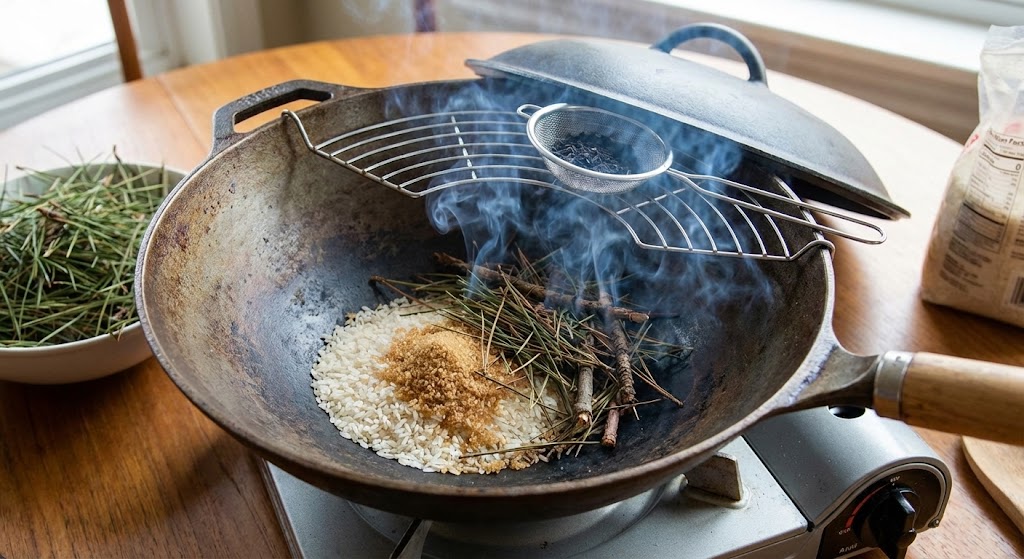
Traditional Chinese wok smoking uses 3-component fuel: white rice (heat source), brown sugar (sweet smoke), pine needles/chips (resinous smoke). Ratio: 2:1:1 by volume.
Example 200g batch:
- 100g white rice (long-grain or jasmine rice, any variety)
- 50g brown sugar (or dark muscovado for deeper smoke)
- 50g pine needles OR 50g pine wood chips (fresh or dried, both work)
Why each component matters:
1. White Rice (50% of fuel mix):
- Purpose: Slow, steady heat source. Rice starches smolder at 50-80°C when heated from below, creating consistent low temperature.
- Chemistry: Rice doesn't contribute flavor—it just burns slowly without flaming. Alternative: sawdust, tea leaves, or fine wood shavings (but rice is cheapest and most consistent).
- Why not skip it? Without rice, sugar burns too fast (caramelizes in 5-10 min, then stops smoking). Pine alone smolders unevenly.
2. Brown Sugar (25% of fuel mix):
- Purpose: Sweet smoke that balances pine's harsh resinous notes. Creates caramel-like aroma.
- Chemistry: Sugar caramelizes at 160-180°C, but in rice mixture stays 120-140°C (sub-caramelization). Produces furans, maltol, and cyclotene (sweet, caramel-like volatiles).
- White vs. brown sugar? Brown sugar contains molasses (adds depth), white sugar is sweeter/cleaner. Either works; brown preferred for fuller flavor.
3. Pine Needles or Wood Chips (25% of fuel mix):
- Purpose: Resinous phenolic smoke (guaiacol, syringol). This is the "Lapsang" component.
- Fresh vs. dried? Both work. Fresh needles produce more moisture (wetter smoke, longer smoldering). Dried needles burn hotter, more intense smoke.
- Alternatives: Fir needles, spruce needles (similar resin content). Avoid cedar (too aromatic, soapy), eucalyptus (medicinal, overpowering).
Expert Tip: Adjusting Smoke Intensity
For lighter smoke (like Russian Caravan—Lapsang + Keemun blend): Use 3:1:0.5 ratio (100g rice, 50g sugar, 25g pine), smoke 15-20 min. For medium smoke (classic Lapsang): Use standard 2:1:1 ratio, smoke 25-30 min. For heavy smoke (Zhengshan Xiaozhong style): Use 1:1:1 ratio (more pine), smoke 35-40 min. Beyond 45 minutes, smoke becomes acrid and bitter—stop before tea tastes like ashtray.
Wok Smoking Method: Step-by-Step
Equipment needed: Wide wok or large pot (12-14 inch diameter minimum), aluminum foil, metal sieve or colander, tight-fitting lid, stovetop vent hood.
Step 1: Prepare Fuel Mixture
- Mix 100g white rice + 50g brown sugar + 50g pine needles in bowl
- Stir thoroughly to distribute evenly
Step 2: Line Wok
- Line wok interior with aluminum foil (prevents smoke staining wok, easier cleanup)
- Foil should cover bottom and sides up to 5-6cm height
- Spread fuel mixture evenly across foil-lined wok bottom (single layer, 1-2cm thick)
Step 3: Position Tea
- Place 50-100g black tea in metal sieve or colander
- Spread tea into single layer (overlapping leaves get uneven smoke)
- Position sieve 15-20cm above fuel mixture (use inverted small bowl or jar as stand if needed)
- Tea must not touch fuel—smoke exposure only, no direct heat contact
Step 4: Heat and Smoke
- Turn stovetop to medium-high heat (gas or electric both work)
- Heat wok uncovered for 2-3 minutes until fuel starts smoking
- When smoke appears (white-gray smoke rising steadily), immediately cover wok with tight lid
- Reduce heat to medium-low (maintain smoldering, prevent flaming)
- Smoke for 15-30 minutes depending on desired intensity
Step 5: Monitor
- Crack lid briefly every 10 minutes to check smoke production
- Smoke should be steady white-gray. If smoke turns dark/acrid, reduce heat immediately.
- If smoking stops completely, increase heat slightly
- Optimal: consistent thin smoke stream, not billowing clouds
Step 6: Cool and Rest
- After 15-30 min, turn off heat, remove lid, let smoke dissipate 2-3 min
- Remove tea sieve, spread tea on plate to cool completely (5-10 min)
- Transfer to airtight container, rest 24 hours before brewing (smoke flavor mellows and integrates)
Safety notes:
- Use vent hood on high—smoke is intense, will set off smoke alarms without ventilation
- Outdoor smoking (camping stove, grill) avoids indoor smoke issues entirely
- Let fuel mixture cool completely before disposal (still smoldering after heat off)
Base Tea Selection: What to Smoke
Not all teas accept smoke well. Best candidates: fully oxidized black teas with twisted leaves.
| Tea Type | Smoke Absorption | Result | Recommendation |
|---|---|---|---|
| Chinese Keemun or Dian Hong | Excellent (twisted leaves, high surface area, mild flavor) | Balanced smoke + tea flavor, traditional Lapsang style | ★★★★★ Ideal for authentic result |
| Assam or Ceylon CTC | Good (small particles absorb quickly) | Strong malt + smoke, robust "Russian Caravan" style | ★★★★☆ Good for bold smoke blends |
| Oolong (medium oxidation) | Moderate (semi-oxidized, some absorption) | Interesting fusion—floral oolong + pine smoke | ★★★☆☆ Experimental, not traditional |
| Green Tea | Poor (smooth surface, minimal absorption) | Weak smoke character, grassy tea overwhelms smoke | ★☆☆☆☆ Not recommended |
| White Tea | Very Poor (downy surface repels smoke) | Barely noticeable smoke, ruins delicate white tea flavor | ☆☆☆☆☆ Don't smoke white tea |
Why black tea works best: Full oxidation creates porous leaf structure. Polyphenols (catechins) convert to theaflavins/thearubigins during oxidation, changing leaf chemistry to accept phenolic smoke compounds. Green tea's catechins chemically resist phenol absorption—smoke doesn't "stick."
Budget option: Generic supermarket black tea (£2-4/100g) works fine for first attempts. No need to waste premium Keemun (£20-30/100g) while learning. Once technique mastered, upgrade to better base tea for noticeable flavor improvement.
Smoke Intensity Timeline: When to Stop
Smoke absorption follows logarithmic curve—most absorption in first 15 minutes, diminishing returns after 30 minutes.
- 10 minutes: Very light smoke, barely perceptible. Good for "hint of smoke" blends (mix 20% smoked tea + 80% regular).
- 15-20 minutes: Light-medium smoke. Recognizable Lapsang character but not overwhelming. Good for daily drinking, approachable for non-Lapsang drinkers.
- 25-30 minutes: Medium-strong smoke. Classic Lapsang Souchong intensity. Smoke prominent but doesn't overpower tea base.
- 35-40 minutes: Heavy smoke. Approaching traditional Zhengshan Xiaozhong intensity. For Lapsang enthusiasts only.
- 45+ minutes: Over-smoked. Acrid, bitter, tastes like licking a fireplace. Undrinkable for most people. Stop before this point.
How to test during smoking: At 15-20 min mark, remove 5-10g tea, let cool 2 min, smell dry leaves. If smoke aroma satisfactory, stop smoking. If too weak, continue 5-10 min more. Better to under-smoke (can always smoke longer next batch) than over-smoke (irreversible).
Expert Tip: The 24-Hour Rest
Freshly smoked tea smells overwhelmingly intense—harsh, one-dimensional pine. After 24-48 hours rest in sealed container, smoke mellows significantly. Harsh phenolic top notes evaporate, leaving balanced smoky-sweet character. Always rest smoked tea minimum 24 hours before brewing. Some blenders rest 3-7 days for optimal integration. If tea still tastes too smoky after rest, blend 50/50 with unsmoked tea to dilute.
Storage and Longevity
Wok-smoked tea has shorter shelf life than commercially hot-smoked Lapsang because smoke compounds are surface-only, not deeply penetrated.
Storage timeline (airtight tin, room temperature):
- Week 1-4: Peak smoke intensity. Flavor still mellowing and integrating.
- Month 2-3: Optimal balance. Smoke has settled, harsh notes faded, sweet notes prominent.
- Month 4-6: Gradual fade. Smoke intensity drops 30-50% from peak. Still enjoyable but weaker.
- Month 9-12: Faint smoke character remains. Mostly tastes like base black tea with ghost of smoke.
Extending shelf life:
- Vacuum seal immediately after 24-hour rest: Extends peak smoke to 6-9 months (removes oxygen that volatilizes phenols)
- Freeze in airtight bag: Stops phenol degradation entirely. Smoke character preserved 12-18 months. Thaw to room temp before opening to prevent condensation.
- Re-smoke after 6 months: Lightly smoke faded tea for 10-15 min to refresh smoke character (be careful—old tea more porous, absorbs faster)
Variations and Blending
Once basic wok smoking mastered, experiment with variations:
Russian Caravan Blend:
- 70% Keemun (unsmoked) + 20% lightly smoked Keemun (15 min) + 10% Lapsang Souchong (commercial or 30 min smoked)
- Result: Malty-sweet with subtle smoke background, less intense than pure Lapsang
- Traditional Russian tea, popular in 1800s trade routes
Smoky Oolong:
- Smoke medium-oxidation oolong (Baozhong, Tie Guan Yin) for 20-25 min
- Result: Floral oolong + pine smoke. Unusual but interesting fusion.
- Similar concept to charcoal-roasted Dong Ding oolong (roast vs. smoke, but both add carbon notes)
Vanilla-Smoke Black:
- Smoke black tea 25 min, then add 0.5-1% vanilla extract while warm (5ml per kg tea)
- Result: Sweet vanilla + pine smoke. Masks harsh smoke edges, more approachable.
- Similar to flavored Earl Grey techniques but with smoke base
Troubleshooting Common Problems
Problem: Tea tastes acrid/bitter, not pleasantly smoky
- Cause: Over-smoked (45+ min) OR fuel burned too hot (flaming instead of smoldering)
- Fix: Reduce smoking time to 20-25 min. Use lower heat to maintain gentle smolder, not flames. Blend over-smoked tea 30/70 with unsmoked to dilute bitterness.
Problem: Weak smoke flavor, barely noticeable
- Cause: Tea positioned too far from smoke (>25cm) OR fuel didn't produce enough smoke (damp ingredients, wrong ratio)
- Fix: Lower tea sieve to 15cm above fuel. Ensure pine needles are dry (damp needles produce steam, not smoke). Increase pine ratio to 1:1:1 (equal parts rice/sugar/pine).
Problem: Smoke smell fills house, sets off alarms
- Cause: Inadequate ventilation
- Fix: Use maximum vent hood power. Open windows. Better: smoke outdoors on camping stove or grill (eliminates indoor smoke entirely). Some people use electric hot plate in garage with door open.
Problem: Fuel catches fire instead of smoldering
- Cause: Heat too high OR insufficient rice (sugar/pine burn faster than rice)
- Fix: Reduce heat immediately if flames appear. Blow out flames if needed (smoking requires smolder, not combustion). Double-check 2:1:1 ratio—more rice = slower burn.
Comparison: DIY vs. Commercial Lapsang
Cost and quality comparison:
Wok-Smoked DIY (per 100g batch):
- Base tea: £1-2 (generic black tea)
- Rice/sugar/pine fuel: £0.50-1
- Labor: 45 min active time
- Total cost: £2-3 per 100g
- Smoke character: Light-medium, fades 30-50% in 6 months, surface-absorbed phenols
Budget Commercial Lapsang (£8-12/100g):
- Often artificially flavored (liquid smoke spray, not real pine smoking)
- Tastes one-dimensional, chemical-smoky
- Inconsistent quality, fades quickly
Premium Zhengshan Xiaozhong (£30-60/100g):
- Authentic Wuyi Mountains production, Masson pine wood smoke 8-12 hours hot-smoke
- Complex smoke (guaiacol + syringol + vanillin layers), retains 80-90% intensity for 12-18 months
- Deep smoke penetration, integrated into leaf structure
Verdict: DIY wok smoking produces better quality than budget commercial Lapsang at 1/3 the cost. Can't match premium Zhengshan intensity/complexity (that requires 8-12 hour hot smoking impossible at home), but excellent for experimenting and daily drinking.
Conclusion: Accessible Smoke, Authentic Technique
Wok smoking brings traditional Chinese tea processing into home kitchens. The 2:1:1 rice:sugar:pine fuel formula creates balanced smoke at safe cold-smoke temperatures (50-70°C). 15-30 minutes produces light-to-medium Lapsang character that rivals budget commercial blends.
Key success factors: Use fully oxidized black tea (best smoke absorption), maintain steady smolder (no flames), position tea 15-20cm above fuel, stop at 25-30 minutes (before acrid bitterness), rest 24 hours minimum before brewing. Outdoor smoking or powerful vent hood prevents indoor smoke issues.
For £2-3 per batch, wok smoking produces 100g of lightly smoked tea—perfect for Russian Caravan blends, introductory Lapsang, or experimental fusions. Won't match £50 premium Zhengshan Xiaozhong, but far superior to £8 artificial liquid-smoke commercial blends.
Related tea processing techniques: home tea roasting (charcoal/oven roasting for depth), authentic Lapsang Souchong production (traditional Wuyi methods), professional blending ratios (creating Russian Caravan and smoke blends), essential oil flavoring (Earl Grey and other flavored teas).
Comments