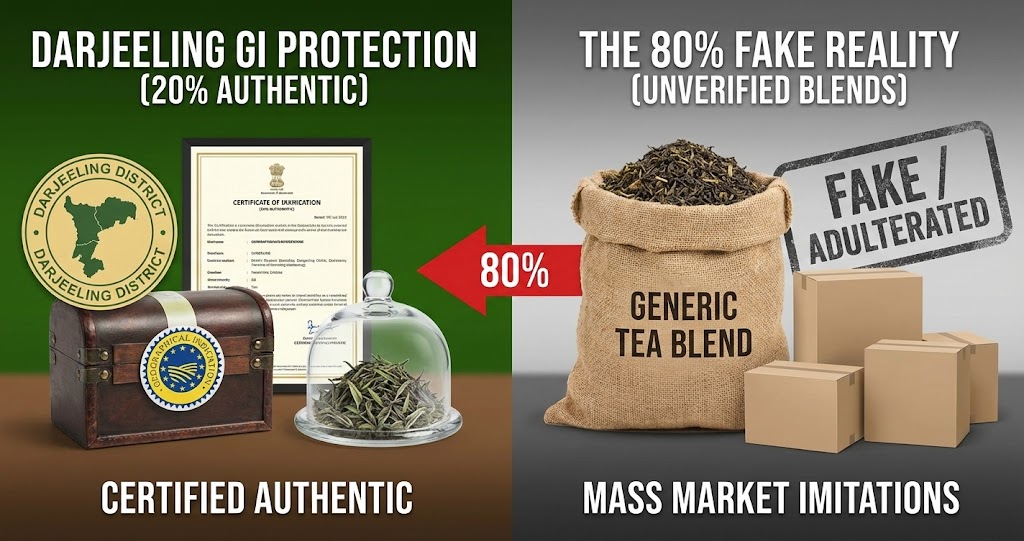
1. What is Geographic Indication Protection for Tea?
GI definition (legal framework): Protected Geographical Indication (PGI) = EU/international law designation (product name linked to specific region—quality/reputation/characteristics attributable to geographic origin, see terroir economics), similar to wine appellations (Champagne/Burgundy model—only wine from Champagne region can be labeled "Champagne", tea equivalents follow same principle). Why GI matters economically: Premium pricing power (Darjeeling GI commands $15-40/kg—vs. generic Indian black tea $2.50-3.50/kg, 5-12x price multiplier from origin authentication), brand protection (prevents dilution—if any tea can claim "Darjeeling" name loses value, GI maintains scarcity premium), producer income (87 Darjeeling estates—collectively benefit from protected branding, without GI would compete as commodity).
Tea GI registrations globally: Darjeeling (India) = First tea GI (2003 EU recognition—1999 India domestic, most famous protected tea origin globally), Ceylon (Sri Lanka) (2007 EU—covers entire island, protects "Ceylon Tea" branding vs. generic "Sri Lankan tea"), Kangra (India) (2005—Himalayan foothill region, lesser-known than Darjeeling but growing niche), Assam Orthodox (India) (proposed not yet fully enforced—CTC Assam remains unprotected commodity). Notable absence: China has no GI for tea in EU (longjing/Biluochun/Tieguanyin—protected domestically but not recognized internationally, limits premium enforcement Western markets), Japan (Uji matcha/gyokuro—no formal EU GI, relies on private branding not legal protection).
2. The Darjeeling Problem: 40,000 Tonnes Sold, 10,000 Produced
The math doesn't work: Actual Darjeeling production (87 registered estates—total annual output ~10,000-12,000 tonnes, limited by geography 19,000 hectares total plantable area can't expand), global "Darjeeling" sales (estimated 40,000-50,000 tonnes annually—4-5x actual production, see auction fraud). 80% fake statistic origin: Tea Board of India studies (2000s investigations—found 75-85% of "Darjeeling" sold globally was counterfeit, blend of Nepal/Assam/Nilgiri teas, relabeled for premium pricing). Economic loss: Estimated $50-80 million annually (legitimate Darjeeling estates—lose sales to counterfeit competition, buyers pay premium for fake tea undermines authentic market).
Where counterfeits come from: Nepal tea substitution (Ilam region—borders Darjeeling geographically identical terroir, similar flavor profile, costs $5-8/kg vs. Darjeeling $20-40/kg, blenders mix 10-20% Darjeeling with 80-90% Nepal claim 100% Darjeeling), Assam/Nilgiri blending (Indian tea from other regions—mixed with small Darjeeling percentage, "Darjeeling blend" sold as "Darjeeling" confusing labeling exploits consumer ignorance), complete fabrication (some tea has zero Darjeeling—pure Kenya CTC or Chinese black tea, packaged with Darjeeling label, relies on buyers never tasting authentic comparison). Distribution channels: Bulk wholesale (UK/German tea packers—source "Darjeeling" from brokers who supply counterfeit, supermarket own-label brands particularly vulnerable, see tea bag economics), online retail (Amazon/eBay listings—claim Darjeeling without certification, enforcement difficult cross-border).
| GI Protection Level | Annual Production (tonnes) | Estimated Global Sales (tonnes) | Counterfeit % Estimate | Price Premium Over Generic |
|---|---|---|---|---|
| Darjeeling (India GI) | 10,000-12,000 | 40,000-50,000 | 75-85% | 5-12x |
| Ceylon (Sri Lanka GI) | 300,000 | 350,000-400,000 | 15-25% | 1.5-2.5x |
| Assam (No GI enforcement) | 650,000 | ~650,000 | Minimal (commodity) | None (baseline) |
| Uji Matcha (No int'l GI) | 1,500-2,000 | 15,000-20,000 | 85-90% | 10-20x (when authentic) |
3. EU GI Recognition: Legal Framework and Enforcement
EU Regulation 1151/2012: PDO vs. PGI distinction (Protected Designation of Origin requires ALL stages in region—tea doesn't qualify because processing often separate from growing, Protected Geographical Indication allows some external processing—tea fits this category), Darjeeling 2011 EU registration (strengthened 2003 initial recognition—full legal protection equivalent to Champagne/Parmigiano, EU customs can seize counterfeit shipments). Requirements for authentic labeling: Tea Board of India certification (estates must be registered—annual inspection verifies production within designated region, logo usage licensed only to certified estates), logo display mandatory (Darjeeling logo with mountain + teapot symbol—must appear on packaging, absence = not authentic even if labeled Darjeeling).
Enforcement mechanisms (weak in practice): Border inspections (EU customs—can request certification documents for "Darjeeling" imports, but limited resources check <1% of tea shipments, most counterfeits pass through), market surveillance (member state authorities—test retail products for origin authenticity, DNA testing/chemical analysis expensive rarely used), litigation (Tea Board vs. violators—legal action slow and costly, settled out of court often violators continue with minor labeling changes). Penalty limitations: Fines typically low (€5,000-50,000—small fraction of counterfeit profits, insufficient deterrent for large-scale fraud), criminal prosecution rare (most cases civil trademark violations—no jail time, business continues under new entity).
How to Verify Authentic Darjeeling
Logo presence: Official Darjeeling logo (mountain + teapot symbol—registered trademark, counterfeiters sometimes copy but quality usually poor), estate name (authentic Darjeeling lists specific estate—like "Castleton" or "Makaibari", generic "Darjeeling tea" without estate suspicious), flush designation (first flush/second flush/autumn—authentic sellers specify harvest period, see flush economics), certificate number (some importers provide Tea Board certificate number—verifiable on Tea Board website, absence doesn't prove fake but presence confirms authentic). Price reality check: Retail <$15/100g = almost certainly counterfeit (authentic Darjeeling wholesale $15-40/kg, retail markup means <$20/100g impossible for genuine first flush, see pricing breakdown).
4. The Nepal Loophole: Geographic Ambiguity
Ilam District (Nepal) problem: Identical terroir (borders Darjeeling—same altitude 1,000-2,500m, rainfall patterns, soil composition, tea cultivars genetically similar), flavor profile overlap (cupping tests—experienced tasters struggle to distinguish Ilam from Darjeeling blind, chemical analysis shows similar polyphenol/catechin profiles, see quality standardization). Why Nepal tea is cheaper: No GI premium (labeled "Nepal Orthodox"—lacks branding cachet, sells $5-8/kg vs. Darjeeling $20-40/kg despite equal quality), lower labor costs (Nepalese wages ~30-40% below Indian equivalent—reduces production cost base), less regulation (Nepal government minimal oversight—estates bypass certification costs Indian Darjeeling bears).
Blending incentives: "Darjeeling-Nepal blend" (legal in some markets—10% Darjeeling + 90% Nepal, labeled "Darjeeling blend" confuses consumers, EU rules ban this but enforcement weak), complete substitution (some packers use 100% Nepal—label Darjeeling fraudulently, profit margin 200-400% selling $5/kg tea at $20-40/kg retail). Ethical sourcing dilemma: Nepal estates argue unfairness (identical quality—penalized by geography, GI protection harms Nepalese farmers who produce equivalent tea but can't access premium market, see trade fairness), Darjeeling estates counter (invested in branding for 150+ years—terroir reputation built through quality consistency, Nepal benefits from proximity without bearing branding costs).
5. Successful GI Cases: Ceylon Tea Branding
Ceylon GI strategy (broader scope): Island-wide protection (entire Sri Lanka—not single district like Darjeeling, includes Nuwara Eliya/Dimbula/Uva/Ruhuna regions), production volume supports GI (300,000 tonnes annually—sufficient supply makes counterfeiting less profitable, contrast Darjeeling scarcity creates fraud incentive). Ceylon Lion Logo: Ubiquitous branding (orange lion symbol—appears on 95% of Ceylon tea exports, consumer recognition strong after 50+ years marketing), enforcement easier (bulk commodity volumes—harder to substitute entire shipments undetected vs. small Darjeeling lots easily diluted).
Why Ceylon faces less counterfeiting: Lower price premium (Ceylon $3.50-6.00/kg—vs. Darjeeling $20-40/kg, fraud margin smaller less attractive to counterfeiters), volume availability (buyers can source legitimate Ceylon easily—no supply shortage driving substitution), competition from India/Kenya (commodity black tea from other origins—openly competes with Ceylon on quality/price, reduces incentive for fraudulent labeling when legitimate alternatives exist). Counterfeiting still exists (estimated 15-25%—but mostly low-end "Ceylon blend" products, premium single-estate Ceylon less affected, see market segmentation).
6. Failed GI Enforcement: Lessons from China and Japan
Longjing (dragon well) case study: Domestic GI (China): (West Lake Longjing—protected since 2001, restricted to 168km² area Hangzhou), massive counterfeiting (estimated 1,000 tonnes authentic—10,000-15,000 tonnes sold as "Longjing" domestically, 90%+ fake rate worse than Darjeeling), why enforcement fails: Weak penalties (China IP law—fines minimal rarely exceed ¥50,000/$7,000, counterfeiters absorb as business cost), local government complicity (counties near West Lake—economies depend on "Longjing" sales, officials reluctant prosecute local businesses), consumer tolerance (Chinese buyers know most Longjing fake—accept "West Lake style" as close enough, cultural acceptance undermines GI value).
Uji matcha (Japan) problem: No international GI (Uji region Kyoto—famous for ceremonial matcha 800+ years, but no EU/WTO recognition), global matcha boom fuels fraud (90% of "matcha" worldwide—Chinese-grown tencha stone-ground, labeled "Japanese matcha" or implies Uji origin, see commodity substitution). Why Japan hasn't pursued GI: Domestic market priority (80% of Uji matcha consumed in Japan—export relatively small, GI costs not justified for limited international sales), quality tiers accepted (Japanese industry acknowledges culinary vs. ceremonial grades—doesn't fight Chinese matcha commodity market, focuses premium niche), private certification (individual estates use trademarks—like Ippodo/Marukyu Koyamaen, brand reputation replaces GI protection).
7. The Economic Impact of GI Protection
Benefits for authentic producers: Price premium capture (Darjeeling estates—earn 5-12x commodity prices when GI enforced, without protection would compete with Assam/Nepal at $3-5/kg), brand investment return (150+ years terroir development—generations of quality consistency, GI ensures this investment not appropriated by free riders), market differentiation (commodity black tea oversupplied—see surplus dynamics, GI creates scarcity niche insulated from global oversupply price collapse). Employment preservation: Darjeeling estates employ 50,000-70,000 workers (tea gardens + processing—families depend on premium wages authentic Darjeeling commands, counterfeit competition threatens livelihoods when prices fall).
Costs and limitations: Certification expenses (estates pay Tea Board fees—annual registration + inspection costs ₹50,000-200,000/$600-2,400 per estate, small producers struggle to afford), enforcement futility (80% counterfeiting persists—despite GI legal protection, resources to police global market insufficient, see auction fraud), consumer confusion (buyers don't understand GI—purchase counterfeit thinking authentic, genuine estates lose sales despite legal rights). Neighboring regions harmed: Nepal/Assam orthodox producers (grow equivalent quality tea—excluded from premium market by geography, GI benefits Darjeeling while penalizing neighbors, see trade equity).
Future of tea GI protection: Blockchain traceability (pilot projects—immutable supply chain records from estate to retailer, could reduce counterfeiting but requires industry-wide adoption expensive for small estates), DNA testing (chemical fingerprinting—laboratories can identify origin via polyphenol profiles, but testing costs $50-200 per sample prohibitive for routine enforcement), expanded GI coverage (Assam orthodox—pursuing GI recognition, Nepal considering Ilam GI to compete legitimately rather than counterfeit Darjeeling). Probable outcome: GI protection persists (valuable for premium tier—despite enforcement failures, symbolic value + niche market willing pay for certified authentic, commodity bulk tea remains unprotected fragmented see market bifurcation), counterfeiting continues (80% fake rate likely improves to 60-70%—but elimination unrealistic given global supply chain complexity + enforcement resource constraints).




Comments