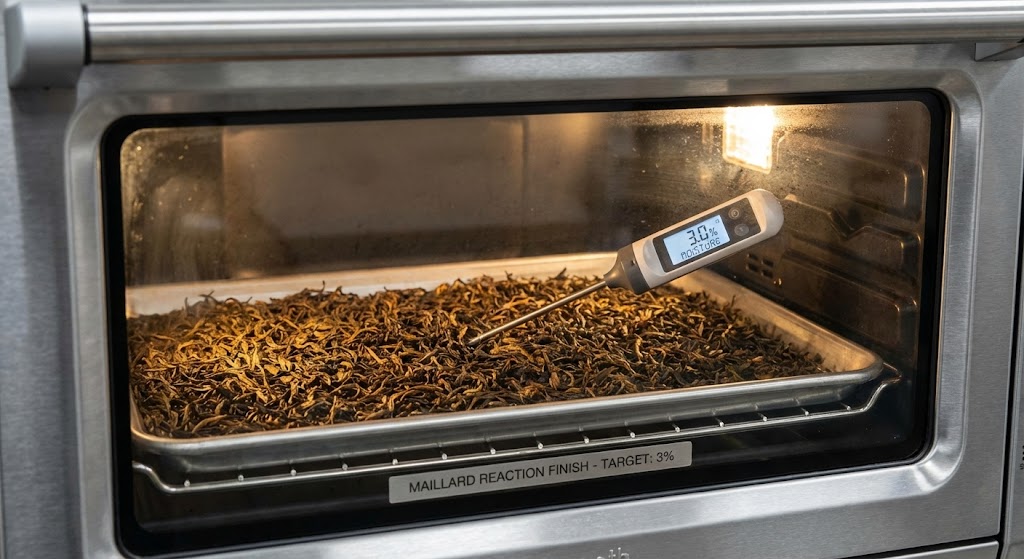
1. The 3% Moisture Target: Why This Number Matters
Moisture science in tea preservation: Fresh tea leaves = 75-80% water (living plant tissue—mostly water like all vegetation), post-rolling = 60-65% moisture (partial dehydration during withering + rolling compression), post-oxidation = still 55-60% moisture (enzymatic reactions don't remove water—just transform compounds). Target for storage = 3-5% moisture (industry standard—low enough to prevent microbial growth + oxidative degradation, high enough to avoid over-drying which makes leaves brittle/dusty). Why 3% specifically: Below 3% = leaves shatter (cell structure too dry—crumbles into dust reducing quality like fannings), above 5% = mold risk (fungal spores activate at 6%+ moisture—creates musty flavors, health hazards in storage).
Testing moisture without equipment: Snap test = Bend dried leaf between fingers (should crack cleanly not bend—brittle but not crumbly, similar texture to dried bay leaves), if bends without breaking = too moist (needs more drying—re-oven at low temp), if disintegrates to dust = over-dried (irreversible—use for blending filler or compost). Weight method = Weigh 100g fresh rolled leaves (after rolling, before drying), dry until weight stabilizes at 15-20g (indicates ~80-85% moisture loss—approaching target range), final weight should be 18-22g for proper 3-5% moisture. Visual cues: Properly dried leaves appear matte not shiny (surface moisture gone—no wet gleam), color deepened/darkened (concentrated compounds—pigment intensity increases), leaves maintain rolled shape (structural integrity—not brittle powder like over-drying creates).
2. Oven vs. Pan vs. Sun Drying: Method Comparison
Oven drying (most controlled): Advantages = Precise temperature control (set 80-90°C—maintains optimal drying without scorching), even heat distribution (convection ovens best—air circulation prevents hot spots like roasting chambers), large batch capacity (full baking sheet holds 200-400g—scales better than pan method), hands-off operation (set timer—reduces labor vs. constant pan stirring). Disadvantages = Energy cost (1-2 hours oven use—electric bill impact), potential over-drying (forgot timer = crispy tea—requires attention), lacks traditional "fire-dried" flavor nuance (some premium teas benefit from charcoal roasting smokiness).
Pan drying (traditional Chinese method): Advantages = Maillard development (direct heat contact—creates toasted notes missing from oven drying, similar to roasting chemistry but milder), artisan control (feel leaves, smell aroma changes—real-time quality adjustment like kill-green technique), traditional authenticity (wok-dried tea = premium character—connoisseurs taste difference). Disadvantages = Labor intensive (constant stirring 30-60 minutes—arm workout, tedious like hand rolling), uneven drying risk (leaves touching hot wok scorch—burnt spots ruin batch if not vigilant), small batches only (100-150g max in standard wok—multiple batches for larger harvests from pruned bushes).
Sun drying (outdoor/emergency method): Advantages = Zero energy cost (free solar drying—sustainable approach like bush tea traditions), natural Vitamin D preservation (UV doesn't destroy nutrients like high heat—retains some fresh leaf benefits), very large capacity (spread on tarps/screens—limited only by available space, good for big harvests). Disadvantages = Weather dependent (rain/clouds ruin schedule—unreliable timing), contamination risk (insects, dust, bird droppings—hygiene concerns without screening), slow process (2-4 days typical—moisture reabsorption overnight extends timeline), UV degradation (prolonged sun exposure breaks down delicate aromatics—reduces quality vs. gentle oven drying).
Optimal Oven Drying Protocol
Preheat oven to 90°C (stabilize temp before adding tea—prevents initial temp spike), spread leaves thin on parchment-lined baking sheet (1cm depth max—even drying like roasting layer), dry 60-90 minutes stirring every 15 min (redistributes moisture—prevents edge over-drying while center stays wet), reduce to 70°C final 30 min (gentle finish—prevents scorching during final moisture loss), cool completely before sealing (residual heat continues drying—warm tea sealed = condensation ruins batch).
3. The Two-Stage Drying Process: Initial + Finishing
Why single-stage drying fails: High temp throughout (90-100°C entire process) = Scorched exterior (surface dries too fast—forms crust trapping moisture inside), undercooked interior (center still 10-15% moisture—mold risk in storage despite dry appearance), burnt aromatics (high heat denatures delicate compounds—creates harsh flavors like over-smoked bitterness). Low temp throughout (60-70°C entire process) = Excessive time (3-4 hours needed—energy waste, occupies oven limiting other uses), incomplete enzyme deactivation (below 80°C some enzymes survive—continue degrading tea in storage causing staleness).
Stage 1: Initial rapid drying (90-100°C, 45-60 minutes): Purpose = Remove bulk moisture quickly (reduce from 60% to 15-20%—major water loss phase), denature remaining enzymes (high temp ensures complete enzyme inactivation—stops all degradation reactions), begin Maillard reactions (develops toasted notes—enhances complexity without over-roasting). Process: Spread 200-300g leaves on baking sheet (thin layer—maximum heat exposure), 90°C convection oven (fan circulates hot air—even drying), stir every 15 minutes (prevents hot-spot scorching—redistributes moisture to surface for evaporation), watch for color change (green → darker green/brown for green tea, brown → black for oxidized tea). Endpoint: Leaves feel dry to touch (no tacky moisture—crisp texture emerging), weight reduced ~70% (100g starting = ~30g now—bulk moisture removed).
Stage 2: Finishing low-temp drying (70-80°C, 30-45 minutes): Purpose = Remove final internal moisture (achieve target 3-5%—storage-safe level), prevent scorching (lower temp = gentler—preserves delicate aromatics that survived stage 1), uniform dryness (slow evaporation allows interior moisture to migrate out—no wet cores trapped by dried crusts). Process: After stage 1 complete, reduce oven to 75°C (significant temp drop—shift from rapid to gentle drying), continue 30-45 min (time varies by batch size—larger batches need longer), stir every 20 minutes (less frequent than stage 1—leaves more fragile now, handle gently to prevent breakage), perform snap test periodically (check readiness—done when leaves break cleanly). Endpoint: Final weight 18-22g per 100g starting material (82-78% moisture loss—optimal range), leaves snap when bent (brittle texture—indicates low moisture), no residual tackiness (completely dry surface—ready for sealing).
4. Temperature Precision: Using an Oven Thermometer
Why built-in oven dials lie: Calibration drift over time (ovens age—thermostats lose accuracy, 10-20°C variation common in 5+ year-old ovens), temperature cycling (ovens don't maintain constant temp—heat cycles on/off creating ±15°C swings around setpoint), hot zones (back of oven vs. front—can differ 20-30°C despite same dial setting, uneven element heating). Result of inaccuracy: Set 90°C but actually 110°C = scorched tea (burnt flavors—batch ruined like over-roasted leaves), set 90°C but actually 70°C = incomplete drying (mold risk—tea spoils in storage despite appearing dry).
Oven thermometer solution (£5-10 investment): Types available: Dial thermometers (mechanical—hang from oven rack, cheap £3-5 but slower response), digital probe thermometers (electronic—£8-12, instant readings but battery-powered), infrared guns (point-and-shoot—£15-25, measures surface temps accurately but can't leave in oven). Placement strategy: Position thermometer at tea leaf level (where baking sheet sits—this is actual drying temp not oven air temp), middle-center of oven (avoids edge hot zones—represents average temp leaves experience). Usage protocol: Preheat oven 15 minutes with thermometer inside (allows stabilization—accurate reading), check actual temp vs. dial setting (note difference—adjust dial to compensate), monitor during drying (temp can drift—recheck hourly especially in older ovens).
5. Stirring Frequency: Preventing Edge Scorching
Physics of moisture migration: Leaves at sheet edges (direct exposure to oven walls—receive radiant heat + convection heat, dry 20-30% faster than center leaves), leaves in center pile (partially insulated by neighbors—slower drying, retain moisture longer creating wet pockets). Without stirring: Edge leaves scorch (over-dried to <1% moisture—brittle dust), center leaves under-dried (6-8% moisture—mold risk), batch quality inconsistent (mix of burnt + underdone—unusable or requires sorting waste). With regular stirring: Edges redistributed to center (even out moisture—all leaves experience both positions), center moved to edges (moisture exposed to heat—complete drying), uniform final moisture (3-5% throughout—professional quality like auction-grade processing).
Optimal stirring schedule: Stage 1 (high temp): Every 15 minutes (critical during rapid drying—prevents scorching at peak heat), use heat-resistant spatula (silicone/wood—metal conducts heat burns hand), gentle lifting and turning motion (don't break leaves—delicate after heating, maintain whole-leaf integrity). Stage 2 (low temp): Every 20-25 minutes (less frequent—lower temp less aggressive, leaves more fragile now), minimal disturbance (light redistribution only—over-handling creates dust). Total stirs: 4-5 times during 90-120 minute process (not excessive—preserves leaf structure, sufficient for uniformity).
| Drying Method | Temperature | Time | Labor | Quality |
|---|---|---|---|---|
| Oven (Two-Stage) | 90°C → 75°C | 90-120 min | LOW (stir 5× total) | EXCELLENT (consistent, controlled) |
| Pan/Wok | 100-120°C | 30-60 min | HIGH (constant stirring) | PREMIUM (traditional, Maillard notes) |
| Sun Drying | Ambient + solar | 2-4 days | VERY LOW (passive) | VARIABLE (weather-dependent) |
| Food Dehydrator | 60-70°C | 4-6 hours | VERY LOW (set and forget) | GOOD (gentle, preserves aromatics) |
6. Cooling and Storage: Post-Drying Critical Steps
Why immediate sealing fails: Tea removed from oven at 70-90°C (internal leaf temp elevated—contains residual heat), sealed immediately while hot (trapped heat continues evaporating residual moisture—creates condensation inside container), condensation re-wets leaves (moisture droplets form on container sides—fall back onto tea, raises moisture from 3% to 6-8% within hours), result = mold growth within days (warm moist environment—perfect fungal conditions, batch spoiled despite proper drying).
Proper cooling protocol: Spread on cooling rack (wire rack allows air circulation all sides—faster cooling than leaving on baking sheet), room temperature 30-60 minutes (until leaves reach ambient temp—test by touching, should feel room-temp not warm), final quality check (snap test confirms dryness—re-dry if any bending detected, smell check for off-odors—musty = failure discard batch). Storage containers: Airtight tins ideal (metal blocks light—prevents UV degradation like photo-oxidation), glass jars acceptable if dark pantry (light exposure fades color/aromatics—opaque better than clear), avoid plastic bags (not airtight enough—moisture infiltrates over weeks).
Long-term storage conditions: Temperature = Cool 15-20°C (room temp acceptable—refrigeration unnecessary unless tropical climate >30°C), humidity = <50% relative humidity (dry environment prevents moisture reabsorption—silica gel packs optional insurance), light protection = Dark cupboard away from windows (UV degrades catechins—reduces antioxidant benefits, dulls flavor over months), oxygen exclusion = Fill containers completely (minimizes headspace—less oxidation potential, or vacuum-seal for long-term aging if desired). Shelf life properly stored: Green tea 6-12 months peak (fades gradually—still drinkable 18 months), black tea 12-24 months (more stable—oxidized tea less prone to further degradation), puerh exceptions improve with age (but requires different processing entirely).
7. Troubleshooting Common Drying Problems
Problem: Burnt/scorched leaves (brown-black spots): Causes = Oven too hot (actual temp >100°C—thermometer confirms), stirring too infrequent (edges left on hot spots—scorch before redistribution), leaves too thick (bottom layer trapped against sheet—direct heat contact burns). Prevention next batch: Lower temp to 85°C stage 1 (reduce heat—slower safer), stir every 10 min (more frequent—prevents any leaf overexposure), spread thinner (1cm max—ensures even heating). Salvage current batch: Pick out black pieces (tedious but salvages rest—burnt spots taste acrid, ruin whole brew like over-smoked tea), or blend with fresh tea (dilutes burnt flavor—emergency measure for drinkability).
Problem: Tea still feels damp after 2 hours: Causes = Oven temp too low (actual 60-70°C—insufficient evaporation rate), leaves too thick (2-3cm pile—center insulated stays wet), high humidity day (ambient moisture >70%—slows drying even in oven), leaves had excess moisture pre-drying (skipped withering—started at 70%+ moisture takes 3-4 hours). Solutions: Increase temp to 95°C (boost evaporation—but watch carefully for scorching), extend drying time (add another hour stage 2—patience required), spread thinner (divide into 2 batches—smaller volume dries faster), check oven door seal (gaps leak heat—reduces effective temp). Testing fix: Snap test every 20 min (done when cleanly breaks—persistence pays off, rushing creates inferior tea).
Problem: Tea turns dusty/powdery: Causes = Over-dried (<2% moisture—cell structure completely brittle), excessive handling while hot (fragile leaves crumble easily—rough stirring breaks them), poor quality starting leaves (old/damaged leaves—already weak before drying, harvest quality matters). Prevention: Don't exceed 90°C stage 1 (prevents excessive drying—monitor thermometer), gentle stirring technique (lift-and-turn not scraping—preserves integrity), use tender two leaves and a bud (young shoots more resilient—mature leaves brittle). Using dusty tea: Powder suitable for blending (mixed into other teas—adds body), tea bags (fine particles extract quickly—acceptable for convenience formats), or composting (return nutrients to soil for next tea plants).
Comments