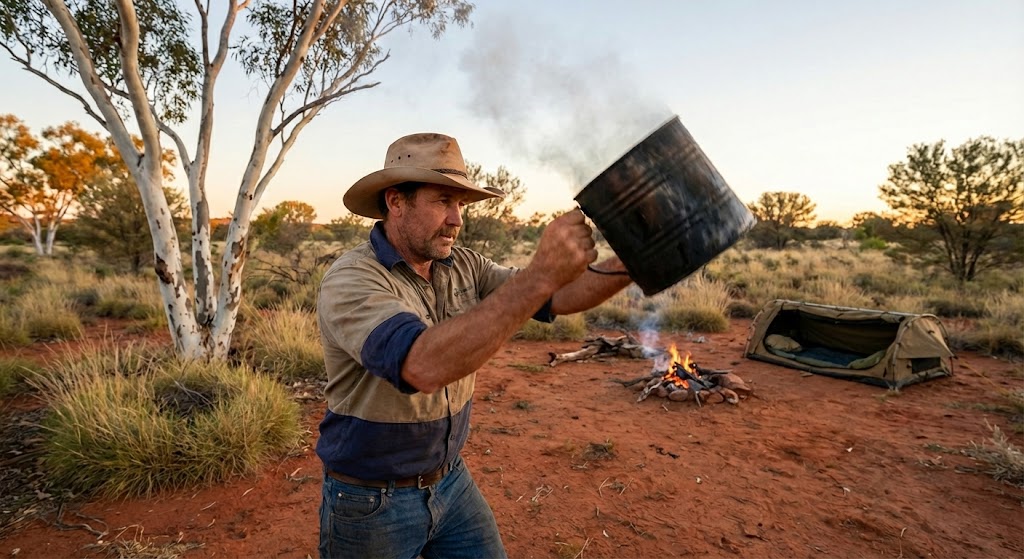
1. The Physics of the Swing: Why Centrifugal Force Settles Tea Leaves
The billy tea swing isn't bravado—it's applied physics. When you swing a liquid-filled container in a vertical circle, centrifugal force pushes contents outward from the center of rotation. For tea leaves suspended in water, this means they're forced to the bottom and sides of the can, leaving clarified tea in the center.
The force equation is elegant: F = mω²r, where m = mass, ω = angular velocity, and r = radius of swing. A typical billy swing (arm length ~0.7m, speed ~2 revolutions/second) generates approximately 11 m/s² of acceleration—slightly more than Earth's gravity. This is enough to overcome the buoyancy of most tea leaves and compact them against the container walls.
Compare this to Grandpa Style brewing where leaves float freely and require teeth-filtering, or Hong Kong's sackcloth filtration—the billy swing achieves mechanical separation without any strainer.
| Swing Parameter | Typical Value | Effect on Clarity |
|---|---|---|
| Arm Radius | 0.6-0.8 meters | Longer radius = higher force, better separation |
| Rotation Speed | 1.5-2.5 rev/sec | Too slow = spillage, too fast = structural stress |
| Swing Duration | 3-5 full rotations | Sufficient to compact leaves without over-cooling tea |
| Centrifugal Acceleration | 10-15 m/s² | Must exceed 1g (9.8 m/s²) to prevent spillage at top of arc |
2. The Critical Velocity Threshold: Don't Spill Boiling Tea on Your Head
There's a minimum speed below which physics punishes you with scalding. At the top of the swing arc, the billy experiences zero normal force—gravity is the only force acting on the liquid. If centrifugal acceleration is less than gravitational acceleration (9.8 m/s²), the tea spills.
The minimum velocity formula is: v = √(gr), where g = 9.8 m/s² and r = swing radius. For a 0.7m arm length, minimum velocity at the top of the arc is 2.6 m/s. This translates to approximately 1.4 revolutions per second—any slower and you're wearing your tea.
Expert Tip: Practice with Cold Water First
Outback veterans recommend practicing the swing with cold water before attempting it with freshly boiled tea. The consequence of insufficient velocity is immediate and painful. Start with a half-full billy to reduce mass, then graduate to full capacity once muscle memory develops. Most spills occur at the transition from upward to downward arc—maintain consistent speed throughout the rotation.
3. Gum Leaf Chemistry: The Eucalyptol Infusion
Traditional billy tea often includes 1-2 eucalyptus (gum tree) leaves added during boiling. This isn't merely flavor—it's functional chemistry borrowed from Aboriginal medicinal practices. Eucalyptus leaves contain eucalyptol (1,8-cineole), a volatile organic compound with expectorant and antimicrobial properties.
When boiled, eucalyptol volatilizes at 176°C, well above water's boiling point, but sufficient concentrations dissolve into the aqueous tea solution. The result is a camphoraceous, mentholated note that complements the malty base of strong Assam or Ceylon black tea commonly used in billy brewing.
| Eucalyptus Compound | Concentration in Leaf | Flavor/Effect Profile |
|---|---|---|
| Eucalyptol (1,8-cineole) | 70-90% of essential oil | Camphor, cooling menthol, respiratory expectorant |
| Alpha-pinene | 5-15% | Pine resin, anti-inflammatory |
| Limonene | 2-8% | Citrus brightness, antimicrobial |
| P-cymene | 1-5% | Woody, thyme-like aromatic |
The antimicrobial properties were particularly valuable for Swagmen (itinerant workers) drinking from potentially contaminated water sources. Similar to how Kashmiri salt tea adapted to high-altitude microbiology, billy tea's gum leaf addition served dual purpose: flavor and food safety.
4. The Swagman Culture: Tea as Social Currency
Billy tea is inseparable from the Swagman—Australia's equivalent to American hobos or British tramps. From the 1850s gold rush through the Great Depression, itinerant workers traveled vast distances on foot, carrying worldly possessions in a "swag" (bedroll) and brewing tea at every camp.
The famous folk song "Waltzing Matilda" (1895) immortalizes this culture: "Once a jolly swagman camped by a billabong, under the shade of a coolibah tree, and he sang as he watched and waited 'til his billy boiled..." The billy wasn't just a cooking vessel—it was the social anchor of transient communities.
Expert Tip: The "Boil Three Times" Rule
Swagman tradition held that billy tea must be boiled three separate times to achieve proper strength and flavor. First boil: initial extraction. Second boil: deepens color and tannins. Third boil: "sets" the tea, making it shelf-stable for hours. Modern taste preferences favor lighter extraction, but historical billy tea was brewed to survive harsh conditions—the equivalent of Mongolian suutei tsai as sustenance rather than refinement.
Unlike the ritualized formality of Japanese tea ceremonies or the class stratification of Victorian afternoon tea, billy tea was radically egalitarian. The billy was shared among all present—no hierarchy, no ceremony, just shared warmth and caffeine in the bush.
5. Billy Can Materials: Enamel vs. Tin vs. Aluminum
Material science matters when boiling tea over open flame. The traditional billy can was enamel-coated tin—tin for structural integrity, enamel (vitreous glass coating) to prevent metallic taste and resist tannin staining.
| Billy Material | Heat Conductivity | Pros & Cons |
|---|---|---|
| Enamel-coated Tin | Moderate (64 W/m·K) | Pros: No metallic taste, durable coating, resists rust. Cons: Enamel chips if dropped, heavy. |
| Bare Aluminum | High (237 W/m·K) | Pros: Lightweight, rapid boil, cheap. Cons: Metallic taste, reacts with tannins, oxidizes. |
| Stainless Steel | Low (16 W/m·K) | Pros: Inert, durable, modern preference. Cons: Slow to boil, expensive, not traditional. |
| Cast Iron (rare) | Low-moderate (52 W/m·K) | Pros: Heat retention, iron fortification. Cons: Very heavy, rusts, requires seasoning. |
Enamel billy cans are prized for the same reason Yixing teapots are valued—they develop patina without imparting off-flavors. The enamel coating is chemically similar to porcelain (both are vitrified ceramics), providing a neutral brewing surface similar to professional cupping equipment.
6. Modern Revival: Billy Tea in Contemporary Australia
Billy tea declined post-1950s as Australia urbanized and Swagman culture vanished. The ritual survived primarily in rural stations (ranches), camping culture, and historical reenactments. However, the 2000s saw a revival driven by "bush tucker" culinary nationalism and outdoor adventure tourism.
Modern billy tea practitioners often substitute gum leaves with native Australian botanicals: lemon myrtle (citral-rich), wattleseed (nutty, coffee-like), or Kakadu plum (vitamin C content 100x higher than oranges). This mirrors the global trend of regional tea hybridization seen in Somali cardamom chai and Malaysian teh tarik.
Expert Tip: The Tourist Swing vs. The Working Swing
Tour operators teach a showy, high-altitude swing for visual impact. Real station workers use a lower, faster rotation (waist-height, 2.5 rev/sec) that's less dramatic but more efficient—leaves settle in 2-3 rotations instead of 5-6. The tourist swing prioritizes spectacle; the working swing prioritizes speed and minimizes cooling. If brewing for function rather than Instagram, keep the swing tight and fast.
7. Comparative Tea Settling Methods Across Cultures
Billy tea's centrifugal settling is unique, but other cultures developed equally ingenious leaf-separation techniques without modern strainers. The Chaozhou gongfu "starving horse" pour uses high-velocity turbulence to separate leaves at the spout. Persian tea relies on samovar sedimentation over hours. Turkish çaydanlık keeps concentrate separate from dilution water entirely.
| Culture | Settling Method | Physics Principle |
|---|---|---|
| Australian Billy | Centrifugal swing | Rotational acceleration (F = mω²r) |
| Chinese Grandpa Style | Gravitational sinking + teeth filter | Density difference + manual straining |
| Moroccan Mint Tea | High pour aerates + leaf retention in pot | Laminar flow separation at spout |
| Indian Chai | Fabric/wire mesh strainer | Mechanical filtration (pore size exclusion) |
| Japanese Kyusu | Built-in ceramic filter screen | Fixed-mesh particle capture |
Each method reflects local materials and cultural priorities. Australian bushmen valued portability (no strainer to carry, no delicate teapot to break). Similar pragmatism drove Indian kulhar cups (disposable, no washing) and East Frisian rock sugar (caloric efficiency in cold climates).
8. How to Brew Authentic Billy Tea (Step-by-Step)
Modern recreation requires adapting historical technique to contemporary safety and taste standards. Here's the functional method:
Equipment Needed: Enamel billy can (1-1.5L capacity), campfire or portable burner, strong black tea (Assam or Ceylon), optional eucalyptus leaves, arm strength, courage.
Step 1 - Boil Water: Fill billy 2/3 full (leave space for swing dynamics). Boil over open flame until vigorous rolling boil—outback water sources may require extended boiling for pathogen elimination (see water quality chemistry).
Step 2 - Add Tea: Remove from heat. Add 1 tablespoon loose leaf per 250mL water (stronger than typical brewing ratios—billy tea compensates for outdoor dilution). Add 1-2 fresh eucalyptus leaves if desired.
Step 3 - Steep: Return to low heat for 2-3 minutes. Traditional method boils tea directly (similar to Tang Dynasty soup tea), but modern palates prefer gentler extraction to avoid excessive tannins.
Step 4 - The Swing: Remove from heat. Grip billy handle firmly. Extend arm fully. Swing in vertical circle at 1.5-2 rev/sec for 3-5 full rotations. Maintain consistent speed—deceleration at top of arc = spillage.
Step 5 - Pour & Serve: Pour slowly from spout (leaves compacted at bottom/sides will stay in billy). Serve black or with condensed milk (historically, fresh milk was unavailable in outback). Sugar to taste, though Swagmen often drank unsweetened to stretch rations.
9. The Cultural Symbolism: Tea as Australian Identity
Billy tea occupies unique cultural space—simultaneously historical artifact and living tradition. Unlike Senchado's scholarly elitism or tea clipper race imperialism, billy tea represents egalitarian resilience. It's working-class poetry: functional, unpretentious, shared.
The swing itself is performative masculinity—a display of strength and risk-taking absent from genteel British afternoon tea. Yet it's also communal: the billy passes hand to hand, everyone drinks from the same vessel. This mirrors Argentine mate circles where the gourd unites rather than divides.
Modern Australians invoke billy tea as cultural shorthand for authenticity and connection to land—even if they've never swung a billy themselves. It's national mythology crystallized in tin and tannins, physics and folklore.
Comments