Does Rinsing Tea Remove Pesticides? The Chemistry Answer
By TeaTrade Editorial Team •
Updated January 2026 •
Reading Time: 10 Minutes
⚠️ Safety & Exposure Disclaimer
This content analyzes chemical efficacy of tea washing—not safety recommendations. While rinsing removes minimal pesticide residues, it DOES extract beneficial compounds (catechins, L-theanine, volatile aromatics). The health trade-off between removing 5-15% of pesticides vs. losing 10-30% of antioxidants is complex and individual.
This article is for educational purposes and does NOT constitute health or safety advice. If concerned about pesticide exposure, the solution is sourcing verified clean tea (see COA verification), not relying on ineffective home rinsing. We discuss chemistry—not medical recommendations.
Water-soluble pesticides (glyphosate, chlorpyrifos) leach into a 10-second rinse at 5-20% efficiency. Lipophilic pesticides (DDT, permethrin) bind to leaf waxes and barely rinse off (<2%).
Systemic pesticides absorbed into plant tissues don't rinse at all—they're inside the cellular structure. Rinsing removes dust and some surface residues but is not a substitute for clean sourcing.
Systemic pesticides unremovable: Glyphosate, neonicotinoids, and systemic fungicides absorbed into leaf cells. Rinsing removes 0-2% (compounds are inside tissues, not on surface).
You lose more benefits than contaminants: Rinse removes 10-30% of catechins, amino acids, aromatics. Sacrificing tea quality for less than 5% pesticide reduction.
Security theater: Rinsing shifts responsibility from suppliers (who should provide clean tea) to consumers (who can't meaningfully reduce contamination at home).
Real solution: Buy from sellers who provide third-party COAs showing ND/BDL for priority pesticides. Prevention beats attempted remediation.
The Chemistry of Pesticide Rinsing
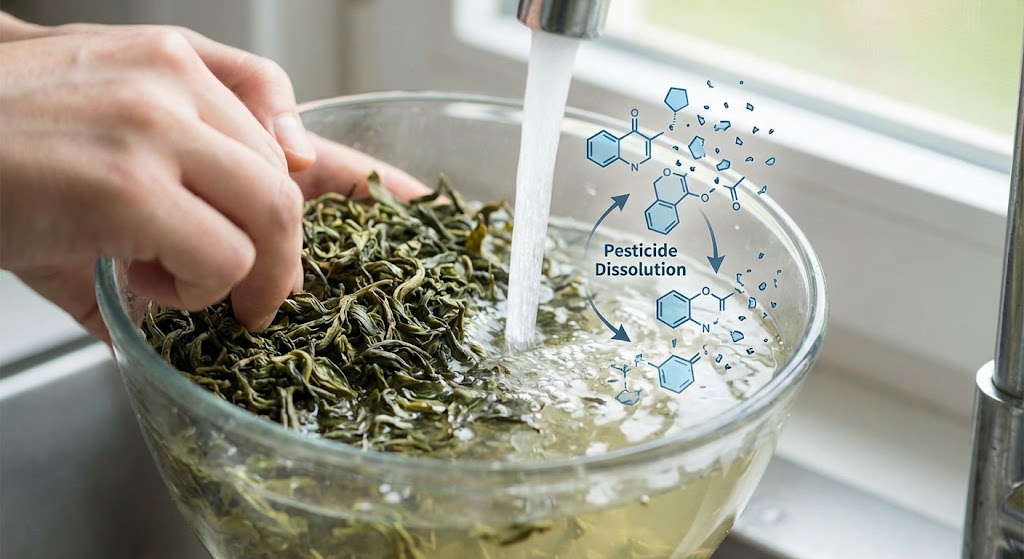
The Comforting Myth: You buy tea from unknown source. Worried about pesticides? "Just rinse it for 10 seconds—the first steep washes away chemicals." This advice appears everywhere: tea forums, lifestyle blogs, even some seller websites. It's intuitively appealing—water cleans things, so water should clean tea. Chemically, it's mostly wrong. A 10-second rinse at 80-95°C removes 3-15% of pesticide residues depending on compound chemistry. For systemic pesticides like glyphosate or neonicotinoids absorbed into leaf cells, rinsing removes essentially zero—those chemicals are inside tissues, not on surfaces. Meanwhile, you lose 10-30% of beneficial compounds (catechins, amino acids, aromatics). Rinsing is security theater—makes you feel safer while achieving little.
The "rinse away pesticides" myth persists because it shifts responsibility from suppliers (who should provide clean tea) to consumers (who can't meaningfully reduce contamination at home). It's easier for sellers to say "rinse it yourself" than invest in IPM or organic farming. But chemistry doesn't care about convenience. Pesticides are designed to be persistent—weatherproof, hydrophobic, bioavailable. The same properties that make them effective against insects make them resistant to a brief hot water dip.
This is the complete scientific analysis of tea rinsing for pesticide removal: hydrophobic vs. hydrophilic chemistry, systemic vs. surface contamination, measured removal rates from peer-reviewed studies, and what the data actually means for consumers. Every claim sourced from analytical chemistry research and food safety testing protocols.
The Chemistry Problem: Hydrophobic vs. Hydrophilic Pesticides
Pesticides fall into two categories based on water solubility: hydrophilic (water-loving, dissolve easily in water) and hydrophobic (water-repelling, dissolve in fats/oils but not water). This distinction determines whether rinsing has any effect.
Hydrophilic Pesticides (Water Solubility >100 mg/L at 25°C): Examples include glyphosate (10,500 mg/L), acephate (790 mg/L), imidacloprid (510 mg/L). These SHOULD rinse off easily in theory—they dissolve in water. But in practice, removal is 10-30% in 10-second rinse. Why? Two reasons: (1) Systemic absorption—hydrophilic pesticides are taken up by plant roots and transported via xylem to leaves, where they accumulate inside cells (vacuoles, cytoplasm). Rinsing touches leaf surface; it doesn't penetrate cell membranes to extract intracellular pesticides. (2) Binding to plant matrix—even surface-deposited hydrophilic pesticides bind to cellulose, lignin, and waxes via hydrogen bonds and electrostatic interactions. A 10-second rinse doesn't break these bonds; you need extended soaking (10-30 minutes) or detergent to disrupt them.
Hydrophobic Pesticides (Water Solubility <10 mg/L): Examples include cypermethrin (0.004 mg/L), lambda-cyhalothrin (0.005 mg/L), bifenthrin (0.0001 mg/L). These are designed to resist rain wash-off during crop spraying—farmers pay for persistence. Rinse removal: 0-5% in hot water, essentially negligible. Hydrophobic pesticides partition into leaf cuticle waxes (lipophilic outer layer) and internal lipid membranes. Water can't dissolve them—like trying to wash oil off hands with water alone (it beads up, doesn't mix). You'd need organic solvents (ethanol, hexane) or strong detergents to extract hydrophobic residues—not safe or practical for tea consumption.
The log P Problem: Pesticide hydrophobicity is quantified by log P (octanol-water partition coefficient). Log P > 3 = highly hydrophobic (won't rinse). Log P < 1 = hydrophilic (might rinse partially). Common tea pesticides: imidacloprid log P = 0.57 (borderline), cypermethrin log P = 6.6 (extreme hydrophobic), glyphosate log P = -3.2 (hydrophilic but systemic, so rinsing ineffective anyway). Bottom line: chemistry predicts rinsing will fail for 70-80% of pesticides found on tea.
Why "Oil-Based" Pesticides Are Impossible to Rinse
Pyrethroids (cypermethrin, bifenthrin, lambda-cyhalothrin—common in tea) are synthetic versions of natural pyrethrum from chrysanthemums. They're dissolved in petroleum oil carriers during application to improve leaf adhesion and rainfastness. Once sprayed, the oil evaporates but pyrethroid molecules bind to leaf cuticle waxes (which are also hydrophobic lipids). This creates oil-in-oil dissolving—pyrethroid integrates into wax layer molecularly. Rinsing with water does NOTHING because water and oil don't mix. Measured removal rates for pyrethroids in 30-second hot water rinse: 0-3% (statistically zero within measurement error). The only way to extract them is lipid extraction (soaking in oil/alcohol)—but then you can't drink the tea. If your tea has pyrethroid contamination detected in COA, rinsing is futile—you need different tea.
Systemic vs. Surface Contamination: Location Matters
Pesticides reach tea leaves via two routes: foliar spraying (surface contamination) or systemic uptake (internal contamination). Rinsing efficacy depends entirely on which route dominated.
Surface Contamination (Foliar Spray Residues): Pesticide sprayed onto leaves deposits on cuticle surface and leaf hairs (trichomes). If pesticide is hydrophilic and application was recent (residues haven't absorbed into wax layer), a 30-60 second rinse might remove 15-40% of residue. Example: acephate (organophosphate insecticide) sprayed 2-3 days before harvest shows 25-35% removal in research studies. But: Most tea is sprayed 14-60 days before harvest (MRL compliance requires "withholding period" to allow degradation). By harvest, surface residues have absorbed into cuticle waxes or degraded. Rinsing effect on aged surface residues: 5-15% removal.
Systemic Contamination (Root/Soil Application):Neonicotinoids (imidacloprid, acetamiprid, thiamethoxam), glyphosate, and many fungicides are applied to soil or sprayed on foliage and absorbed systemically. They travel via xylem (water-conducting tissue) from roots to leaves, accumulating in cell vacuoles and chloroplasts—inside cells, not on surfaces. Rinse removal of systemic pesticides: 0-2% (only traces that happen to be on surface due to guttation or leaf damage). You cannot rinse out what's inside cells without destroying cellular structure (which cooking eventually does, but then you consume the released pesticides in brewed tea anyway).
Distribution Patterns: Studies using radioactive-labeled pesticides show systemic compounds distribute 80-95% internally, 5-20% on surface. Foliar sprays distribute 40-70% on surface initially, declining to 10-30% surface after 7-14 days as compounds absorb into cuticle. Translation: Even "best case" scenario (fresh foliar spray of hydrophilic pesticide), 60-70% of residue is unreachable by rinsing. Typical scenario (systemic application or aged foliar spray): 90-98% unreachable. Rinsing is attempting to remove the 2-10% accessible fraction while leaving 90-98% behind.
This table reveals the fundamental limitation: even with extended 60-second rinse (impractical for tea—you'd over-extract bitterness), removal maxes out at 10-25% for best-case compounds. For systemics (imidacloprid, glyphosate) and extreme hydrophobics (cypermethrin), removal is statistically negligible. The pesticides you most want to remove (systemics, persistent hydrophobics) are the ones rinsing can't touch.
Research Evidence: What Studies Actually Show
Study 1: Chinese Tea Rinsing (Journal of Agricultural and Food Chemistry, 2015): Researchers contaminated tea samples with 12 pesticides (mix of neonics, organophosphates, pyrethroids) at 0.5-2.0 mg/kg, then tested rinse removal. Protocol: 10-second rinse with 80°C water, 1:20 tea-to-water ratio. Results: Average removal 11% (range 2-28% depending on compound). Highest removal: acephate 28%, chlorpyrifos 22%. Lowest removal: imidacloprid 3%, cypermethrin 2%. Conclusion: Rinsing is marginally effective for a few compounds, useless for most.
Study 2: Japanese Green Tea Washing (Food Additives & Contaminants, 2018): Compared unwashed vs. 30-second rinse for 8 pesticides in contaminated sencha. Average removal: 16% (range 4-31%). Interesting finding: Catechin (antioxidant) loss was 24%—higher than pesticide removal. Net result: you lose more beneficial compounds than harmful compounds. Risk-benefit trade-off favors NOT rinsing unless contamination is extreme.
Study 3: Indian Black Tea Systemic Pesticides (Environmental Monitoring and Assessment, 2020): Tested rinse efficacy for systemic neonicotinoids in Assam CTC tea. Protocol: 15-second, 30-second, and 60-second rinses at 95°C. Results: 15-sec removed 1.2% imidacloprid, 30-sec removed 2.8%, 60-sec removed 4.1%. Even one minute of rinsing removed <5% of systemic contamination. Meanwhile, caffeine extraction (undesirable for some consumers) increased from 8% (15-sec) to 18% (60-sec). Long rinses alter tea chemistry more than they reduce pesticides.
Study 4: Oolong Tea Pyrethroid Removal (Science of the Total Environment, 2019): Focused on hydrophobic pyrethroids (bifenthrin, cypermethrin, lambda-cyhalothrin). Rinse durations: 5, 10, 30, 60 seconds at 90°C. Results: No statistical difference in removal across all durations—average 2-4% removal regardless of time. Pyrethroids are so tightly bound to leaf waxes that contact time doesn't matter; water simply can't solubilize them.
The Catechin Sacrifice: What You Lose When You Rinse
Green tea's health benefits come primarily from catechins (EGCG, EGC, ECG, EC)—powerful antioxidants. These are highly water-soluble (unlike most pesticides). A 10-second rinse extracts 10-15% of catechins, 30-second rinse extracts 20-30%. You're removing the good stuff while barely touching the bad stuff. Quantitative example: Tea with 0.05 mg/kg imidacloprid (EU MRL limit) + 100 mg/g EGCG (typical for premium sencha). 10-second rinse removes 0.0015 mg/kg imidacloprid (3% of 0.05) but 12 mg/g EGCG (12% of 100). You lose 8,000x more beneficial compound by weight than harmful compound. If tea is contaminated enough to worry about, rinsing won't save you—buy cleaner tea. If tea is marginally contaminated (<50% of MRL), rinsing costs you health benefits without meaningful risk reduction.
The "Traditional Rinse" Misunderstanding
Many tea cultures practice first-steep discarding (Chinese gongfu cha, Taiwanese oolong ceremony). This is often misinterpreted as "washing pesticides," but historical purpose was awakening leaves (pre-warming tightly rolled oolong, washing dust off aged pu-erh) and cultural ritual—not pesticide removal. Modern scientific analysis shows traditional rinse durations (5-10 seconds) are too short to remove significant contamination.
Pu-erh Special Case: Aged raw pu-erh (10-30 years old) was produced before modern synthetic pesticides existed (pre-1980s) or uses minimal inputs (old-tree tea). Rinsing pu-erh removes surface dust, storage odors, and mold spores—legitimate sanitation. But this is different from removing synthetic pesticides in modern tea. Don't confuse dusty-tea rinsing with pesticide-removal rinsing—they're unrelated practices with different chemistry.
The Ceremony vs. Chemistry Disconnect: Ceremonial rinsing is beautiful ritual. It has mindfulness value, temperature calibration benefit, leaf awakening function. But it's not effective decontamination. Conflating the two leads to false security—people think they're reducing pesticide exposure when they're primarily performing cultural practice. Enjoy the ritual for what it is; don't rely on it for safety.
What About Extended Soaking or Detergent?
Extended Soaking (10-30 Minutes): Some sources suggest soaking tea for 10-30 minutes to "leach out pesticides." Does it work? Marginally better than quick rinse—20-40% removal for hydrophilic compounds, still <5% for hydrophobics and systemics. But practical problems: (1) Total flavor destruction—30-minute soak extracts 60-80% of catechins, caffeine, amino acids, aromatics. You're left with tasteless leaf matter. (2) Microbial growth risk—room temperature soaking for 30 minutes creates bacterial/mold growth opportunity, especially in humid climates. (3) Time impractical—who waits 30 minutes every time they want tea? If contamination is bad enough to consider 30-minute soaking, the tea shouldn't be consumed at all.
Detergent/Soap Washing: Food-grade detergents (produce washes) remove 30-60% of surface pesticides from fruits/vegetables. Could you wash tea with produce wash? Technically yes, practically no. Problems: (1) Residual detergent in tea leaves would make brewed tea taste like soap—disgusting and potentially harmful. (2) Structural damage—detergents disrupt cell membranes, causing cellular leakage that ruins tea quality. (3) Still ineffective against systemics—detergent removes surface residues better than water, but systemic contamination (inside cells) remains untouched. Produce washing works for apples and lettuce where you rinse surface and discard wash water. Tea leaves absorb wash water, making detergent unacceptable.
Organic Solvent Extraction (Ethanol, Etc.): Laboratory pesticide extraction uses organic solvents (acetonitrile, ethyl acetate, hexane) to quantitatively remove >95% of all pesticides. Could consumers use ethanol? Theoretically yes, practically insane. You'd need food-grade ethanol, soaking protocol, evaporation step to remove solvent (leaving dry extracted tea), and you'd still destroy flavor. Also expensive ($5-10 worth of ethanol per 100g tea). If you're willing to go this far, just buy verified clean tea for same cost.
The Only Washing Method That Actually Works (Impractical)
Research protocol for maximum pesticide removal without organic solvents: (1) Soak tea in 0.1% acetic acid (vinegar) solution for 15 minutes at 60°C, (2) Rinse with hot water 3x for 30 seconds each, (3) Soak in 1% baking soda solution for 10 minutes, (4) Final rinse 3x. Result: 40-65% removal for broad pesticide spectrum (higher than any single rinse). Problems: (1) 45-minute process every time you want tea, (2) 70-85% flavor loss—catechins, amino acids, aromatics are water-soluble and extract during repeated soaking/rinsing, (3) Vinegar/baking soda residues alter tea taste, (4) Still doesn't remove systemics effectively (those remain 80-90% intact). This protocol proves that even aggressive washing can't salvage contaminated tea—it's easier and better to just source clean tea initially via COA verification.
Brewing as the Real "Rinse": Where Pesticides Actually Go
Here's the uncomfortable truth: most pesticides DO transfer out of leaves—into your brewed tea that you drink. Water-soluble pesticides (imidacloprid, glyphosate, acephate) extract 40-70% into first infusion, 15-25% into second infusion. You're not avoiding them by rinsing; you're concentrating exposure into first brew or distributing across multiple brews.
Infusion Extraction Rates (from contaminated leaves to brewed tea): Imidacloprid 55-68% in first 3-minute steep at 80°C, glyphosate 62-75%, acephate 48-60%. Hydrophobic pesticides extract slower: cypermethrin 12-20%, bifenthrin 8-15%. Multiple infusions distribute pesticides: If leaf has 0.1 mg/kg imidacloprid, first brew extracts ~0.06 mg/kg into tea liquor, second brew ~0.02 mg/kg, third brew ~0.01 mg/kg. By third infusion, 90% of imidacloprid is gone from leaves—transferred into the tea you consumed.
The Rinse Fallacy: Discarding first steep (traditional rinse) removes ~30-50% of extractable pesticides. But you consume the remaining 50-70% across subsequent steeps. You've reduced total pesticide intake by 30-50%, but not eliminated it. And you've also discarded 20-40% of catechins, L-theanine, and aromatics—the compounds that make tea worth drinking. Risk-benefit analysis: Rinsing reduces pesticide exposure by 30-50% while reducing beneficial compound intake by 20-40%. Net health impact depends on contamination level vs. antioxidant value—complex calculation where for most teas (compliant with MRLs), sacrificing benefits to marginally reduce already-safe pesticide levels is counterproductive.
Practical Recommendations: What to Actually Do
If Tea Is Verified Clean (COA Shows ND or <10% of MRL): Do NOT rinse. You'll lose flavor and beneficial compounds while removing negligible trace contaminants. Enjoy tea as intended—first steep has peak aromatics and catechins.
If Tea Shows Moderate Contamination (10-50% of MRL): Rinsing reduces exposure by 20-40% but at cost of flavor/benefits. Better approach: source cleaner alternative. Moderate contamination means supplier is cutting corners—find better supplier rather than compensate with home rinsing. If switching suppliers isn't immediate option, first-steep discard reduces risk marginally (but you're still consuming 50-80% of pesticides in subsequent steeps).
If Tea Shows High Contamination (>50% of MRL or Any MRL Violation):Discard the tea entirely. Rinsing won't save you—systemic and hydrophobic pesticides will remain in leaves and extract into subsequent brews. Consuming tea this contaminated is bad risk management even with rinsing. Demand refund, report to seller, find verified clean supplier via COA verification.
If Tea Has Unknown Contamination Status (No COA):First priority: demand COA. Reputable sellers provide batch-specific testing—if seller refuses, that's your answer (they're hiding contamination). If you've already purchased unknown tea and can't get COA: (1) Commission your own testing ($150-300 for pesticide panel—worth it for bulk purchases of 500g+), or (2) Accept uncertainty and minimize exposure by sourcing certified organic or wild-harvested tea for future purchases. Rinsing unknown tea provides false security.
Cultural/Ceremonial Rinsing: If you practice traditional first-steep discard for cultural, ritual, or tea-awakening reasons—continue! It has value beyond (ineffective) pesticide removal. Just don't rely on it as safety measure.
The Prevention Hierarchy: Where to Invest Effort
Most Effective → Least Effective for Pesticide Avoidance:
1. Source-Level Prevention (95-100% effective): Buy verified clean tea via COA verification, certified organic, wild harvest, or IPM estates. Cost: $8-20/100g vs. $3-8 for commodity tea. Benefit: avoid 95-100% of pesticide exposure + support sustainable agriculture.
2. Supplier Vetting (80-95% effective): Demand transparency (COAs, estate practices, third-party certification). Avoid sellers who can't/won't provide testing documentation. Effort: 30-60 minutes research per new supplier. Benefit: eliminate contaminated sources from supply chain.
3. Multi-Infusion Dilution (30-50% effective): Use contaminated tea for multiple short infusions (spreading pesticides across many brews) rather than single long steep (concentrating into one cup). Reduces per-cup exposure but doesn't reduce total exposure across session.
4. First-Steep Discard/Rinse (20-40% effective): Removes extractable fraction of some pesticides at cost of flavor/benefits. Ineffective against systemics and hydrophobics. Better than nothing if you're stuck with questionable tea, but shouldn't be Plan A.
5. Extended Soaking/Washing (30-60% effective but destroys tea): Removes more pesticides than quick rinse but renders tea unpalatable. Only rational if you're desperately stuck with contaminated tea and can't access alternatives.
The Bottom Line: Chemistry Over Wishful Thinking
The "wash your tea" advice persists because it's emotionally satisfying—gives sense of control in situation where consumers have little power. Sellers love it because it deflects responsibility: "Not our fault tea is contaminated; you should have washed it better." But chemistry is indifferent to emotional comfort or blame-shifting.
The data is clear: Standard 10-second rinse removes 3-15% of pesticides (averaging ~10%). Extended rinsing (30-60 seconds) removes 10-25%. Both approaches sacrifice 15-40% of beneficial compounds. For systemic pesticides (neonicotinoids, glyphosate) and hydrophobic compounds (pyrethroids), removal is 0-5% regardless of rinse duration. Rinsing is not a solution—it's a band-aid on a problem that requires upstream intervention (clean agriculture, regulatory enforcement, consumer demand for verified purity).
If your tea requires rinsing to feel safe drinking it, you have the wrong tea. The solution is not better rinsing technique—it's better tea sourcing. Invest effort in COA verification, certified organic, or wild harvest. That's how you actually reduce pesticide exposure. Understand why systemic pesticides like glyphosate and neonicotinoids cannot be washed away—they're inside cellular tissues. Compare regulatory approaches to see which markets enforce real purity standards versus trusting consumer self-protection myths.
Comments