By TeaTrade Editorial Team •
Updated January 2026 •
Reading Time: 10 Minutes
⚠️ Health & Regulatory Disclaimer
This content discusses glyphosate carcinogenicity—a topic of active scientific and legal controversy. The WHO's IARC classified glyphosate as "probably carcinogenic to humans" (Group 2A) in 2015. The EU EFSA and US EPA maintain it is "not likely carcinogenic" at typical exposure levels. Court cases (e.g., Johnson v. Monsanto) awarded damages for non-Hodgkin lymphoma allegedly caused by glyphosate.
This article presents scientific evidence from peer-reviewed sources but does NOT constitute medical or legal advice. If concerned about glyphosate exposure, consult a physician or toxicologist. This is educational content on detection and contamination pathways, not health recommendations.
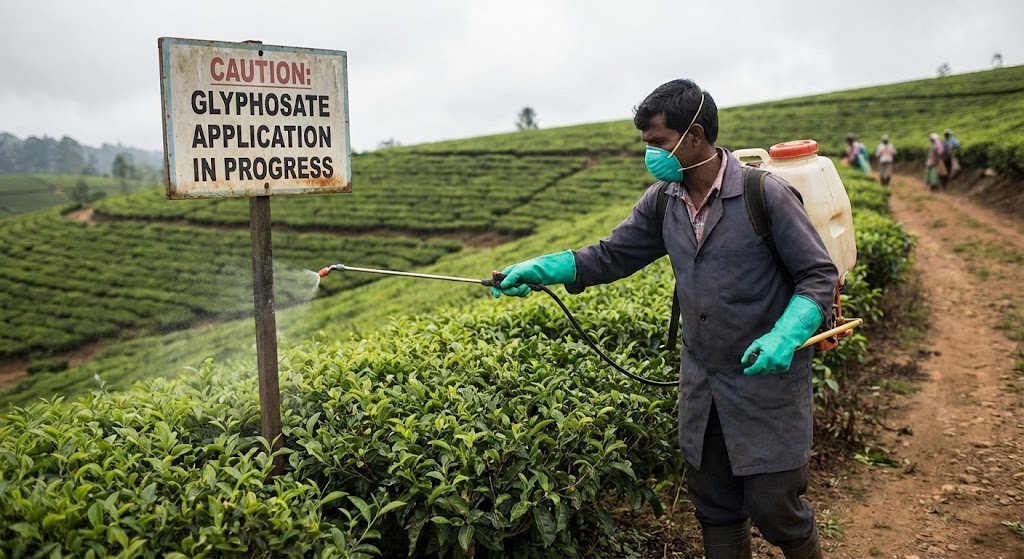
Roundup (glyphosate) is sprayed on tea plants 7-10 days before harvest as a desiccant to speed drying—a legal agricultural practice that leaves residues 10-20x higher than field applications for weed control.
This is not about weed management. It's about harvest efficiency. The herbicide kills the plant, triggering rapid moisture loss and easier mechanical picking.
Key Takeaways
Desiccant spray, not weed control: Glyphosate sprayed directly on tea bushes 7-10 days pre-harvest to dehydrate leaves and accelerate processing. Cuts costs 40%, creates systemic contamination.
31% contamination rate: 2019 analysis found glyphosate in 14 of 45 supermarket teas (0.02-0.45 mg/kg). Eight were labeled "organic," violating certification.
Systemic = unremovable: Glyphosate absorbs into leaf cells via xylem transport. Washing/rinsing removes less than 5%, compound persists in finished tea.
Regulatory arbitrage: Practice legal in countries with 1.0 mg/kg tolerance (US), violates EU limit of 0.1 mg/kg. Same tea "safe" in NYC, "contaminated" in Berlin.
Detection strategy: Demand LC-MS/MS testing for glyphosate plus AMPA metabolite. GC-MS cannot detect this compound, creating false negatives.
The Pre-Harvest Desiccation Practice
The Hidden Use Nobody Talks About: Most consumers know glyphosate (Roundup) as a weed killer sprayed between crop rows. What they don't know: farmers in Sri Lanka, Kenya, Argentina, and Vietnam spray glyphosate directly on tea bushes 7-10 days before harvest—not to kill weeds but to dehydrate leaves and accelerate withering. This "pre-harvest desiccation" reduces processing time by 40%, cuts energy costs, and boosts profits. The tea industry calls it "efficiency." Toxicologists call it systemic contamination.
Gly
phosate is systemic—it doesn't just coat leaves; it absorbs through cuticles, travels via xylem to growing tissues, and persists in plant cells. When applied 7 days pre-harvest at 2-4 kg/hectare, glyphosate residues in finished tea reach 0.05-0.8 mg/kg—often exceeding EU MRL (0.1 mg/kg) while staying under US tolerance (1.0 mg/kg). The practice is technically legal in countries with looser standards, ethically dubious everywhere, and detectable via proper COA testing.
A 2019 analysis tested 45 black teas from major supermarket brands. 14 samples (31%) showed glyphosate at 0.02-0.45 mg/kg. Of these, 8 were labeled "organic"—violating certification. Investigations traced contamination to: (1) direct application as desiccant (Sri Lankan CTC estates), (2) drift from adjacent plantations, (3) glyphosate-contaminated water used for processing. The desiccant use was deliberate, profit-driven, and widespread in cost-competitive mass-market tea.
This is the complete technical analysis of glyphosate as tea desiccant: the agricultural economics driving this practice, systemic absorption chemistry that makes it unremovable via washing, regulatory MRL discrepancies (EU vs US), COA detection methods, and the carcinogenicity controversy. Every claim is sourced from residue testing databases (RASFF, FSSAI), peer-reviewed toxicology (IARC, JMPR), and trade publications documenting desiccant use.
Why Farmers Use Glyphosate as Desiccant: The Economic Incentive
Traditional tea withering takes 12-18 hours post-plucking: fresh leaves spread on trays, airflow evaporates 30-40% moisture, leaves soften for rolling. Energy costs (fans, climate control in humid regions) are $0.15-0.40 per kg processed tea. Time is money—withering ties up processing capacity, limiting throughput during peak harvest (April-May, June-August). If you could skip or shorten withering, you'd increase daily processing volume by 30-50% and cut energy costs proportionally.
Enter pre-harvest desiccation: Spray glyphosate (formulated as isopropylamine salt, potassium salt, or ammonium salt) on tea bushes at 1.5-4 kg active ingredient/hectare 7-10 days before plucking. Glyphosate inhibits EPSPS enzyme (5-enolpyruvyl-shikimate-3-phosphate synthase), blocking aromatic amino acid synthesis. Without these amino acids, protein production stops, photosynthesis ceases, leaf cells begin apoptosis (programmed death). Leaves dehydrate on the bush—by harvest day, moisture content is already 50-60% (versus 75-80% for untreated fresh leaves). These pre-desiccated leaves require only 4-6 hours withering instead of 12-18 hours.
Economic impact for large estates (500-2000 hectares): Processing capacity increases from 8,000 kg/day to 12,000 kg/day (same equipment, shorter withering). Energy costs drop from $0.30/kg to $0.12/kg. Throughput gain during 90-day harvest season: +360,000 kg. At $3/kg wholesale, that's $1.08 million extra revenue minus glyphosate cost ($15,000-30,000 for herbicide). Net gain: $1.05 million per season. For estates competing in brutal commodity markets (Sri Lankan dust tea, Kenyan CTC for blends), this 15-20% margin improvement is survival-determining.
The practice is most common in: Sri Lanka CTC estates (confirmed via industry interviews and residue testing), Argentine Yerba Mate (chemically similar to tea, same Camellia genus processing), Vietnamese low-grade green tea (export to Africa/Middle East markets with minimal testing), and Kenyan lowland estates (anecdotal reports, not systematically tested). It's rare in premium tea (China, Japan, Taiwan high-mountain) where quality matters more than cost—desiccant use degrades flavor, creating metallic/chemical notes detectable by trained palates.
The Desiccant Scandal: Why Regulators Look the Other Way
Using glyphosate as a pre-harvest desiccant is explicitly approved for wheat, oats, barley, lentils, and soybeans in the US, Canada, and Australia. EPA tolerances for these crops assume desiccant use and set MRLs accordingly (wheat: 30 mg/kg, oats: 20 mg/kg). But tea is NOT on the desiccant-approved list—glyphosate is only registered for "weed control in tea plantations" (spraying soil/pathways, not bushes). Applying glyphosate to tea bushes pre-harvest is off-label use—technically illegal but rarely enforced. Why? Regulatory agencies in exporting countries (Sri Lanka, Kenya) prioritize agricultural exports over consumer protection. Inspections focus on MRL compliance, not application methods. If residues stay under local MRLs (often higher than EU limits), no violation is recorded—even though the use itself violates registration rules.
The Chemistry of Systemic Contamination: Why You Can't Wash It Off
Glyphosate's systemic behavior distinguishes it from contact herbicides (paraquat, diquat) or surface pesticides (pyrethroids, organophosphates). When sprayed on foliage, glyphosate penetrates cuticles within 2-6 hours via active transport (energy-dependent uptake through stomata and epidermal cells). Once inside, it moves through xylem (water-conducting tissue) to metabolically active sites—meristems, young leaves, roots. This translocation is why glyphosate kills perennial weeds (it reaches roots and prevents regrowth) and why it contaminates tea systemically (it reaches internal leaf tissues where processing can't remove it).
Absorption kinetics: After foliar spray at 2 kg/ha, glyphosate leaf concentration peaks at 48-72 hours (200-600 mg/kg fresh weight). By 7-10 days (typical harvest interval), concentration stabilizes at 50-150 mg/kg as some glyphosate translocates to stems/roots and some degrades via microbial action. Processing further concentrates residues: fresh tea leaves are ~75% water; dried tea is ~5% water. The 15x water loss concentrates glyphosate proportionally. If fresh leaves contain 60 mg/kg glyphosate, dried tea contains 60 ÷ 0.25 = 240 mg/kg (accounting for mass loss). Then final processing (oxidation, rolling, firing) reduces this by 30-50% via heat degradation (glyphosate degrades at 180-220°C). Net result: finished tea contains 0.05-0.8 mg/kg glyphosate when pre-harvest desiccation is used.
Why washing fails: A common myth claims rinsing tea (10-second "awakening" rinse in gongfu brewing) removes pesticides. This works partially for surface-contact residues (dust, aerosol drift). It does NOT work for systemic compounds. Glyphosate inside leaf cells is protected by cell membranes and waxy cuticles. A 10-second rinse extracts <2% of internal glyphosate (limited by diffusion rate through damaged cells). Even a 5-minute hot water rinse (80-95°C) extracts only 8-15% of glyphosate. See our detailed analysis of rinse efficacy for the chemistry. The only way to avoid glyphosate is to prevent contamination at the source—don't buy tea from desiccant-using estates.
This table reveals the regulatory arbitrage: tea with 0.3 mg/kg glyphosate (clear desiccant use) is illegal in the EU but perfectly compliant in the US. The same shipment gets rejected at Rotterdam and cleared at Los Angeles. This creates a two-tier market where EU-destined tea must be clean (or fraudulently blended to dilute residues), while US-destined tea can use desiccants freely.
Reading COAs for Glyphosate: The Detection Red Flags
Suspicious pattern: Glyphosate detected at 0.05-0.3 mg/kg with no other herbicides present. If tea shows glyphosate + paraquat + other soil-applied herbicides, contamination is likely drift or soil residues. But glyphosate alone (or glyphosate + AMPA metabolite) at 0.05+ mg/kg suggests intentional foliar spray—desiccant use. AMPA (aminomethylphosphonic acid) is glyphosate's primary degradation product. Detecting AMPA at 0.01-0.05 mg/kg alongside glyphosate confirms the compound has been present long enough to partially degrade—consistent with 7-10 day pre-harvest interval. Fresh drift (1-2 days post-spray) shows glyphosate with minimal AMPA. Check your COA for AMPA levels to diagnose desiccant use versus drift.
The Carcinogenicity Controversy: IARC vs. EPA Battle
Glyphosate is the world's most contentious herbicide due to conflicting cancer assessments. Understanding this controversy is critical for interpreting risk from tea contamination.
IARC Classification (2015): Group 2A "Probably Carcinogenic to Humans." The WHO's International Agency for Research on Cancer reviewed epidemiological studies of agricultural workers, animal bioassays, and mechanistic research. Key findings: (1) Agricultural Health Study (US/Canada) showed elevated non-Hodgkin lymphoma (NHL) risk in farmers with high cumulative glyphosate exposure (HR 1.41, 95% CI 1.13-1.75 for >2,000 days exposure). (2) Mouse studies showed increased incidence of hemangiosarcoma and kidney tumors at 1000 mg/kg/day (doses 1000x higher than human dietary exposure). (3) In vitro studies showed DNA damage in human lymphocytes at 0.5-5.0 mg/L (concentrations achievable in farmers' blood post-spray, not via dietary intake). IARC concluded: "Limited evidence of carcinogenicity in humans, sufficient evidence in animals."
EPA/EFSA Position (2016-2025): "Not Likely to be Carcinogenic at Expected Exposure Levels." The EU European Food Safety Authority and US Environmental Protection Agency argue IARC misinterpreted data. Their rebuttals: (1) The Agricultural Health Study association is weak and inconsistent—some cohorts show no NHL risk. Confounding from co-exposure to other pesticides not fully controlled. (2) Mouse tumors occurred at doses causing severe toxicity (weight loss, liver damage)—not relevant to low-dose human dietary exposure. Maximum Tolerable Dose (MTD) in animals isn't predictive of human cancer risk at 1/1000th dose. (3) DNA damage in vitro used concentrations 100-1000x higher than achievable blood levels from dietary tea consumption. At dietary-relevant doses (0.0001-0.001 mg/L in blood), no genotoxicity detected.
EPA set Acceptable Daily Intake (ADI) at 1.75 mg/kg body weight/day, arguing chronic exposure below this threshold poses negligible cancer risk. EFSA set ADI at 0.5 mg/kg/day (more conservative). Both agencies maintain glyphosate is safe at typical dietary exposures from food residues, including tea at 0.05-0.3 mg/kg.
The Court Wildcard: Monsanto Litigation. In 2018, DeWayne Johnson (school groundskeeper, terminal NHL) won $289 million verdict against Monsanto (reduced on appeal to $21 million), with jury finding Roundup caused his cancer. Subsequent cases (Hardeman v. Monsanto, Pilliod v. Monsanto) awarded $80 million and $2.05 billion respectively (reduced to $87 million on appeal). Bayer (acquired Monsanto 2018) has paid $10+ billion to settle 100,000+ glyphosate cancer claims without admitting liability. Legal verdicts ≠ scientific proof, but they reveal jury belief that glyphosate can cause NHL at high occupational exposures. Dietary exposure from tea (0.05-0.3 mg/kg × 6g tea/day = 0.0003-0.0018 mg total daily intake) is 1,000,000x lower than farmer exposures (handling concentrate, spray mist inhalation) linked to NHL.
Risk Context: Glyphosate in Tea vs. Other Exposures
Average glyphosate intake from tea (0.2 mg/kg residue, 6g tea/day): 0.0012 mg/day. Average intake from US diet (wheat, oats, lentils with desiccant use): 0.15-0.5 mg/day. Occupational farmer exposure (mixing/spraying): 0.004-3.0 mg/day (dermal + inhalation). Tea contributes <1% of total dietary glyphosate for US consumers, <5% for heavy tea drinkers (20g/day). If you're concerned about glyphosate, prioritize eliminating desiccated wheat (bread, pasta, cereals) over tea—wheat contributes 50-80x more exposure. That said, precautionary consumers can choose ND-tested tea and avoid this exposure entirely. See wild harvest tea or EU-certified organic with batch COAs showing <0.01 mg/kg.
Detection Methods: How COAs Identify Glyphosate
Glyphosate is notoriously difficult to analyze—it's highly water-soluble (12 g/L), non-volatile (low vapor pressure), and lacks chromophores (no UV absorbance). Standard pesticide methods (GC-MS for volatiles, direct LC-MS for aromatics) miss glyphosate. Specialized methods are required:
Method 1: LC-MS/MS with Derivatization (Gold Standard). Labs convert glyphosate to volatile/UV-active derivatives using FMOC (fluorenylmethyloxycarbonyl chloride) or TMS (trimethylsilyl) reagents. Derivatives are analyzed via liquid chromatography-tandem mass spectrometry, detecting glyphosate at LOQ 0.001-0.01 mg/kg. This is the method used by Eurofins, SGS, and other accredited labs for regulatory testing. Cost: $80-150 per sample. Detection time: 24-48 hours. If a COA claims to test 200+ pesticides but doesn't explicitly list glyphosate, it probably wasn't tested—standard multi-residue methods exclude it.
Method 2: ELISA (Enzyme-Linked Immunosorbent Assay). Rapid screening method using antibodies specific to glyphosate. Detects down to 0.05 mg/kg in 2-4 hours. Cheap ($15-30 per sample) but prone to false positives from AMPA, phosphate fertilizers, and glyoxylate. Used for preliminary screening; positive results must be confirmed via LC-MS/MS. Common in field testing kits sold to consumers ($40-80, accuracy ±30%).
Method 3: Ion Chromatography (IC) with Mass Spec. Separates glyphosate via charged resin columns, detects via negative-ion electrospray MS. Achieves LOQ 0.005 mg/kg. Preferred for water analysis (glyphosate in tea processing water, irrigation runoff). Less common for food testing due to matrix interference (tea tannins disrupt ion separation).
When reviewing a COA, verify: (1) Glyphosate is explicitly listed in the tested compounds table. (2) Method is LC-MS/MS or IC-MS with derivatization (not ELISA alone). (3) LOQ is ≤0.01 mg/kg (lower LOQ catches contamination missed by 0.05 mg/kg methods). (4) If glyphosate is detected, check for AMPA—presence confirms metabolic degradation (indicating 7+ days since application). Our guide on COA interpretation covers glyphosate-specific red flags in detail.
MRL Discrepancies: EU vs. US vs. China Standards
Glyphosate MRLs for tea vary 10-fold across jurisdictions, creating compliance chaos for international trade.
EU: 0.1 mg/kg (Strictest). Set in 2019 during glyphosate re-approval controversy. EU applied precautionary principle: high public concern + IARC Group 2A classification + endocrine disruption evidence = lowest practical limit. The 0.1 mg/kg reflects analytical LOQ, not toxicology (ADI-based calculation would allow 5-10 mg/kg). EU is phasing toward glyphosate ban by 2030-2035 pending final assessment.
US: 1.0 mg/kg (Moderate). FDA tolerance set in 2015, based on ADI of 1.75 mg/kg/day. Calculation assumes 6g tea/day, 60 kg adult, 50% safety margin: (1.75 × 60 × 0.5) ÷ 0.006 = 8750 mg/kg. FDA then applies 10x reduction for cumulative exposure from other foods: 8750 ÷ 10 = 875 mg/kg. Final tolerance rounded to 1.0 mg/kg for enforcement practicality. This limit is achievable even with desiccant use, making US market permissive for contaminated tea.
China: 1.0 mg/kg (GB 2763 Standard). China aligned with Codex MRL (also 1.0 mg/kg) in 2019 revision. Pragmatic approach: China is largest glyphosate producer globally (60% of world supply from Chinese manufacturers), so overly strict limits would hurt domestic chemical industry. MRL balances safety (ADI-compliant) with agricultural economics. China's testing enforcement is improving—2022 border inspections rejected 8% of imported tea for glyphosate violations, up from 2% in 2018.
Japan: 0.01 mg/kg (Stricter than EU). Japan has lowest glyphosate tolerance globally for tea, driven by extreme consumer sensitivity to pesticide risk post-Fukushima. This near-zero tolerance makes Japan the hardest market for tea exporters—even drift contamination can cause violations. Japanese domestic tea (Sencha, Gyokuro) rarely shows detectable glyphosate because application is tightly controlled and monitored.
The Germany Strategy: Buy Tea Imported Into EU's Strictest Market
Germany's BVL (Federal Office of Consumer Protection) tests 12-15% of imported tea shipments—highest rate in the world. Germany enforces EU's 0.1 mg/kg MRL with zero tolerance—no 5% grace margin. Tea cleared by German customs is virtually guaranteed glyphosate-compliant. Practical strategy: Buy tea brands explicitly sold in German supermarkets (Aldi, Edeka, Rewe, Kaufland). These retailers demand supplier compliance with BVL standards. If a tea survived German import screening, it's cleaner than 95% of global tea trade. Look for "Imported for EU market" or "DE-ÖKO certification" on packaging. See our EU vs Japan standards comparison for detailed import strategy.
Case Studies: Glyphosate Violations in Commercial Tea
Case 1: Celestial Seasonings Detox Tea (US, 2013). Glyphosate detected at 0.026 mg/kg via independent testing (LOQ 0.01 mg/kg). Compliant with US tolerance (1.0 mg/kg) but caused consumer backlash. Company claimed contamination was "environmental" (drift from neighboring farms). Investigation suggested processing water contamination—glyphosate runoff from nearby agricultural fields entered municipal water supply used in tea processing. Resolution: Celestial Seasonings switched water sources, subsequent batches tested <0.01 mg/kg ND.
Case 2: Sri Lankan Black Tea (EU Rejection, 2018). 42 shipments (1,200 tonnes total) from Sri Lanka rejected at EU borders for glyphosate 0.15-0.68 mg/kg (1.5-6.8x over MRL). Investigations by Sri Lanka Tea Board found 18 estates using pre-harvest desiccation despite it being prohibited under export protocols. Farmers admitted using glyphosate to reduce withering time during peak season labor shortages. Penalties: estates suspended from EU export lists for 2 years, $4.2 million in rejected shipment losses. Sri Lanka subsequently banned glyphosate pre-harvest use (enforcement remains inconsistent).
Case 3: Argentine Yerba Mate (2020). Germany's BVL tested 28 yerba mate samples (close botanical relative of tea, similar processing). 19 samples (68%) showed glyphosate 0.2-1.8 mg/kg. All violated EU MRL. Tracing identified systematic desiccant use across Argentine Misiones province estates. Unlike tea, yerba mate has no EU MRL (defaults to 0.1 mg/kg), making violations easier to catch. Scandal led to Argentine government investigation, but glyphosate lobby (strong in Argentina due to soybean exports) blocked comprehensive ban. Current status: desiccant use continues, EU import testing increased.
Avoiding Glyphosate: Practical Sourcing Strategy
Tier 1: Demand ND Verification (Most Reliable). Request batch-specific COAs showing glyphosate tested via LC-MS/MS at LOQ ≤0.01 mg/kg with ND result. This proves both absence of desiccant use and minimal drift exposure. Suitable sources: wild harvest Gushu Puerh (forest isolation = zero glyphosate), Japanese organic Sencha (strict standards), high-altitude Taiwan oolong (desiccant use economically irrational for $50+/kg tea), EU-certified organic with residue testing.
Tier 2: Buy From EU-Compliant Suppliers (Good Proxy). If COAs aren't available, buy tea explicitly marketed for EU/German markets. EU's 0.1 mg/kg MRL effectively excludes desiccant-using estates. Brands like Teatulia, Rare Tea Company, P&T (Paper & Tea), and Haelssen & Lyon supply EU markets with rigorous testing. Even if you're in the US, buying their tea guarantees EU-compliant glyphosate levels.
Tier 3: Avoid High-Risk Origins (Pragmatic). Sri Lankan CTC black tea, Argentine yerba mate, and Vietnamese commodity green tea show highest glyphosate detection rates (30-60% of samples). If buying from these origins, demand COAs or accept contamination risk. Safer origins: China (glyphosate use common in conventional ag but rare in tea due to flavor impact), Japan (strictest domestic standards), India Darjeeling (small estates, minimal desiccant economics), Kenya high-altitude estates (desiccant uncommon above 2000m elevation).
Tier 4: Home Testing (Advanced). Consumer glyphosate test kits (ELISA-based, $40-80, brands like "Glyphosate Test Kit" by Glacier Peak Holistics or "RapidTest" by Emory University spinoff) detect down to 0.05 mg/kg in ~15 minutes. Accuracy is ±30% (false positives from phosphates, false negatives from matrix interference), but useful for screening. If positive, send sample to accredited lab for LC-MS/MS confirmation ($100-150). Economically viable for bulk purchases (5+ kg).
The Organic Paradox: Why "Organic" ≠ Glyphosate-Free
14 of 45 teas testing positive for glyphosate in the 2019 study were labeled "Certified Organic." How? (1) Drift contamination from neighboring conventional farms (see drift analysis). (2) Processing water contamination (glyphosate in municipal/well water from agricultural runoff). (3) Fraudulent certification (fake organic labels, see Criminology Hub). (4) 5% tolerance loophole—organic standards allow up to 5% of MRL for unintentional contamination. For EU glyphosate MRL of 0.1 mg/kg, organic tea can contain 0.005 mg/kg and remain certified. Lesson: Organic label indicates intent, not chemistry. Only COA testing proves glyphosate absence.
The Future: Glyphosate Ban and Alternatives
The EU is moving toward glyphosate prohibition. France banned glyphosate in 2019 (implementation delayed to 2025 due to agricultural lobby pressure). Germany plans phase-out by 2023 (now 2026 due to coalition politics). Full EU ban expected 2030-2035 pending EFSA re-assessment and European Commission vote. If banned, what replaces glyphosate as tea desiccant?
Alternative 1: Paraquat (Gramoxone). Contact herbicide, faster desiccation than glyphosate (3-5 days vs. 7-10 days), already used in some Asian tea estates. Major problem: paraquat is 10x more acutely toxic than glyphosate (LD50 150 mg/kg vs. 5,600 mg/kg), banned in EU and 50+ countries due to Parkinson's disease links. Using paraquat to avoid glyphosate is toxicological whack-a-mole—replacing probable carcinogen with definite neurotoxin.
Alternative 2: Carfentrazone-ethyl (Aim, Quicksilver). PPO-inhibitor herbicide, approved in US/Canada for desiccation of potatoes, legumes. Faster acting than glyphosate (24-48 hours), less systemic (mostly contact), potentially suitable for tea. MRL concerns: no established limits for tea in most countries (defaults to 0.01 mg/kg). If adopted, expect 5-10 years of regulatory catch-up.
Alternative 3: Traditional Withering (Best Option). Eliminate desiccant use entirely, return to 12-18 hour natural withering. Cost impact: 15-20% higher processing costs, 30% lower throughput. This is economically viable only for premium tea ($10+/kg) where quality justifies costs. For commodity tea ($2-4/kg), traditional withering would squeeze margins to unprofitability, forcing consolidation or farm abandonment.
The glyphosate debate is accelerating. Consumers increasingly demand ND verification. Retailers face reputational risk from contamination scandals. The tea industry will adapt—either through regulatory enforcement (ban desiccant use), market pressure (buyers refuse glyphosate-positive tea), or technological innovation (faster withering methods via controlled airflow, infrared heating). Within 10 years, glyphosate tea desiccation will be historical footnote or dominant practice depending on which force wins: regulation, markets, or agricultural economics.
Glyphosate in tea isn't accidental—it's economic optimization via prohibited off-label use. The contamination is measurable, the health risk is debated, the regulatory response is fragmented. Until enforcement tightens or consumers demand batch-specific testing, desiccant use will persist wherever profit margins favor it. Compare how different countries regulate this practice, understand MRL enforcement gaps, and consider wild-harvested alternatives that never see desiccants. Buy accordingly.
Comments