Tea MRL Limits Explained: Maximum Residue Levels & Safety Standards
By TeaTrade Editorial Team •
Updated January 2026 •
Reading Time: 10 Minutes
⚠️ Regulatory Disclaimer
This content is for educational purposes only and does NOT constitute food safety or regulatory advice. MRL standards are set by national authorities (FDA, EFSA, AQSIQ, FSSAI) and change periodically. The MRLs cited here are current as of January 2026 but may be outdated by the time you read this.
If you are importing tea commercially or have concerns about compliance, consult a qualified food safety consultant or regulatory attorney. Individual countries enforce different standards—tea legal in one market may be rejected in another. This article discusses toxicological principles, not legal compliance.
Maximum Residue Limits (MRLs) are calculated from animal toxicity studies divided by safety factors of 100-1000x. They represent bureaucratic thresholds, not toxicological danger zones. Tea MRLs vary 1000x between countries for political, not scientific reasons.
The EU allows 0.1 mg/kg glyphosate in tea. Japan allows 100 mg/kg for the same chemical. Both claim "science-based" standards.
Key Takeaways
Safety factors 100-10,000x below toxic dose: Regulatory limits incorporate massive safety margins. "Exceeds MRL" doesn't mean immediate health risk.
Global regulatory chaos: Same pesticide has 10-50x different MRLs across countries. Tea legal in US rejected by EU creates trade barriers.
Cocktail effect ignored: MRLs test single chemicals, but 5-10 pesticides in one cup create additive/synergistic toxicity regulations don't address.
Detection technology paradox: Modern LC-MS/MS detects parts-per-trillion. Atmospheric DDT from 1970s still appears, making "zero residues" technically impossible.
Economic protectionism: EU sets strictest MRLs to protect domestic growers, blocking cheaper imports under guise of consumer protection.
What MRLs Actually Measure (And Don't)
The Fundamental Truth: No agricultural product grown outdoors in the modern world is "pesticide-free." The term is scientifically meaningless. What matters is whether residues fall below Maximum Residue Limits (MRLs)—regulatory thresholds set at 100-10,000x below levels that cause harm in animal studies.
When a tea seller claims "pesticide-free," they're either lying, ignorant of detection limits, or using tests so insensitive they couldn't find residues if present. Modern analytical chemistry (LC-MS/MS, GC-MS/MS) detects pesticides at parts-per-trillion—concentrations where a single drop diluted in an Olympic swimming pool would register. At these detection limits, everything tests positive for something. Atmospheric deposition of DDT banned in 1972 still appears in Antarctic ice cores. Glyphosate from Midwest corn fields shows up in Hawaiian pineapples 4,000 km away.
This is why regulatory agencies abandoned "zero tolerance" in the 1960s and adopted MRLs—science-based thresholds that distinguish between toxicological irrelevance and actual risk. But MRLs vary wildly by country, creating a regulatory patchwork where the same tea shipment is "safe" in the US, "borderline" in China, and "illegal" in the EU. Worse, MRLs only address single-chemical toxicity—they ignore the cocktail effect when 5+ pesticides combine below their individual limits.
This is the complete technical explanation of MRLs: how they're calculated from rat toxicity studies, why EU limits are 10-100x stricter than US limits, the fatal flaw in single-chemical testing (cumulative risk from cocktails), and how to interpret lab reports when multiple pesticides appear "below MRL" but potentially dangerous in combination. Every number is sourced from regulatory databases (EU Pesticides Database, FDA Tolerance Levels, Codex Alimentarius).
How MRLs Are Calculated: From Rat Studies to Teacups
Maximum Residue Limits aren't arbitrary political decisions—they're derived from chronic toxicity studies using standardized protocols mandated by OECD Test Guidelines. Here's the actual calculation pathway from laboratory to regulation:
Step 1: NOAEL Determination (No Observed Adverse Effect Level). Rats (typically Sprague-Dawley strain) are fed pesticide-laced food at various doses for 90 days to 2 years. Researchers monitor blood chemistry, organ weights, histopathology (tissue damage), reproductive outcomes, and tumor formation. The NOAEL is the highest dose causing zero statistically significant effects—not "no effects at all" but "no effects distinguishable from control group variability." For example, imidacloprid NOAEL is 5.7 mg/kg body weight/day (the dose causing no measurable changes in rat health over 2 years of daily exposure).
Step 2: Safety Factor Application. Regulatory agencies apply uncertainty factors to account for interspecies differences (rats aren't humans) and intraspecies variability (humans vary in sensitivity). Standard practice: NOAEL ÷ 100 = ADI (Acceptable Daily Intake). The 100x factor breaks down as 10x for rat-to-human extrapolation (humans may be 10x more sensitive) × 10x for human variability (infants, elderly, and genetically susceptible individuals may be 10x more sensitive than healthy adults). For particularly toxic chemicals or data gaps, agencies use 1000x or even 3000x safety factors. Imidacloprid ADI = 5.7 mg/kg/day ÷ 100 = 0.057 mg/kg/day.
Step 3: MRL Back-Calculation from ADI. The MRL is the residue level in food that, when consumed at typical dietary intake rates, keeps total exposure below the ADI. Formula: MRL = (ADI × body weight × safety margin) ÷ (daily food consumption). For tea, regulators assume 60 kg adult consuming 6 g dry tea daily (3 cups at 2g each). EU imidacloprid MRL for tea = (0.057 mg/kg/day × 60 kg × 0.5 safety margin) ÷ 0.006 kg tea = 285 mg/kg. But EU rounds down aggressively for insecticides, setting actual MRL at 0.05 mg/kg—5,700x lower than the calculated safe level. This conservative approach is why EU limits are so strict.
The US FDA uses the same NOAEL data but applies different assumptions. FDA assumes some consumers drink 10+ cups daily (20g tea), so they account for higher exposure—but they also use smaller safety margins (50x instead of 100x for well-studied chemicals). US imidacloprid tolerance for tea: 40 ppm (40 mg/kg)—800x higher than EU. This discrepancy causes massive trade friction: tea legal in the US gets rejected at EU borders.
Why the EU Has the World's Strictest MRLs
EU Regulation 396/2005 follows the precautionary principle: when scientific uncertainty exists, assume higher risk. The EU also bans pesticides based on hazard (inherent toxicity) not just risk (exposure × toxicity). If a chemical is an endocrine disruptor, genotoxin, or persistent organic pollutant, the EU sets MRL at 0.01 mg/kg (default limit of quantification) regardless of ADI calculations. This is why EU MRLs for neonicotinoids, organophosphates, and triazole fungicides are 10-1000x lower than US/China limits. It's not that EU rats are more sensitive—it's that EU regulators apply stricter policy interpretations of the same toxicology data.
The Regulatory Tower of Babel: EU vs. US vs. China Standards
The global tea trade operates under three dominant regulatory regimes, each with conflicting MRLs for the same pesticides. This creates a multi-tier market where tea quality is defined by destination, not intrinsic chemistry.
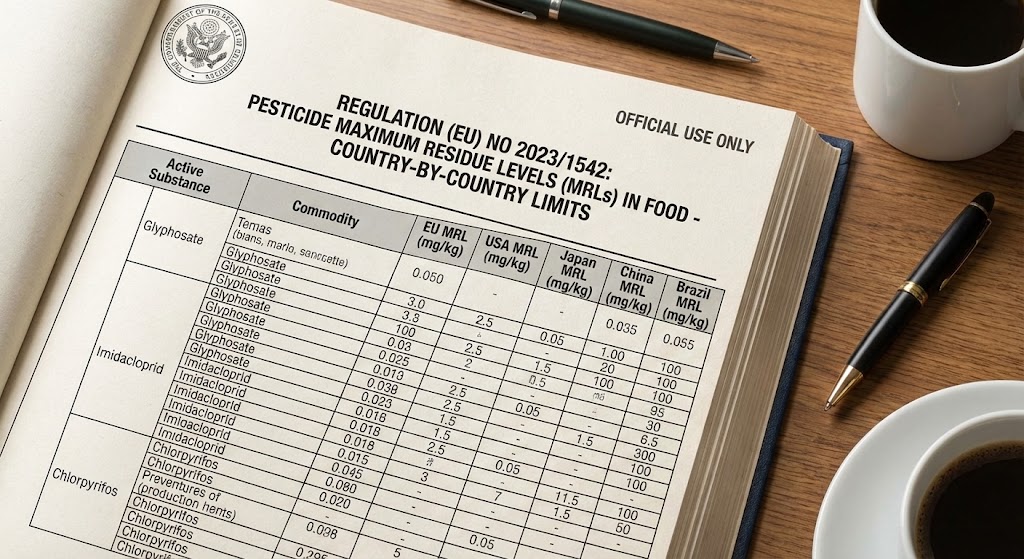
*Chlorpyrifos EU MRL reduced to 0.01 mg/kg (default LOQ) after ban in 2020 due to neurotoxicity evidence. US still allows 15.0 mg/kg as of 2026 despite EPA proposed ban (industry litigation ongoing).
These discrepancies aren't trivial. A shipment of Assam CTC with 0.08 mg/kg imidacloprid is legal in the US (2% of tolerance), legal in China (16% of GB limit), but illegal in the EU (160% over MRL). EU customs will reject it, impose fines, and blacklist the exporter. The same chemical load, three different legal verdicts.
China's GB 2763 standard occupies the middle ground—stricter than the US but more permissive than the EU. China's pragmatic approach recognizes that domestic agriculture relies on pesticides (80% of Chinese tea uses some synthetic inputs), so MRLs balance safety with economic feasibility. China also updates MRLs faster than the US (annual revisions vs. FDA's 5-10 year review cycles), incorporating new toxicology data quickly.
The Codex Alimentarius: The Unheeded International Standard
The WHO/FAO Codex Alimentarius Commission sets international MRLs to harmonize trade, but adoption is voluntary. Codex MRLs are supposed to represent "scientific consensus," derived from JMPR (Joint FAO/WHO Meeting on Pesticide Residues) risk assessments. In practice, Codex splits the difference between US permissiveness and EU strictness—which satisfies nobody.
Example: Codex imidacloprid MRL for tea is 10 mg/kg. The EU ignores this (uses 0.05 mg/kg based on hazard classification). The US ignores this (uses 40 mg/kg based on domestic risk assessment). China sometimes aligns with Codex (uses 0.5 mg/kg for imidacloprid, citing Codex as justification). The result: Codex recommendations influence ~30% of national MRLs, mostly in countries lacking domestic toxicology capacity (Southeast Asia, Africa, South America).
The Import Loophole: Selling "Illegal" Tea Legally
Here's the dirty secret: MRLs only apply at the point of import, not at retail sale. If a US importer buys EU-rejected tea (e.g., 0.08 mg/kg imidacloprid, over EU limit but under US limit), US customs clears it because it meets US tolerance. That tea then gets repackaged with "Imported from Germany" stickers and sold to American consumers who assume it met EU standards. Technically legal, ethically fraudulent. Only solution: demand batch-specific COAs showing compliance with the strictest standard (EU) regardless of where you live.
The Cocktail Effect: Why 5 "Safe" Pesticides Can Be Dangerous
MRLs are calculated assuming single-chemical exposure. You drink tea containing only imidacloprid at 0.03 mg/kg (well below all MRLs), regulators deem it safe. But real-world tea contains pesticide mixtures. A typical imported sample might show: imidacloprid 0.03 mg/kg, acetamiprid 0.02 mg/kg, difenoconazole 0.05 mg/kg, carbendazim 0.04 mg/kg, lambda-cyhalothrin 0.01 mg/kg. Each individual residue is 10-50% of its MRL—no violations. But is the mixture safe?
Toxicologists recognize two interaction modes: dose addition (chemicals with similar mechanisms add their effects) and synergism (chemicals interact to amplify toxicity beyond additive predictions). Dose addition is well-documented for pesticides sharing targets. Imidacloprid and acetamiprid both bind nicotinic acetylcholine receptors—neurotoxicity from both combines linearly. If imidacloprid alone at 0.03 mg/kg causes 30% receptor occupancy, and acetamiprid at 0.02 mg/kg causes 20%, the mixture causes 50% occupancy—potentially exceeding the safety threshold even though each is "compliant."
Synergism is rarer but more dangerous. Certain fungicides (piperonyl butoxide, triazoles) inhibit cytochrome P450 enzymes that metabolize insecticides, prolonging their half-life in the body. A mixture of carbendazim (P450 inhibitor) + imidacloprid could cause 2-5x higher blood levels of imidacloprid than predicted from the residue alone. The EU EFSA has begun cumulative risk assessment for pesticide groups (all organophosphates together, all triazoles together), but implementation is incomplete. The US FDA does not systematically evaluate mixtures.
A 2021 study tested 50 tea samples for cocktail effects using in vitro bioassays (human liver cell toxicity). 18% of samples with no individual MRL violations showed cytotoxicity in mixture, attributed to synergistic interactions between fungicides and insecticides. This demonstrates the fatal flaw in MRL-based regulation: compliance with limits doesn't guarantee safety when multiple residues co-occur.
The Hazard Index Method: DIY Cocktail Risk Assessment
To crudely estimate mixture risk, calculate the Hazard Index (HI): sum of (residue concentration ÷ MRL) for all detected pesticides. HI <0.5 = low concern. HI 0.5-1.0 = moderate concern (approaching cumulative limit). HI >1.0 = high concern (mixture exceeds safe threshold even if each chemical is individually compliant). Example: Tea with imidacloprid 0.03/0.05 + acetamiprid 0.02/0.05 + carbendazim 0.04/0.1 = HI of 0.6 + 0.4 + 0.4 = 1.4 (exceeds safe threshold). This is a rough tool—it assumes dose addition and ignores synergism—but it's better than ignoring mixtures entirely.
Detection Limits vs. MRLs: The "Not Detected" Deception
When a lab report shows "ND" (Not Detected) or "
This creates the "Not Detected vs. Below Limit" distinction critical for interpreting COAs. If EU glyphosate MRL is 0.1 mg/kg and LOQ is 0.01 mg/kg, "ND" means <0.01 mg/kg (truly minimal residue). But if LOQ is 0.1 mg/kg, "ND" only means <0.1 mg/kg—potentially right at the MRL. Always check the method's LOQ before celebrating a clean report.
Unscrupulous sellers exploit this. They test using cheap methods with LOQ = 0.5 mg/kg, get "ND" results for pesticides actually present at 0.3 mg/kg (60% of some MRLs), then market as "Pesticide-Free Tested and Verified!" Technically the report says ND. Ethically it's fraud. See our guide on reading COAs to avoid this trap.
Acute vs. Chronic Toxicity: The Time Dimension of Risk
MRLs are set to prevent chronic toxicity—health effects from years of daily exposure. They're NOT designed to prevent acute poisoning from a single high dose. This distinction matters for interpreting MRL violations. If a tea sample shows imidacloprid at 5.0 mg/kg (100x over EU MRL), is it immediately dangerous? No. You'd need to consume ~5 kg of this tea in one sitting to approach acute toxicity thresholds (LD50 in humans is ~400 mg/kg body weight, so 24,000 mg total for a 60 kg person).
The risk from high-residue tea is cumulative organ damage over months/years: liver enzyme elevation (fungicides), dopaminergic neuron loss (organophosphates), thyroid disruption (triazoles), or reproductive hormone imbalance (pyrethroids). These effects appear at 1/100th to 1/1000th of acute toxic doses, which is why MRLs are set so conservatively. A single cup of "illegal" tea won't harm you. A lifetime of daily consumption might.
This is also why regulatory agencies focus enforcement on chronic dietary staples (tea, rice, wheat, milk) rather than occasional foods (exotic fruits, specialty spices). Tea drinkers consuming 3-5 cups daily for decades accumulate significant pesticide exposure if residues persist at MRL levels. The ADI calculation assumes this chronic scenario: 60 years × 365 days × 6g tea/day × MRL concentration = total lifetime exposure. It's designed to keep that cumulative burden below thresholds for cancer, neurotoxicity, or reproductive harm.
The Heavy Drinker's Dilemma: Adjusting MRLs for High Consumption
Standard MRLs assume 3 cups/day (6g dry leaf). If you drink 10 cups/day (20g), your exposure is 3.3x higher—potentially exceeding ADI even with compliant residues. Calculate your personal safety margin: (Your daily tea consumption in grams ÷ 6) × residue level must stay below MRL. Example: You drink 15g/day. Tea has imidacloprid at 0.02 mg/kg (40% of EU MRL). Your adjusted exposure: (15÷6) × 0.02 = 0.05 mg/kg = 100% of MRL. You're at the safety limit. Solution: switch to lower-residue tea or reduce consumption to 6g/day.
Why MRLs Keep Changing: The Data Lag Problem
MRLs aren't static—they're revised as new toxicology data emerges. Chlorpyrifos provides a case study. In 2000, US EPA set chlorpyrifos tolerance for tea at 30 ppm based on 1990s rat studies showing NOAEL of 3 mg/kg/day. In 2015, new epidemiological studies linked prenatal chlorpyrifos exposure to IQ deficits in children (Columbia CCCEH study, n=265). EPA proposed lowering tolerance to 0.01 ppm. Chemical manufacturers sued. As of 2026, litigation continues—US MRL remains 15 ppm while EU lowered to 0.01 ppm in 2020.
This regulatory lag creates knowledge asymmetry. Academic toxicologists know chlorpyrifos is neurotoxic at levels previously considered safe (epigenetic effects, mitochondrial dysfunction, dopamine depletion). But regulations take 5-15 years to catch up due to industry lobbying, agency risk-aversion, and political interference. Consumers drinking MRL-compliant tea may unknowingly exceed safety thresholds based on cutting-edge science not yet reflected in law.
The EU's precautionary principle partially addresses this: when new evidence suggests harm, the EU can ban immediately (subject to review) rather than waiting for definitive proof. The US requires "substantial evidence" before changing tolerances—a higher bar that favors status quo. This philosophical difference explains why EU MRLs drop faster than US limits when new toxicity data appears.
Practical Interpretation: What MRLs Actually Tell You
Given these complexities, how should consumers interpret MRLs? Here's a tiered risk framework:
TIER 1: All residues "ND" at LOQ ≤0.01 mg/kg (Excellent). Exposure is 10-1000x below MRLs. Even heavy drinkers (20g/day) or sensitive populations (children, pregnant women) face negligible risk. This is the standard for wild-harvested tea from isolated regions.
TIER 2: Residues detected but all <10% of MRL (Very Good). Single-chemical risk is minimal. Cocktail risk depends on how many pesticides are present—if 10+ compounds each at 5-10% of MRL, Hazard Index could approach 1.0. Acceptable for moderate consumption (6g/day).
TIER 3: Some residues 10-50% of MRL (Good for Light Use). Compliant with regulations. Safe for occasional drinkers (1-2 cups/day). Concerning for heavy drinkers or if 5+ pesticides detected (cocktail risk). This describes most supermarket tea.
TIER 4: Residues 50-100% of MRL (Marginal). Technically legal but approaching limits. Unacceptable for daily consumption. One regulatory change could make this tea illegal overnight. Avoid if pregnant, nursing, or giving to children.
TIER 5: Any residue >100% of MRL (Illegal/Unsafe). Violates import regulations in that jurisdiction. Chronic consumption exceeds ADI. Should be rejected at customs or recalled if already sold. Report to FDA (US), RASFF (EU), or CFDA (China).
When comparing teas, prioritize those meeting EU MRLs even if you live in the US—EU limits incorporate more recent toxicology and larger safety margins. If you can afford it, seek Tier 1 tea (ND across 200+ pesticides). If budget-constrained, Tier 2-3 is acceptable with moderation. Never knowingly buy Tier 5 tea regardless of price.
The Pregnancy Exception: Tighten Standards 10x
Developing fetuses are 10-100x more sensitive to pesticides than adults due to incomplete blood-brain barrier, immature detox enzymes, and rapid cell division. If pregnant or breastfeeding, apply a personal 10x safety factor: only accept tea with residues <10% of MRL (Tier 1-2). Avoid organophosphates (neurotoxic), triazole fungicides (endocrine disruptors), and pyrethroids (reproductive toxins) entirely—even at trace levels. Switch to wild-harvested white tea or certified organic Japanese Sencha from Shizuoka with published COAs showing ND.
Beyond MRLs: Why Testing Standards Matter More Than Limits
The weakest link isn't MRL values—it's enforcement. MRLs are meaningless without rigorous testing at borders and markets. The EU tests 10-15% of imported tea shipments using multi-residue LC-MS/MS. The US FDA tests <1% of food imports due to budget constraints. China tests 5-8% of imports but focuses on exporting countries with known violations (India, Vietnam, Kenya). This testing gap means illegal tea routinely enters markets undetected.
Private sector testing fills the gap. Retailers like Whole Foods, Marks & Spencer, and Tesco require suppliers to provide third-party COAs for every batch. This shifts enforcement burden from government to commerce—a more reliable system because retailers face reputational damage from contamination scandals. If you can't trust government testing, trust brands that voluntarily exceed legal requirements.
MRLs are imperfect tools—better than nothing, worse than comprehensive testing. They protect against gross contamination but fail to prevent low-level chronic exposures from pesticide cocktails. Use them as a minimum bar, not a gold standard. Real safety comes from transparency: sellers publishing batch-specific COAs, testing 200+ pesticides at 0.01 mg/kg LOQ, and meeting EU limits regardless of destination market. Understand why certain pesticides like glyphosate require special testing methods, and why even organic farms can show detections. That's the future of tea safety—chemistry-verified, not regulation-assumed.
Comments