The Dark Side of the Leaf
Tea is the second most consumed beverage on Earth (after water), consumed by 2+ billion people daily. This global ubiquity makes tea the perfect vehicle for financial crime, smuggling, and fraud. Unregulated markets, difficult authentication, and cultural prestige create ideal conditions for criminal activity.
Welcome to The Evidence Room
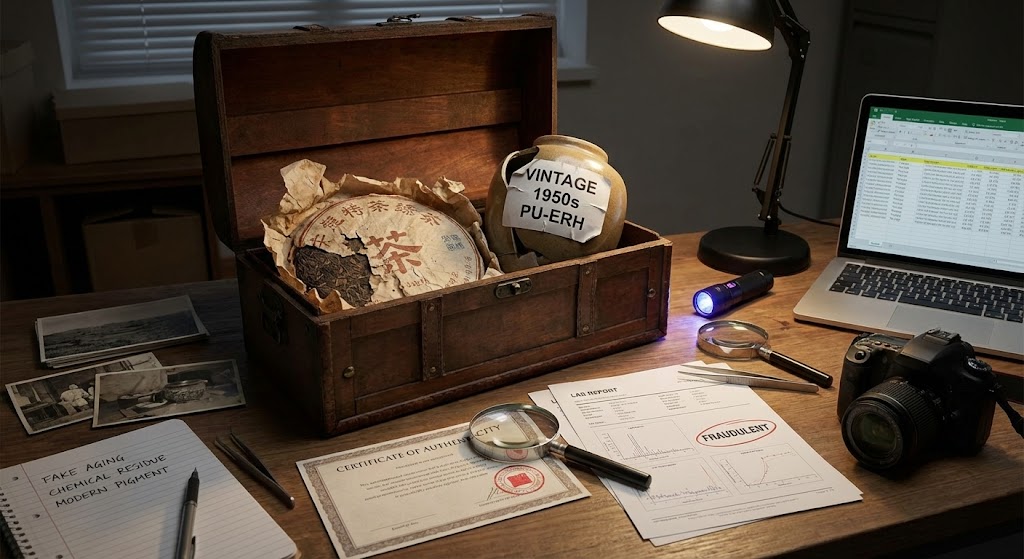
Tea has a criminal history as rich as its cultural one. From Victorian London's dyed used-leaf scam (sheep dung and lead paint) to modern Puerh money laundering, tea sits at the intersection of high value, low regulation, and difficult authentication—the perfect crime trifecta.
This cluster explores tea's dark side across four domains: Financial Crimes (money laundering, market manipulation, forgery), Forensics (scientific authentication methods), Smuggling (historical and modern trade routes), and Famous Fakes (case studies of specific scams).
Why Tea? The Perfect Crime Asset
1. Difficult to Value (Subjective Pricing)
Unlike gold or diamonds, tea has no objective price. A Puerh cake might be worth £50 or £5,000 depending on age claims, storage history, and vendor reputation. This subjectivity enables wash trading: criminals buy their own tea at inflated prices to create fake price history, then sell at "market value" to launder money.
2. Portable and Compact (Easy to Move)
A kilogram of aged Puerh can be worth £10,000-£50,000, yet fits in a backpack. Compare this to art (bulky, fragile), real estate (immobile), or cash (heavy, suspicious). Tea is the ideal smuggling asset—high value per kilogram, unassuming appearance, and legal to transport (unlike drugs or weapons).
3. Unregulated Market (No Oversight)
Art has provenance databases, real estate has title registries, stocks have SEC oversight. Tea has none of this. No central registry tracks tea ownership, no authentication standards exist, and international tea trade has minimal regulation. This enables massive-scale fraud (70% of "Taiwanese" oolong is fake Vietnamese).
4. Cultural Prestige (Social Cover)
Criminals can openly discuss tea purchases without suspicion. "I bought a 1990s Puerh cake for £15,000" sounds like sophisticated collecting, not money laundering. The cultural legitimacy of tea appreciation provides perfect cover for financial crime.
The Four Criminal Domains
- Financial Crimes: Money laundering, market bubbles, certificate forgery
- Forensics: Radiocarbon dating, isotope analysis, UV wrapper tests, DNA barcoding
- Smuggling: Industrial espionage, historic trade routes, modern smuggling
- Famous Fakes: Lao Ban Zhang fraud, 88 Qing Bing mystery, artificial aging, Victorian dye scandal
The Scale of Tea Crime
Conservative estimates:
- 70%+ of "Taiwanese High Mountain Oolong" is Vietnamese oolong relabeled and smuggled via China (source)
- 99%+ of "88 Qing Bing" cakes on the market are fake—the original production was ~300 cakes in 1988 (source)
- £500M+ in Puerh market value evaporated in the 2007 crash, revealing massive speculation and fraud (source)
- 50 tons of real Lao Ban Zhang produced annually, yet 5,000+ tons sold globally as "authentic" (source)
These aren't edge cases—fraud is the norm in unregulated premium tea markets.
Who Commits Tea Crime?
Organized Crime (Triads, Money Laundering)
Chinese Triad organizations use tea for money laundering. Hong Kong auction houses enable wash trading (buying your own tea to inflate prices). Macau casinos accept tea as collateral for gambling debts. The Puerh market's opacity and lack of regulation make it ideal for organized crime.
Small-Time Vendors (Mislabeling, Inflation)
Most tea fraud isn't dramatic—it's a vendor claiming 2015 tea is "vintage 2005," or labeling factory tea as "ancient tree." These micro-frauds are endemic because customers can't verify claims without lab testing (radiocarbon dating, isotope analysis).
Farmers and Cooperatives (Origin Fraud)
Lao Ban Zhang village produces 50 tons annually but 5,000+ tons are sold globally as "authentic LBZ." Neighboring villages relabel their tea to capture LBZ premium pricing (£500+/kg vs £50/kg for identical material from 5km away).
Why Don't We See Arrests?
Tea fraud is rarely prosecuted because: (1) no international tea authentication standards exist, (2) "aged" and "ancient tree" are marketing terms without legal definitions, (3) victims are often complicit (buyers want to believe they own rare tea), and (4) law enforcement lacks tea expertise to distinguish fraud from legitimate quality variation.
The Psychology of Tea Crime Victims
Tea fraud succeeds because victims want to be fooled. Owning "1950s Puerh" or "Lao Ban Zhang ancient tree" provides status and identity. Admitting you were scammed means admitting your expertise was insufficient—psychologically painful for collectors who've built identity around tea knowledge.
This creates willful ignorance: buyers avoid lab testing because negative results would destroy the fantasy. They rely on vendor reputation, narrative storytelling, and community validation rather than forensic verification. Criminals exploit this by selling emotionally compelling stories rather than chemically verifiable tea.
Can Tea Crime Be Stopped?
Technological solutions exist: radiocarbon dating can prove age, isotope analysis can verify origin, DNA sequencing can confirm cultivar. But these cost £200-£2,000 per test, making them impractical for everyday purchases.
The realistic solution: buyer education. Understanding fraud mechanisms (artificial aging, fake certificates, adulteration) allows consumers to ask better questions, demand better evidence, and avoid obvious scams.
| Crime Type | Mechanism | Detection Method | Prevalence |
|---|---|---|---|
| Money Laundering | Wash trading at auction | Track buyer-seller patterns | Common in high-end Puerh |
| Age Fraud | Claim 2015 tea is 1990s | Radiocarbon dating | Extremely common (50%+ of "aged" tea) |
| Origin Fraud | Relabel cheap tea as premium region | Isotope fingerprinting | Very common (70%+ Taiwanese oolong fake) |
| Artificial Aging | Humidify tea to fake age | White frost test, smell | Common in wet-stored Puerh |
| Certificate Forgery | Fake "Master" signatures on Yixing | Artist verification | Ubiquitous (95%+ Yixing certs fake) |
Explore The Evidence Room
This cluster provides tools to understand, detect, and avoid tea fraud. Whether you're a casual drinker or serious collector, understanding tea's criminal ecosystem protects your wallet and sharpens your palate. Start with The Puerh Laundromat to see how tea washes money, or jump to Radiocarbon Dating the Leaf to learn forensic authentication.
Welcome to the dark side of the leaf. Your cup of tea might be evidence.
Comments