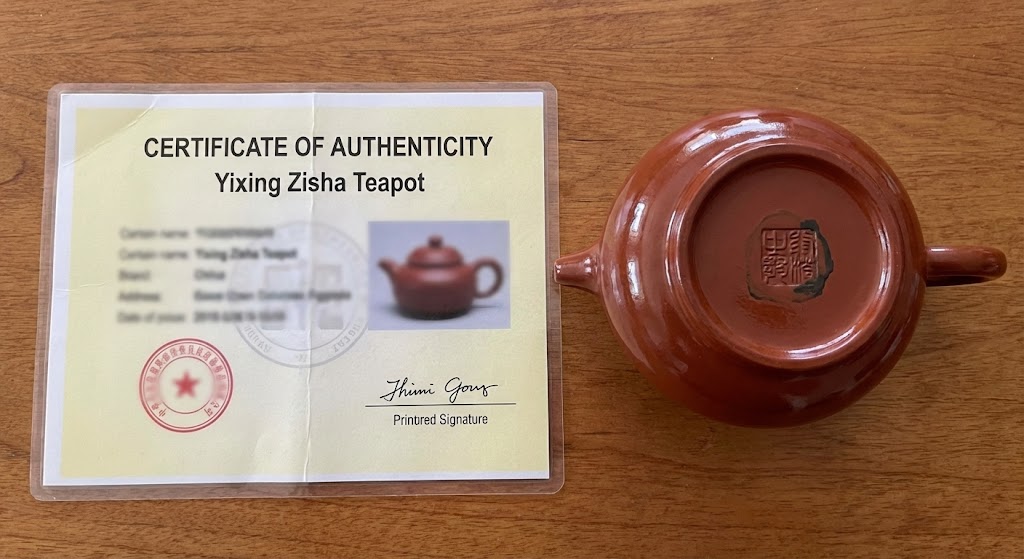
The Certificate Premium Scam
Identical Yixing pot: £80 without certificate, £2,000 with "Master" signature. The only difference is a piece of paper—easily forged, impossible to verify, and meaningless even when genuine (master signs pots his assistants made). You're paying £1,920 for worthless paperwork.
The Yixing Certificate Ecosystem
What Are Yixing "Master" Certificates?
Yixing certificates are papers accompanying teapots claiming they were made by named "Master" artisan. Format varies but typically includes: master's name/stamp, pot specifications (clay type, volume, style), production date/number, and sometimes photo of pot. These sell pots for 5-50x more than identical uncertificated pots.
The scam: 95%+ of certificates are fake, and even "genuine" certificates are misleading. A "Master Zhang" pot wasn't made by Zhang—it was made by his 20-person factory team, and Zhang signed the certificate. You're buying factory production marketed as artisan craft.
| Pot Type | Without Certificate | With "Master" Cert | Markup | Actual Maker |
|---|---|---|---|---|
| Factory standard pot | £50-80 | £500-1,000 | 900% | Anonymous factory worker |
| Mid-grade artisan pot | £150-300 | £1,500-3,000 | 900% | Assistant/apprentice |
| Fine artisan pot | £400-800 | £4,000-8,000 | 900% | Senior assistant (not "master") |
| True master pot (rare) | £1,000-2,000 | £10,000-50,000 | 900% | Actually made by master (1% of certs) |
The Three Types of Certificate Fraud
Type 1: Complete Forgery (70%+ of Certificates)
Certificate printed in forgery workshop, master never saw the pot. Signature is photocopy or stamp. These are easiest to create (costs £2-5 to print) and hardest to detect (unless you have master's genuine signature for comparison).
How it works: Wholesaler buys 100 factory pots at £30 each (£3,000 total). Prints fake certificates from "famous master" (£200 for batch). Sells pots at £800 each (£80,000 revenue). Profit: £76,800 from £200 in fake paperwork.
Red Flags for Complete Forgeries
- Certificate too perfect: No wear, creases, or aging despite claiming to be 10+ years old
- Generic language: "Authentic Zisha clay" without specific clay type or mine
- Suspicious numbering: "No. 8888" or "No. 1" (auspicious/suspicious numbers)
- English text: Genuine Chinese certificates rarely have English (added for Western buyers)
- Stock photo: Pot photo doesn't match your actual pot's details
- Modern printing: Laser printing, glossy paper (genuine uses traditional stamps/seals)
Type 2: Factory Backdoor (20%+ of Certificates)
Master has factory producing "his" designs. Factory workers make pots; master signs certificates. Technically "authorized" but deeply misleading—you're buying factory ware marketed as master-made artisan craft.
This is industry-standard practice for famous masters. A single master can't hand-make 500+ pots/year (claim implies), but his factory can. The "master" becomes brand name, not craftsperson descriptor.
Why it's fraud: Certificate says "Made by Master Zhang." Reality: made by factory worker under Zhang's brand. Buyers pay artisan premiums for factory production. If certificate said "Zhang Factory," premium would disappear.
Type 3: "Genuine" but Worthless (9%+ of Certificates)
Master actually made pot and signed certificate—but pot is mediocre. Certificate authenticates maker, not quality. A genuine master-made pot using poor clay, rushed execution, or apprentice-level skill is still master-made but not worth premium.
Additionally, many "masters" are self-proclaimed. Yixing has no official master registry or certification body. Anyone can claim "National Master" or "Provincial Master" title. Genuine certificate from fake master = worthless authentication.
The " National Master" Title Scam
China does award official "National Master" (国家级大师) titles for arts/crafts, but only ~20 Yixing artisans hold this. Hundreds claim the title falsely. Verify via China Arts and Crafts Association official list—if name missing, title is fake. Even genuine title doesn't guarantee pot quality (masters make bad pots too).
Why Certificates Are Fundamentally Worthless
No Independent Verification Exists
Unlike radiocarbon dating (lab verifies age) or isotope analysis (lab verifies origin), certificates have no verification mechanism. You can't lab-test who made pot. Authentication relies entirely on trusting certificate—which is the thing being forged.
Some vendors offer "master verification" services—send certificate photo, master confirms authenticity. But master has incentive to confirm (increases his pots' value) and can't remember every pot from 10+ years ago. "Verification" is performance, not forensics.
Even Genuine Certificates Mislead
If certificate is genuine (master actually signed it), what does that authenticate? Not that master made pot—only that master signed paper. Famous masters sign hundreds of certificates monthly for pots their factories produce. The signature is brand endorsement, not craftsmanship claim.
Analogy: Designer clothing with brand label. Label proves factory had license to use brand, not that designer personally sewed garment. Yixing certificates work identically—brand authentication, not artisan verification.
| What Certificate Claims | What It Actually Means | What You're Paying For |
|---|---|---|
| "Made by Master Zhang" | Made in Zhang's factory or brand | Brand premium (like designer label) |
| "Authentic Zisha clay" | Contains some Yixing clay (mixed with other clays) | Marketing claim (no clay purity standard) |
| "Limited edition 88/100" | Arbitrary numbering (factory made 1,000+) | Artificial scarcity theater |
| "Personal signature/stamp" | Stamp/photocopy, or signed in bulk batch | Worthless authentication ritual |
| "Certificate of authenticity" | Vendor self-certification (no third party) | Confidence scam prop |
How to Actually Assess Yixing Quality
Ignore Certificates, Examine Clay and Craft
Clay quality tests (physical assessment, not paperwork):
- Sound test: Tap pot—high, clear ring indicates dense, well-fired clay. Dull thunk suggests low-temperature firing (weak pot)
- Water absorption: Pour water on exterior—should absorb slowly (genuine Zisha is porous). If water beads up, pot is glazed/sealed (not traditional Yixing)
- Texture: Genuine Zisha has slight sandy texture (visible mineral particles). Too-smooth surface suggests clay additives or non-Yixing clay
- Color consistency: Uniform color inside/outside suggests artificial dyes. Natural Zisha has subtle color variation
- Weight: Thin walls (1-3mm) indicate skilled craftsmanship. Thick walls (5mm+) suggest beginner work or mold-made factory pot
The Ultimate Test: Brew Tea
Genuine high-quality Yixing improves tea flavor via clay porosity and heat retention. Brew same oolong in Yixing vs. porcelain gaiwan. If no flavor difference, pot is low-quality (glazed, poor clay, or too thick). Certificate is irrelevant—your palate is the test.
Buy from Artisans Directly, Not Dealers
Certificate scams thrive in dealer/wholesale chains where pot passes through 3-5 intermediaries before reaching buyer. Each intermediary adds markup and certificate legitimizes price. Buying direct from maker eliminates certificate need—you meet artisan, watch them work, verify craftsmanship firsthand.
Yixing pottery markets (宜兴陶瓷城) have hundreds of artisans selling direct from workshops. Prices: £50-300 for excellent pots (no certificate). Same pots with "master" certificates from Hong Kong/Taiwan dealers: £500-5,000. The markup is pure certificate fraud.
The Economics of Certificate Fraud
Why The Scam Persists
Low cost, high reward: Printing fake certificate costs £2-5. Adding it to £80 pot lets dealer sell for £800-2,000. Return on investment: 10,000-40,000%. Even if 50% of buyers detect fraud, remaining buyers generate massive profit.
Buyer psychology: Status signaling drives Yixing collecting. Owning "Master Zhang pot" provides identity/prestige. Certificate enables buyers to claim ownership without embarrassment of admitting they can't assess pot quality themselves. The fraud is psychologically collaborative—buyers want to be fooled.
No legal consequences: Yixing certificates aren't legally binding documents. No consumer protection laws govern them. Prosecuting fraud requires proving intent to deceive—difficult when terms like "master" and "authentic" have no legal definitions. Fraudsters operate with impunity.
Protect Yourself: Certificate-Free Buying Strategy
- Ignore all certificates: Treat them as worthless paper (because they are)
- Pay factory-pot prices: £50-200 for functional Yixing, £200-500 for fine artisan work
- Assess clay/craft directly: Learn sound test, water absorption, weight/thickness evaluation
- Buy based on brewing performance: Does tea taste better? That's only metric that matters
- Avoid "investment" Yixing: Pots are tools for tea, not assets. Speculation bubbles crash
- Visit Yixing directly: Buy from artisan workshops, skip dealer markup and certificate theater
- Embrace anonymous craftwork: Beautiful unsigned pot is better than mediocre "master" pot
The Cultural Damage of Certificate Fraud
Certificate scams don't just defraud buyers—they destroy genuine artisan culture. When fake certificates make factory pots worth more than real artisan work, quality craftspeople can't compete. Why spend 10 years mastering clay techniques when factory worker + fake certificate earns more?
This creates race to bottom: artisans abandon traditional methods for factory efficiency, master artisans become brand managers signing certificates for factory output, and "Yixing tradition" becomes marketing performance rather than living craft.
The tragedy: genuine master artisans exist in Yixing—elderly craftspeople with 40+ years experience making extraordinary pots. But they're buried under avalanche of certificate fraud, indistinguishable to buyers from factory output with fake papers. The fraud punishes quality and rewards deception.
Conclusion: Trust Clay, Not Paper
A Yixing pot's value comes from three things: clay quality (how it interacts with tea), craftsmanship (how well it's made), and brewing performance (how tea tastes). Certificates measure none of these. They measure only gullibility—yours.
The best Yixing pot is the one that makes your tea taste best. That's it. Signature, certificate, "master" title, limited edition number—all worthless theater. Pour water, brew tea, taste result. That's your authentication.
If a dealer says "but it has a certificate," walk away. They're selling paper, not pots.
Comments