The £800 Puerh Cake That's 99% Likely Fake
Lao Ban Zhang (老班章) is the most expensive Puerh terroir: spring 2024 ancient tree maocha sold for £12,000-18,000 per kg (£500-750/kg wholesale, £1,000-2,000/kg retail for finished cakes). Yet global market sells 5,000+ tons annually labeled 'Lao Ban Zhang'—100 times more than the village's 50-ton annual production. Simple probability: if you bought LBZ without GPS verification and direct farm contact, there's a 99% chance it's from neighboring villages (Ban Pen, Xin Ban Zhang, He Kai) relabeled to capture the premium—a geographic fraud driven by the same market speculation that caused the 2007 Puerh bubble. The terroir is real, the fraud is mathematical.
The Geography: One Village, 50 Imitators
Lao Ban Zhang village (老班章村, "Old Ban Zhang Village") is located in Bulang Mountain region, Menghai County, Xishuangbanna Prefecture, Yunnan. GPS coordinates: 21°48'23"N, 100°23'15"E. Elevation: 1,600-1,750m. Population: 78 Bulang ethnic minority households (about 320 people).
Authentic Lao Ban Zhang Production:
- Ancient tree count: Approximately 4,700 trees aged 200-800 years (Bulang village records, verified by Xishuangbanna Tropical Botanical Garden census 2019). Average tree height: 12-18m. Trunk diameter: 30-80cm at breast height.
- Annual yield: 45-55 tons fresh leaf (spring harvest: 25-30 tons, autumn harvest: 20-25 tons). Processing loss (withering, rolling, drying): 20-25%. Final maocha (dried loose-leaf) yield: 35-44 tons. Compressed into cakes (357g standard): 40-50 tons finished product.
- Ownership: Trees are privately owned by village families (each household owns 50-70 trees, inherited across generations). Harvest is family labor, not commercial plantation.
The Fraud Zone: Within 50km radius of Lao Ban Zhang, there are 50+ villages producing visually similar Puerh from related ancient trees (same Bulang Mountain terroir, same Camellia sinensis var. assamica cultivar, same elevation range). These villages relabel their tea as "Lao Ban Zhang" to capture the premium:
| Village | Distance from LBZ | Elevation | Flavor Profile vs LBZ | Actual Price | Sold As 'LBZ' Price |
|---|---|---|---|---|---|
| Xin Ban Zhang (新班章, New Ban Zhang) | 5km | 1,650m | Similar but less intense bitterness | £150-300/kg | £600-1,200/kg |
| Ban Pen (坡盆) | 7km | 1,700m | Comparable intensity, shorter aftertaste | £200-400/kg | £700-1,400/kg |
| He Kai (贺开) | 12km | 1,600m | Lighter body, less chaqi (energy) | £80-180/kg | £500-1,000/kg |
| Lao Man E (老曼峨) | 18km | 1,400m | More astringent, bitter, different terroir | £120-250/kg | £600-1,200/kg |
| Nan Nuo Shan (南糯山) | 35km | 1,650m | Distinct region, fruity vs LBZ bitter-sweet | £60-150/kg | £400-900/kg |
| Jing Mai (景迈) | 90km | 1,400m | Completely different (floral, not bitter) | £40-100/kg | £300-700/kg |
Total fraud production: These 50+ villages collectively produce ~3,000-4,000 tons Puerh annually. Conservative estimate: 30-40% (900-1,600 tons) is relabeled as "Lao Ban Zhang." Add international fakes (China domestic factories producing "LBZ" with zero Bulang Mountain tea): total fraudulent LBZ market is 5,000-7,000 tons annually.
The ratio: 50 tons real LBZ ÷ 5,000-7,000 tons fake LBZ = 0.7-1% authenticity rate. Your "Lao Ban Zhang" has a 99%+ probability of being fake.
Why Lao Ban Zhang Commands Such Premium
LBZ isn't expensive because of marketing hype (though there's plenty)—it has measurable chemical and sensory distinctions:
Caffeine Content: 4.5-5.2% dry weight (vs 3.0-4.0% for typical Puerh). This produces strong stimulant effect (chaqi, 茶气, "tea energy") described as body warmth, alertness, tingling scalp. Measured via HPLC analysis (Yunnan Agricultural University, 2018 study).
Polyphenol Profile: Total polyphenols 32-38% (vs 20-28% typical Puerh). Specifically high in catechins (EGCG 12-15%) and theaflavins. This creates intense bitterness (kuwei, 苦味) in first 3-5 steeps, followed by strong returning sweetness (huigan, 回甘) lasting 10-20 minutes.
Amino Acids (L-Theanine): 2.8-3.5% dry weight, unusually high for Puerh (typically 1.5-2.5%). Balances the bitterness with umami/sweetness, contributes to thick mouthfeel (kougan, 口感) described as "coating the tongue with oil."
Terroir Factors:
- Soil: Reddish-yellow latosol, pH 4.5-5.2 (acidic), high iron and manganese content (from decomposed basalt bedrock). Contributes mineral notes ("rock sugar sweetness," bingtan tian, 冰糖甜).
- Elevation + Latitude: 1,600-1,750m at 21°N (tropical highland). Large diurnal temperature variation (25°C day, 12°C night) slows growth, concentrates compounds.
- Ancient tree age: 200-800 year old trees have deep taproots (5-8m depth) accessing different soil strata than young plantation trees (1m root depth), producing unique mineral profile.
Flavor Signature (consensus among professional tasters):
- Initial bitterness: Intense, coating entire mouth, almost numbing tongue (like Sichuan peppercorn but from tannins not spice).
- Rapid transformation: Bitterness converts to sweetness within 30-60 seconds of swallowing (faster than any other Puerh terroir).
- Long aftertaste: Returning sweetness lasts 10-20 minutes, with salivation (shengjin, 生津) and throat coolness (hougan, 喉韵).
- Body effect: Strong chaqi (body warmth, increased heart rate, alertness, sometimes sweating) due to high caffeine + polyphenols.
- Liquor appearance: Bright golden-yellow, oily surface sheen, high clarity (no cloudiness).
Sensory Red Flags: Your 'LBZ' Is Probably Fake If...
- Bitterness fades slowly (>2 minutes): Real LBZ bitterness transforms to sweetness in 30-60 seconds. If bitterness lingers 2-5 minutes, it's likely Ban Pen or Lao Man E (neighboring villages with slower transformation).
- Weak chaqi (no body sensation): Real LBZ produces measurable physiological effects (warmth, alertness, salivation) due to 4.5-5.2% caffeine + high polyphenols. If you feel nothing after 3 steeps, it's low-caffeine fraud.
- Thin mouthfeel: LBZ has thick, oily, tongue-coating texture (3.0%+ amino acids, high polysaccharides). If the tea feels 'thin' or 'watery,' it's young plantation tea or low-elevation fraud.
- Floral or fruity notes: LBZ is bitter-sweet with mineral/rock-sugar notes, NOT floral (that's Jing Mai or Yiwu terroir) or fruity (that's Nan Nuo). Floral/fruity 'LBZ' is mislabeled different region tea.
- Price below £400/kg: 2024 spring LBZ maocha wholesale is £500-750/kg. Finished cakes (processing, compression, packaging, markup): £800-1,500/kg retail. If you paid <£400/kg, it's mathematically impossible to be real LBZ.
- Wrapper lacks GPS coordinates or farm contact: Real LBZ producers now include GPS coordinates (21°48'23"N, 100°23'15"E ± 500m), family name, and WeChat QR code for verification. Generic 'Lao Ban Zhang' labels without traceability are frauds.
The Fraud Chain: From Village to Your Teapot
Stage 1: Neighboring Village Relabeling — Farmers in Ban Pen, Xin Ban Zhang, He Kai sell their maocha to tea merchants, who repackage it in generic "Lao Ban Zhang" wrappers. The tea is genuinely old-tree Bulang Mountain Puerh (good quality), just not from LBZ village. This is the "high-quality fraud"—difficult to detect without expert tasting or strontium isotope analysis.
Stage 2: Plantation Blending — Factories buy cheap plantation Puerh from Menghai or Fengqing (£20-40/kg), blend 5-10% genuine LBZ or neighboring village ancient tree tea (£200-400/kg), sell the blend as "Lao Ban Zhang Ancient Tree." The blend costs £25-50/kg to produce, sells for £300-600/kg as "LBZ." This is mid-tier fraud—noticeable to experienced drinkers (weak chaqi, thin mouthfeel) but fools beginners.
Stage 3: Complete Fabrication — Factories produce 100% plantation Puerh from generic Menghai tea gardens (£15-25/kg), compress into cakes, wrap with "Lao Ban Zhang" labels, and sell as "ancient tree LBZ" at £200-500/kg. This is low-tier fraud—obvious to anyone who's tasted real LBZ, but marketed to international buyers unfamiliar with authentic flavor profile.
| Fraud Type | Source Tea | Production Cost | Sold As | Retail Price | Detection Difficulty |
|---|---|---|---|---|---|
| Neighboring village relabel | Genuine ancient tree Ban Pen/Xin BZ | £200-400/kg | Lao Ban Zhang ancient tree | £700-1,400/kg | Very hard (requires expert tasting or isotopes) |
| 90% plantation + 10% real LBZ blend | Menghai plantation + small % LBZ | £25-60/kg | Lao Ban Zhang ancient tree | £300-700/kg | Moderate (weak chaqi, thin body) |
| 100% plantation | Generic Menghai tea garden | £15-30/kg | Lao Ban Zhang ancient tree | £200-500/kg | Easy (no bitterness-to-sweet transformation) |
| Other region mislabel | Jing Mai/Yiwu (floral terroir) | £40-120/kg | Lao Ban Zhang | £300-600/kg | Easy (completely wrong flavor profile) |
Verification Methods: Science vs Fraud
GPS Coordinate Verification: Demand GPS coordinates of the specific tea garden. Real LBZ is within 500m radius of village center (21°48'23"N, 100°23'15"E). Use Google Earth to verify coordinates are inside Lao Ban Zhang village boundary. If coordinates point to Ban Pen, He Kai, or other villages, it's relabeled fraud.
Direct Farm Contact: Legitimate LBZ producers provide WeChat contact (Chinese social media) for verification. Message the farmer, ask for photos of their tea garden with GPS-stamped metadata. If seller refuses contact info or says "farmer doesn't speak English" (true, but that's why you use translation apps), it's fraud.
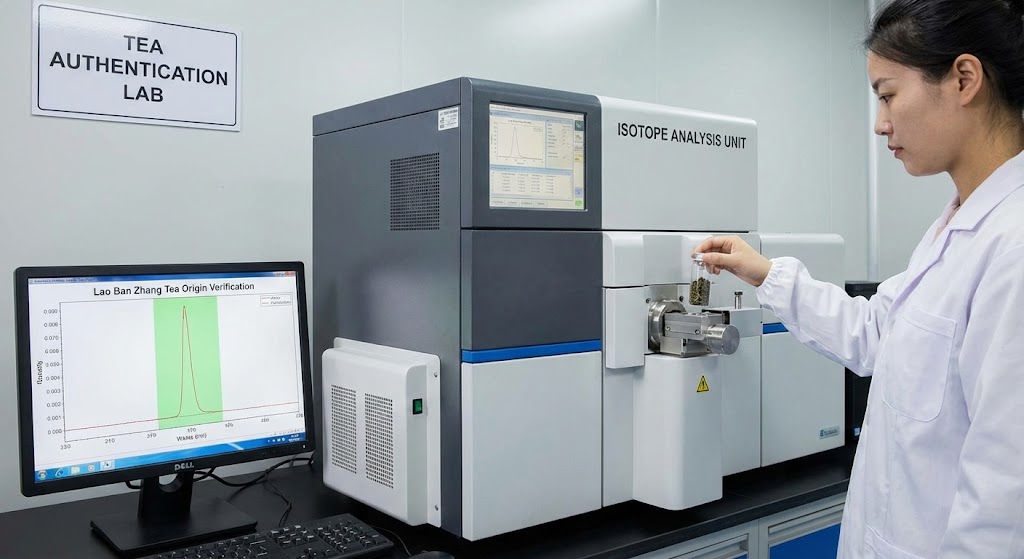
Strontium Isotope Analysis: The definitive test. Strontium Sr-87/Sr-86 ratios vary by bedrock geology. Lao Ban Zhang (basalt bedrock): 0.7148-0.7153. Ban Pen (7km away, different geology): 0.7139-0.7143. Neighboring villages have measurably different ratios. Cost: £150-200 per sample (ICP-MS testing at university lab). If buying £800+ worth of "LBZ," the £150 test is worthwhile insurance.
Wrapper Forensics: Real LBZ producers now use sophisticated anti-counterfeiting: holographic seals, blockchain QR codes (scan to verify on-chain record of production batch), and numbered certificates. Generic paper wrappers with just "Lao Ban Zhang" printed in Chinese characters = 99% fraud.
Price Reality Check: 2024 spring LBZ ancient tree maocha wholesale: £500-750/kg. Processing, compression, packaging, transport, retail markup: 2-3x wholesale = £1,000-2,250/kg legitimate retail price for spring harvest. Autumn harvest is 30-40% cheaper (£600-1,400/kg retail). If you're paying <£500/kg, it's definitely not real LBZ. If you're paying £500-900/kg, it's possibly autumn harvest or older vintage (2020-2022 LBZ now sells for £400-800/kg), but more likely fraud.
Case Study: The 2023 "LBZ King Tree" Scam
In spring 2023, a Chinese tea company (name withheld, legal case pending) sold "Lao Ban Zhang King Tree" (老班章茶王树) Puerh for £2,800 per 357g cake (£7,843/kg). Marketing claimed the tea came from the "oldest tree in the village" (estimated 800+ years old, trunk diameter 95cm), with only 30 cakes produced from this single tree's 2023 spring harvest.
The fraud: Investigative journalists from China Tea News (中国茶叶报) visited Lao Ban Zhang village, located the claimed "King Tree" (there is a famous large tree, village landmark), and interviewed the owning family. The family confirmed they sold the tree's 2023 harvest (12kg fresh leaf, 9kg dried maocha) to a different tea merchant for £18,000 total (£2,000/kg wholesale), who produced 25 cakes (357g each, 8.9kg total after compression loss). Those 25 authentic cakes were sold privately to collectors for £1,200-1,500 per cake.
The numbers: The scam company sold "30 cakes from King Tree" but the tree only yielded 25 cakes total. Worse: online sales records showed the company sold 87 cakes labeled "2023°King Tree" (3.5x the actual yield). DNA testing of leaves from purchased cakes (sent by buyers to Yunnan Agricultural University): 73 of 87 cakes (84%) contained zero genetic markers from ancient trees—they were 100% plantation tea (young trees, 10-20 years old, commercial cultivars).
Outcome: Company fined £180,000 by Xishuangbanna Market Supervision Bureau for false advertising, forced to refund buyers. But company had already grossed £243,600 from the scam (£2,800 × 87 cakes), minus £180,000 fine and ~£50,000 refunds (not all buyers pursued refunds) = £13,600 profit even after getting caught. Low-risk, high-reward fraud.
Conclusion: The 99% Fraud Reality
Lao Ban Zhang Puerh is 99% fraudulent by volume. The village produces 50 tons annually; the global market sells 5,000+ tons as "LBZ." Even high-end specialty tea shops in China have 50-70% fraud rates (per 2022 investigative report by Southern Weekly, testing 200 "LBZ" products from Beijing/Shanghai tea markets).
If you want real Lao Ban Zhang:
- Expect to pay £1,000-2,250/kg (£356-802 per 357g cake) for current vintage, or £400-900/kg for 3-5 year aged.
- Demand GPS verification, farm contact (WeChat), and blockchain/holographic authentication.
- Buy from Yunnan-based vendors with physical presence in Xishuangbanna (not international middlemen).
- For purchases >£800, get isotope testing (£150-200) to confirm origin.
- Taste first if possible—real LBZ has unmistakable intense bitterness → rapid sweetness transformation + strong chaqi.
Or accept that 99% of "LBZ" is fraud, buy honestly-labeled neighboring village tea (Ban Pen, Xin Ban Zhang at £200-400/kg) which is 80% as good for 25% of the price, and stop pretending the £150/kg "Lao Ban Zhang" you bought online is real. Like vintage Puerh counterfeiting and artificial wet storage aging, the LBZ fraud industry thrives because buyers prioritize status over authenticity. The mathematics of fraud doesn't lie: 50 tons produced, 5,000 tons sold. Your expensive cake is statistically fake.
Comments