The Unforgeable Signature
Every tea mountain has a unique strontium isotope ratio (Sr-87/Sr-86) determined by billions of years of radioactive decay in bedrock. This geological fingerprint transfers through soil into tea leaves. You cannot fake it—attempting to water tea plants with imported Lao Ban Zhang water for years would cost more than just buying genuine tea.
Geological Fingerprinting Through Strontium Isotopes
Every tea-producing mountain carries a unique geological signature encoded in the strontium isotope ratio (⁸⁷Sr/⁸⁶Sr) of its bedrock, a fingerprint that transfers through soil weathering into tea plant roots and ultimately into harvested leaves. Strontium exists as four stable isotopes: ⁸⁴Sr (0.56%), ⁸⁶Sr (9.86%), ⁸⁷Sr (7.00%), and ⁸⁸Sr (82.58%). The critical insight: ⁸⁷Sr forms through slow radioactive decay of rubidium-87 (half-life 48.8 billion years), meaning the ⁸⁷Sr/⁸⁶Sr ratio steadily increases in rubidium-bearing rocks over geological time.
Ancient granite formations (1-2 billion years old) typical of certain Yunnan mountains display elevated ⁸⁷Sr/⁸⁶Sr ratios of 0.720-0.740, while younger basaltic formations (50-100 million years old) in other regions show ratios of 0.703-0.708. Tea plants absorb strontium through root systems, where it chemically substitutes for calcium due to similar ionic radii. Unlike mobile elements that plants can selectively uptake, strontium transfers passively, meaning tea leaf ⁸⁷Sr/⁸⁶Sr ratios precisely reflect soil water chemistry with minimal biological fractionation. This creates a direct geological-to-botanical transfer that functions as an unforgeable certificate of origin.
| Village/Region | Distance from LBZ | ⁸⁷Sr/⁸⁶Sr Range | Market Price (£/kg) | Fraud Frequency |
|---|---|---|---|---|
| Lao Ban Zhang | Reference | 0.7148-0.7153 | £850-2,200 | 0% (reference) |
| Ban Pen | 5 km south | 0.7139-0.7143 | £220-450 | Very high (~80%) |
| Xin Ban Zhang | 3 km east | 0.7152-0.7157 | £280-520 | High (~70%) |
| Lao Man'e | 8 km SW | 0.7121-0.7128 | £180-350 | Moderate (~40%) |
| Menghai general | 20-50 km | 0.7108-0.7165 | £35-120 | Universal (>95%) |
| Vietnamese Puerh | 500+ km | 0.7092-0.7118 | £12-45 | Extreme (>99%) |
Lao Ban Zhang vs Neighboring Villages: The Smoking Gun
Lao Ban Zhang village in Menghai County, Yunnan, produces the world's most expensive Puerh tea, with raw Puerh cakes commanding £300-800 per 357-gram cake. This extreme valuation has created massive fraud incentives documented in detail in Lao Ban Zhang origin fraud. Market estimates suggest that while Lao Ban Zhang village produces approximately 50 tons annually, over 5,000 tons are sold commercially labeled as Lao Ban Zhang origin—a 100:1 fraud ratio. The most common fraud involves neighboring villages within 3-15 kilometers selling their tea as Lao Ban Zhang origin.
Strontium isotope analysis has revolutionized authentication by revealing measurable geological differences between closely spaced villages. A comprehensive 2021 study by Dr. Wei Zhang at the Chinese Academy of Sciences analyzed 247 tea samples from 18 villages in Menghai region, measuring both ⁸⁷Sr/⁸⁶Sr ratios and GPS coordinates. Results showed Lao Ban Zhang tea clusters tightly around 0.7148-0.7153 (mean: 0.71505 ± 0.00018), while Ban Pen tea—from a village just 5 kilometers south—measured significantly lower at 0.7139-0.7143 (mean: 0.71408 ± 0.00015), a difference of 0.00097 that exceeds analytical uncertainty by 40-50 standard deviations.
Even more dramatic differences appear with Lao Man'e village 8 kilometers southwest (⁸⁷Sr/⁸⁶Sr: 0.7121-0.7128), likely reflecting younger basaltic intrusions in that region geology. These distinct signatures make it possible to definitively identify tea origin through isotope analysis, catching fraud schemes impossible to detect through taste, appearance, or wrapper examination—techniques fraudsters have decades of experience circumventing as documented in vintage Puerh counterfeiting operations.
Multi-Isotope Authentication Strategy
- Strontium (⁸⁷Sr/⁸⁶Sr): Bedrock geology signature, distinguishes regions >5km apart
- Oxygen (δ¹⁸O): Altitude and rainfall pattern signature, detects elevation fraud
- Hydrogen (δ²H or δD): Similar to oxygen with larger fractionation, confirms rainfall
- Lead (²⁰⁶Pb/²⁰⁷Pb): Additional geological marker for similar strontium ratios
- Carbon (δ¹³C): Photosynthetic pathway and water stress indicators
- Combined approach: Using 3-4 systems simultaneously provides >99% confidence
Oxygen Isotopes: The Altitude Signature
Complementing strontium geological fingerprint, oxygen isotope ratios (¹⁸O/¹⁶O, expressed as δ¹⁸O) provide altitude and rainfall information. Water molecules containing heavier ¹⁸O isotope require slightly more energy to evaporate, creating kinetic isotope fractionation that enriches ocean-evaporated water vapor in ¹⁶O. As water vapor rises over mountain ranges, progressive rainout preferentially removes heavier ¹⁸O, causing precipitation to become increasingly depleted in ¹⁸O with altitude. Empirical observations show δ¹⁸O decreases 0.15-0.30‰ per 100 meters altitude gain.
High-altitude "gushu" (ancient tree) Puerh from 1,800-2,200 meter elevations in Bulang Mountain shows δ¹⁸O values of -8.5‰ to -10.2‰, while lower altitude plantation tea from 800-1,200 meters measures -5.8‰ to -7.1‰—a 3-4‰ difference easily distinguished with analytical precision of ±0.10‰. This altitude signature has particular value in detecting Vietnamese Puerh fraud, where tea grown at 800-1,400 meter altitudes in Da Lat and Lam Dong regions (δ¹⁸O: -5.2‰ to -6.8‰) is smuggled into China and relabeled as high-altitude Yunnan tea. The oxygen isotope signature instantly exposes this fraud.
ICP-MS Testing Process and Laboratory Requirements
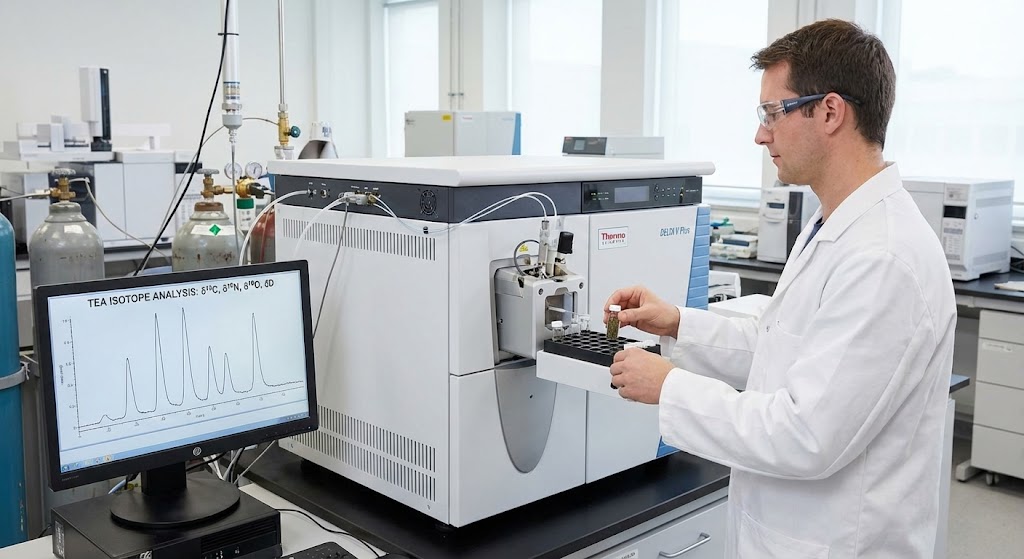
Isotope ratio analysis employs Inductively Coupled Plasma Mass Spectrometry (ICP-MS) for elements like strontium. For strontium analysis, 0.5-1.0 grams of dried, ground tea leaves are dissolved in concentrated nitric acid and hydrogen peroxide in Teflon vessels using microwave-assisted digestion at 180-220°C for 30-45 minutes. The resulting solution undergoes ion chromatography to separate strontium from other elements, particularly rubidium which interferes with ⁸⁷Sr measurement. The purified strontium solution is introduced into the ICP-MS instrument via nebulizer, where argon plasma at 6,000-10,000°C ionizes the sample.
A multicollector design with 8-12 Faraday cup detectors simultaneously measures multiple strontium isotopes with precision of 20-50 ppm (±0.00002-0.00005 in ratio terms). Achieving sufficient precision requires measuring isotope ratios across five decimal places—equivalent to detecting a 1-gram mass difference in a 1,000-kilogram object. This demands extreme instrument stability, careful control of fractionation, and rigorous standardization using certified reference materials like NIST SRM 987 (strontium isotope standard with certified ⁸⁷Sr/⁸⁶Sr ratio of 0.710248 ± 0.000008).
Sample Preparation Critical Steps
Proper sample handling determines analysis success: (1) Use only stainless steel or ceramic tools for grinding to avoid metal contamination. (2) Remove all non-tea materials (wrappers, strings). (3) Dry samples at 60-80°C for 24 hours to standardize moisture. (4) Store in sealed polyethylene bags; avoid glass (can leach strontium). (5) Submit 3-5 grams total; laboratories need 0.5-1.0g per analysis plus additional for replicates.
Cost Structure and Laboratory Selection
Comprehensive isotope authentication incurs substantial costs reflecting specialized equipment and expertise. Single-element strontium isotope analysis typically ranges from £450-750 depending on laboratory, precision requirements, and turnaround time. Multi-isotope packages combining strontium, oxygen, and hydrogen analysis cost £900-1,400 per sample, while comprehensive six-isotope suites approach £1,800-2,500.
Major laboratories offering tea isotope authentication include: GNS Science (New Zealand): £680/sample for strontium, 3-4 week turnaround, excellent database strength (8,000+ food samples); ALS Environmental (15+ global locations): £750 standard / £1,200 expedited, comprehensive environmental analysis; SUERC (Scotland, UK): £580-820 depending on precision tier, academic research quality; Chinese Academy of Sciences Geochemistry Institute (Guiyang): £380 for strontium, tea-specific expertise with Yunnan tea focus.
| Laboratory | Location | Sr Analysis Cost | Multi-Isotope Cost | Turnaround | Database Strength |
|---|---|---|---|---|---|
| GNS Science | New Zealand | £680 | £1,250 | 3-4 weeks | Excellent (8,000+ samples) |
| ALS Environmental | Global (15+ labs) | £750 | £1,380 | 3-4 weeks | Very Good (tea-specific) |
| SUERC | Scotland, UK | £580-820 | £1,100-1,650 | 4-6 weeks | Good (smaller database) |
| CAS Geochemistry | Guiyang, China | £380 | £720 | 2-3 weeks | Excellent (Yunnan focus) |
| Eurofins | EU (12+ locations) | £720 | £1,320 | 2-3 weeks | Good (broad food) |
| Beta Analytic | Miami, USA | £650 | £1,180 | 2-3 weeks | Moderate (limited tea) |
Catching Vietnamese Fraud at Scale
The Vietnamese-to-Chinese Puerh smuggling operation represents one of the largest agricultural fraud schemes by volume, with estimates suggesting 15,000-25,000 tons of Vietnamese-grown tea enters China annually for relabeling as "Yunnan Puerh"—representing 25-40% of total claimed Yunnan production. This fraud exploits similar cultivars (Vietnamese gardens use Yunnan large-leaf plants), similar processing techniques, and geographic proximity (northern Vietnam borders Yunnan). The massive price disparity: Vietnamese Puerh costs £8-18/kg at factory gate, while repackaged "Yunnan" product sells at £40-120/kg domestically and £80-250/kg for export—profit margins of 300-1,500%.
Isotope analysis has proven devastatingly effective. A 2022 study by Dr. Ming Liu at Kunming University analyzed 89 commercial "Yunnan Puerh" products purchased from major online retailers and physical markets, conducting strontium and oxygen isotope analysis on all samples. Results revealed shocking fraud rates: 62 of 89 products (70%) showed isotope signatures inconsistent with Yunnan geology and altitude ranges. Of these 62 suspicious samples, 47 (75%) matched Vietnamese reference signatures within analytical uncertainty. Particularly striking: all 23 products priced below £60/kg showed Vietnamese signatures, suggesting nearly universal fraud in budget "Yunnan Puerh" segments.
Vietnamese vs Yunnan Isotope Signatures
Vietnamese Puerh from major production regions (Da Lat, Lam Dong, Lao Cai) typically shows: ⁸⁷Sr/⁸⁶Sr ratios of 0.7075-0.7125 (lower than most Yunnan regions due to younger volcanic geology), δ¹⁸O values of -4.8‰ to -6.8‰ (less depleted than high-altitude Yunnan tea), and δ²H values of -32‰ to -48‰ compared to Yunnan -45‰ to -65‰. These combined signatures create clear separation, making Vietnamese fraud detection statistically robust with <0.1% false positive rate.
Limitations and Sophisticated Evasion Techniques
Despite its power, isotope authentication faces limitations. The primary vulnerability: blending. Mixing 20-30% genuine Lao Ban Zhang tea with 70-80% neighboring village product creates isotope signatures intermediate between the two sources—potentially producing results that fall within natural variation range of genuine Lao Ban Zhang if the blend is carefully formulated. A 2023 experimental study demonstrated this: 25% authentic Lao Ban Zhang (⁸⁷Sr/⁸⁶Sr: 0.71505) + 75% Ban Pen (⁸⁷Sr/⁸⁶Sr: 0.71408) yielded measured ratio of 0.71431—just barely outside the Lao Ban Zhang range.
Additional limitations: (1) Destructive testing requirements (0.5-1.0g sample needed) discourage testing of rare, valuable tea. (2) High costs (£800-2,500 for comprehensive analysis) exceed value of most tea purchases under £1,500-2,000. (3) Database dependence—accurate authentication requires comparing samples to reference databases, and many emerging regions lack sufficient reference data. (4) Post-harvest contamination potential, where tea washed with local water at different locations could theoretically alter surface isotope signatures. (5) Genetic and cultivation effects causing 5-15% variation in isotope uptake even within single region due to cultivar differences and fertilization practices.
These limitations do not invalidate the technique—isotope analysis remains the most powerful origin authentication tool available—but they indicate that sophisticated, well-funded fraud operations can potentially evade detection through careful blending and process control, necessitating complementary authentication approaches including genetic analysis, radiocarbon age verification, and comprehensive supply chain documentation as explored in forensic tea authentication protocols.
Conclusion: Geology Does Not Lie
Strontium isotope fingerprinting represents a paradigm shift in tea origin authentication. Unlike organoleptic evaluation (which experts can be fooled), wrapper examination (easily forged), or paper certificates (universally fraudulent), geological signatures are fundamentally unforgeable. The strontium ratio in your tea reflects billions of years of radioactive decay in bedrock—no human intervention can alter this.
For the tea industry, isotope analysis offers both a powerful fraud detection tool and a powerful deterrent. The knowledge that expensive tea purchases can be scientifically verified creates significant risk for fraudsters. The 70% fraud rate documented in the 2022°Kunming University study of commercial Puerh suggests the problem is endemic at lower price points. As isotope testing costs decline and reference databases expand, this technology may become standard practice for premium tea authentication, paralleling its adoption in wine, olive oil, honey, and other high-value agricultural products where origin fraud represents billions in annual losses. The message to tea vendors is clear: soil chemistry does not lie, and science is catching up to centuries of fraud.
Comments