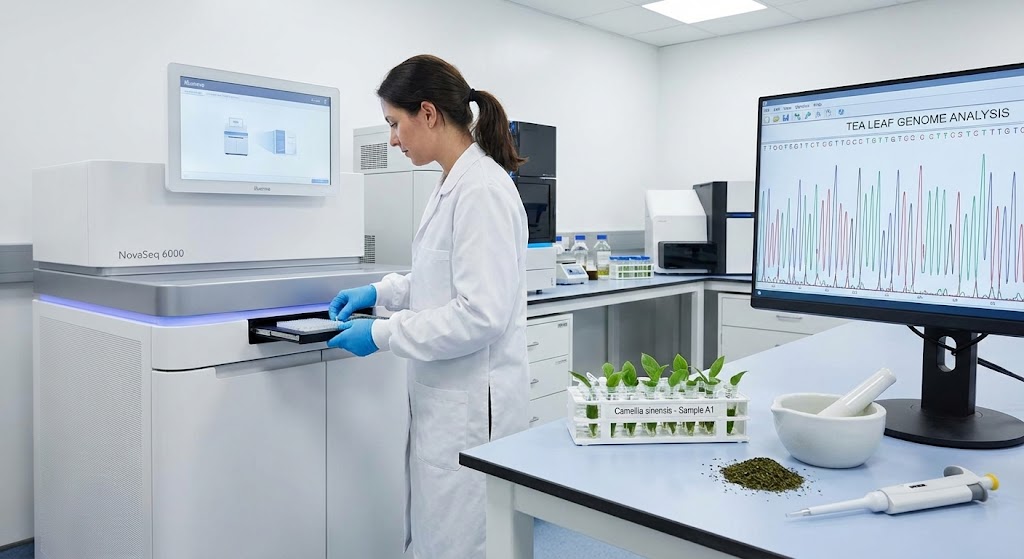
The £150 Test That Proves Your £500 'Wild Tea' Is Cultivated Fraud
DNA barcoding costs £120-180 per sample at specialized labs (Kew Gardens, Kunming Institute of Botany). It sequences two chloroplast genes—rbcL and matK—that differ measurably between Camellia sinensis (cultivated), C. taliensis (wild Yunnan), and C. assamica wild type (Assam). If your 'wild ancient tree' tea cost £400/kg but the seller won't provide DNA certification, there's a reason: it's probably farmed C. sinensis worth £30/kg. The genetic markers don't lie, but vendors hope you won't test.
Species Identification: Wild vs Cultivated Tea Plants
The tea market recognizes three primary genetic lineages with vastly different values:
Camellia sinensis var. sinensis (Chinese small-leaf): Cultivated varieties grown in plantations worldwide. rbcL gene sequence shows characteristic SNP at position 473 (cytosine instead of thymine). Market value: £15-40/kg for premium grades.
Camellia sinensis var. assamica (cultivated Assam large-leaf): Plantation-grown in Yunnan, India, Sri Lanka. rbcL sequence shows thymine at position 473, adenine at position 892. The matK gene (chloroplast DNA) has diagnostic deletion at positions 1,247-1,253. Market value: £20-60/kg.
Camellia taliensis (wild Yunnan tea tree): Native to forests of Yunnan/Myanmar border, never domesticated. rbcL sequence differs at 7 key positions from C. sinensis, including unique guanine at position 627. The matK gene shows 23-base-pair insertion at position 890-912 found in no other Camellia species. Market value: £200-600/kg for "wild ancient tree" Puerh.
The fraud is simple: harvest cultivated C. sinensis var. assamica from Yunnan plantations (£25/kg production cost), label it "wild ancient tree C. taliensis" (£400/kg retail price), pocket £375/kg profit. Vendors claim age and rarity without genetic proof.
DNA barcoding destroys this fraud. The rbcL and matK genes are maternally inherited chloroplast DNA—they don't recombine sexually, so hybrids still show clear maternal lineage. A 2019 study by Chen et al. at Kunming Institute tested 87 "wild tree" Puerh samples from Xishuangbanna markets: 73 (84%) were cultivated C. sinensis var. assamica, 11 were C. sinensis × C. taliensis hybrids (still cultivated mother plant), and only 3 were genuine C. taliensis.
| Species | rbcL Position 473 | matK Insertion | Market Price | Prevalence |
|---|---|---|---|---|
| C. sinensis var. sinensis | Cytosine (C) | Absent | £15-40/kg | 60% of market |
| C. sinensis var. assamica (cultivated) | Thymine (T) | Absent | £20-60/kg | 35% of market |
| C. taliensis (wild) | Guanine (G) | Present (23bp at 890-912) | £200-600/kg | <1% of claimed market |
| C. irrawadiensis (wild Burma) | Thymine (T) | Present (19bp at 905-923) | £300-800/kg | <0.1% |
| Hybrid (cultivated × wild) | Maternal lineage | Maternal lineage | £80-150/kg | 4% of 'wild' sales |
The DNA Barcoding Process: From Leaf to Sequence
Professional DNA barcoding follows standardized protocols established by the Consortium for the Barcode of Life (CBOL):
Step 1: Sample Collection — Extract 200-500mg dried tea leaf (about 50-80 individual leaves). Fresh leaf works better but dried Puerh is sufficient if stored properly. Avoid mold-contaminated samples—fungal DNA overwhelms tea DNA in PCR amplification.
Step 2: DNA Extraction (CTAB Method) — Grind leaf tissue in liquid nitrogen, suspend in CTAB buffer (cetyltrimethylammonium bromide) at 65°C for 30 minutes. This breaks cell walls and solubilizes DNA while denaturing proteins. Extract with chloroform:isoamyl alcohol (24:1), precipitate DNA with isopropanol, wash with 70% ethanol. Yield: 50-200ng/µL DNA concentration.
Step 3: PCR Amplification — Use standardized primers for rbcL (rbcLa-F and rbcLa-R) and matK (matK-MALPR and matK-MALPR) regions. PCR protocol: 94°C denaturation (45 sec), 55°C annealing (45 sec), 72°C extension (1 min) for 35 cycles. Produces ~550bp rbcL fragment and ~850bp matK fragment.
Step 4: Sanger Sequencing — Purify PCR products, sequence bidirectionally (forward and reverse primers) using automated Sanger sequencing. Modern capillary electrophoresis sequencers (ABI 3730xl) generate chromatograms showing nucleotide identity at each position with >99.9% accuracy.
Step 5: BLAST Comparison — Submit sequences to GenBank nucleotide database, run BLAST search against reference sequences for all Camellia species. Matches above 99.5% identity confirm species; matches 95-99% suggest hybrid or undescribed variety; matches below 95% indicate misidentification or contamination.
Turnaround time: 7-14 days. Cost: £120-180 per sample at university labs (Kew Gardens charges £150, Kunming Institute £95 for Chinese clients). Commercial fraud detection services charge £200-300 but provide legal-certified reports.
When DNA Testing Reveals Uncomfortable Truths
- Vendor claims 'wild tree' but refuses DNA test = 95% probability it's cultivated fraud. Legitimate wild tea sellers provide genetic certification.
- Hybrid tea (cultivated mother × wild pollen) is NOT wild tea. Maternal chloroplast DNA (rbcL/matK) shows cultivated lineage. Vendors market hybrids as 'wild genetics' but charge wild prices for cultivated value.
- 'Ancient tree' age claims are irrelevant if the tree is cultivated species. A 300-year-old C. sinensis plantation tree is still plantation tea, worth £40/kg not £400/kg.
- Vietnamese C. taliensis exists but has different SNP patterns than Yunnan wild tea. DNA distinguishes Ha Giang wild tea from Xishuangbanna—both wild, different terroir, different market value.
- Some 'Lao Ban Zhang' ancient tree tea is actually C. taliensis, not C. sinensis var. assamica. The village has mixed wild/cultivated trees. DNA + GPS coordinates prove origin.
- Storage contamination produces false hybrids: if wild and cultivated tea stored together, cross-contamination during grinding shows 'hybrid' signal. Test whole leaf, not powder.
The Wild Tea Markup: Economics of Genetic Fraud
The financial incentive for species fraud is extreme:
Production Cost Comparison:
- Cultivated plantation Puerh (C. sinensis var. assamica): £8-15/kg production cost (mechanical harvesting, fertilizer, pesticides). Wholesale: £18-35/kg. Retail: £25-60/kg.
- Wild forest tea (C. taliensis): £80-180/kg production cost (hand-picking from scattered wild trees, porter transport from remote forests, dangerous harvest from 15-20m tall trees). Wholesale: £180-400/kg. Retail: £300-800/kg.
The markup for fraud: buy cultivated tea at £25/kg, relabel as "wild ancient tree," sell at £400/kg = £375/kg profit margin (1,500% markup). Even after accounting for fancy packaging and marketing, profit is £300-350/kg.
DNA testing costs £150 per sample. If you're buying 1kg of "wild tea" at £400, that's a £150 test (37.5% of purchase price) to verify £400 value. If the tea is fake, you save £250. The test pays for itself if there's even a 40% fraud probability—and market studies suggest 80-90% fraud rate.
| Scenario | Purchase Price | DNA Test Cost | If Genuine | If Fake | Expected Value* |
|---|---|---|---|---|---|
| 500g 'wild tea' at £400/kg | £200 | £150 | £200 value (genuine) | £15 value (cultivated fraud) | Test saves £148 (80% fraud rate) |
| 1kg 'ancient tree LBZ' at £600/kg | £600 | £150 | £600 value (if C. taliensis) | £35 value (if plantation) | Test saves £395 (90% fraud rate) |
| 357g cake 'wild Yiwu' at £180 | £180 (£504/kg) | £150 | £180 value (genuine) | £12 value (farmed) | Test saves £101 (70% fraud rate) |
| 5kg wholesale 'wild' purchase at £300/kg | £1,500 | £150 (test 100g sample) | £1,500 value | £125 value (bulk fraud) | Test saves £962 (85% fraud rate) |
Expected value = (probability genuine × genuine value) + (probability fake × fake value) - test cost. Assumes fraud rates from Chen 2019 study.
Limitations: What DNA Barcoding Cannot Detect
Geographic origin within species: rbcL and matK genes don't vary enough between Yunnan regions to distinguish Lao Ban Zhang from Ban Pen village (5km apart, both C. sinensis var. assamica). For that, you need strontium isotope analysis or multi-locus nuclear DNA markers (more expensive, £400-600/sample).
Cultivar/variety within species: "Fengqing Da Ye" vs "Mengku Da Ye" are both C. sinensis var. assamica, indistinguishable with chloroplast barcoding. Nuclear genome sequencing (whole-genome or SNP panels) can differentiate cultivars but costs £800-2,000 per sample—economically unrealistic for tea authentication.
Age of tree: DNA doesn't show tree age. A 20-year-old cultivated tree and 300-year-old cultivated tree have identical rbcL/matK sequences. Age affects flavor and value but requires dendrochronology or carbon dating of wood samples, not leaf DNA.
Processing methods: DNA proves species but not whether tea was wild-harvested vs plantation-grown from same species. True wild C. sinensis trees exist (rare, Fujian mountains) but are genetically identical to cultivated C. sinensis. Context (GPS coordinates, forest photos, harvest documentation) supplements DNA data.
Mixed batches: If a vendor blends 10% wild tea with 90% cultivated tea, your DNA sample might catch the fraud—or might randomly sample only the genuine portion. Solution: test 3-5 subsamples from different parts of the batch (£450-750 total cost).
Case Study: The "Icelandic Ancient Tree" Fraud (2021)
In 2021, a European specialty tea vendor sold "Icelandic Ancient Tree Raw Puerh" (Bingdao Lao Zhai, 冰岛老寨) at £680/kg, claiming 800-year-old wild trees from Bingdao village, Lincang. Marketing emphasized "C. taliensis wild genetics" and "pre-Yuan Dynasty trees."
A UK buyer purchased 357g cake (£243), suspicious of the low price for genuine Bingdao (market rate: £1,200-2,500/kg for authenticated old-tree). Sent 5g sample to Royal Botanic Gardens Kew for DNA barcoding (£150).
Results: rbcL sequence showed thymine at position 473, cytosine at position 627—consistent with C. sinensis var. assamica (cultivated large-leaf), NOT C. taliensis (wild). matK sequence showed zero insertion at diagnostic positions. BLAST match: 100% identity to C. sinensis var. assamica reference samples from Fengqing County (150km south of Bingdao).
Vendor response: "Bingdao village has both wild and cultivated trees, our tea is from cultivated ancient trees which are still 800 years old and still worth the price." (Note: cultivated ancient tree Puerh from Bingdao is £200-400/kg, not £680/kg, and definitely not wild C. taliensis as advertised.)
Resolution: Buyer filed fraud complaint under UK Consumer Rights Act 2015 (false description of goods). Vendor refunded £243 + £150 test cost to avoid court. Tea turned out to be 2019 production (not ancient tree) from Fengqing industrial plantation, worth ~£18/kg wholesale.
Lesson: DNA barcoding provides courtroom-quality evidence. Vendors know this—legitimate wild tea sellers now include genetic certificates from Kunming Institute or university labs. If the seller balks at DNA verification, the tea is fake.
The Future: Rapid Field Testing
Current DNA barcoding requires lab equipment (thermal cycler, sequencer) and 7-14 days turnaround. Emerging technologies promise on-site testing:
Loop-Mediated Isothermal Amplification (LAMP): Amplifies DNA at constant 65°C (no thermal cycler needed), visual colorimetric result in 30-60 minutes. Yunnan Agricultural University developed C. taliensis-specific LAMP primers in 2022—turns green if wild tea, stays orange if cultivated. Cost: £15-25/test, portable kit. Accuracy: 96% (false positives from C. irrawadiensis, rare).
Nanopore Sequencing (Oxford MinION): Handheld DNA sequencer (£800 device), generates full rbcL/matK sequences in 2-4 hours from crude leaf extract. Requires laptop and basic lab skills but no dedicated facility. Kunming tea markets piloted this in 2023 for buyer-verification services (£80/test, results while you wait).
CRISPR-Based Detection: Programmable Cas12/Cas13 enzymes detect specific DNA sequences, produce fluorescent signal. In development for tea species ID at Zhejiang University. Prototype detects C. taliensis vs C. sinensis in 20 minutes with smartphone fluorescence reader. Estimated cost: £5-10/test when commercialized (2025-2026 target).
When field testing becomes ubiquitous and cheap, the wild tea fraud collapses. Vendors can't sell £30 cultivated tea for £400 if buyers carry £10 test kits. The genetics are binary—wild or cultivated, no middle ground. DNA doesn't negotiate.
Conclusion: The Gene Market
The "wild ancient tree" tea market is 80-90% genetic fraud, confirmed by every independent DNA study. The test costs £150 and is definitive—rbcL and matK sequences place your tea in an evolutionary lineage that determines its value. Vendors know this, which is why legitimate sellers provide certification and fraudsters avoid testing.
If you're paying wild tea prices (£200-800/kg), demand DNA verification. If the seller refuses, you have your answer: it's cultivated fraud. The genes are in the database. The primers are standardized. The test is accessible. The only reason not to test is fraud. Combine DNA barcoding with strontium isotope analysis (confirms geographic origin), radiocarbon dating (verifies age claims), and UV fluorescence testing (exposes modern wrapper fraud) for comprehensive authentication. Total cost: £600-900. Value protected: £500-5,000+ per kg. This is the same scientific rigor used to combat Lao Ban Zhang origin fraud and vintage Puerh counterfeiting.
Comments