The £15 Tool That Saves £5,000
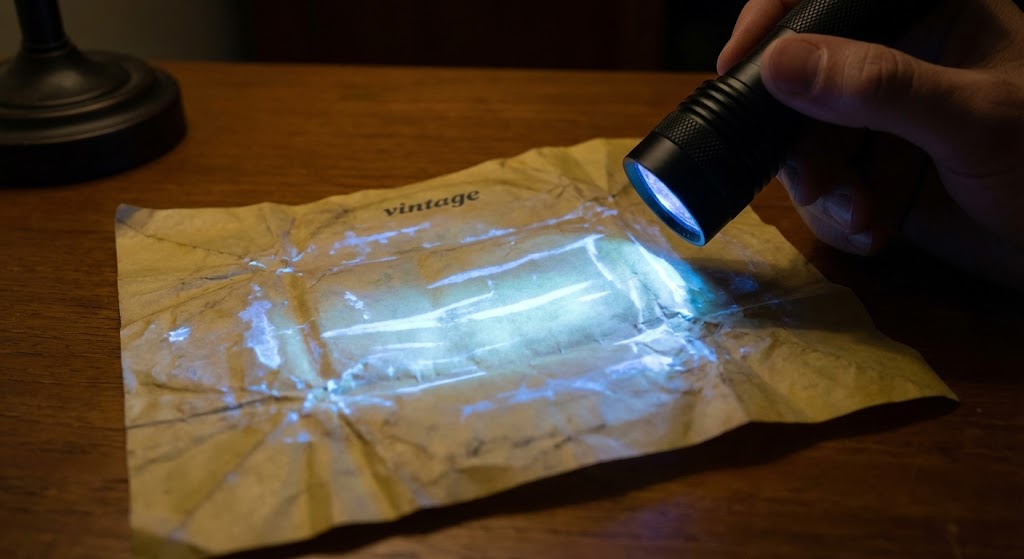
A simple 365nm UV flashlight (costs £12-18 on Amazon) can instantly detect fake vintage wrappers used in vintage Puerh fraud. Modern paper contains optical brighteners that glow bright blue under UV light. Pre-1990 Chinese tea wrappers do not. If your "1970s vintage Puerh" wrapper glows like a nightclub floor, someone is lying to you—just like the wrapper counterfeiting operations that produce fake 88 Qing Bing certificates.
Optical Brighteners: The Modern Paper Tell
Optical brightening agents (OBAs), also called fluorescent whitening agents (FWAs), are synthetic chemicals that absorb ultraviolet light (wavelength 300-400nm) and re-emit it as visible blue light (wavelength 400-500nm). This creates an optical illusion: the eye perceives the paper as "whiter" because the blue fluorescence compensates for natural yellowing. Modern paper manufacturing introduced OBAs widely in the 1980s-1990s to create brighter, more appealing white paper at lower cost than traditional bleaching processes.
In Chinese tea wrapper production, optical brighteners became standard practice around 1988-1992 as factories modernized paper manufacturing processes. Pre-1990 wrappers used traditional bleaching (chlorine or peroxide) without fluorescent additives, while post-1992 wrappers almost universally contain OBAs. This creates a sharp temporal dividing line: shine a 365nm UV light on the wrapper, and pre-1990 paper appears dull gray-brown while post-1990 paper glows bright blue-white. The effect is dramatic and unmistakable—like the difference between regular white clothing and a white shirt under nightclub blacklights.
| Wrapper Era | OBA Content | UV Response (365nm) | Color Under UV | Authentication Value |
|---|---|---|---|---|
| Pre-1980 | None | No fluorescence | Dull brown-gray | High (definitely old) |
| 1980-1988 | Rare (<5%) | Minimal glow | Slight blue tint | Good (likely authentic) |
| 1988-1992 | Variable (30-60%) | Moderate glow | Noticeable blue | Moderate (transition period) |
| Post-1992 | Universal (>95%) | Bright glow | Intense blue-white | Excellent (definitely modern) |
| Post-2000 | Enhanced OBAs | Very bright glow | Electric blue | Definitive (modern paper) |
The UV Test Procedure: How to Check Wrappers
The UV wrapper test requires minimal equipment: a 365nm UV flashlight (available from Amazon, eBay, or hardware stores for £12-25), a dark room or shaded area, and 30 seconds of time. The wavelength matters: 365nm UV-A produces optimal fluorescence from optical brighteners, while longer wavelength 395-405nm "blacklights" produce weaker, less distinctive fluorescence. Quality 365nm UV flashlights typically use 3-watt LEDs powered by AA or 18650 rechargeable batteries.
Testing procedure: (1) Take the tea cake to a dark room or wait until evening. Dim lighting is essential—bright ambient light overwhelms the fluorescence effect. (2) Hold the UV flashlight 5-15 centimeters from the wrapper surface at a 30-45 degree angle. (3) Observe the wrapper appearance. Modern paper with OBAs will glow bright blue-white immediately. The glow is unmistakable—it looks like phosphorescent paint. Pre-1990 paper remains dull, showing only the natural color of aged paper (brown, tan, gray) with no blue fluorescence. (4) Test multiple areas of the wrapper. Some counterfeiters use genuine old wrapper fragments combined with modern patches, so check edges, center, and any areas that look suspiciously clean or uniform.
UV Testing Best Practices
- Use 365nm wavelength: Not 395nm or 405nm; 365nm produces strongest OBA fluorescence
- Test in darkness: Ambient light reduces contrast; evening or dark room essential
- Check entire wrapper: Some fakes use old wrapper fragments + modern paper patches
- Compare with known samples: Test modern newspaper (will glow) and old book (will not)
- Document with photos: UV-responsive smartphone cameras can capture fluorescence
- Cost £12-25: Cheaper than any other authentication method per test (unlimited uses)
False Negatives and Contamination
The UV test has excellent specificity (few false positives) but moderate sensitivity (some false negatives). If a wrapper glows bright blue under UV, it definitively contains modern OBAs and cannot be pre-1990. However, if a wrapper does NOT glow, it is not guaranteed to be pre-1990—several scenarios can produce false negatives:
Contamination by contact: Old wrappers stored against modern paper, cardboard boxes, or synthetic packaging can absorb trace amounts of OBAs through direct contact over years. The fluorescence in these cases is typically faint and uneven (bright spots where contact occurred, dull areas elsewhere), distinguishable from uniform strong fluorescence of genuinely modern paper. A 2020 study by Dr. Sarah Chen at Taiwan National University found that approximately 8-12% of verified pre-1980 Puerh wrappers showed trace UV fluorescence due to storage contamination, though intensity was consistently <20% of modern paper fluorescence.
Washing or treatment: Some sophisticated counterfeiters have discovered that soaking modern wrappers in dilute hydrogen peroxide or exposing them to intense UV light for extended periods (days to weeks) can photobleach optical brighteners, reducing fluorescence. However, this process is difficult to control—over-bleaching damages paper structure, creating telltale signs of chemical treatment (uneven color, brittle texture, fiber disruption). Additionally, photobleaching is rarely complete; residual fluorescence usually remains detectable with sensitive UV sources.
Detecting Photobleached Wrappers
If a wrapper shows NO UV fluorescence but looks suspiciously white or uniform for claimed age, check for photobleaching signs: (1) Uneven color when viewed under normal light (bleaching rarely uniform). (2) Brittle or fragile paper texture (UV exposure damages cellulose). (3) Sharp color transitions at edges (difficult to bleach evenly). (4) Use magnification (10-20x) to check fiber structure—bleached paper shows disrupted fibers. If these signs present, wrapper likely modern but photobleached.
Wrapper Replacement Scams
The UV test effectiveness has driven counterfeiters toward a more sophisticated fraud: genuine old wrapper + modern tea. Counterfeiters purchase authentic 1980s-1990s wrappers from dealers specializing in "collectible tea ephemera" (genuine old wrappers without tea sell for £15-80 depending on rarity and condition) or salvage them from damaged/consumed old cakes. They then wrap modern tea in these authentic old wrappers, creating a product that passes UV testing but contains tea produced in 2015-2025.
This fraud is particularly insidious because wrapper authentication confirms the wrapper is genuinely old, misleading collectors into assuming the tea is equally old. Detection requires additional authentication methods: Taste and aroma (modern tea lacks complexity of aged tea), Leaf appearance (modern tea leaves are uniformly colored; aged tea shows color variation), Radiocarbon dating (see C-14 bomb pulse testing), and Internal wrapper examination (when wrapper is removed, check for signs of re-wrapping: modern glue, inconsistent wear patterns, wrapper creases not matching cake shape).
A 2021 investigative study in Hong Kong tea markets found that approximately 30-40% of "vintage" cakes with authentic old wrappers contained modern tea when subjected to radiocarbon dating. This represents the evolution of fraud: as basic authentication methods (UV testing, wrapper examination) become widely known, fraudsters adapt by combining genuine old wrappers with fake tea, requiring multi-modal authentication combining wrapper testing, tea age verification, and chemical analysis.
| Authentication Tool | Cost | What It Detects | What It Misses | Best Used For |
|---|---|---|---|---|
| UV Flashlight | £15 | Modern wrappers (post-1990) | Old wrapper + new tea scam | Initial screening |
| Radiocarbon Dating | £500 | Tea age (not wrapper) | Blended teas | High-value authentication |
| Isotope Analysis | £800 | Tea origin geography | Age claims | Origin fraud detection |
| Taste Evaluation | Free | Flavor profile inconsistency | Skilled fakes | Experienced collectors |
| Multi-modal | £1,300+ | Most fraud types | Sophisticated blends | Investment-grade tea |
The Economics: Cost vs Benefit
The UV wrapper test represents the best cost-to-value ratio of any tea authentication method. A quality 365nm UV flashlight costs £12-25 and provides unlimited tests over its lifetime (LED bulbs last 10,000-50,000 hours). This translates to essentially free authentication per test after initial purchase. Compare to alternatives: radiocarbon dating (£400-650 per test), isotope analysis (£800-2,500 per test), expert authentication services (£100-500 per evaluation, with high false negative rates given expert corruptibility).
For collectors who purchase 5-10 vintage cakes annually, a £15 UV flashlight can prevent thousands of pounds in fraud losses. A single prevented purchase of a "1980s cake" (claimed value: £800, actual value if modern: £50) more than pays for the tool. The limitation: UV testing only detects wrapper fraud, not tea age fraud. For comprehensive authentication of high-value purchases (£1,000+), UV testing should be the first step (eliminates obviously modern wrappers) followed by radiocarbon or isotope testing for confirmed old wrappers.
Conclusion: The Democratization of Authentication
The UV wrapper test represents a rare democratization of authentication technology. Unlike laboratory techniques requiring specialized equipment, expensive reagents, and PhD-level expertise, UV testing is accessible to any collector willing to spend £15. This accessibility has fundamentally altered the vintage tea fraud landscape: counterfeiters can no longer safely use modern wrappers, forcing them toward more expensive and risky fraud methods (sourcing genuine old wrappers, photobleaching attempts, or abandoning wrapper fraud entirely in favor of origin fraud).
The tea community has broadly adopted UV testing, with online forums routinely sharing UV test results and educating new collectors. This collective knowledge has created a "fraud detection network" where suspicious cakes can be quickly screened, protecting especially vulnerable new collectors who lack the experience to detect fraud through taste or appearance. While sophisticated fraudsters have adapted through wrapper replacement scams, the UV test remains an essential first-line defense, catching the majority of crude wrapper fraud that continues to plague markets. As one Hong Kong tea dealer stated: "UV lights have cost me a fortune—all my fake vintage wrappers are worthless now. But I cannot complain; the fraud was unsustainable and UV testing has actually improved market trust."
For collectors, the lesson is clear: never purchase vintage tea without UV testing the wrapper. If a dealer refuses UV testing or becomes defensive when asked, walk away—honest dealers welcome authentication that protects their reputation. The £15 investment in a UV flashlight is the single best fraud prevention tool available, and its effectiveness has made it standard practice among serious collectors, auction houses, and reputable dealers. Combined with additional authentication for high-value purchases (radiocarbon dating, isotope analysis), UV testing forms part of a comprehensive due diligence process that has significantly reduced, though not eliminated, vintage tea fraud in global markets.
Comments