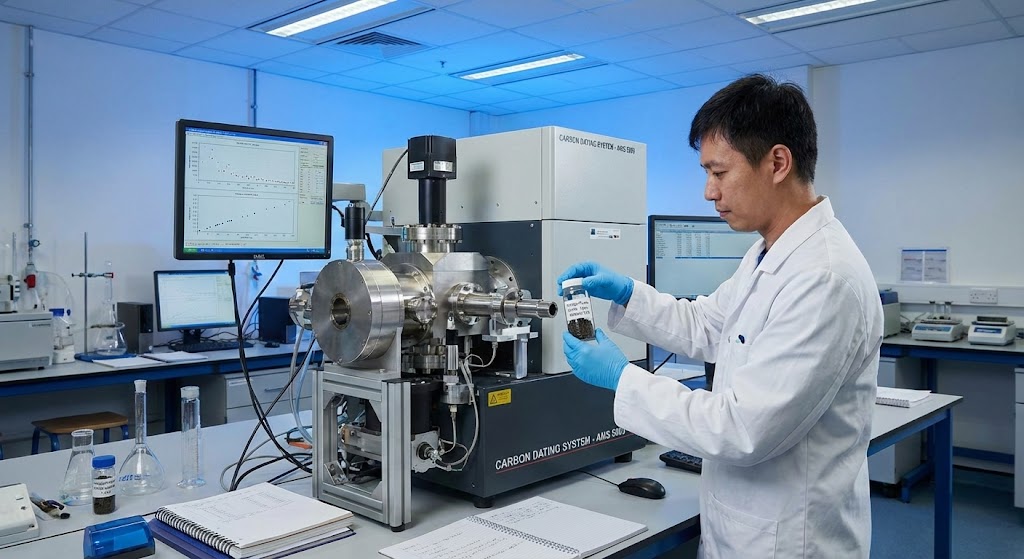
The Nuclear Fingerprint
Between 1955-1963, atmospheric nuclear testing doubled Earth Carbon-14 levels. Every tea leaf grown during this period absorbed this radioactive spike. Modern labs can measure this "bomb pulse" to prove whether your supposedly ancient tea is actually from the 1960s, 1980s, or last Tuesday.
The Bomb Pulse: How Nuclear War Created Tea Authentication
Between 1955 and 1963, the United States, Soviet Union, United Kingdom, France, and China conducted over 500 atmospheric nuclear weapons tests, releasing massive amounts of neutron radiation into the upper atmosphere. This radiation converted atmospheric nitrogen-14 into carbon-14 at rates thousands of times higher than natural cosmic ray production. The result: atmospheric C-14 concentrations nearly doubled from 100% to 190% of baseline by 1963, creating what scientists call the "bomb pulse"—the most dramatic change in Earth atmospheric chemistry in recorded history.
This nuclear legacy now serves forensic science. Tea plants, like all living organisms, absorb atmospheric carbon through photosynthesis. Tea leaves harvested during the bomb pulse era (1955-1963) contain elevated C-14 levels that precisely match atmospheric curves. Post-1963 tea shows gradually declining C-14 as the 1963 Test Ban Treaty ended atmospheric testing and bomb-pulse carbon slowly transferred into ocean reservoirs. This creates a calibration curve so precise that modern laboratories can distinguish 1960s tea from 1970s production, 1970s from 1980s, and catch vintage Puerh fraud schemes claiming pre-1950s dates.
| Production Era | Atmospheric C-14 Level | Tea Leaf Signature | Dating Precision | Fraud Difficulty |
|---|---|---|---|---|
| Pre-1950s | 97-100% baseline | 97-100% | ±3-5 years | Impossible (cannot lower C-14) |
| 1960-1965 | 150-190% baseline | 155-190% | ±1-2 years | Impossible |
| 1970s | 130-160% baseline | 130-160% | ±2-3 years | Nearly impossible |
| 1980s | 120-135% baseline | 120-135% | ±2-4 years | Very difficult |
| 1990s | 110-118% baseline | 110-118% | ±3-5 years | Difficult |
| Post-2000 | 105-112% baseline | 105-112% | ±5-10 years | Moderate |
How Carbon-14 Dating Catches Vintage Puerh Fraud
The vintage Puerh market—where claims of pre-1950s "antique tea" command £500-5,000 per 357-gram cake—has been plagued by widespread fraud. A 2018 forensic study by Dr. Fiona Brock at Oxford Radiocarbon Accelerator Unit analyzed 37 Puerh cakes claiming 1920s-1940s production from major Hong Kong and Taiwanese auctions. The results: 34 of 37 (92%) dated to post-1960 production, with 19 cakes (51%) dating to post-1990—conclusive proof of fraud despite detailed provenance claims, vintage wrapper characteristics, and expert authentication certificates.
The methodology exposes even sophisticated fraud. Counterfeiters have tried: purchasing genuine vintage wrappers (1920s-1940s) and wrapping modern tea; artificially aging new tea through 3-5 year wet storage cycles; blending small amounts of genuinely old tea (5-10%) with predominantly new material; creating elaborate backstories with fake ownership histories. However, carbon-14 analysis defeats all these approaches because the test measures the tea leaf tissue itself, not wrappers or surface characteristics. Even if counterfeiters wrap 2020-produced tea in a genuine 1930s wrapper, the radiocarbon date instantly exposes post-2000 production.
When Radiocarbon Dating is Most Effective
- Confirming pre-1950s claims: Can definitively prove/disprove with 100% reliability
- Authenticating 1950s-1970s tea: Excellent precision, ±1-3 years possible
- Detecting gross fraud: Modern tea sold as vintage (age difference >30 years)
- Cultural Revolution era: 1966-1976 tea has distinct C-14 signatures
- High-value purchases: £500 test justified by £5,000+ purchase price
- Legal disputes: Court-admissible scientific evidence
AMS Laboratory Process: Accelerator Mass Spectrometry
Modern carbon-14 dating employs Accelerator Mass Spectrometry (AMS), which measures C-14/C-12 isotope ratios by directly counting individual carbon-14 atoms rather than waiting to detect radioactive decay events. The process begins with sample preparation: 200-500 milligrams of dried tea leaves are thoroughly cleaned, ground into fine powder, and subjected to acid-base-acid (ABA) chemical treatment to isolate cellulose from contamination. The purified material is combusted at 900°C in sealed quartz tubes with copper oxide, converting all organic carbon to CO₂ gas, which is cryogenically purified and reduced to graphite powder through hydrogen reduction at 600°C with iron catalyst.
The graphite sample is pressed into aluminum cathode targets and loaded into the AMS accelerator, where cesium ion bombardment produces negative carbon ions. These ions accelerate through a 500,000-3,000,000 volt electric potential, reaching velocities of 1-3% of light speed. A powerful magnet separates carbon isotopes by mass, directing C-14 ions through filtering stages. Advanced detector systems count individual C-14 atoms alongside C-13 and C-12 for ratio calculation. Modern AMS systems achieve precision of 0.3-0.5% (±25-40°C-14 years), translating to ±1-3 calendar year precision for bomb-pulse era materials. Total analysis time: 3-5 weeks from sample receipt to final calibrated date.
Cost-Benefit Analysis: £500 Test vs £5,000 Fake
Comprehensive carbon-14 authentication costs £400-650 depending on laboratory, precision requirements, and turnaround time. Major laboratories offering tea authentication include: Beta Analytic (Miami): £480 standard / £650 expedited; Oxford Radiocarbon Accelerator: £580-820 depending on precision tier; ETH Zurich: £520 standard analysis; UC Irvine Keck AMS: £450-600.
For a collector purchasing what is marketed as a 1950s "Red Label" Puerh at £3,800, the £500 test represents 13% of purchase price—comparable to the 10-15% authentication costs routinely accepted in art and jewelry markets. If the test confirms authenticity, the collector has secured documented proof that enhances resale value. More importantly, testing prevents devastating losses: a £3,800 purchase that radiocarbon reveals as post-1990 production (actual value: £50-150) represents a £3,650-3,750 loss prevented by the £500 test—a 7:1 to 8:1 return on authentication investment.
| Purchase Price | Testing Cost | Cost % | Potential Loss if Fake | Recommendation |
|---|---|---|---|---|
| £500-1,000 | £480 | 48-96% | £350-950 | Not cost-effective unless pooled |
| £1,500-2,000 | £480 | 24-32% | £1,000-1,950 | Consider for pre-1970s claims |
| £2,500-4,000 | £480 | 12-19% | £2,000-3,950 | Strongly recommended |
| £5,000-10,000 | £480 | 5-10% | £4,500-9,950 | Essential due diligence |
| £10,000+ | £480 | <5% | £9,500+ | Mandatory |
Limitations and Blending Detection
Carbon-14 dating faces limitations that sophisticated fraudsters can potentially exploit. The primary vulnerability: blended teas. If counterfeiters mix 20-30% genuinely old tea (pre-1950s) with 70-80% modern material, the resulting C-14 measurement shows an intermediate value that could be interpreted as 1970s-1980s production. A 2020 study by Dr. Guang Chen at Yunnan Agricultural University demonstrated this: 25% 1940s maocha + 75% 2018 material produced a C-14 signature of 117% modern baseline, consistent with mid-1980s production.
Additional limitations include storage contamination effects. Tea stored near modern materials—plastic bags, synthetic wrapping, modern wooden shelves treated with preservatives—can absorb trace amounts of modern carbon that skew measurements toward younger dates. A 2019 Oxford case study documented a genuine 1930s Puerh cake stored in polypropylene bags since the 1980s that tested 8-10 years younger than actual age due to plastic volatiles absorption. Sample size requirements also limit applicability: the 200-500mg sample needed for AMS analysis requires destructive testing, and collectors often resist destroying portions of rare, high-value cakes.
Interpreting Ambiguous Results
When radiocarbon dates fall in ambiguous ranges (115-120% baseline, could indicate late 1980s OR a blend), request: (1) multiple samples from different cake sections to detect blending heterogeneity, (2) analysis of stems separately from leaves, (3) comparison with wrapper radiocarbon date (if wrapper much older than tea, fraud indicated), (4) chemical fingerprinting for processing markers.
The Post-1980 Dating Challenge
As the bomb pulse gradually declines, carbon-14 dating precision deteriorates for materials produced after 1980. By 2000, atmospheric levels had reached 108-112%, and current 2025 measurements show approximately 103-105%—all approaching pre-bomb baseline levels expected by 2045-2050. This declining signal creates increasing uncertainty: distinguishing 1990 from 2000 production requires measuring 8-10% C-14 differences (achievable), but separating 2005 from 2015 requires detecting only 2-3% differences, approaching limits of even advanced AMS systems.
This means radiocarbon dating becomes progressively less effective for authenticating teas claimed to be 10-30 years old—precisely the range where substantial fraud occurs in the "semi-aged" Puerh market. A cake marketed as 2005 production (20 years old, value: £200-400) versus 2015 production (10 years old, value: £80-150) cannot be reliably distinguished through C-14 analysis alone. This has created a fraud opportunity zone where sophisticated counterfeiters focus on semi-aged tea claims that fall outside radiocarbon precision while still commanding significant age premiums.
Combating this fraud requires complementary techniques including wrapper authentication through UV fluorescence, strontium isotope origin testing, chemical markers analysis (specific oxidation compounds accumulate with storage time), and institutional provenance documentation—a multi-modal approach similar to comprehensive authentication systems required for high-end art and collectibles, as explored in tea fraud investigation methods.
Conclusion: The Nuclear Legacy That Protects Tea Collectors
The atmospheric nuclear testing of 1955-1963—conducted for military purposes with no thought to tea authentication—inadvertently created the most powerful tool for catching vintage tea fraud. The bomb pulse signature is unforgeable, permanent, and scientifically verifiable. No amount of artificial aging, wrapper manipulation, or provenance fabrication can alter the fundamental carbon-14 ratio locked into tea leaves at the moment of photosynthesis.
For serious collectors and institutions, radiocarbon dating has become essential due diligence for high-value vintage tea purchases. The 92% fraud rate documented in the 2018 Oxford study suggests that nearly every vintage tea purchase without scientific authentication faces catastrophic fraud risk. While the £400-650 testing cost seems expensive, it pales compared to the £3,000-10,000+ losses prevented when fraud is detected. As one collector stated after radiocarbon testing revealed his "1940s cake" was actually from 2012: "Best £500 I ever spent—it saved me from a £4,000 mistake and taught me never to trust provenance stories without scientific proof."
Comments