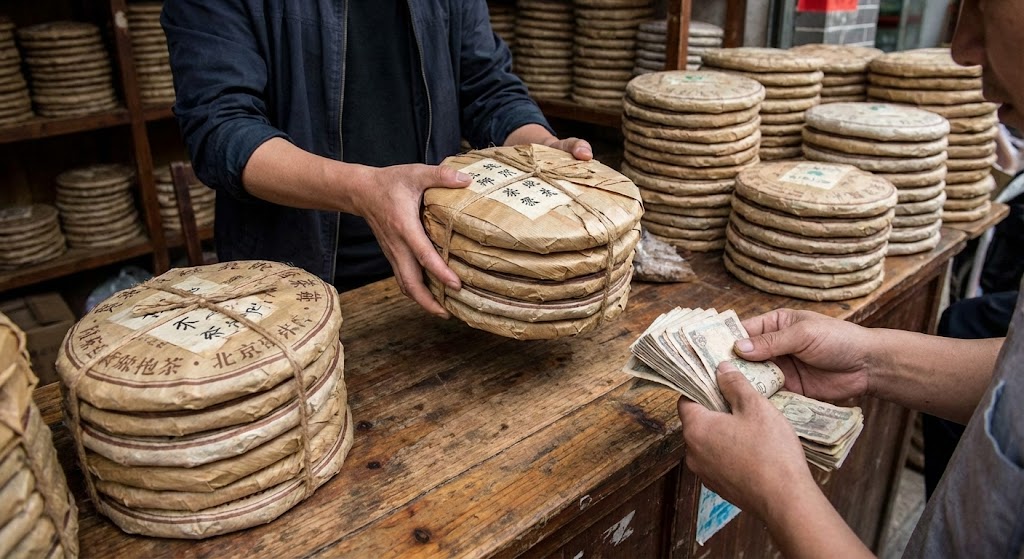
Why Criminals Prefer Tea Over Art
Art requires provenance paperwork, expert authentication, and public display (suspicious for criminals). Tea requires none of this—no central registry, no authentication standards, and culturally legitimate collecting. A £50,000 Puerh cake fits in a backpack and can be "discovered" in any warehouse without raising suspicion.
The Puerh Laundromat: How Tea Washes Money
Aged Puerh has become the criminal's favorite money laundering asset, surpassing art, jewelry, and even real estate in efficiency. The mechanism is simple: buy your own tea at inflated prices to create fake price history, then sell to unwitting buyers at "market value." Clean money comes out; dirty money goes in. The tea market's opacity makes detection nearly impossible—similar to how fake Yixing authentication exploits subjective valuation.
The Wash Trading Mechanism
Step 1: Acquire Bulk Tea (Legitimate Purchase)
Criminal organization buys 100kg of decent 2010 Puerh at legitimate market price (£50/kg = £5,000 total). This is clean money, legally sourced. The tea is real, properly stored, and unremarkable. This creates the physical asset for laundering.
Step 2: Create Shell Buyers (Fake Auction Bids)
Organization creates 3-5 shell companies or uses associates to pose as independent bidders at Hong Kong or Guangzhou tea auctions. These "bidders" compete for the organization's own tea, driving prices up artificially. Example: Tea worth £50/kg gets "bid up" to £500/kg through coordinated fake competition.
Step 3: Execute Wash Trades (Self-Dealing)
Organization sells tea to itself through shell bidders at £500/kg. The auction house records this as legitimate sale. The organization pays the auction house commission (10-15%), but gets clean money with documented "market value." The dirty £50,000 (original cost + markup) is now clean, with auction records as proof.
Step 4: Sell to Public (Exit Strategy)
After 2-3 rounds of wash trading, the tea has "auction history" showing £500/kg value. Organization sells to unsuspecting collectors at £400-450/kg (slightly below "market" to appear attractive). Buyers think they're getting deals; criminals get clean money. The tea was never worth £500/kg—the price was fiction.
Red Flags for Wash Trading
- Same buyer wins multiple auctions from same seller (shell companies recycling)
- Prices jump 300-500% in single auction without quality justification
- Recently produced tea sold as "investment grade" (wash trading needs liquidity)
- Vendor owns auction house or has board seats (conflict of interest)
- No third-party verification of tea age, origin, or storage history
Why Puerh? The Perfect Laundering Asset
Subjective Valuation (No Objective Price)
Unlike gold (spot price), stocks (ticker price), or real estate (comparable sales), Puerh has no objective value. Two "identical" cakes can differ 10x in price based on storage claims, origin stories, or vendor reputation. This subjectivity allows criminals to justify any price—£50/kg and £5,000/kg are both "defensible" depending on narrative.
Difficult Authentication (No Testing Standard)
Art has carbon dating, forensic pigment analysis, and provenance databases. Tea has radiocarbon dating and isotope analysis, but these cost £500-£2,000 per test and aren't standard practice in tea sales. Most Puerh changes hands based on vendor storytelling, not lab results. This means fake value is undetectable to buyers.
Legal to Own and Transport (Unlike Drugs/Weapons)
Crossing international borders with £50,000 in Puerh raises zero suspicion. It's tea—culturally legitimate, legal worldwide, and unregulated. Criminals don't need to hide it; they can openly discuss "my tea collection" without law enforcement interest. Compare this to cash (currency reporting laws), art (export restrictions), or jewelry (customs declarations).
Compact and Portable (High Value Density)
A 357g Puerh cake claiming "1980s aged" status can be worth £5,000-£20,000 yet fits in a coat pocket. Compare value density: 1kg Puerh (£50,000) vs 1kg gold (£50,000) vs 1kg cocaine (£50,000). The tea is legal, clean-looking, and culturally prestigious. It's the perfect smuggling asset.
The Macau Casino Connection
Macau casinos (world's largest gambling market) accept Puerh tea as collateral for gambling credit. Criminals "lose" at tables using tea as stake, then the casino "wins" the tea. The criminal gets clean casino chips (convertible to cash), the casino gets tea (resellable at auctions). Both sides profit; money is laundered through "gambling losses."
Case Study: The 2007 Puerh Bubble (Laundering Gone Wrong)
The 2007 Puerh crash exposed massive money laundering when the bubble burst. Prices had been inflated 500-1000% through wash trading, but when real buyers stopped entering the market (realizing prices were fictional), the scheme collapsed. Key lessons:
- £500M+ in "value" evaporated when wash trading stopped—proof most prices were fake
- Pig farmers became "tea investors" overnight—classic bubble behavior indicating speculation, not genuine collecting
- Factories couldn't sell inventory after crash—revealing overproduction driven by laundering demand, not tea demand
- Criminal networks shifted to wet-stored tea after crash—faster artificial aging via humidity fraud to recreate "aged" premium product
The crash didn't stop tea money laundering—it just made criminals more careful. Modern wash trading uses smaller price jumps (50-100% instead of 500%), longer timelines (3-5 years instead of 1 year), and better storytelling (fake "discovery" of warehouse finds).
Why Law Enforcement Struggles
No Legal Definition of "Aged" or "Vintage"
"This tea is 20 years old" is marketing claim, not legally verifiable statement. Unlike wine (strict appellation laws) or whiskey (age statement regulations), tea has zero legal standards for age claims. Prosecutors can't prove fraud when no legal definition of fraud exists.
Victims Complicit (Willful Ignorance)
Buyers want to believe they own rare tea. Admitting you were scammed destroys collector identity built around expertise. Most victims never report fraud; they quietly resell to next victim, perpetuating the cycle. No victims = no prosecution.
International Jurisdiction Complexity
Tea is bought in China, auctioned in Hong Kong, stored in Taiwan, sold to buyers in Europe/US. Which country has jurisdiction? Chinese authorities don't prioritize tea fraud, Hong Kong operates under different legal system, and Western law enforcement lacks tea expertise. Criminals exploit this jurisdictional complexity.
| Money Laundering Method | Tea Mechanism | Detection Difficulty | Effectiveness |
|---|---|---|---|
| Wash Trading | Buy own tea at auction via shell companies | Very High (looks like legitimate bidding) | 90%+ clean money |
| Over/Under Invoicing | Claim £50 tea cost £500 on import docs | Medium (customs may check) | 70% clean money |
| Casino Collateral | Use tea as gambling stake in Macau | High (casino records opaque) | 85% clean money |
| Fake Storage Fees | Pay inflated "storage" to shell warehouse | Low (easily audited) | 50% clean money |
| Gift Transactions | Claim tea was "gift" to justify wealth | High (hard to disprove) | 80% clean money |
How to Avoid Funding Crime
Demand Lab Testing for Expensive Tea
If paying £500+ for "aged" Puerh, insist on radiocarbon dating (£500-800) to verify age. If vendor refuses or claims "testing damages tea" (it doesn't for small sample), walk away. Legitimate sellers welcome authentication; criminals avoid it.
Verify Auction House Independence
Check if auction house has financial ties to major vendors or tea factories. Independent auction houses reduce wash trading risk. Red flag: "in-house auctions" where vendor also owns auction platform.
Track Price History Skeptically
If tea jumped from £50/kg to £500/kg in 12 months, demand explanation beyond "market discovery." Legitimate appreciation is gradual (5-10% annually); wash trading is explosive (100-500% annually).
Buy for Drinking, Not Investment
The only way to avoid tea laundering schemes is to ignore investment narrative entirely. Buy tea you'll drink within 2-5 years, ignore "appreciation potential," and treat aging as personal preference rather than financial strategy. This eliminates criminal targeting—they need speculative buyers to exit laundered tea.
The Blockchain "Solution" Scam
Some vendors claim blockchain tracking "solves" tea fraud by recording provenance. This is false: blockchain only records what you input. If you input "1980s vintage tea" for 2015 factory tea, blockchain permanently records the lie. Blockchain doesn't verify truth—it just makes lies immutable. Demand physical lab testing, not digital provenance theater.
Conclusion: Tea as Financial Crime Infrastructure
Puerh money laundering isn't edge case—it's systemic feature of unregulated tea markets. The same characteristics that make tea culturally valuable (subjective quality, aging potential, cultural prestige) make it criminally useful (price opacity, difficult authentication, social legitimacy).
The solution isn't banning tea sales—it's buyer education and forensic standards. Understand wash trading mechanics, demand lab verification for expensive purchases, and reject investment narratives that require finding "greater fool" to resell to. Drink your tea; don't launder with it.
Comments