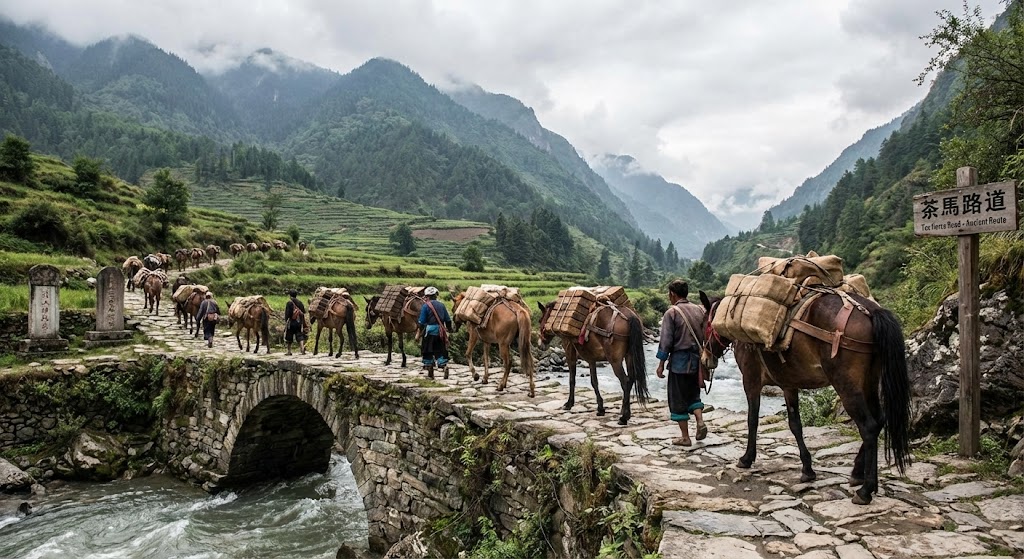
Why Puerh is Compressed: It's Bandit-Resistant Engineering
Loose-leaf tea in sacks is easy to steal: bandits slit the sack, scoop out tea, disappear. Compressed tea bricks (357g cakes, 250g bricks, 100g tuocha) require tools to break apart, can't be secretly pilfered, and have distinctive stamps identifying the merchant. If bandits stole compressed tea, they had to sell whole bricks—merchants recognized each other's stamps and reported theft. The compression wasn't for aging or transport convenience (though it helped)—it was anti-theft technology. This is why tea from historically dangerous routes (Yunnan-Tibet, Sichuan-Tibet, Yunnan-Burma) is always compressed, while safe-route tea (Jiangxi-Beijing canal route) was loose-leaf.
The Route: 2,250km Through Hell
The Ancient Tea Horse Road (Chamagudao, 茶马古道) connected Yunnan tea-growing regions (Xishuangbanna, Simao/Pu'er) to Tibet (Lhasa, Shigatse) via two main routes:
Yunnan-Tibet Route (primary, 2,250km): Pu'er → Dali → Lijiang → Shangri-La (Zhongdian) → Deqin → Markam → Chamdo → Lhasa. Duration: 6-8 months one-way. Altitude: starts 1,200m (Pu'er), climbs to 5,000m+ (Deqin-Markam pass), descends to 3,650m (Lhasa).
Sichuan-Tibet Route (secondary, 2,800km): Ya'an (Sichuan tea) → Kangding → Litang → Chamdo → Lhasa. Duration: 8-12 months. Altitude: peaks at 5,200m (Litang-Batang pass).
Both routes crossed:
- Five major river gorges: Mekong (Lancang), Salween (Nu), Yangtze (Jinsha), Yalong, Yellow River. Each required rope bridges (frequently destroyed by storms) or dangerous ferry crossings. Drowning was the #1 cause of death.
- Mountain passes above 4,500m: Baima Snow Mountain (4,292m), Hongla Mountain (4,448m), Dongda Mountain (5,008m). Altitude sickness, frostbite, snowstorms killed 15-20% of caravan members on these passes.
- Landslide and avalanche zones: The Hengduan Mountains (vertical relief 3,000-4,000m) experience monsoon rains (May-September) triggering landslides, and winter snows (November-March) avalanching onto narrow mountain trails. Historical records: 3-5 major caravan-destroying avalanches per decade.
- Bandit territories: Kham region (eastern Tibet) had organized bandit clans controlling mountain passes. Caravan passage required "toll" payments—50-80% of tea cargo or armed confrontation.
| Segment | Distance | Duration | Primary Hazard | Mortality Rate (Historical) |
|---|---|---|---|---|
| Pu'er to Dali (Yunnan lowlands) | 420km | 3-4 weeks | Malaria, bandits | 5-8% |
| Dali to Lijiang (Yunnan highlands) | 180km | 2 weeks | Landslides, river crossings | 8-12% |
| Lijiang to Deqin (Tibetan border) | 250km | 3-4 weeks | Altitude sickness, snow | 15-20% |
| Deqin to Markam (Kham entry) | 180km | 4-6 weeks | Avalanches, bandit ambush | 20-30% |
| Markam to Chamdo (Kham) | 450km | 6-8 weeks | Bandit tolls, extreme cold | 10-15% |
| Chamdo to Lhasa (central Tibet) | 770km | 8-10 weeks | Altitude, starvation (supplies ran out) | 12-18% |
Total cumulative mortality: Historical caravan records (Qing Dynasty archives, Yunnan Provincial Museum) indicate 30-35% of caravan members who departed Pu'er never returned. Some died en route (above percentages), others settled in Tibet, but the majority died. This is why tea caravan work paid 10x normal labor wages—it was a death sentence with good money.
Bandit Tactics: The Kham Mountain Gangs
The Kham region (eastern Tibet, now split between Tibet Autonomous Region, Sichuan, and Yunnan provinces) was historically lawless—Lhasa government had weak control, local chieftains ruled, and banditry was quasi-legitimate economy. Bandit clans controlled mountain passes and extorted caravans.
Chokepoint Control: Bandits didn't roam randomly—they controlled narrow passes where caravans couldn't avoid them. Example: Hongla Pass (4,448m) had a 200m section with cliffs on both sides, single-file trail. Bandits built stone fortifications at both ends, trapped caravans in the middle, and demanded payment.
Toll System: Bandits operated like informal government: caravans paid "toll" (usually 50-60% of tea cargo, or equivalent silver), received safe passage and a token (stamped wood plaque or silk ribbon) proving payment. Other bandit clans honored the token—violating it meant inter-clan war. This system was more profitable than outright robbery: bandits wanted repeat customers, not one-time theft.
Seasonal Raiding: During winter (November-March), passes were impassable due to snow—bandits raided valleys below the passes, stealing tea from warehouses where caravans waited for spring thaw. During summer (May-September), monsoon rains made trails muddy—bandits attacked bogged-down caravans at river crossings.
Violence: If caravans refused to pay toll, bandits killed the caravan leader (pour encourager les autres) and took 100% of cargo. Historical records describe bandits throwing resistors off cliffs, leaving bodies as warnings. Caravans that fought back rarely survived—bandits had home-terrain advantage, fortifications, and crossbows (effective range 200m in thin mountain air).
Bandit Economics: A successful Kham bandit clan (50-100 members) controlling one major pass could extract 200-400 tons of tea annually (50-60% toll from 400-700 tons passing through). Market value in Lhasa: 15-25 taels silver per 50kg brick = 60,000-200,000 taels/year (£4-13 million modern equivalent). Bandit clans were wealthier than minor Tibetan nobility.
Why Caravans Didn't Use Alternate Routes
- Geography permitted no alternatives: The Hengduan Mountains run north-south, creating parallel river gorges. To go from Yunnan to Tibet, you MUST cross 5 rivers and their intervening mountains. There are no lowland routes—the only choice is which specific pass to use, and bandits controlled them all.
- Longer routes = higher mortality from other hazards: Detouring around bandit-controlled passes added 200-400km and 2-4 months travel time. More time = more exposure to altitude sickness, avalanches, starvation. Paying bandits was safer than detours.
- Bandits had intelligence networks: Caravan departures from Pu'er were public knowledge (big events, Buddhist ceremonies for safe journey). Bandits had spies in tea towns who sent runners ahead (faster than slow-moving mule caravans) to alert mountain gangs. Caravans couldn't sneak through.
- Tibetan monasteries cooperated with bandits: Monasteries along the route (Ganden Sumtseling near Shangri-La, Qamdo Jampaling) received tea donations from caravans (10-15% of cargo). Monasteries had relationships with bandit clans (some bandits were monks' relatives). Monasteries wouldn't help caravans evade tolls.
- Winter closures meant no seasonal evasion: Caravans couldn't travel in winter (passes closed by snow) or late monsoon (landslide risk). The safe seasons (April-May, October-November) were when bandits were most active because all caravans traveled then.
Compression Engineering: The Anti-Theft Design
Puerh tea compression evolved specifically to resist theft on the Tea Horse Road:
The Problem with Loose Leaf: Early tea caravans (Tang Dynasty, 600-900°CE) transported loose-leaf tea in bamboo baskets or cloth sacks. Bandits could:
- Slit the sack with a knife, scoop out 10-20kg, reseal it without obvious evidence. Merchants didn't discover short weight until reaching Lhasa.
- Transfer tea to unmarked containers, sell it anonymously in markets along the route.
- Dilute tea with sawdust or tree leaves, reducing value without changing weight.
The Compression Solution (Song Dynasty, 960-1279°CE): Compress tea into bricks stamped with merchant seals. Advantages:
- Tamper-evident: Breaking a brick requires tools (hammer, axe). A broken brick is obvious evidence of theft—can't be secretly pilfered.
- Traceable: Each brick stamped with merchant's chop mark (印章, yinzhang), production year, and weight. Merchants published their seal designs in regional trade guilds. If stolen tea appeared in Lhasa markets, buyers could identify which caravan it came from and report to authorities.
- Standardized value: Bricks had fixed weight (357g, 250g, 500g) and tea grade (high-grade surface layer, lower-grade compressed core). Merchants and bandits both knew the value—reduced disputes and violence. "Ten 357g cakes" was clear toll demand; "ten baskets of loose tea" led to arguments about weight and quality.
- Difficult to dilute: Compressing tea with adulterants (sawdust, leaves) produces weak, crumbly bricks that break apart during transport. High-quality compression requires pure tea and hydraulic presses (stone weights, screw presses).
Compression Pressure: Historical tea bricks were compressed at 200-400 psi (stone weight pressing on molds for 12-24 hours). Modern hydraulic presses use 400-800 psi for 5-10 minutes. The result: density of 0.7-0.9 g/cm³ (similar to hardwood), hard enough to resist casual breakage but brittle enough to break cleanly when deliberate.
Shapes and Sizes:
- 357g cake (bing, 饼): Most common. Seven cakes = 2.5kg, wrapped together in bamboo leaf bundle (tong, 筒). Twelve tongs = 30kg, one mule load. Dimensions: 18-20cm diameter, 2-3cm thick.
- 250g brick (zhuan, 砖): Rectangular, easier to stack. Dimensions: 12cm × 8cm × 2cm. Used for lower-grade tea (border-grade tea, bian xiao zhuan).
- 100g tuocha (沀茶, "bowl tea"): Bowl-shaped, convenient for individual sale in Tibet. Dimensions: 8cm diameter, 4cm tall.
- 5kg large brick (da zhuan, 大砖): For wealthy Tibetan monasteries and nobility. Dimensions: 35cm × 25cm × 8cm. Too heavy to steal easily—requires two people to carry.
| Brick Type | Weight | Uses | Compression Pressure | Anti-Theft Features |
|---|---|---|---|---|
| 357g bing cake | 357g (12.6oz) | Standard trade unit, 7 cakes = 1 tong | 400-600 psi | Stamped seal, fixed weight, traceable |
| 250g rectangular brick | 250g (8.8oz) | Lower-grade tea, military rations | 300-500 psi | Harder to break than cake, stackable for counting |
| 100g tuocha bowl | 100g (3.5oz) | Retail sale in Tibet, single-use | 500-700 psi | Small size = low theft value, distinctive shape |
| 500g fang cha square | 500g (17.6oz) | Premium tea, gift market | 400-600 psi | Embossed patterns, luxury packaging, high-value seals |
| 5kg da zhuan large brick | 5kg (11 lb) | Monasteries, nobility bulk purchases | 200-400 psi (too large for high pressure) | Too heavy to steal secretly, requires team to transport |
The Tea-Horse Trade Economics
The name "Tea Horse Road" comes from the barter system: Yunnan tea for Tibetan horses.
Why Tibet Wanted Tea:
- Dietary necessity: Tibetan diet (barley tsampa, yak butter, yak meat) is high-fat, low-vitamin, causes digestive issues. Tea provides tannins (aid fat digestion), vitamin C (prevents scurvy), and warmth. Tibetans drank po cha (butter tea): brick tea boiled for hours, mixed with yak butter and salt, churned into soup-like beverage. Consumed 3-5 liters per day.
- Cultural ritual: Tea offering to guests, monks, and gods. Tibetan Buddhism incorporated tea into monastic life (monks drank tea during long meditation sessions to stay alert). Offering tea = social obligation.
- Medicine: Tibetan medicine used tea to treat altitude sickness (high tannin tea acts as mild stimulant, improves oxygen absorption), digestive disorders, and infections (tea's antimicrobial properties were empirically observed, though mechanism unknown until 20th century).
Why Yunnan Wanted Horses:
- Military: Tibetan and Mongolian horses (small, hardy, high-altitude adapted) were superior to Chinese lowland horses for cavalry in Yunnan's mountainous terrain. Song and Ming Dynasties purchased 10,000-20,000 horses annually for military use.
- Transport: Horses and mules were essential for mountain transport. Yunnan bred mules from imported Tibetan horses × local donkeys—mules were the caravan animals that carried tea to Tibet, creating self-sustaining trade loop.
Exchange Rate: Highly variable by dynasty, region, and year, but Tang Dynasty (618-907°CE) records suggest:
- 1 superior Tibetan warhorse = 50-80kg fine tea (equivalent to 140-224 × 357g cakes)
- 1 ordinary Tibetan pony = 20-30kg border-grade tea (56-84 cakes)
- 1 mule = 15-20kg tea (42-56 cakes)
By Qing Dynasty (1644-1912), the trade shifted to silver-based: Tibet paid silver for tea (sourced from Himalayan trade with India/Nepal), and China paid silver for horses. The barter system persisted only in remote regions.
Decline and Modern Relics
1950s: End of the Road: After Chinese Communist Party established control over Tibet (1950-1951), the Tea Horse Road was replaced by motorized truck routes. The Sichuan-Tibet Highway (completed 1954) and Yunnan-Tibet Highway (completed 1957) reduced transport time from 6-8 months to 7-10 days. Caravans ceased by 1960.
Bandit Suppression: The PLA suppressed Kham bandit clans during the 1950s as part of "anti-bandit campaigns." Former bandits were either executed (leadership), imprisoned (fighters), or "reformed" into agricultural communes (lower-level members). The clan structure was destroyed.
Modern Relics:
- Trails: Sections of the original stone-paved caravan trail survive in Yunnan (Shaxi Ancient Town, Cizhong village) and Sichuan (Litang, Kangding). Now tourist attractions and UNESCO Heritage Sites.
- Caravan songs: Naxi and Tibetan ethnic groups preserve traditional caravan songs (mengdiao, 赶马调), sung to coordinate mule pacing and ward off loneliness. Recordings archived by Chinese Academy of Social Sciences.
- Tea brick production: Compression technology persists—modern Puerh is still sold in 357g cakes and 250g bricks, using the same shapes designed 1,000 years ago for bandit resistance. The functional purpose is obsolete but tradition continues.
Conclusion: Compressed Tea as Historical Artifact
When you break apart a 357g Puerh cake today, you're using a form designed to resist bandits on the Tea Horse Road. The compression, the weight, the stamped seal—all anti-theft engineering from an era when 30% of tea caravan members died en route and bandits extracted 50-80% tolls at mountain passes.
The Tea Horse Road operated for 1,300 years (600-1950°CE), transported millions of tons of tea, built Tibetan Buddhist culture's tea dependency, and shaped Yunnan-Tibet relations. It was the most dangerous trade route on Earth—more deadly than the Silk Road, more bandit-infested than the Saharan caravan routes.
Modern Puerh drinkers romanticize "ancient tea horse road tea," but the reality was violence, death, and theft. The brick in your hand is a survival tool, not an aesthetic choice.
For other smuggling routes: modern Taiwan smuggling, British tea espionage. For authentication: Lao Ban Zhang fraud detection, radiocarbon dating old tea. See full criminology at Tea Criminology Hub.
Comments