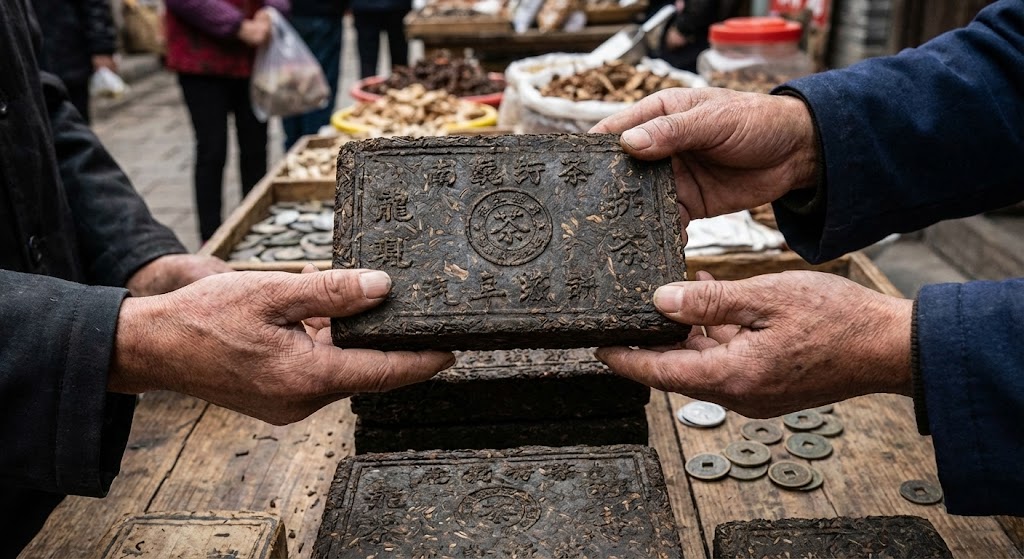
Tea Was Literally Money
From ~1600-1940s, tea bricks were legal tender across Siberia, Mongolia, Tibet, and parts of China. Not metaphorical "valuable like money"—actual currency you could pay taxes with, receive as wages, and use in shops. Russian government even stamped tea bricks with official currency marks.
Why Tea Made Better Money Than Metal Coins
Gold and silver have no intrinsic use value—they're valuable because people agree they are. If monetary system collapses, gold becomes decorative metal. Tea bricks are different: even if tea-as-currency system fails, you can still drink the tea. This creates value floor that metal currency lacks.
In harsh climates (Siberia, Tibet, Mongolia), tea provided calories, warmth, and medicinal benefits. A tea brick was simultaneously money and survival resource. This dual function made tea more reliable than silver during economic crises—when famine hit, you couldn't eat silver, but you could drink tea.
| Currency Type | Intrinsic Value | Portability | Counterfeiting Risk | Inflation Resistance |
|---|---|---|---|---|
| Silver coins | Low (decorative only) | Medium (heavy) | Medium | Low (mintable) |
| Paper money | None | Very High | Very High (printable) | Very Low |
| Grain | High (food) | Low (bulky) | Low | Medium |
| Tea bricks | High (drink + medicine) | High (compressed) | Low (skill-intensive) | High (limited supply) |
Historical Tea Currency Systems
Russian Empire (1700s-1917)
Russian government recognized tea bricks as legal tender in Siberia. Government-stamped tea bricks circulated alongside ruble coins. Tax collectors accepted tea payment; frontier traders preferred tea over paper rubles (more stable, harder to counterfeit). Why Russia adopted tea-currency: Siberian distance from European Russia made coin transport expensive and risky. Local populations already used tea in barter. Government formalized existing practice.
Mongolia (1600s-1921)
Mongolian nomads lived in remote pasturelands far from markets. Metal coins were scarce; paper money meaningless. Tea bricks became universal medium of exchange. Valuation system: 1 brick tea = 1 sheep (approximate). This created stable pricing—tea supply limited by transport difficulty from China via the dangerous Tea Horse Road, so inflation was minimal compared to modern speculative tea bubbles.
Why Nomads Preferred Tea-Money
Nomadic lifestyle requires portable wealth. Livestock cannot be easily divided. Metal coins are heavy and scarce. Tea bricks solved both problems: lightweight, divisible (break into chunks), and universally valued. A nomad could carry wealth in tea bricks, trade them anywhere, and drink them if trade opportunities did not arise.
Tibet (1300s-1950s)
Tibetan monasteries controlled tea distribution from Yunnan/Sichuan via Tea Horse Road. Monks received tea bricks as tithes; monasteries paid workers in tea. This created monastic currency system where tea was both religious offering and economic medium. Tibetan tea currency persisted until 1950s Chinese occupation, when PRC government banned tea-as-currency, mandating yuan-only transactions.
Supply Control and Anti-Inflation
Tea currency worked because supply was naturally limited. Tea grew in specific regions, required skilled processing, and took months to transport via dangerous caravan routes. This made sudden supply increases impossible—couldn't just "print more tea" like paper money.
Compare to modern Puerh speculation: when tea becomes investment rather than currency, supply constraints break down. Historical tea-currency avoided this because tea was consumed, not hoarded—spending was mandatory (you need to drink tea), preventing speculative bubbles.
| Period | Tea Type | Standard Unit | Approximate Value | Geographic Range |
|---|---|---|---|---|
| Russia 1700s-1917 | Black brick | 1 brick (500g) | 1 week wages | Siberia, Far East |
| Mongolia 1600s-1921 | Black/Dark brick | 1 brick (350g) | 1 sheep / 5 days wages | All Mongolia |
| Tibet 1300s-1950s | Dark brick (Puerh) | 1 brick (250-357g) | Variable (monastery rates) | Tibet, Qinghai |
| China borderlands | Compressed Puerh | 1 tuo (100-250g) | Daily wages | Yunnan, Sichuan |
Modern Resurgence: Prepper Tea-Money
Survivalist/prepper communities (2000s-present) have rediscovered tea-as-currency concept. Reasoning: in economic collapse, paper money becomes worthless, but consumables retain value. Tea offers shelf-stable, tradeable, consumable wealth. Modern prepper tea focuses on individually wrapped single-serving Puerh (easier to trade) rather than large bricks. Vacuum-sealed packaging extends shelf life to 20+ years.
Prepper Tea Currency Strategy
- Buy compressed Puerh: Lasts decades, improves with age, compact storage
- Smaller units preferred: 5-10g packets easier to trade than 357g cakes
- Vacuum seal for longevity: Prevents oxidation, extends shelf life 20+ years
- Diversify varieties: Black/dark tea for labor trades, green/white for luxury
- Avoid speculation-grade: Buy functional tea (£5-20/kg), not investment Puerh (£500/kg)
Lessons from Tea Currency History
Historical tea-currency reveals money's essential properties: Scarcity (difficult to produce unlimited quantities), Divisibility (breakable into smaller units), Portability (lightweight and compact), Durability (doesn't spoil quickly), Recognizability (easy to verify authenticity), and Utility (has use-value beyond being money).
Modern fiat currency has most properties except scarcity (central banks can print unlimited amounts) and utility (paper has no use-value). This explains why fiat currencies experience inflation while historical tea-currency didn't.
The Ultimate Stable Currency?
Economist F.A. Hayek proposed "commodity currencies" backed by consumables rather than government promise. Tea-currency was real-world test of this theory—and it worked for centuries. Modern cryptocurrencies attempt similar goal (decentralized, inflation-resistant money), but lack tea consumable value floor.
Could Tea-Currency Return?
If global financial system collapses (hyperinflation, cyberattack on banking, geopolitical crisis), commodity currencies will re-emerge. History shows people spontaneously adopt alternative money when official money fails: cigarettes in post-WWII Germany, mobile phone minutes in Africa, Bitcoin in Venezuela.
Tea has advantages: universally valued across cultures (unlike cigarettes), no technology requirement (unlike Bitcoin, which needs electricity/internet), and health benefits (unlike alcohol-as-currency, which is destructive). Will it happen? Unknown. But history proves tea-currency isn't fantasy—it's established precedent.
Conclusion: Tea as Monetary Insurance
For 300 years, tea bricks functioned as reliable currency across Asia. They provided portable wealth, inflation resistance, and consumable value floor. Modern fiat currency offers none of these—only government promise and legal tender laws.
Stockpiling tea isn't prediction of collapse—it's diversification strategy. If financial system remains stable, you have delicious tea to drink. If system collapses, you have tradeable commodity with intrinsic value. Downside risk is minimal (tea costs £5-20/kg); upside in crisis scenario is substantial.
The Mongolian nomads knew something modern economists forgot: the best money is money you can drink.
Comments