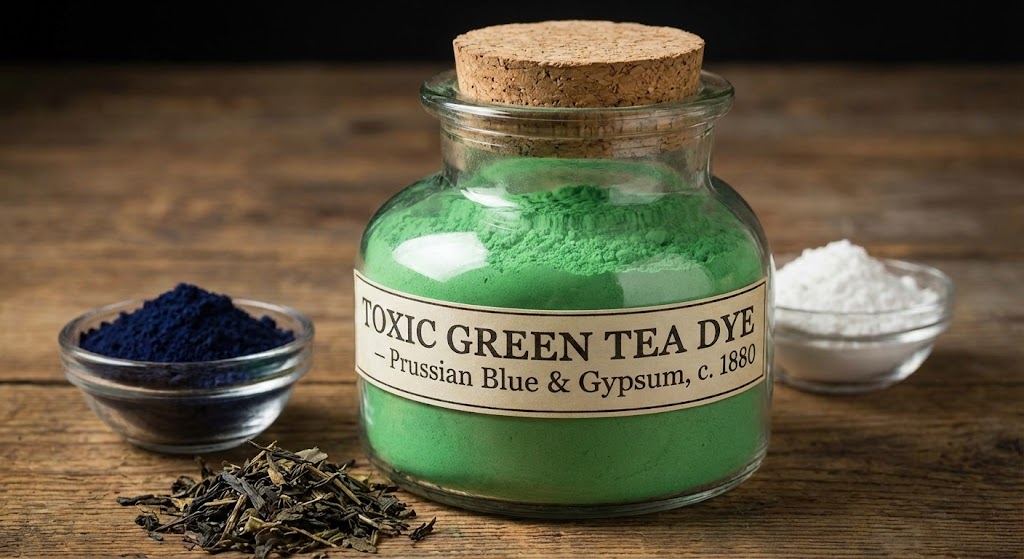
The 1851 Scandal: 4 Tons of Sheep Dung in London's Tea Supply
In 1851, London chemist Arthur Hill Hassall analyzed 34 samples of 'green tea' from working-class grocers. Results published in The Lancet: 31 of 34 samples (91%) contained Prussian blue dye (iron ferrocyanide, toxic), 24 samples (71%) contained lead chromate or lead arsenate (deadly heavy metals), and 18 samples (53%) contained foreign plant matter—identified as ash tree leaves, willow leaves, and dried sheep dung. The adulterators used sheep dung as bulking agent (it's fibrous, looks like low-grade tea when dried and dyed green). Estimated 4-6 tons of sheep dung entered London tea supply annually in the 1840s-1850s. The scandal triggered the 1860 Food Adulteration Act, Britain's first food safety law.
The Business of Used Tea: Collecting and Recycling
Victorian tea adulteration had an entire underground economy:
Used Leaf Collection: Professional "tea collectors" (often children or elderly poor) went door-to-door in London, buying used tea leaves from households for 1-2 pence per pound. Hotels, restaurants, and wealthy homes sold their spent tea in bulk (5-20 pounds weekly). The collectors paid 1-3 shillings per hundredweight (50kg), reselling to adulterators for 5-8 shillings per hundredweight (100-166% markup).
Processing Facilities: East London warehouses (Whitechapel, Bethnal Green) processed used tea:
- Drying: Spread used leaves on heated metal plates (coal-fired, 60-80°C) for 4-6 hours until moisture content dropped from 80% to 10-15%. This restored crispness, making the leaves look "fresh."
- Dyeing: Mix dried leaves with Prussian blue powder (iron(III) ferrocyanide, bright blue pigment) + gypsum powder (calcium sulfate, white bulking agent) + a small amount of turmeric or saffron (yellow dye). Ratio: 100 pounds tea + 2-4 pounds Prussian blue + 3-6 pounds gypsum + 0.5 pounds turmeric. The blue + yellow = vivid green color mimicking high-grade Chinese green tea.
- Bulking with Adulterants: To increase volume (and profit), add cheaper materials:
- Ash tree leaves: Dried, chopped ash leaves (from London parks, gathered by children for 1 penny per pound) mixed at 20-40% ratio.
- Willow leaves: Similar to ash, but cheaper (collected from riverbanks).
- Hawthorn leaves: Collected from hedgerows.
- Dried sheep dung: Collected from pastures, dried, crumbled, dyed green. Looks fibrous like low-grade tea. Mixed at 10-30% in cheapest tea grades.
- Floor sweepings: Dust and debris from tea warehouses (contains real tea fragments + dirt + insect parts).
- Tumbling and Polishing: Mix in rotating drum for 30-60 minutes to blend colors evenly and break up clumps. Add a small amount of linseed oil or tallow (fat) to create glossy appearance (mimics fresh tea's natural oils).
Repackaging and Sale: The adulterated tea was sold to grocers as "China Green Tea, Second Grade" or "Common Green" at 2-4 shillings per pound (vs 6-12 shillings for genuine imported Chinese tea). Grocers resold it to working-class customers at 3-5 shillings per pound, making 50-100% markup.
| Adulterant | Cost (per pound) | Purpose | Health Effect | Detection Method (Victorian) |
|---|---|---|---|---|
| Prussian blue (iron ferrocyanide) | 1 shilling (wholesale) | Blue dye (mixed with yellow = green) | Acute: vomiting, diarrhea. Chronic: cyanide poisoning (releases HCN in stomach acid) | Burn tea leaves—blue flame = Prussian blue |
| Lead chromate (chrome yellow) | 2 shillings | Yellow dye (brighten green color) | Lead poisoning: abdominal pain, anemia, neurological damage, death (cumulative) | Dissolve in nitric acid—yellow precipitate = lead |
| Gypsum (calcium sulfate) | 2 pence | White powder (increase weight, dilute color) | Mild: digestive irritation. Mostly inert. | Doesn't dissolve in water (sinks to bottom of teacup) |
| Ash/willow/hawthorn leaves | 1 pence | Bulk (look like tea leaves when dried + dyed) | Non-toxic but nutritionally empty, displaces real tea | Microscope: wrong leaf venation pattern vs Camellia sinensis |
| Sheep dung | Free (collected from fields) | Fibrous bulk (looks like low-grade tea) | Bacterial contamination (E. coli, Salmonella), parasites | Smell test (dung smells like manure when wet) |
| Verdigris (copper acetate) | 3 shillings | Green dye (alternative to Prussian blue) | Copper poisoning: liver damage, kidney failure | Dissolve in ammonia—blue solution = copper |
Health Consequences: Poisoning the Working Class
Prussian Blue Toxicity: Chemically iron(III) hexacyanoferrate(II), Prussian blue is relatively stable—but in acidic environment (stomach acid, pH 1.5-3.5), it slowly releases hydrogen cyanide (HCN) gas, interfering with cellular respiration much like how genuine tea's L-theanine and EGCG have beneficial biochemical effects. Chronic low-dose exposure causes:
- Acute symptoms (high dose, 50-100mg Prussian blue in one cup): nausea, vomiting, diarrhea, dizziness, rapid heartbeat (cyanide interferes with cellular respiration).
- Chronic symptoms (daily consumption over months): fatigue, headaches, difficulty breathing, neurological damage (cyanide accumulates in tissues). Victorian medical records (London Hospital archives, 1840s-1860s) show 200+ cases annually of "tea poisoning" with these symptoms.
Lead Poisoning Epidemic: Lead chromate (PbCrO₄) and lead arsenate were used to brighten green color. Lead is cumulative toxin (body excretes only 1-2% daily, rest accumulates in bones/organs). Victorian working-class families drinking adulterated tea daily consumed estimated 5-20mg lead per day (modern WHO safe limit: 0.025mg/day for children). Effects:
- Children: Developmental delays, reduced IQ (3-5 point average drop in lead-exposed Victorian children per modern analysis of bone samples), behavioral problems, anemia.
- Adults: Abdominal pain ("lead colic"), kidney damage, hypertension, gout, neurological impairment ("wrist drop," "foot drop" from nerve damage).
- Pregnant women: Miscarriage, stillbirth, low birth weight (lead crosses placenta).
Estimated deaths: 500-800 annually in London (1830s-1860s) from lead-adulterated tea, plus 2,000-3,000 with chronic lead poisoning symptoms (per British Medical Journal retrospective analysis, 1921).
Microbial Contamination: Sheep dung contains E. coli, Salmonella, parasites (tapeworm eggs, Giardia cysts). Victorian tea was brewed with boiling water (kills most bacteria), but contamination still caused dysentery outbreaks. 1849 London cholera epidemic (14,000 deaths) was partly attributed to fecal contamination in food/water supply, including adulterated tea.
Why Adulteration Was So Widespread (Economic Incentives)
- Huge profit margins: Genuine Chinese green tea cost 8-12 shillings/pound wholesale (imported via 6-month sea voyage, expensive). Adulterated tea cost 6-12 pence/pound to produce (used leaves free, dyes/adulterants cheap). Sold at 2-4 shillings/pound = 300-700% profit margin.
- No regulation until 1860: Food adulteration was legal in Britain until the 1860 Food Adulteration Act. Selling poisonous tea wasn't a crime—it was just business. Even after 1860, enforcement was weak (12 inspectors for all of London, population 3 million).
- Working-class buyers couldn't afford real tea: Genuine Chinese tea at 6-12 shillings/pound was 3-6 days' wages for a laborer (earning 2-3 shillings/day). Adulterated tea at 3-4 shillings/pound was 1.5-2 days' wages—still expensive but affordable. Buyers knew it tasted bad but had no alternative.
- Visual deception worked: Most working-class Britons had never seen real Chinese green tea (it was luxury good for upper classes). They didn't know what genuine tea should look/taste like. Bright green color (from Prussian blue + lead chromate) looked 'premium' to inexperienced buyers.
- Repeat business despite sickness: Even though adulterated tea caused chronic illness, buyers didn't connect the symptoms (fatigue, headaches, digestive issues) to the tea—they blamed poverty, poor living conditions, 'bad air.' The tea trade continued for 40+ years before reform.
The Reform Movement: How the Fraud Ended
1850-1851: Arthur Hill Hassall's Investigation: Chemist Hassall, commissioned by medical journal The Lancet, analyzed foods sold in London. His tea findings (published 1851-1852) shocked the public: 91% of "green tea" contained Prussian blue, 71% contained lead compounds, 53% contained non-tea plant matter or animal waste.
1855: First Parliamentary Inquiry: House of Commons Select Committee on Adulteration of Food investigated tea fraud. Testimony from tea merchants, chemists, and adulterators (granted immunity) revealed the scale: estimated 2,000-3,000 tons of adulterated tea sold annually in Britain (30-40% of total tea market).
1860: Food Adulteration Act: Britain's first national food safety law. Key provisions:
- Prohibited selling food "mixed with any ingredient injurious to health."
- Established penalties: £20-50 fines (equivalent to £12,000-30,000 today), up to 6 months jail for repeat offenders.
- Created local "public analysts" (chemists employed by municipalities to test food samples).
Effect: Gradual decline in adulteration. By 1875, adulterated tea dropped to ~10% of market (per parliamentary follow-up report). By 1890, <5% (mostly due to increased enforcement + cheaper genuine tea from British India plantations reducing price gap).
1875: Sale of Food and Drugs Act: Strengthened 1860 law, increased penalties, required accurate labeling. Specifically banned Prussian blue and lead compounds in food.
1899: Complete Ban on Dyed Tea: British law prohibited adding any coloring agents to tea (even non-toxic dyes). Tea must be sold in "natural state" without artificial color enhancement.
| Era | Adulteration Prevalence | Primary Adulterants | Regulatory Status | Enforcement |
|---|---|---|---|---|
| 1820-1850 (Peak Fraud) | 50-70% of cheap tea | Prussian blue, lead chromate, sheep dung, plant leaves | Legal (no food safety laws) | Zero (no inspectors) |
| 1851-1860 (Scandal Exposure) | 40-60% (declining) | Same, but public awareness rising | Legal but socially condemned | Voluntary testing by Lancet, newspapers |
| 1860-1875 (Early Regulation) | 20-35% (gradual decline) | Prussian blue (still common), plant leaves | Illegal (1860 Act) | Weak (12 inspectors for London) |
| 1875-1900 (Enforcement Era) | 5-15% (niche fraud) | Mostly plant leaves (lead/Prussian blue rare) | Illegal (1875 Act, stronger penalties) | Moderate (50+ inspectors, routine testing) |
| 1900-present (Modern Era) | <1% in UK (higher in unregulated markets) | Artificial colors (food dyes), sugar coating | Strictly regulated (FSA standards) | Strong (routine HPLC testing, heavy penalties) |
Modern Tea Fraud: The Bright Green Matcha Problem
Victorian-style toxic adulteration is eliminated in regulated markets (UK, EU, US, Canada, Australia)—but a new version exists: artificially brightened matcha.
The Fraud: Low-grade matcha (made from summer-harvest tea, or blended with sencha powder) is naturally dull yellow-green (chlorophyll degrades in heat/light). To mimic premium ceremonial-grade matcha (vibrant bright green from shade-grown spring harvest), vendors add:
- Food-grade colorants: Spirulina powder (blue-green algae, gives vibrant green color), chlorophyll extract (from alfalfa or nettles), or synthetic food dye (Tartrazine/E102 yellow + Brilliant Blue/E133 = artificial green).
- Sugar or maltodextrin: Low-grade matcha is bitter/astringent (high catechin, low theanine). Adding 5-15% sugar or maltodextrin improves taste, mimicking premium matcha's natural sweetness.
Detection:
- Color too bright: Genuine ceremonial matcha is vibrant green but not neon. If it looks like highlighter ink, it's dyed. Compare to known-authentic Japanese matcha (Ippodo, Marukyu Koyamaen).
- Color doesn't fade: Real matcha oxidizes (turns brownish-yellow) within 30-60 minutes after whisking (chlorophyll degrades in air/light). Dyed matcha stays bright green for hours (synthetic dyes are more stable).
- Dissolves too easily: Genuine matcha requires vigorous whisking (chasen bamboo whisk, 30-60 seconds) to suspend in water. Dyed matcha with added maltodextrin dissolves instantly (maltodextrin is water-soluble, matcha is suspension).
- Tastes sweet without sugar: Premium matcha has natural umami/sweetness (L-theanine 2-3%). If budget matcha tastes sweet, check ingredients—if it lists only "matcha" but tastes sweet, it has unlabeled sugar (illegal in EU/UK).
- Lab testing: HPLC analysis detects synthetic food dyes (Tartrazine, Brilliant Blue) and added sugars. Cost: £150-250. UK Food Standards Agency occasionally tests matcha (2019 survey found 8 of 45 products contained undeclared additives).
Geographic Risk: Where Adulteration Still Happens
Low-Risk Markets (strong regulation, routine testing):
- UK, EU, US, Canada, Australia: Food safety agencies (FSA, EFSA, FDA, CFIA, FSANZ) conduct routine testing. Heavy penalties for adulteration (£50,000-500,000 fines, jail time, business closure). Adulteration rate: <1% of tested products.
- Japan: Strict tea quality standards (JAS - Japanese Agricultural Standards). Adulteration is cultural taboo (would destroy company reputation). Virtually zero domestic adulteration.
Medium-Risk Markets (some regulation, inconsistent enforcement):
- China domestic market: Food Safety Law (2015) prohibits adulteration, but enforcement varies. Urban areas (Beijing, Shanghai): low risk. Rural areas: medium risk (less oversight). Estimated 5-10% of cheap tea contains additives (mostly artificial colors, rarely toxic compounds).
- India: FSSAI (Food Safety and Standards Authority) regulates tea, but testing capacity is limited. Estimated 3-8% adulteration in domestic market (mostly added colors in CTC tea, sugar in instant tea mixes).
High-Risk Markets (weak regulation, minimal enforcement):
- Southeast Asia informal markets: Vietnam, Indonesia, Thailand street vendors and small shops. Estimated 15-30% of loose-leaf tea contains added colors, sugar, or flavor enhancers (not toxic like Victorian dyes, but undeclared additives).
- Africa loose-leaf markets: Kenya, Tanzania local markets. Some tea bulked with plant leaves (hibiscus, moringa) without labeling. Mostly harmless but misleading.
Conclusion: From Sheep Dung to Spirulina
Victorian tea adulteration—Prussian blue, lead chromate, sheep dung—killed hundreds and sickened thousands. It took 40 years of public outcry (1850-1890) to eliminate the fraud through regulation and enforcement. The scandal birthed modern food safety law (1860 Food Adulteration Act, precursor to all modern food safety agencies).
Modern adulteration in regulated markets (UK, EU, US) is non-toxic but still deceptive: artificially brightened matcha, undeclared sugars, colorants. The risk isn't death—it's paying premium prices (£30-60/100g for "ceremonial matcha") for adulterated product worth £5-10/100g.
The lesson: food fraud is eternal. Victorian adulterators used lead because it was profitable and legal. Modern adulterators use spirulina because it's profitable and hard to detect. The technology changes, the economics don't. Trust regulation (buy from FSA/FDA-compliant vendors), verify quality (compare to known-authentic standards), and test when stakes are high (HPLC analysis for expensive matcha).
For modern tea fraud: origin fraud, artificial aging, smuggling and relabeling. See full criminology scope at Tea Criminology Hub.
Comments