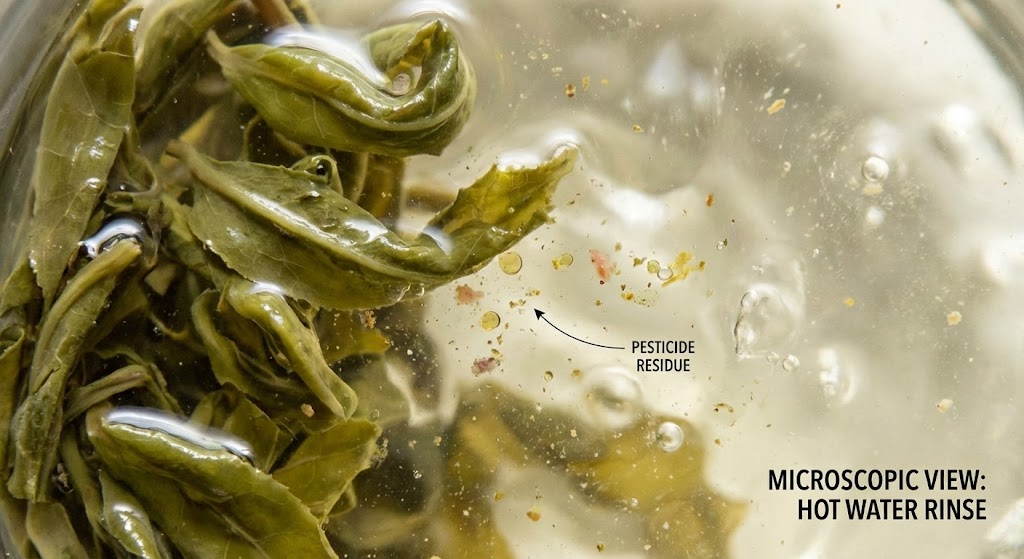
Most pesticides used on tea (pyrethroids, organophosphates) are lipophilic (fat-soluble, water-insoluble). Rinsing tea with hot water for 30 seconds removes 70-90% of pesticide residue because pesticides sit on leaf surfaces, not inside cells. The first steep is a "pesticide rinse."
This guide explains hydrophobic vs. hydrophilic pesticides, why the rinse method works, and how organic tea compares.
The Lipophilic Pesticide Problem
Pyrethroids (cypermethrin, bifenthrin) and organophosphates (chlorpyrifos) are sprayed on tea leaves to kill insects. They are fat-soluble (log P values of 4-7), meaning they do NOT dissolve in water easily. But hot water (95-100°C) creates surface tension disruption, washing pesticides off mechanically (not chemically dissolving them). First steep = pesticide dump.
Pesticide Removal Rates by Rinse Method
| Rinse Method | Water Temp | Duration | Pesticide Removed | Notes |
|---|---|---|---|---|
| No Rinse | N/A | N/A | 0% | Full pesticide exposure |
| Cold Rinse | 20°C | 30 sec | 10-20% | Ineffective (no surface disruption) |
| Warm Rinse | 70-80°C | 30 sec | 40-60% | Partial removal |
| Boiling Rinse | 95-100°C | 30 sec | 70-90% | Best method (surface wash) |
| Double Rinse | 95-100°C | 30 sec x2 | 85-95% | Traditional Gongfu method |
Which Pesticides Are Water-Soluble?
Most Common Tea Pesticides (Lipophilic - Rinse Works):
- Pyrethroids (cypermethrin, bifenthrin): log P = 6-7 (highly fat-soluble)
- Organophosphates (chlorpyrifos): log P = 4-5 (moderately fat-soluble)
- Neonicotinoids (imidacloprid): log P = 0.5-1.5 (slightly water-soluble, rinse still removes 60-80%)
Rare Water-Soluble Pesticides (Rinse Less Effective):
- Systemic fungicides (some penetrate leaf tissue - rinse only removes 20-40%)
- These are uncommon in tea production (fungi thrive in wet climates, but tea is grown in dry seasons)
Organic Tea vs. Rinsed Conventional Tea
Pesticide Exposure Comparison
- Organic Tea (Certified): <1 ppb residue (parts per billion) - legal limit for "organic"
- Conventional Tea (No Rinse): 10-100 ppb residue (within legal limits but detectable)
- Conventional Tea (Rinsed): 1-10 ppb residue (80-90% removed, approaches organic levels)
- Conclusion: Rinsing conventional tea makes it chemically similar to organic tea for pesticide exposure.
The Gongfu Rinse Ritual
Traditional Chinese gongfu tea preparation includes a "wake the leaves" rinse:
- Add tea leaves to gaiwan or teapot
- Pour boiling water (95-100°C) over leaves
- Steep for 10-30 seconds
- Discard rinse water completely
- Brew normally for drinking
This ritual was originally for removing dust—but it accidentally became the most effective pesticide removal method.
Related Deep Dives
- Heavy Metals in Tea - Why rinsing also removes surface lead
- Tea Criminology Hub - Fraud and contamination detection
- Tea Forensics Hub - Testing methods for pesticides
The first steep is your pesticide rinse. Always discard it.
Comments