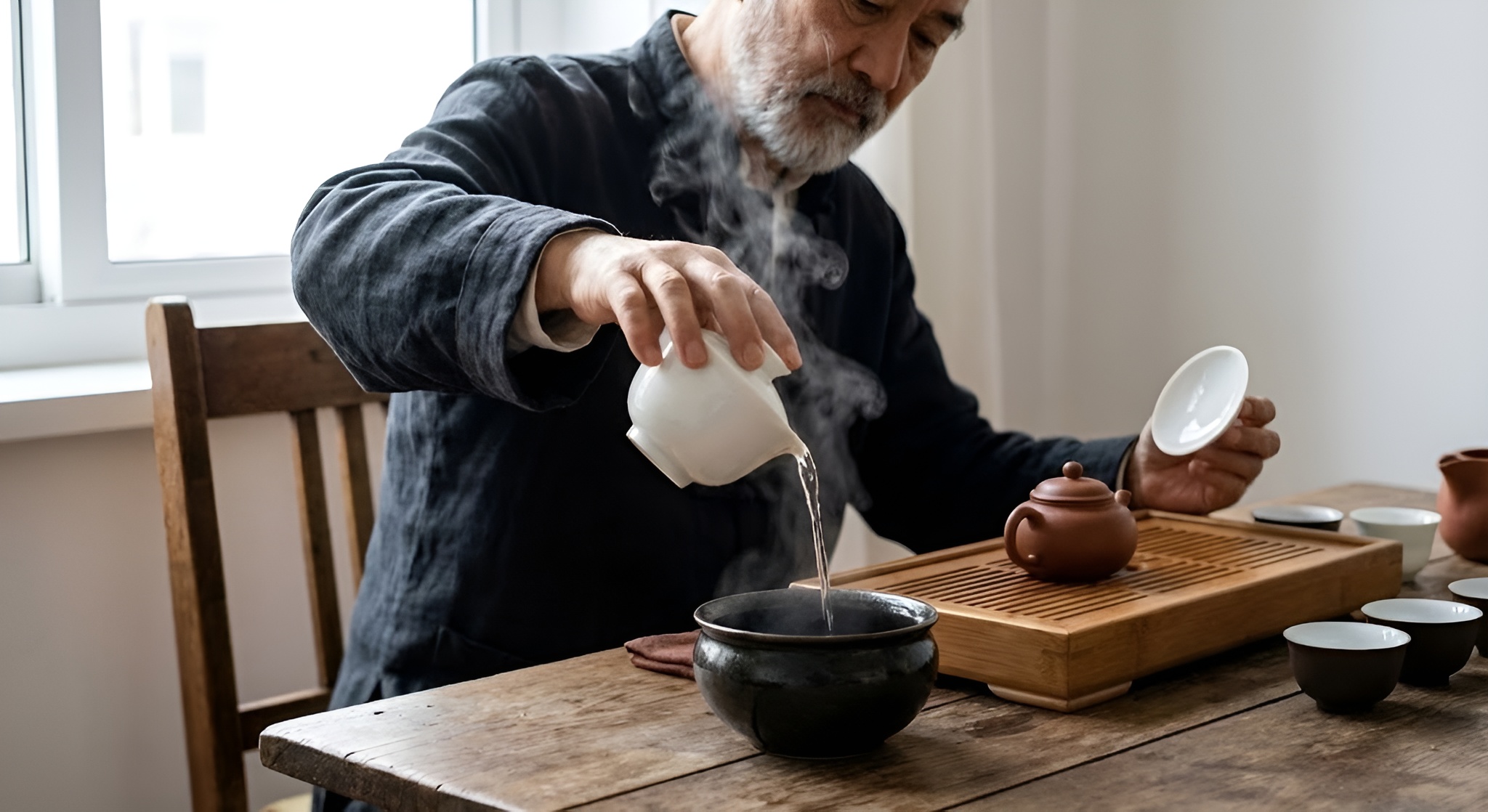
1. Why Rinse? The Three Pillars
In Western brewing, we put a bag in a mug and leave it. In Eastern brewing, we treat the leaf as a dense, compressed object that needs to be "unlocked."
1. Hygiene and Purity
Tea is an agricultural product. While premium teas are processed in sanitary facilities, aged teas like Pu-erh may have sat in a warehouse for 20 years. During that time, they accumulate dust ("tea scum") and micro-debris. Rinsing washes away this surface layer, ensuring your first sip is clean.
2. Temperature Equilibrium
If you pour boiling water onto cold leaves in a cold pot, the water temperature instantly drops by 10-15°C. This is disastrous for extraction. The rinse warms both the vessel (Gaiwan or Yixing pot) and the leaves, ensuring the first actual steep happens at the correct stable temperature.
3. Mechanical "Opening"
Teas like Tie Guan Yin are rolled into tight balls. If you try to brew them immediately, the water only touches the outside of the ball. The rinse hydrates the outer layer, causing the ball to unfurl. This allows the water to penetrate the center of the leaf during the actual brewing steep.
The "Incense Cup" Effect
Don't just dump the rinse water! This is the best time to smell the aroma. The heat from the rinse volatilizes the essential oils. Open the lid of your gaiwan immediately after draining the rinse and smell the steam rising from the wet leaves. This "hot scent" is often different from the brewed tea flavor.
2. The caffeine Myth: Can You "Wash Away" the Jitters?
A persistent myth in tea culture is that you can make "decaf" tea at home by rinsing the leaves for 30 seconds. This is chemically false.
According to a study published in *Food Chemistry*, caffeine extraction follows a curve. While surface caffeine dissolves quickly, the cellular caffeine takes time.
- 30 Second Rinse: Removes approx 9-15% of caffeine.
- 3 Minute Steep: Removes approx 60-70% of caffeine.
To remove enough caffeine to make it "decaf," you would need to steep the tea for 3+ minutes and throw it away—at which point, you have also thrown away all the flavor. Do not rely on rinsing to fix caffeine sensitivity.
Warning: Don't Rinse Matcha
Matcha is a powder, not a leaf. If you "rinse" Matcha, you are literally pouring the tea down the sink. Matcha requires suspension, not extraction. Never rinse powders or broken tea bags (fannings).
3. Cheat Sheet: What to Rinse?
Not all teas need an awakening. In fact, rinsing delicate teas can strip away the prized "trichomes" (tea hairs) that provide sweetness. Use this table as your guide.
| Tea Type | Rinse? | Duration | Reason |
|---|---|---|---|
| Ripe Pu-erh (Shou) | MUST | 2 x 10s | Remove pile-fermentation dust/funk. |
| Raw Pu-erh (Aged) | MUST | 1 x 10s | Wake up dormant leaves, clean dust. |
| Rolled Oolong | YES | 1 x 5s | Unfurl the tight ball structure. |
| Wuyi Rock Tea | YES | 1 x 5s | Flash rinse to remove roasting char. |
| Black Tea | Optional | Flash | Only if whole leaf; never for cut leaf. |
| Green Tea | NO | N/A | You lose the fresh amino acids (umami). |
| White Tea | NO | N/A | Preserve the delicate trichomes (hairs). |
The "Flash" Rinse
For Oolongs and Black teas, the rinse should be nearly instantaneous. Pour the water in, put the lid on, and pour it out immediately. You want to wet the leaves, not steep them. Only Ripe Pu-erh (Shou) needs a longer "soak" to break up the compressed brick.
4. Step-by-Step: How to Execute the Perfect Rinse
Executing a rinse correctly sets the stage for the entire session. Here is the mechanical breakdown for a Gaiwan setup.
- The Dry Heat: Warm your empty Gaiwan with boiling water first. Pour that water out. Place your dry leaves into the hot, damp Gaiwan. Put the lid on and shake it. Open the lid and smell—this is the dry aroma.
- The Pour: Pour boiling water (or appropriate temp) gently onto the side of the Gaiwan, not directly onto the leaves. Spiraling the water helps wet all leaves evenly.
- The Overflow: Fill until the water slightly overflows the rim. This bubbles away the "scum" or foam floating on top.
- The Skim (Optional): Use the lid of the Gaiwan to scrape across the surface, pushing the foam off the edge. This foam contains dust and saponins (bitter compounds).
- The Exit: Immediately pour the liquid out. Do not drink it. (You can pour it over your tea pet if you have one!).
- The Rest: Leave the lid off for 10-15 seconds. Let the steam escape. The leaves are now "breathing" and expanding.
Why Pour on the Side?
Pouring boiling water directly onto the center of the dry leaves is called "scalding." It can shock the leaf and lock in flavor. Pouring down the side of the vessel creates a whirlpool that gently submerges the leaves without aggressive force.
5. When Rinsing Goes Wrong
Can you over-rinse? Absolutely. If you let a Dan Cong Oolong sit in the rinse water for 20 seconds, you have just poured the best part of the tea (the top notes) down the drain. The first steep is often the most aromatic—you are sacrificing it only for hygiene or texture improvement.
If you are drinking a high-quality, organic, loose-leaf Black Tea (like a Single Origin Dian Hong), you might skip the rinse entirely to enjoy those fleeting high notes. Trust your nose and the quality of your source.
What is that Foam?
The bubbles you see during the rinse aren't always dirt. They are often Saponins—natural compounds in tea. While bitter, they are safe. However, in Gongfu Cha aesthetics, we skim them off for a clear, jewel-like liquor. Read more in our guide: What is Tea Scum? →
References
- Hicks, M. B., Hsieh, Y-H. P., & Bell, L. N. (1996). Tea preparation and its influence on methylxanthine concentration. Food Research International, 29(3-4), 325-330.
- Zhang, L. (2013). The Science of Chinese Tea Culture. Beijing University Press.
- Global Tea Hut. (2018). "The Awakening: Brewing Methodology." Tea & Tao Magazine.
Comments