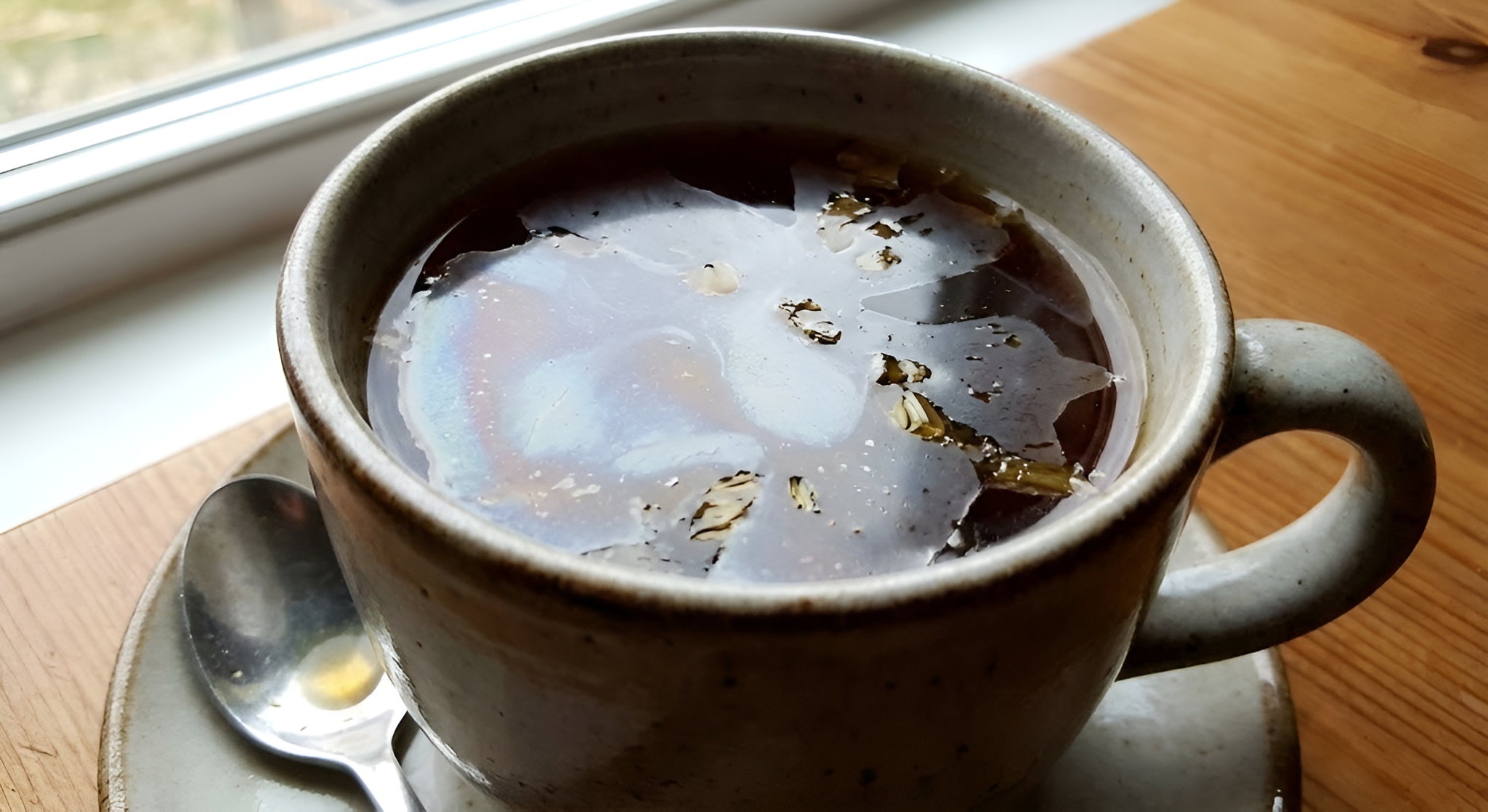
1. The Chemistry of the "Scum": Calcium vs. Tannins
For decades, people believed this film was waxy residue from tea bag paper. In 1994, scientists at Imperial College London finally proved what it really is: an insoluble precipitate formed by Calcium and Complex Organic Compounds.
Here is the step-by-step reaction:
- The Hard Water: Your tap water contains dissolved minerals, specifically Calcium Bicarbonate. When you boil the water, this breaks down into Calcium Carbonate (limescale).
- The Tea Leaf: Tea leaves are packed with polyphenols (antioxidants) and Tannins. These organic compounds are what give tea its color and astringency.
- The Collision: As the tea steeps, the organic compounds float to the surface. There, they meet the calcium ions and oxygen from the air. They bind together to form a thin, solid skin that floats on top.
Essentially, your tea is acting like a water filter, grabbing the limescale out of your water and turning it into a visible solid.
Why London Tea Tastes Different
If you live in a "Hard Water" area (like London), your tea will always be darker, stronger, and scummier than tea made in Scotland (Soft Water). The calcium acts as a solvent, pulling out more color but killing the delicate top notes. To fix this, check our guide: How Water Chemistry Affects Flavor →
2. Why Does It Look Like Oil? (The Iridescence)
The film often looks like an oil slick, shimmering with rainbow colors. This is simple physics. The film is incredibly thin—only a few nanometers thick. Because it is so thin, it interferes with light waves, creating an "interference pattern" similar to oil on a puddle or a soap bubble. It is not actual oil; it is a solid precipitate refracting light.
3. The "Acid Hack": How to Fix It Instantly
You can perform a science experiment in your kitchen right now. If you have a cup of tea with a heavy scum layer, squeeze a single drop of Lemon Juice into it.
The Result: The scum will vanish instantly. The tea will also turn a lighter, brighter color.
The Science: The citric acid in the lemon lowers the pH of the tea. This dissolves the Calcium Carbonate bonds, turning the solid precipitate back into a liquid solution. This is why Earl Grey (which contains citrus oil) rarely develops a heavy scum.
4. Prevention: How to Stop It Forever
Adding lemon changes the taste of your tea. If you want a clean cup of English Breakfast without the citrus, you need to attack the root cause: The Water.
Solution 1: Water Filtration (The Best Method)
You must remove the calcium before you boil. A standard carbon filter (like a basic Brita) helps, but an Ion Exchange filter is better. These filters physically swap calcium ions for sodium or hydrogen ions, softening the water.
Tip: Bottled spring water varies. Some (like Evian) are high in calcium and will still cause scum. Look for "Low Mineral" water like Ashbeck or Volvic.
Solution 2: Don't Over-Boil
The longer you boil water, the more concentrated the minerals become as pure H2O evaporates as steam. If you constantly re-boil the same water in your kettle, you are creating a "Calcium Concentrate." Always empty your kettle and fill with fresh cold water for each brew.
Solution 3: Clean Your Mug
Tea scum loves to cling to existing deposits. If your mug has brown rings from yesterday, the new scum will anchor to them immediately. Using a little baking soda to scrub your mugs can prevent the buildup from starting.
Why the Microwave is the Enemy
Microwaving water for tea is a cardinal sin for many reasons, but it is especially bad for scum. The microwave super-heats the water unevenly, often causing "nucleation points" where calcium precipitates rapidly. Always use a kettle. Need a good one? See our review: The Best Variable Temp Kettles →
5. Is Tea Scum Ever Good?
Surprisingly, yes. In some cultures, a heavy, dark tea with a bit of "bite" is preferred. The calcium in hard water extracts more caffeine and tannins, making the tea taste stronger and "thicker."
Many "Yorkshire" or "Builder's Tea" blends are specifically formulated to be brewed in hard water. They use strong Assam leaves that can punch through the calcium. If you brew a delicate Darjeeling or Green Tea in hard water, however, the flavor will be completely flattened.
Comments