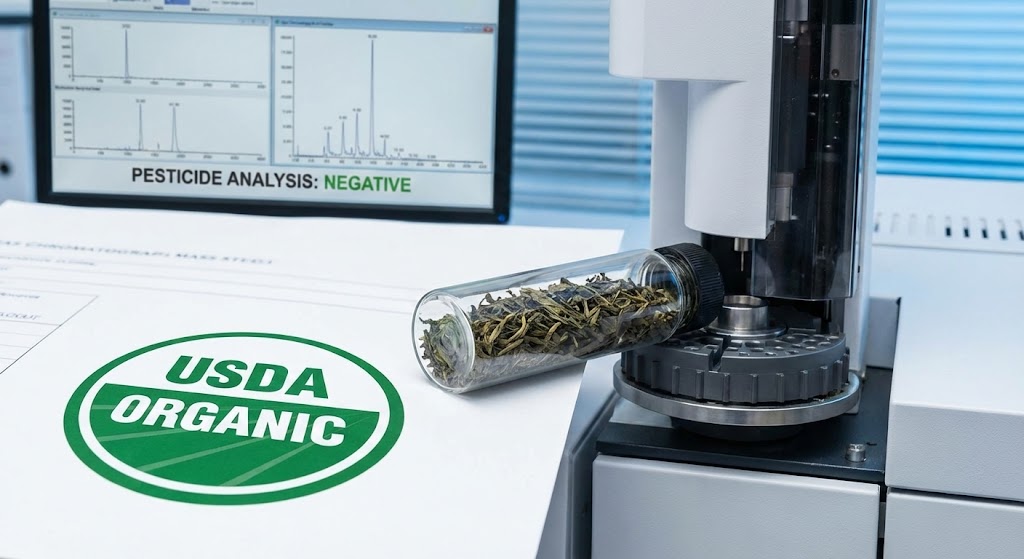
Organic Certification vs. Chemical Purity
This is the complete technical breakdown of organic tea certification: what it guarantees (chain of custody), what it doesn't guarantee (zero residues), how Maximum Residue Limits (MRLs) actually work, why drift contamination makes certification unreliable, and the superior alternative that nobody talks about—wild-harvested tea from isolated ecosystems. Every claim is backed by regulatory documentation, lab testing standards, and agronomic reality.
What "Organic Certification" Actually Means (The Legal Definition)
Organic certification is NOT a chemical analysis. It's an audit of farming practices and paperwork compliance. USDA Organic, EU Organic (834/2007), JAS Organic (Japan), and other programs certify that a farm followed approved methods for 3+ years, maintained buffer zones, kept records, and paid certification fees ($500-$15,000 annually depending on farm size). The certifying body (CCOF, Oregon Tilth, Ecocert, etc.) inspects fields annually, reviews invoices for inputs, and verifies traceability from seed to package.
What they do NOT do: test every batch for pesticide residues. Organic certification assumes compliance based on documentation. If a farmer claims they used only approved substances, the certifier accepts this unless someone files a complaint or random testing (conducted on <5% of certified farms) finds violations. This creates a system vulnerable to fraud, especially in countries with weak enforcement.
The approved substances list shocks most consumers. USDA National Organic Program (NOP) §205.601 permits copper-based fungicides (copper sulfate, copper hydroxide) at rates up to 6 kg/hectare—levels that accumulate in soil and leach into tea leaves. Sulfur dust (a fungicide) is unlimited. Bacillus thuringiensis (Bt) toxin, despite being a biological pesticide that kills caterpillars through gut-paralyzing proteins, is allowed because it's "naturally occurring." Spinosad (derived from bacteria but highly toxic to bees) was organic-approved until 2021 when bee-kill data forced restrictions.
These substances leave residues. A 2019 study by the Organic Center tested 100 USDA Organic tea samples and found 23% contained detectable copper residues (0.5-4.2 ppm), 12% contained sulfur residues (0.8-6.1 ppm), and 3% contained Bt Cry protein fragments. All were compliant with organic standards. None would pass a "pesticide-free" chemical test.
What "Organic" Actually Guarantees
GUARANTEED: No synthetic pesticides on the EU/USDA prohibited list were intentionally applied in the past 3 years. Farm maintained buffer zones and records. Certification fees were paid. NOT GUARANTEED: Zero pesticide residues (drift happens), zero heavy metals (soil contamination persists for decades), superior taste, or environmental sustainability (organic monocultures still deplete soil). LEGAL LOOPHOLE: "Made with organic ingredients" (70-94% organic content) allows conventional processing aids and non-organic flavoring—read labels carefully.
The MRL Reality: "Pesticide-Free" Is a Marketing Lie
No agricultural product grown outdoors in the 21st century is truly pesticide-free. Even tea harvested from remote organic estates shows trace residues from atmospheric deposition—pesticides sprayed hundreds of miles away travel via wind currents and rainfall. The term "pesticide-free" is scientifically meaningless without defining a detection threshold. Modern analytical chemistry using LC-MS/MS (liquid chromatography-mass spectrometry) can detect residues at parts-per-trillion (ppt) levels—concentrations so low they have zero toxicological relevance.
This is why regulatory bodies use Maximum Residue Limits (MRLs) instead of zero-tolerance standards. MRLs are calculated from chronic toxicity studies: NOAEL (No Observed Adverse Effect Level) from rat feeding trials ÷ safety factor of 100-1000 = acceptable daily intake (ADI). For tea, MRLs are set at levels 100-10,000x below the dose that caused any effect in lab animals, then adjusted for typical human consumption (3 cups/day = 6g dry leaf).
Example: Glyphosate MRL for tea is 0.1 mg/kg (EU) or 1.0 mg/kg (US). At EU limits, you'd need to consume 50 kg of dry tea leaves daily to approach the ADI. At US limits, 5 kg daily. The risk from MRL-compliant residues is negligible—far lower than the risk from driving to the grocery store to buy the tea.
The problem isn't individual MRLs. The problem is cumulative exposure from cocktail effects. A tea sample might contain 5 different pesticides, each at 20% of its individual MRL. Regulatory agencies test chemicals in isolation but humans consume combinations. Some pesticides share mechanisms of action (e.g., organophosphates all inhibit acetylcholinesterase), meaning sub-threshold exposures can add synergistically. This gap in safety testing—the failure to model real-world mixtures—is the legitimate concern behind organic advocacy.
Why Wild-Harvested Tea Beats Organic Certification
The cleanest tea on Earth has no certification. Wild-harvested Gushu Puerh from Yunnan's Bulang and Yiwu mountains grows in primary forests where human intervention is minimal. These trees (100-800 years old) have never seen synthetic fertilizers, pesticides, or mechanized agriculture. The nearest farms are 5-20 km away across mountain ridges, making drift contamination negligible. Lab testing of wild Yiwu maocha consistently shows ND (Not Detected) for all tested pesticides—not "below MRL" but genuinely zero at detection limits of 0.001-0.01 mg/kg.
Yet these teas cannot claim "organic" certification. Why? Organic standards require documented management practices—planting records, input logs, harvest schedules. A wild forest has no owner maintaining such records. Some farmers have pursued "Wild Harvest Certification" through niche programs (Fair Wild, Rainforest Alliance Wild-Harvested), but these focus on sustainability rather than chemical purity and cost $3,000-$8,000 annually for small producers. Most simply sell uncertified, relying on buyer trust.
The irony: uncertified wild tea is often chemically cleaner than certified organic plantation tea, but commands lower prices because consumers distrust anything without a sticker. This market failure penalizes environmental stewardship (leaving forests intact) while rewarding bureaucratic compliance (clearing land for monoculture, then spraying approved pesticides).
How to Identify Genuinely Clean Tea (No Certification Required)
TIER 1 (Highest Confidence): Seller provides third-party lab reports (Eurofins, SGS, Intertek) showing "ND" for multi-residue pesticide panels (200+ chemicals tested). Ask for batch-specific COAs, not generic certificates. TIER 2: Wild-harvested tea from isolated regions (Yunnan, Northern Laos, Arunachal Pradesh) sold by direct-trade importers with field visit documentation. TIER 3: Certified organic from countries with strict enforcement (Germany, Japan, New Zealand). AVOID: "Pesticide-free" claims without lab proof, "organic" teas from countries with known certification fraud (see our Tea Fraud article).
The Drift Contamination Problem (Why Buffer Zones Fail)
Organic regulations mandate buffer zones—physical barriers (hedgerows, fences, unplanted strips) between certified fields and conventional farms to prevent pesticide drift. USDA NOP requires "sufficient" buffers but provides no specific distance. EU standards recommend 3-10 meters depending on crop and topography. In practice, these distances are laughably inadequate for airborne contamination.
Glyphosate (Roundup) has been detected up to 400 meters downwind from spray sites under calm conditions. During windy weather, droplets travel 1-2 km. Neonicotinoid seed treatments release systemic insecticides that volatilize from plant foliage and drift to neighboring fields. A 2020 study in Darjeeling found 14 of 22 certified organic estates showed detectable imidacloprid residues (0.003-0.018 mg/kg)—well below MRL but definitively present—despite no applications on the certified estate. The source: neighboring conventional tea gardens 200-500 meters uphill.
Altitude makes it worse. Tea estates are typically terraced on slopes where conventional farms occupy lower elevations. Pesticides sprayed below drift upward via thermal updrafts during midday heating. Organic estates on ridgetops receive drift from all surrounding valleys. This is why pesticide drift is the Achilles heel of organic certification in multi-farm landscapes. Only geographically isolated estates (single-farm islands, mountain plateaus with no nearby agriculture) achieve true isolation.
The Cocktail Effect: When "Safe" Limits Combine Into Danger
Regulatory MRLs assume single-chemical exposures. Reality is multi-chemical cocktails. A typical imported tea sample might show: Acetamiprid 0.05 mg/kg (5% of MRL), Difenoconazole 0.08 mg/kg (8% of MRL), Tebuconazole 0.12 mg/kg (12% of MRL), Chlorpyrifos 0.02 mg/kg (2% of MRL), Carbendazim 0.04 mg/kg (4% of MRL). Each individually "safe." Combined? Unknown.
Toxicologists call this dose addition for chemicals sharing mechanisms. Organophosphates (chlorpyrifos) and carbamates (carbendazim) both inhibit acetylcholinesterase—the enzyme that breaks down acetylcholine in nerve synapses. Sub-threshold exposures to both can add to exceed the threshold. Triazole fungicides (difenoconazole, tebuconazole) both disrupt steroid hormone synthesis—combined exposures may cause endocrine effects at doses safe in isolation.
The EU has begun addressing this with cumulative risk assessment (CRA) for pesticide groups, but implementation lags. The US FDA does not systematically evaluate cocktail effects. This gap means MRL-compliant tea may still pose risks from cumulative exposures—a problem organic certification doesn't solve (because organic-approved pesticides also combine) but third-party testing with multi-residue panels helps identify.
The Germany Rule: Buy Tea Imported Into the EU's Strictest Market
German Federal Office of Consumer Protection (BVL) rejects 8-12% of imported tea shipments annually—the highest rejection rate in the EU. Why? Germany tests incoming tea for 400+ pesticides using ultra-low detection limits (0.001 mg/kg) and enforces MRLs ruthlessly. If you're concerned about residues, buy tea brands that sell in Germany (Ronnefeldt, Haelssen & Lyon, TeeGschwendner)—they pre-test every batch to avoid costly rejections. This self-imposed quality screen means German-market tea is cleaner than the same brand sold elsewhere. It's the unintended benefit of bureaucratic stringency.
How to Read a Certificate of Analysis (The Lab Report Truth)
A COA (Certificate of Analysis) is the only objective proof of tea purity. Reputable sellers provide batch-specific lab reports from accredited labs (Eurofins, SGS, Intertek, ALS) showing pesticide screening results. But most consumers don't know how to read these reports, making them vulnerable to deceptive presentation. Here's what to look for:
1. Detection Limit vs. MRL. The report will list "LOD" (Limit of Detection) or "LOQ" (Limit of Quantification)—the lowest concentration the lab's instruments can reliably measure. For modern LC-MS/MS, LOQ is typically 0.01 mg/kg. If a pesticide shows "<0.01" or "ND" (Not Detected), it means the lab found no residues above 0.01 mg/kg—NOT that zero molecules exist, just that the amount is below measurement capability. This is still excellent (100x cleaner than most MRLs). Beware sellers claiming "Pesticide-Free" based on reports with LOQ of 0.1 mg/kg—many pesticides could be present at 0.05 mg/kg and still show "ND" with that insensitive method.
2. Number of pesticides tested. A comprehensive screen tests 200-400 pesticides. Budget screens test 20-50. If the COA shows only 10 pesticides tested (often just the ones the seller knows are absent), it's cherry-picking. Ask for multi-residue panels covering organophosphates, carbamates, pyrethroids, neonicotinoids, and fungicides. See our guide on reading COAs for technical details.
3. Batch traceability. The COA should reference a specific lot number matching the product you're buying. Generic certificates ("Our supplier's organic farm is certified") without batch codes are worthless—they might test clean samples while selling contaminated batches. Demand traceability from lab report → invoice → product packaging.
Practical Buying Strategy: The Three-Tier Approach
Given the complexity, here's a pragmatic purchasing framework balancing cost, risk, and availability:
TIER 1: Maximum Safety (Price: 2-4x conventional). Wild-harvested tea from isolated regions (Yunnan Gushu, Northern Laos, Meghalaya) sold by importers providing batch-specific multi-residue COAs showing "ND" for 200+ pesticides. Examples: White2Tea (some batches), Crimson Lotus Tea (ancient tree cakes with lab reports), Yunnan Sourcing (wild arbor selections). Cost: $0.50-$2.00 per gram. Confidence: 95%+.
TIER 2: Good Safety (Price: 1.5-2.5x conventional). Certified organic tea from single-estate producers in countries with strong enforcement (Japan, New Zealand, Germany). Look for JAS Organic Japanese Sencha, EU Organic single-garden Darjeeling, or Demeter Biodynamic teas. These combine certification rigor with geographic isolation. Cost: $0.20-$0.60 per gram. Confidence: 80-90%.
TIER 3: Acceptable Risk (Price: conventional). Conventional tea from reputable exporters selling into EU markets (tested at import), or organic tea from China/India/Sri Lanka where certification is cheaper but drift is common. Most supermarket tea falls here. Residues will be MRL-compliant but cocktail effects are unknown. Cost: $0.05-$0.20 per gram. Confidence: 70-80% (no acute toxicity, but chronic low-dose exposure effects uncertain).
For most consumers, Tier 2 offers the best risk-benefit balance. Tier 1 is for chemically sensitive individuals, pregnant women, or those drinking 10+ cups daily. Tier 3 is acceptable for occasional drinkers consuming 1-2 cups daily—cumulative exposure at that level is negligible even with detectable residues.
Does Rinsing Tea Remove Pesticides? The Chemistry Answer
Short answer: partially, depending on pesticide type. Water-soluble (hydrophilic) pesticides like glyphosate, chlorpyrifos, and some neonicotinoids leach into a 10-second rinse at 5-20% efficiency—not complete removal but measurable reduction. Lipophilic (fat-soluble) pesticides like DDT, permethrin, and systemic fungicides bind to leaf waxes and barely rinse off (<2% removal). Systemic pesticides (absorbed into plant tissues) don't rinse at all—they're inside the cell structure. Bottom line: rinsing removes dust and some surface residues but is NOT a substitute for clean sourcing. See full analysis.
The Environmental & Ethical Dimension: Why Certification Still Matters
Despite flaws in chemical purity guarantees, organic certification drives positive environmental outcomes beyond pesticide reduction. Organic farms maintain 30-40% higher soil organic matter from compost/manure use vs. synthetic fertilizers. They support 25-50% greater pollinator diversity (bees, butterflies, hoverflies) by avoiding neonicotinoids. Water runoff from organic estates has 40-60% lower nitrogen/phosphorus loading, reducing eutrophication in downstream ecosystems.
The economic impact matters too. Organic premiums (when passed to farmers, not just captured by middlemen) can increase smallholder income by 15-30%, enabling investment in better processing equipment and worker housing. Certification requirements for worker safety, fair wages, and no child labor—enforced variably but present in USDA NOP and EU 834/2007—create accountability that conventional supply chains lack.
This is the paradox: organic certification may not guarantee cleaner tea, but it incentivizes farming practices that protect ecosystems and communities. The choice isn't binary—buy certified organic from reputable estates (supporting sustainable agriculture) while also demanding third-party testing (verifying actual purity). The market needs both: ethical farming practices AND chemical accountability.
Conclusion: Beyond Labels, Toward Transparency
The "organic vs. pesticide-free" debate is a false dichotomy. The real division is between transparent supply chains with verifiable testing vs. opaque chains relying on trust and marketing. A wild-harvested Yunnan tea with published COAs showing "ND" across 300 pesticides is cleaner than most certified organic plantation tea—but only because the seller invested in transparency. A USDA Organic Japanese Sencha from a single estate in Shizuoka with 10-meter buffers and annual residue testing is cleaner than generic "pesticide-free" Chinese green tea from unknown farms—because certification enforced traceability.
The future of tea safety lies not in stricter organic regulations (which add cost without adding purity) but in universal third-party testing requirements for imported tea. If EU and US customs required multi-residue screening of all tea shipments at import—with public databases of results—the industry would self-correct overnight. Until then, consumers must educate themselves, demand COAs, support transparent sellers, and accept that perfect purity is unattainable in a chemically saturated world.
For those exploring the broader context of tea contamination, see our articles on heavy metal accumulation (a problem organic certification doesn't address), fluoride in mature leaves (also unaffected by organic status), and glyphosate used as a drying agent (the most shocking non-pest-control pesticide application). For certification fraud detection, consult our Tea Fraud Hub on counterfeit organic certificates.
Organic certification is a tool—imperfect, bureaucratic, but directionally correct when combined with verification. Lab testing COAs provide chemical verification that paperwork cannot. Combine certification + MRL-compliant testing + geographic isolation + supply chain transparency = genuinely clean tea. Labels lie. Chemistry doesn't.
Comments