Anatomy of a Certificate of Analysis (COA)
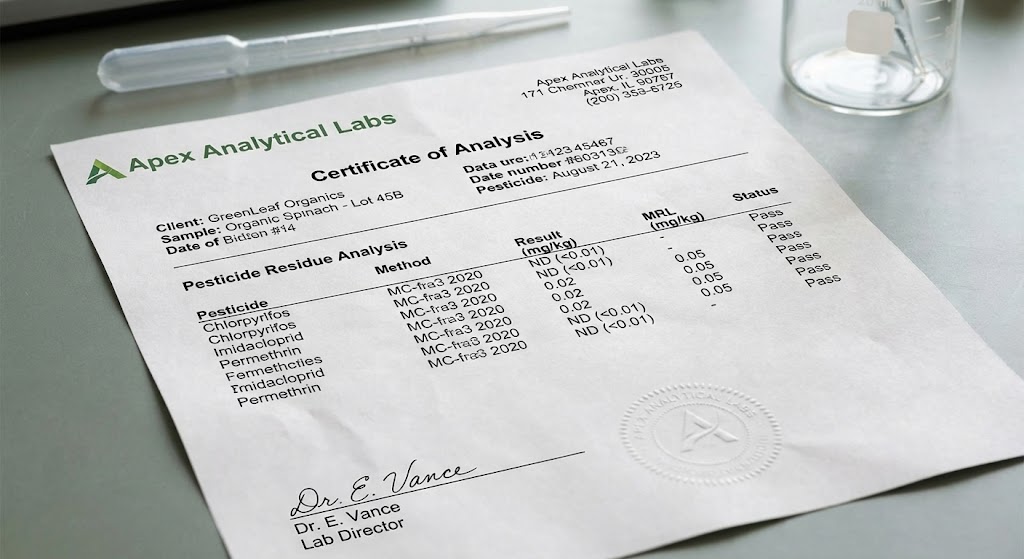
A legitimate Certificate of Analysis for tea pesticide/contaminant testing contains 8-12 critical fields. Missing or vague entries in any field should trigger skepticism.
1. Lab Identification & Accreditation. Header should show lab name, address, contact, and accreditation credentials. Look for: ISO/IEC 17025 (international standard for testing lab competence), specific scope (pesticide residue testing in food matrices), and accreditation body (ANAB, A2LA, UKAS, DAkkS, etc.). Example: "Eurofins Food Testing UK Ltd—ISO 17025 accredited by UKAS (Testing 0123), Scope: Multi-residue pesticide analysis in tea and herbs." If accreditation is absent or vague ("certified lab"), the COA may be from uncalibrated facility—results unreliable.
2. Sample Identification. Must include: client name, sample description ("Black tea CTC, Assam origin"), batch/lot number (estate-specific code linking COA to production batch), sampling date, and analysis date. Critical check: Does batch number match your tea's packaging label? Fraudulent sellers provide genuine COAs from different batches (clean tea tested, contaminated tea sold). If batch traceability is missing, the COA is unverifiable.
3. Test Method. Specifies analytical protocol used. For pesticides, common methods: QuEChERS extraction + LC-MS/MS (liquid chromatography–mass spectrometry for polar pesticides like neonicotinoids, glyphosate), GC-MS/MS (gas chromatography for volatile pesticides like pyrethroids), or multi-residue LC/GC-MS/MS (combines both, 400-600 compound panels). Critical distinction: GC-MS alone MISSES many important pesticides (imidacloprid, glyphosate, glufosinate—all require LC-MS). If method is "GC-MS" only and claims "400 pesticides tested," it's technically impossible—demand LC-MS confirmation.
4. Tested Compounds List. Should enumerate every pesticide/contaminant tested. Comprehensive panels list 200-600 compounds individually. Budget panels test 20-100 compounds. Red flag: COA says "Multi-residue screen" but doesn't list specific compounds—impossible to verify scope. Always demand explicit compound list. Verify your priority contaminants are included: imidacloprid, acetamiprid (neonics), glyphosate, AMPA (glyphosate metabolite), anthraquinone, chlorpyrifos, cypermethrin.
5. LOD and LOQ Values. LOD (Limit of Detection): Lowest concentration where lab can detect presence but not accurately quantify. LOQ (Limit of Quantification): Lowest concentration where lab can measure amount with acceptable precision (typically 3-10x higher than LOD). Example: LOD = 0.001 mg/kg, LOQ = 0.005 mg/kg. If result shows "<0.005 mg/kg," it means compound is below quantification limit—might be zero, might be 0.001-0.004 mg/kg (detected but too low to quantify accurately). For most purposes, " 6. Results Column. Shows detected levels for each compound. Interpretation: "<0.005 mg/kg" or "ND" = not detected above LOQ, compliant for all standards. "0.012 mg/kg" = detected, compare to MRL (see MRL guide)—if result is 0.012 and EU MRL is 0.05, compliant; if MRL is 0.01, violation. "LOD" = absolutely not detected even at detection limit—strongest possible clean result. 7. Regulatory Comparison (Optional but Valuable). Best COAs include column showing applicable MRLs for tested jurisdiction (EU, US, Japan, etc.) and Pass/Fail designation. Example: "Imidacloprid: <0.005 mg/kg | EU MRL: 0.05 mg/kg | Status: PASS." This removes interpretation burden from buyer—lab confirms compliance. 8. Uncertainty and Confidence Intervals. Advanced COAs report measurement uncertainty (e.g., "0.012 ± 0.003 mg/kg at 95% confidence"). This acknowledges no measurement is perfect—true value is 0.009-0.015 mg/kg with 95% probability. For results near MRL thresholds (e.g., 0.048 mg/kg when MRL is 0.05), uncertainty matters—could be 0.045-0.051, potentially violating limit within error margin. Conservative buyers reject borderline results; risk-takers accept if point estimate is below MRL. Marketing claims: "Lab tested—ZERO pesticides!" Sounds great. Reality check: "Zero detected" depends entirely on LOQ. Lab A with LOQ = 0.05 mg/kg reports "ND" for sample with 0.03 mg/kg imidacloprid. Lab B with LOQ = 0.01 mg/kg reports "0.03 mg/kg detected" for SAME sample. Lab A says "clean," Lab B shows contamination—same tea, different detection limits. Always check LOQ values—demand LOQ ≤0.01 mg/kg for pesticides you care about. "Zero pesticides" with LOQ = 0.1 mg/kg is meaningless (you could have 0.09 mg/kg—just below detection but still significant). EU labs typically use LOQ 0.005-0.01 mg/kg. Asian contract labs sometimes use 0.05-0.1 mg/kg to generate "clean" reports cheaply. Insist on sensitivity specs. Detection limits are the most misunderstood aspect of COAs—yet they determine whether testing is meaningful or theater. Limit of Detection (LOD): Statistical threshold where signal from compound exceeds background noise with 99% confidence. Below LOD, you can't distinguish real signal from instrument noise. Calculation: LOD = 3 × (standard deviation of blank measurements). For pesticides in tea, typical LODs: 0.001-0.005 mg/kg (LC-MS/MS), 0.005-0.01 mg/kg (GC-MS). If lab reports LOD = 0.05 mg/kg, their equipment is outdated or improperly calibrated—modern instruments achieve 10-50x better sensitivity. Limit of Quantification (LOQ): Threshold where lab can measure concentration with <20% error (industry standard). Below LOQ but above LOD, you know something is there but can't trust the number. Calculation: LOQ = 10 × (standard deviation of blank). For tea: typical LOQ = 0.005-0.01 mg/kg (good labs), 0.02-0.05 mg/kg (budget labs), 0.001-0.003 mg/kg (premium ultra-sensitive testing). Why LOQ matters more than LOD: Regulatory limits (MRLs) are quantitative—you need accurate numbers to compare. "Detected at ND (Not Detected): Compound is This table is your decision tree for any COA result. The "Not tested" row is critical—many COAs omit glyphosate (requires separate derivatization method) or anthraquinone (not standard pesticide). If priority contaminants aren't listed, the COA is incomplete regardless of how many other compounds show ND. Premium tier (Eurofins, SGS, ALS, TÜV): LOQ 0.005-0.01 mg/kg for most pesticides, 0.001-0.005 mg/kg for priority compounds (glyphosate, neonics, chlorpyrifos). Cost: $200-500 per sample, 400-600 compound panels. Use for: EU/Japan export, premium retail tea ($15+/100g), brand reputation protection. Standard tier (regional labs, NABL/ISO certified): LOQ 0.01-0.02 mg/kg, 150-300 compound panels. Cost: $80-150 per sample. Use for: US/domestic compliance, mid-tier retail ($8-15/100g), routine monitoring. Budget tier (local contract labs): LOQ 0.02-0.1 mg/kg, 50-150 compounds, often GC-MS only (misses LC-amenable pesticides). Cost: $30-60 per sample. Use for: Bulk commodity tea, initial screening before premium testing, cost-constrained small estates. Risk: False negatives (contamination below LOQ but above health concern). COAs advertise "Multi-residue screening"—but scope varies 20-fold. A 20-pesticide panel costs $30-50, a 400-pesticide panel costs $250-500. You get what you pay for. 20-50 Pesticide Panels (Targeted Screening): Test only highest-risk compounds for specific crop/region. For tea: typically organophosphates (chlorpyrifos, profenofos), pyrethroids (cypermethrin, bifenthrin), common neonicotinoids (imidacloprid), and triazoles (hexaconazole). Advantage: Cheap, fast (48-72 hour turnaround). Disadvantage: Misses uncommon pesticides—if estate uses atypical compounds not in panel, contamination goes undetected. Use case: Routine monitoring of known-clean suppliers, bulk commodity tea where cost is critical. 150-300 Pesticide Panels (Broad Screening): Covers 80-90% of pesticides used globally in agriculture. Includes most neonicotinoids, organophosphates, carbamates, pyrethroids, fungicides, herbicides. Usually combines GC-MS and LC-MS methods. Advantage: Balances cost and coverage—catches most realistic contamination scenarios. Disadvantage: Still misses specialty compounds (glyphosate often excluded unless specified, rare fungicides). Use case: Standard for reputable tea sellers, EU/US import compliance, mid-to-premium retail. 400-600 Pesticide Panels (Comprehensive Screening): Includes everything in 150-300 panel PLUS rare pesticides, metabolites (degradation products that indicate parent compound was used), and non-pesticide contaminants (PAHs like anthraquinone, heavy metals if requested). Requires multi-method approach: QuEChERS extraction, LC-MS/MS, GC-MS/MS, HPLC for glyphosate/glufosinate. Advantage: Detects virtually all plausible contamination including unexpected compounds. Disadvantage: Expensive ($250-500), slower (5-7 days), generates massive data (10-page COAs)—overkill for routine monitoring. Use case: First-time supplier verification, export to Germany/Japan (strictest enforcement), premium/organic certification audits, fraud investigation. The Glyphosate Gap: Standard multi-residue panels (even 400-compound) often omit glyphosate and AMPA (its metabolite) because they require separate sample preparation (derivatization to make them detectable by MS). Always ask: "Is glyphosate included?" If no: "Can you add glyphosate/AMPA testing?" Cost: +$40-80 per sample. Given glyphosate's prevalence as desiccant, this add-on is essential for full safety picture. The most common COA fraud: provide legitimate test results from clean batch, ship contaminated batch from different lot. Prevention: verify batch traceability. Step 1: Check Batch/Lot Number. COA should state sample ID like "Batch ASD2024-03-15-A" or "Lot 04152024-SFTGFOP." Your tea packaging should have IDENTICAL code. If COA shows "Sample 12345" with no batch link, it's unverifiable. Demand batch-specific testing. Step 2: Verify Sampling Date vs. Production Date. COA sampling date should be AFTER production date on your tea packaging. If COA is dated March 2024 but your tea was produced June 2024, the test is for different batch (or fraudulent backdating). For seasonal teas (Darjeeling first flush, Shincha), harvest date is narrow—COA should be within weeks of harvest. Step 3: Cross-Check Supplier Information. COA client name should match your seller or their parent estate. If COA says "Client: ABC Tea Estate" but you're buying from "XYZ Importers," ask for chain-of-custody documentation linking estate→importer→you. Unrelated COA = probable fraud. Step 4: Request Sample Retention Proof. Accredited labs keep retained samples 30-90 days post-testing for dispute resolution. Ask lab directly (contact on COA): "Do you have retained sample for batch X tested on date Y?" Legitimate labs confirm within 24 hours. If seller balks at you contacting lab, they're hiding something. You request COA. Seller provides report showing " Not all labs are equal. Accreditation, equipment, and reputation vary dramatically. Tier 1: Global Accredited Labs. Eurofins (1000+ locations, 200,000 staff, gold standard for food testing), SGS (2600 offices, ISO 17025 accredited globally), ALS (Australia-based, strong in Asia-Pacific), TÜV Rheinland (German rigor, preferred by EU importers). Strengths: Latest LC-MS/MS and GC-MS/MS equipment, LOQ 0.005-0.01 mg/kg, comprehensive 400-600 compound panels, strict quality controls, legal defensibility (results accepted by all regulatory bodies). Cost: $200-500 per sample. Turnaround: 5-10 days. Use when: EU/Japan export, premium retail, dispute resolution, first-time supplier verification. Tier 2: Regional Accredited Labs. National labs with ISO 17025 for pesticide testing: NABL-accredited labs in India, CMA-certified labs in China, A2LA-accredited US labs. Strengths: Lower cost ($80-200), faster turnaround (3-5 days), adequate for US/domestic compliance. Weaknesses: Smaller compound panels (150-300), slightly higher LOQ (0.01-0.02 mg/kg), occasional quality lapses (proficiency testing failures). Use when: Routine monitoring, cost-sensitive testing, domestic market compliance. Verify: Check accreditation status on accreditation body website—some labs claim credentials they've lost. Tier 3: Local Contract Labs. Unaccredited or minimally certified labs offering cheap testing ($30-80). Strengths: Affordability, 24-48 hour results, convenient for producers. Weaknesses: Often GC-MS only (misses LC-amenable pesticides), high LOQ (0.05-0.1 mg/kg—allows significant contamination to hide), no external quality checks, results not accepted by EU/Japan customs, higher false negative rate (20-40% in proficiency tests vs. 2-5% for Tier 1). Use when: Initial screening only—if ND, follow up with Tier 1/2 confirmation before export/premium sale. Lab Fraud (Rare but Exists): Fake COAs with fabricated accreditation stamps, real lab letterhead but falsified results, "ghost labs" that don't exist. Verification: (1) Google lab name + "ISO 17025 accreditation"—should find accreditation body listing. (2) Call lab directly (use number from their official website, NOT from COA—forgers put fake numbers on fake COAs) and reference report ID. (3) Check accreditation body database (e.g., UKAS Schedule of Accreditation for UK labs, ANAB directory for US labs). Takes 10 minutes, prevents $10,000-100,000 fraudulent purchase. Eurofins is the most expensive lab—but also the most defensible. Their COAs are accepted without question by EU customs, EFDA, FDA, Japanese Ministry of Health. If shipment is rejected despite Eurofins COA showing compliance, importer can sue customs for wrongful rejection (and win—has happened). When Eurofins premium is justified: (1) Container-scale shipments (10,000+ kg, value >$50,000)—$400 test is 0.4-0.8% of shipment value, cheap insurance. (2) EU export (Eurofins results preferred by German BVL, French DGCCRF). (3) Reputation-critical brands (one contamination scandal costs more than lifetime of premium testing). When to save money: Domestic US/Asian sales, routine monitoring of proven suppliers (use Tier 2, escalate to Eurofins if problems emerge), commodity tea <$5/kg (testing cost exceeds profit margin). COAs test what you send, not what you receive. Seller can submit clean cherry-picked sample, ship contaminated bulk. Only solution: demand pre-shipment testing (test after packaging, before dispatch) + arrival testing (you test upon delivery). Cost: 2x testing expense. Value: eliminates bait-and-switch fraud. COAs are snapshots, not guarantees. Tea tested in March might degrade or become contaminated by July (see packaging migration). Shelf-life testing: retest tea every 6-12 months if stored long-term. ND doesn't mean zero—means below LOQ. If LOQ = 0.05 mg/kg and result is ND, true level could be 0.04 mg/kg—significant for sensitive populations (pregnant women, children). For absolute safety, demand LOQ ≤0.01 mg/kg—then ND = negligible exposure. COAs don't test everything. Standard panels omit heavy metals (lead, cadmium, arsenic—see toxicology hub), mycotoxins (aflatoxin from mold), microplastics, radioactivity (relevant for Japanese tea post-Fukushima). Comprehensive safety requires multi-test approach: pesticide panel + heavy metals + microbiology. Cost: $300-600 total for complete picture. COAs can't detect fraud beyond chemistry. Testing confirms chemical safety, not authenticity. Darjeeling COA showing ND pesticides doesn't prove tea is actually from Darjeeling (could be Nepal/Assam fraud—see tea fraud). Authentication requires isotope ratio analysis, DNA testing, or blockchain traceability—separate from residue COAs. Step 1: Request COA BEFORE Purchase. Email: "Please provide Certificate of Analysis for [specific product/batch] including: (1) Multi-residue pesticide testing (minimum 200 compounds via LC-MS/MS and GC-MS/MS), (2) Glyphosate/AMPA, (3) Anthraquinone, (4) Heavy metals (Pb, Cd, As), (5) Batch number matching product, (6) ISO 17025 accredited lab." Reputable sellers provide within 24-48 hours. Hesitation = red flag. Step 2: Verify Lab Accreditation. Google "[Lab Name] ISO 17025 accreditation" + "[Country] accreditation body." Confirm scope includes pesticide testing in tea/food. If unverifiable, request testing from Tier 1 lab at your expense (deduct from payment). Step 3: Check Batch Traceability. Match COA batch/lot number to product packaging. Verify sampling date is appropriate for production date. If mismatch, reject or demand new batch-specific test. Step 4: Evaluate Test Scope. Count tested compounds—should be ≥200 for meaningful coverage. Verify glyphosate, neonics (imidacloprid, acetamiprid, thiamethoxam), anthraquinone are explicitly listed. If absent, demand supplementary testing. Step 5: Assess LOQ Adequacy. For priority contaminants, LOQ should be ≤0.01 mg/kg (EU compliance), ideally ≤0.005 mg/kg (premium safety). If LOQ = 0.05-0.1 mg/kg, results are too coarse—request retest with sensitive method. Step 6: Interpret Results. ND or Step 7: Spot-Check Suspicious Perfection. If 100% ND with no trace detections, consider independent confirmation testing—statistically unusual for even premium organic tea. Step 8: Archive for Traceability. Keep COA with batch number for future reference—if customer questions safety, you have documentation. Recommended retention: 3 years (typical statute of limitations for product liability). Red flags requiring independent verification: (1) First-time supplier with unknown reputation, (2) Price 20%+ below market (too cheap suggests cutting corners somewhere—often safety), (3) COA from Tier 3 local lab or unverifiable lab, (4) Batch number mismatch or missing, (5) Suspiciously perfect results (100% ND), (6) Seller hesitates to provide COA or provides after delays, (7) Large order value (>$10,000)—testing cost is <2% of purchase, worth the insurance. Your testing protocol: Upon arrival, pull random samples from 3-5 boxes (contamination can be uneven). Combine into composite sample, send to Eurofins/SGS for 400+ pesticide panel + glyphosate + anthraquinone. Cost: $350-500. If results contradict supplier COA, you have evidence for refund/replacement demand or legal action. COA literacy is the difference between informed buying and blind trust. Every field on that document contains information—if you know how to read it. The acronyms, numbers, and technical jargon are not meant to obscure (though some sellers exploit opacity)—they're precise language for communicating measurable safety. Learn the language, and you control the conversation. COA literacy transforms you from passive consumer to informed buyer. Every field on that document contains critical information—MRL comparisons show regulatory compliance, LOQ values reveal testing sensitivity, batch numbers enable traceability verification. Understanding how different countries enforce standards helps you navigate international tea markets. For sourcing strategies, compare certified organic versus wild-harvested options—lab data often reveals surprising differences in actual residue levels.The "0 Pesticides Detected" Deception
Understanding Detection Limits: LOD, LOQ, and ND
LOQ Standards by Testing Tier
Multi-Residue Panels: 20 vs. 200 vs. 400+ Pesticides
Batch Traceability: Matching COA to Your Tea
The Cherry-Picking Red Flag: Suspiciously Perfect COAs
Lab Credibility: Eurofins vs. SGS vs. Local Labs
The Eurofins Gold Standard (And When to Pay For It)
Reading Between the Lines: What COAs DON'T Tell You
Practical Workflow: How to Request and Evaluate COAs
When to Demand Your OWN Testing (Don't Trust Supplier COA)
Comments