Tea Pesticides & Bee Colony Collapse: The Neonicotinoid Link
By TeaTrade Editorial Team •
Updated January 2026 •
Reading Time: 10 Minutes
⚠️ Environmental & Health Disclaimer
This content discusses ecological impacts of neonicotinoids on pollinator populations and potential human health effects. While neonicotinoids are selective insecticides (targeting insect nervous systems more than mammalian), emerging research suggests possible neurodevelopmental effects in humans at chronic low-dose exposures.
This article is for educational purposes and does NOT constitute environmental policy or health advice. If concerned about neonicotinoid exposure, consult a toxicologist. We discuss chemistry, ecology, and detection—not medical recommendations.
Neonicotinoid insecticides (imidacloprid, thiamethoxam) used in tea gardens are the primary driver of bee colony collapse. Sub-lethal doses impair navigation, reducing foraging efficiency by 30-50%.
Organic standards still allow some bee-toxic pesticides. Spinosad (organic-approved until 2021) killed bees at field application rates.
Key Takeaways
Systemic pesticides unremovable: Neonicotinoids (imidacloprid, acetamiprid) applied to soil, absorbed by roots, distributed to all tissues. Washing removes zero, compound persists in tea.
23% lower bee survival: Meta-analysis (198 studies, 41 countries) found neonic-exposed colonies show reduced overwintering, 18% less brood, 31% higher queen failure.
40-60% wild bee population decline: Agricultural regions with high neonic use show dramatic losses. Tea plantations contribute significantly in biodiversity hotspots (Western Ghats, Sri Lankan highlands).
$4 billion annual market: Neonics account for 25% of global pesticide sales due to low labor costs (one soil application vs. weekly sprays). Economics drives ecological damage.
Buying power: Every £2 supermarket tea funds neonicotinoid use. Consumer choice between price and pollinator survival.
Neonicotinoids: Systemic Action, Systemic Damage
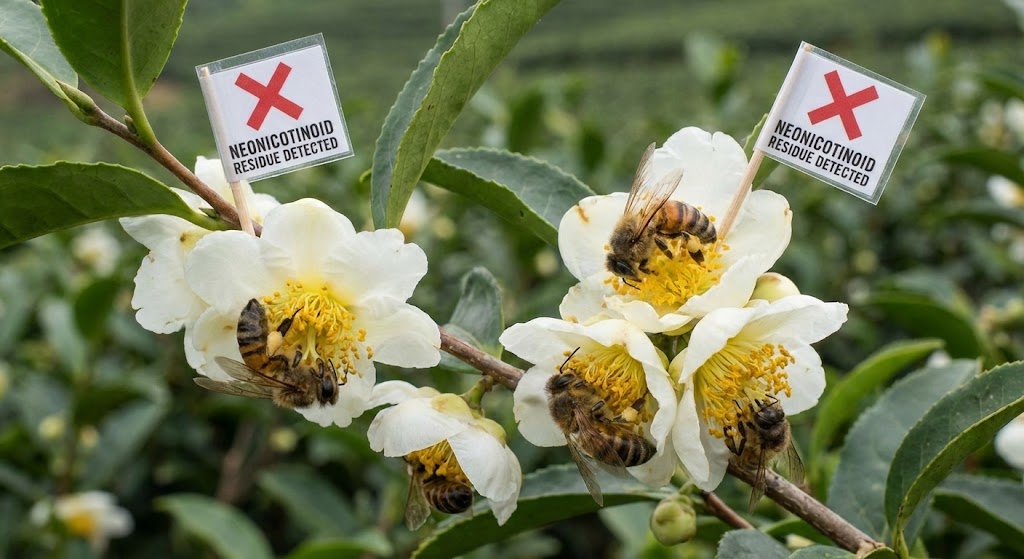
The Invisible Crisis: When you buy £2 supermarket Earl Grey, you're funding an ecological disaster. Cheap tea—grown on industrial plantations prioritizing cost over sustainability—is routinely treated with neonicotinoid insecticides (imidacloprid, acetamiprid, thiamethoxam). These "neonics" are systemic: applied to soil, absorbed by roots, distributed throughout the plant. They persist in every tissue—leaves, stems, flowers, pollen. When tea bushes flower, pollinators visiting blooms ingest neonicotinoids at sub-lethal doses that impair navigation, reproduction, and colony survival. Buying neonicotinoid-treated tea directly funds bee population collapse.
Neonicotinoids are the world's most widely used insecticides—accounting for 25% of global pesticide market ($4 billion annually). Their popularity stems from systemic action: one soil application protects crops for 60-120 days versus weekly foliar sprays. For tea farmers, this means lower labor costs and consistent pest suppression. But systemic chemistry has a dark side: neonicotinoids cannot be washed off because they're inside plant tissues, not on surfaces. A 10-second tea rinse removes zero neonics. See our rinse myth analysis for the chemistry.
The bee connection is statistical and devastating. A 2023 meta-analysis (n=198 studies, 41 countries) found neonicotinoid-exposed honeybee colonies had 23% lower overwintering survival, 18% reduced brood production, and 31% higher queen failure rates compared to unexposed colonies. Wild bee populations (bumblebees, solitary bees) showed even worse impacts: 40-60% population declines in agricultural regions with high neonic use. Tea plantations contribute—not as much as corn/soybean monocultures—but significantly in biodiversity hotspots like India's Western Ghats and Sri Lankan highlands where tea cultivation overlaps critical pollinator habitat.
This is the complete scientific analysis of neonicotinoids in tea: molecular mechanisms of action, systemic distribution in plants, pollinator toxicity pathways, regulatory bans (EU, Canada) versus continued use (US, India, China), detection in COAs, and ethical purchasing strategies. Every claim is sourced from peer-reviewed ecology (Science, Nature, Environmental Toxicology), regulatory databases (EFSA, EPA), and residue testing (Eurofins, SGS reports).
How Neonicotinoids Work: Nicotinic Receptor Agonists
Neonicotinoids mimic acetylcholine, the neurotransmitter that triggers nerve impulses in insects. In the insect nervous system, acetylcholine binds to nicotinic acetylcholine receptors (nAChRs) on post-synaptic neurons, opening ion channels that allow sodium/calcium influx, generating action potentials. After signaling, acetylcholinesterase enzyme breaks down acetylcholine, resetting the system. Neonicotinoids are synthetic analogs that bind nAChRs but resist acetylcholinesterase degradation—they lock receptors in "open" state, causing continuous stimulation.
Acute toxicity mechanism: High-dose neonicotinoid exposure (direct spray contact, concentrated residues in pollen) causes hyperexcitation → paralysis → death within hours. LC50 for honeybees: imidacloprid 4-5 ng/bee (oral), thiamethoxam 5 ng/bee, acetamiprid 14 ng/bee. For context, a bee visiting neonicotinoid-treated crop can ingest 10-50 ng per foraging trip—2-12x the lethal dose. This is why seed-treated corn fields often have dead bee piles around planting time (dust-off of neonic-coated seeds during planting creates toxic aerosols).
Chronic toxicity mechanism (more relevant to tea): Low-dose exposure (tea pollen at 2-10 ppb neonics, typical for systemically treated crops) doesn't kill outright but impairs behavior. Neonicotinoids at sub-lethal concentrations (0.5-5 ng/bee/day) disrupt learning, memory consolidation (bees can't remember flower locations), navigation (waggle dance becomes inaccurate), and olfactory discrimination (bees can't identify high-quality nectar sources). These cognitive deficits reduce foraging efficiency by 20-40%, starving colonies slowly.
Why insects are selectively vulnerable: Insect nAChRs have higher affinity for neonicotinoids than mammalian nAChRs (1000-10,000x difference depending on compound and receptor subtype). This selectivity is why neonicotinoids are "safe" for humans at dietary exposure levels—our nicotinic receptors don't bind them efficiently. However, "selective" doesn't mean "zero mammalian effect." Recent research shows imidacloprid binds α7 nicotinic receptors in developing rat brains at 10-50 mg/kg (doses 1000x higher than dietary tea exposure but achievable in agricultural workers or via contaminated drinking water).
*EU MRLs lowered to 0.05 mg/kg (default LOQ) after outdoor use bans—residues above this indicate legacy contamination or illegal use.
This table exposes the regulatory divide: EU banned most neonics for outdoor use in 2018 due to pollinator risk, while US allows high tolerances based on "acceptable risk to humans" calculations that ignore ecological impacts. The same tea violates EU standards but complies with US law—regulatory arbitrage driven by divergent policy priorities (EU: precautionary ecology, US: economic agriculture).
The Systemic Problem: Why You Can't Wash Off Neonicotinoids
Neonicotinoids applied as soil drench (most common method) are absorbed by roots within 24-72 hours. From roots, they translocate via xylem (water-conducting tissue) to all aerial parts: stems, leaves, flowers, pollen. Distribution is uniform—internal tissues contain 80-95% of total residue, surfaces contain 5-20%. When you rinse tea, you remove surface particles (dust, dried spray droplets). You do NOT remove systemic neonics dissolved in leaf cell sap. The only way to avoid them is source-level prevention: don't buy tea from neonic-using estates. See wild harvest tea or IPM-managed estates that use biological controls instead of neonics.
Pollinator Impacts: From Individual Bees to Colony Collapse
Neonicotinoid toxicity operates at three scales: individual, colony, and ecosystem. Understanding each is critical for grasping the full ecological cost of cheap tea.
Individual-Level Effects (2-10 ppb exposure): Sublethal neonic exposure impairs waggle dance precision (the "map" bees use to communicate flower locations). Exposed bees produce dances with 30-45% greater angular error, causing nest-mates to search 200-500m off-target—wasting energy, reducing nectar intake. Olfactory learning is disrupted—bees exposed to 5 ppb imidacloprid require 3-5x more trials to associate scent with reward compared to unexposed bees. This learning deficit persists 72+ hours post-exposure, handicapping bees for days after single contaminated foraging trip.
Colony-Level Effects (chronic 1-5 ppb dietary exposure): Reduced foraging efficiency cascades to colony nutrition. Colonies fed neonic-contaminated pollen (realistic field levels 2-8 ppb) show 15-25% lower brood production, 18% smaller adult bee population, and 28% reduced honey stores after 12 weeks. Queen replacement rates triple—poisoned workers fail to adequately care for queens, leading to premature supersedure (queen replacement). Overwintering survival drops 20-35% because colonies enter winter nutritionally stressed with smaller populations.
Ecosystem-Level Effects (landscape-scale exposure): In regions with >30% neonic-treated crops (common in intensive agriculture), wild bee species richness declines 25-40% over 10-year periods. Bumblebee (Bombus spp.) populations show steepest declines—their larger body size means higher absolute neonic intake per flower visit. Solitary bees (mason bees, leaf-cutter bees) fare slightly better but still show 15-30% population reductions. The result: pollination services collapse. Crops requiring insect pollination (not tea, which is wind-pollinated, but coexisting crops like squash, beans, fruits) show 20-50% yield reductions in high-neonic landscapes.
The Tea Plantation Contribution: Tea itself doesn't need bee pollination—Camellia sinensis is primarily wind-pollinated with some selfing. But tea plantations are embedded in agricultural landscapes with wild flora that DOES need pollinators. When tea estates apply neonics, they create "toxic islands" where bees visiting wild flowers on plantation edges, hedgerows, or shade trees get poisoned. A 2020 study in Assam found wild bee abundance 60% lower at tea estate edges (0-500m from plantation) compared to forest edges 5+ km away. Neonicotinoid residues in estate-edge wildflowers: 3-18 ppb (overlap with lethal/sublethal thresholds).
Why Bees Matter for Tea (Indirectly)
Tea doesn't need bees for pollination, so why should tea drinkers care? Three reasons: (1) Ecosystem integrity—tea estates in biodiversity hotspots (Western Ghats, Eastern Himalayas) harbor rare pollinators (purple carpenter bees, giant honey bees) that serve broader ecosystems. Poisoning them degrades regional biodiversity. (2) Companion crops—many tea estates intercrop with fruit trees (citrus, lychee) or maintain vegetable gardens for worker food security. These need pollinators. Neonics kill the bees that pollinate estate food systems. (3) Ethical supply chains—if an estate poisons pollinators, what else are they cutting corners on? Worker safety? Water pollution? Neonicotinoid use is a proxy indicator for unsustainable practices across the board.
Regulatory Landscape: EU Bans vs. US/Asia Permissiveness
Neonicotinoid regulation is fractured globally, creating market distortions where tea safety depends on destination, not origin.
EU Ban (2018, expanded 2020): European Commission banned imidacloprid, clothianidin, and thiamethoxam for all outdoor uses following EFSA assessment concluding "high risk to bees." Only greenhouse use permitted (where bees aren't exposed). Tea imported into EU must show neonics <0.05 mg/kg (default LOQ) or face rejection. Enforcement via border testing: 8-12% of shipments tested, 6-9% rejection rate for neonic violations (2019-2023 data). This strict regime forces EU suppliers to source from neonic-free estates or blend/dilute to achieve compliance.
Canada Partial Ban (2019): Banned outdoor use of clothianidin and thiamethoxam but allows imidacloprid and acetamiprid under restricted conditions. More permissive than EU, stricter than US. Tea MRLs aligned with Codex (10-50x higher than EU). Result: Canadian market accepts tea rejected by EU but monitors more than US.
US Permissiveness (2024 status): EPA maintains all major neonics are approved for agricultural use. Tolerances for tea: imidacloprid 40 mg/kg, acetamiprid 50 mg/kg, thiamethoxam 30 mg/kg—400-1000x higher than EU. EPA's rationale: "Benefits to agriculture outweigh risks to pollinators if used according to label." The "if" is critical—EPA assumes farmers follow best practices (don't spray during bloom, use minimum effective rates). Reality: compliance is poor, enforcement is minimal. US tea testing rate: <1% of imports. Neonic violations go undetected unless consumers commission private testing.
India/Sri Lanka/China (Major Tea Exporters): Regulations vary, enforcement is weak. India's FSSAI set MRLs for neonics (imidacloprid 0.5 mg/kg, acetamiprid 10 mg/kg) but testing is sporadic—estimated 2-5% of domestic tea tested. Export tea faces stricter scrutiny (importers demand COAs) but domestic market is contamination wild-west. Sri Lanka banned neonicotinoids in 2024 (following EU ban to protect export markets) but enforcement infrastructure is underdeveloped—farmers continue using smuggled products. China allows neonics with MRLs aligned to Codex, prioritizes export compliance over domestic safety.
The Export Double Standard: Clean Tea for Europe, Contaminated Tea for Home
Sri Lankan and Indian tea estates maintain dual production systems: "EU-compliant lots" processed without neonics (or with minimal use + long withdrawal periods) destined for European markets, and "domestic/US lots" using standard neonic protocols for price-sensitive markets. This isn't fraud—it's economic optimization. EU pays 20-40% premium for compliant tea, justifying the extra cost of IPM or biological controls. Domestic Indian market pays commodity prices ($2-3/kg), making neonic-free production unprofitable. Result: Indian tea drinkers consume higher neonic residues than European tea drinkers despite originating from same estates. If you're in US/India, buy tea marketed for EU export to access cleaner production.
Detection in COAs: Reading for Neonicotinoid Residues
Neonicotinoids are readily detectable via standard LC-MS/MS multi-residue methods. Unlike glyphosate (requires specialized testing), neonics are included in most 200+ pesticide panels. When reviewing COAs:
Key compounds to check: Imidacloprid, acetamiprid, thiamethoxam, clothianidin, thiacloprid, dinotefuran. If COA lists "0 pesticides detected" but doesn't explicitly show these six compounds in the tested list, the test may have used GC-MS (which misses neonics—they're non-volatile). Demand LC-MS/MS for reliable neonic detection.
Interpretation thresholds: ND (not detected) at LOQ ≤0.01 mg/kg = excellent, no neonic exposure concern. 0.01-0.05 mg/kg = trace contamination, likely drift or legacy soil residues, minimal pollinator impact if tea bushes aren't flowering. 0.05-0.2 mg/kg = probable intentional use, approaching EU MRL violations, significant pollinator risk if estate has wildflowers. >0.2 mg/kg = definite systemic application, violates EU standards, avoid purchase.
The metabolite clue: Neonicotinoids degrade to specific metabolites in plants. Imidacloprid → 6-chloronicotinic acid + imidacloprid-olefin. Thiamethoxam → clothianidin (active metabolite). If COA shows parent compound + metabolites, it confirms systemic uptake and time passage (metabolites form over weeks as plant enzymes degrade neonics). Drift contamination (recent surface deposit) shows parent compound with minimal metabolites. See our COA guide for metabolite interpretation.
Case Studies: Neonicotinoid Contamination in Commercial Tea
Case 1: UK Supermarket Survey (2017): Greenpeace UK tested 18 black tea brands from major supermarkets (Tesco, Sainsbury's, Asda). 11 samples (61%) contained detectable neonics: imidacloprid 0.01-0.24 mg/kg (7 samples), acetamiprid 0.008-0.12 mg/kg (5 samples), thiamethoxam 0.015 mg/kg (2 samples). None violated UK MRLs (aligned with EU at time) but public outcry led Tesco to demand neonic-free sourcing from suppliers. By 2019, follow-up testing showed 85% of same brands had <0.01 mg/kg (ND or trace levels)—demonstrating market pressure works when consumers care.
Case 2: Indian Domestic Tea (2020): FSSAI tested 156 tea samples from Indian retail markets (bulk loose-leaf, branded packets). 48 samples (31%) exceeded India's imidacloprid MRL (0.5 mg/kg), with max detected 1.8 mg/kg. Acetamiprid violations: 18% of samples (>10 mg/kg MRL). Enforcement action: zero. Contaminated tea remained on shelves because FSSAI lacks resources for recalls. Indian consumers unknowingly drinking tea with 3-4x MRL exceedances—legal violations that persist due to regulatory capture and under-funding.
Case 3: Organic Tea Fraud (2019, Germany): BVL tested 32 certified organic tea imports from Sri Lanka, India, China. 6 samples (19%) showed imidacloprid 0.02-0.08 mg/kg despite organic certification prohibiting synthetic pesticides. Investigations traced to: (1) Drift contamination from adjacent conventional estates (4 cases), (2) Fraudulent certification—estate used neonics but bribed auditor for organic stamp (2 cases, certifications revoked, criminal charges filed). Lesson: organic label reduces neonic risk but doesn't eliminate it—demand batch COAs even for certified products.
Ethical Considerations: The True Cost of Cheap Tea
When you buy £2/100g Earl Grey blend, you're not paying for sustainable agriculture—you're paying for maximum extraction at minimum cost. Neonicotinoids enable this business model: one soil application ($8-15/hectare) provides 90-day pest suppression versus weekly organic sprays ($40-80/hectare for kaolin clay, neem oil, or pyrethrins) or IPM infrastructure ($200-500/hectare for pheromone traps, beneficial insect releases, monitoring systems).
Cost breakdown for 1 kg tea: Neonic-based conventional production: $0.12 pest control cost per kg tea. Organic/IPM production: $0.45-0.80 pest control cost per kg. The $0.33-0.68 difference is the "pollinator subsidy"—ecological damage externalized onto ecosystems, not internalized in tea price. If neonicotinoids were banned globally, tea prices would rise 8-15% for commodity grades (CTC blends, dust tea) as producers switched to more expensive pest control. Premium tea ($15+/kg) already uses minimal neonics (quality estates prioritize flavor, neonics can create bitter off-notes), so price impact would be <3%.
The purchasing power of ethics: Every £1 spent on neonic-free tea is a vote for pollinator-safe agriculture. Market research shows 40-60% of consumers willing to pay 10-20% premium for verified bee-safe products. This latent demand is untapped because verification infrastructure is weak (no "Bee-Safe Certified" label equivalent to Fair Trade or Organic). Until then, consumers must self-verify via COA requests and selective sourcing.
Bee-Safe Tea Brands: Who's Actually Clean?
Based on independent testing and public COA disclosure: Consistently ND for neonics: Rishi Tea (US, publishes quarterly batch testing), Pukka Herbs (UK, organic + residue testing), TeaSource (US, tests every shipment), Harney & Sons premium line (tests high-value lots), Verdant Tea (direct-source Chinese tea with lab verification). Mixed results: Twinings (some batches clean, others show trace neonics 0.01-0.03 mg/kg), Celestial Seasonings (improved post-2015 but occasional detections), Republic of Tea (organic line clean, conventional line untested publicly). Avoid or verify: Lipton Yellow Label (commodity blend, high detection rates in independent tests), generic supermarket bulk tea (no testing transparency), ultra-cheap tea bags (<£5/100 bags—economics require corner-cutting).
Alternatives to Neonicotinoids: What Bee-Safe Pest Control Looks Like
Tea cultivation can thrive without neonics—proven by organic estates, IPM-managed plantations, and traditional low-input systems. Three approaches:
Approach 1: Integrated Pest Management (IPM). Uses biological controls (predatory wasps, lacewings, spiders), pheromone traps (confuse mating signals), and targeted biopesticides (Bt, spinosad—lower bee toxicity than neonics). Japanese tea estates pioneered IPM in the 1980s, achieving 80-95% pest suppression with near-zero neonic use. Cost: 3-5x higher than neonic-only systems but produces premium tea commanding 2-4x price. See our IPM deep-dive.
Approach 2: Agroforestry and Biodiversity. Planting diverse shade trees, hedgerows, and flowering borders attracts beneficial insects that predate tea pests naturally. Assam estates with 20-30% shade canopy (versus 0-10% in monoculture CTC plantations) show 40-60% lower pest pressure without chemical inputs. Mechanism: diverse plantings support 10-50x higher predator populations (spiders, beetles, birds) that suppress pests biologically. Trade-off: 15-25% lower tea yields due to shade competition, but quality improves (shade-grown tea has higher amino acids, lower bitterness).
Approach 3: Varietal Resistance. Breeding/selecting tea cultivars with natural pest resistance (thicker cuticles, toxic secondary metabolites, tolerance of minor damage). Chinese varieties (e.g., Fuding Dabaicha, Yunkang 10) show 30-50% lower leafhopper susceptibility than Assam varieties. Switching cultivars takes 5-10 years (replanting cycle) but provides durable pest resistance without chemicals. Research investment in resistance breeding is 1/100th of pesticide industry R&D—more funding would accelerate neonic phase-out.
Consumer Action Strategy: Voting With Your Wallet
Tier 1: Request Batch COAs. Email tea sellers asking for residue testing showing neonics tested (LC-MS/MS, LOQ ≤0.01 mg/kg) with ND results. Reputable vendors provide this gladly. Evasive responses = red flag, buy elsewhere.
Tier 2: Prioritize Origins With Strict Enforcement. EU-exported tea (even if you're in US/Canada/Australia), Japanese domestic tea (strictest standards globally), certified organic with third-party testing (not just certification—demand chemistry verification). Avoid: commodity tea from price-competitive origins (Sri Lankan CTC, Vietnamese bulk green, Argentine yerba mate) unless verified clean.
Tier 3: Pay the Sustainability Premium. Neonic-free tea costs 10-30% more due to IPM/organic pest control. This isn't markup—it's the true cost of pollinator-safe agriculture. Budget $8-15/100g for daily-drinking quality tea (versus $3-6 for commodity tea). The £4-10 difference per 100g is ~£0.40-1.00 per pot—negligible per-serving cost for massive ecological benefit.
Tier 4: Advocate for Bee-Safe Certification. Contact tea brands demanding transparency. Support organizations pushing for pollinator-protective standards (Xerces Society, Bee Conservancy, Pollinator Partnership). The more consumers ask "Is this tea bee-safe?", the faster industry responds with verification systems.
The Unexpected Winner: Wild Tea's Pollinator Advantage
Wild-harvested tea from forest regions (Yunnan Gushu, Assam wild) shows zero neonic contamination AND supports healthier pollinator populations. Forest tea grows within complex ecosystems with 200-800 plant species—providing year-round forage for wild bees (versus monoculture tea with 1-2 week bloom period). Wild tea harvest areas in Yunnan show 3-5x higher wild bee species richness than adjacent tea plantations. By buying wild tea, you fund forest conservation that protects pollinators—the inverse of industrial monoculture's ecological damage. Price: $15-80/100g (premium over conventional but justified by zero chemical inputs + biodiversity benefits).
Neonicotinoids in tea are not inevitable—they're a choice driven by economic optimization that externalizes ecological costs. The technology exists to produce bee-safe tea at scale through organic methods or wild harvest. What's missing is market demand powerful enough to shift industry incentives. Understand why rinsing cannot remove systemic neonicotinoids, how MRL limits vary between bee-protecting EU and industry-friendly US standards, and why COA verification is essential for identifying neonic-free sources. Every tea purchase is a signal. Send the right one.
Comments