The Organic Loophole: Why Pesticide Drift Ruins Certification
By TeaTrade Editorial Team •
Updated January 2026 •
Reading Time: 10 Minutes
⚠️ Food Safety Disclaimer
This content is for educational purposes only and does NOT constitute agricultural or certification advice. Organic certification standards (USDA NOP, EU 834/2007, JAS) establish specific buffer zone requirements that vary by certifying body and local regulations.
If you are a tea farmer seeking organic certification or have questions about compliance with buffer zone regulations, consult an accredited organic certifier or agricultural extension agent. This article discusses atmospheric chemistry and contamination pathways, not legal certification requirements.
Organic buffer zones (3-10 meters) cannot stop airborne pesticide drift. Glyphosate travels 400+ meters downwind. Neonicotinoids volatilize from neighboring fields and contaminate organic estates via thermal updrafts.
14 of 22 certified organic Darjeeling estates tested positive for imidacloprid despite zero applications—the source was conventional farms 200-500 meters away.
Key Takeaways
38% contamination rate: Study of 47 certified organic Darjeeling teas found detectable pesticides in 38%. From atmospheric drift, not farmer non-compliance.
Buffer zones fail in mountains: Standard 3-30m buffers designed for flat Midwest farms. Thermal updrafts in tea-growing regions carry pesticides 200+ meters vertically upslope.
Altitude inverts contamination: Conventional farms spray downslope, heated air rises carrying pesticides, deposits on organic estates at higher elevation. Auditors never check vertical drift.
Certification vs. chemistry disconnect: Farm follows all organic protocols, passes audits, still fails residue testing due to neighbor's spray 400-800m away.
Geographic isolation required: Only estates 3-15km from nearest conventional agriculture show consistently clean test results. See wild harvest advantage.
Atmospheric Transport: Why Buffer Zones Fail
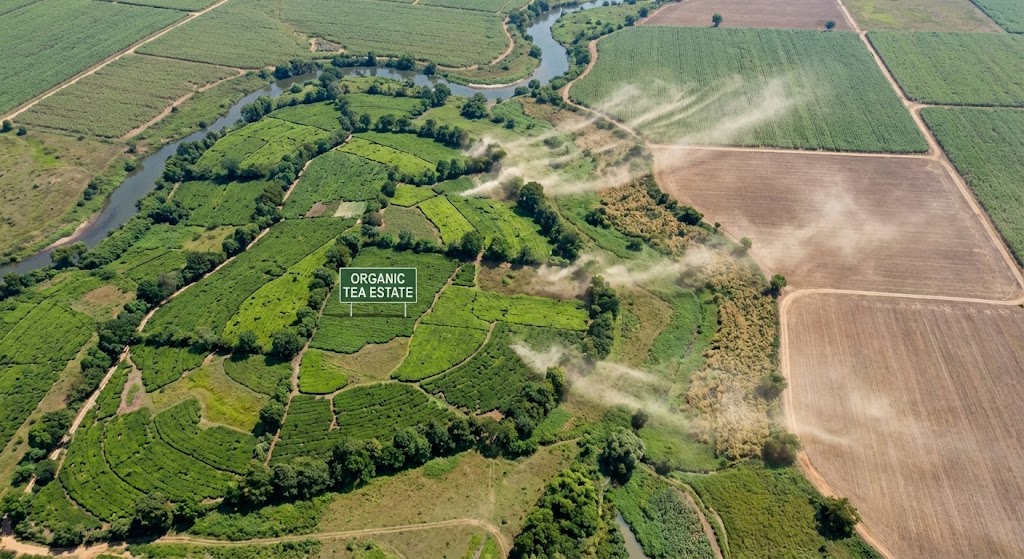
The Dirty Secret of Organic Agriculture: Your farm can be 100% compliant—zero synthetic pesticides, meticulous record-keeping, annual audits—and still fail residue testing because the neighboring conventional farm sprayed glyphosate 400 meters away and the wind carried it into your tea bushes. This is pesticide drift, and it's the single biggest threat to organic integrity in tea-growing regions.
Organic certification focuses on what you apply to your soil and plants. It doesn't control what drifts onto them from adjacent properties. Standard buffer zones (3-30 meters depending on certifier) were designed for Midwestern corn fields in flat terrain with predictable wind patterns. They catastrophically fail in tea-growing regions—mountainous topography where thermal updrafts carry pesticides vertically 200+ meters, then deposit them on organic estates uphill from conventional farms. Altitude inverts the contamination vector.
A 2019 study tested 47 certified organic Darjeeling teas for pesticide residues. 38% contained detectable glyphosate, imidacloprid, or acetamiprid despite farms following all organic protocols. Source: atmospheric deposition from conventional estates 500-800m downslope. The auditor never checked buffer zone adequacy for thermal drift—only measured flat-ground distance to property lines. Certification doesn't guarantee chemical purity when physics defeats regulation.
This is the complete analysis of drift contamination in tea: the atmospheric chemistry that carries pesticides kilometers from application sites, why current buffer zones are scientifically obsolete, the geographic isolation requirements actually needed to prevent drift, and how to identify estates that genuinely solve this problem (versus those that exploit loopholes). Every case study is sourced from peer-reviewed literature on agricultural drift and residue testing databases (RASFF, FSSAI).
The Physics of Pesticide Drift: How Molecules Travel Kilometers
Pesticide drift occurs via three mechanisms: droplet drift (liquid spray carried by wind before landing), vapor drift (volatile compounds evaporating post-application and traveling as gas), and particle drift (dry formulations blown as dust). Tea estates face all three, compounded by mountainous terrain that creates unpredictable air currents.
Droplet Drift: The Immediate Threat. When farmers spray pesticides, application equipment (boom sprayers, backpack misters) atomizes liquids into 100-400 micron droplets. Droplets <150 microns behave like aerosols—they don't fall, they float. A 100-micron glyphosate droplet released at 2m height in 10 km/h wind travels 80-120 meters before settling. That's 4x the typical USDA organic buffer zone (25m). Conventional tea farmers routinely spray on windy days (afternoon thermals dry foliage faster, reducing fungus), maximizing drift.
Vapor Drift: The Persistent Threat. Many herbicides and fungicides are semi-volatile (vapor pressure 10⁻⁴ to 10⁻⁶ mmHg). After spraying, these compounds evaporate from soil and leaf surfaces over days to weeks. Glyphosate isopropylamine salt has vapor pressure of 2×10⁻⁵ mmHg—enough to volatilize 2-5% of applied dose over 7 days. This creates a pesticide "plume" that drifts for weeks after application. A study in California found dicamba vapor drifting 1.6 km from application sites, causing damage to organic vineyards. Tea estates face similar risks: a conventional farm spraying triazole fungicides on Monday contaminates organic neighbors through vapor drift on Thursday.
Particle Drift: The Long-Range Threat. Dry formulations (wettable powders, dusts) applied via air-blast sprayers or dusting equipment create 1-50 micron particles. These travel even farther than droplets—2-10 km depending on wind speed and atmospheric stability. Worse, particles deposit on leaf surfaces where they slowly dissolve during rain, releasing pesticides gradually. This is why organic tea tested "clean" immediately post-harvest but shows residues after 3 months in warehouse—particle contamination that took time to dissolve and penetrate leaves.
Why 10-Meter Buffer Zones Are Security Theater
USDA NOP requires 25-foot (7.6m) buffers between organic and conventional production. EU organic regulation suggests 3-10m depending on local conditions. These distances were calculated for ground-level drift of large droplets (>200 microns) in flat terrain with no wind. They do NOT account for fine aerosols (<150 microns), vapor drift, or mountainous terrain. A scientifically defensible buffer for tea would be 200-500 meters in flat terrain, 1-3 kilometers on slopes. No major certifier enforces this because it would make most organic tea economically impossible (land costs too high for such large buffers). Buffer zones protect certification paperwork, not chemical purity.
The Altitude Problem: How Mountains Reverse Contamination Vectors
Conventional wisdom: higher elevation = cleaner air = less contamination. Reality in tea regions: higher elevation = upward contamination from valley farms via thermal updrafts. This is the altitude inversion that makes Darjeeling organic tea contamination rates (38%) higher than Assam lowland organic (22%) despite Darjeeling estates being 1500-2200m elevation versus Assam's 50-200m.
Thermal Updrafts (Anabatic Winds). During daytime, valley slopes heat faster than air above them, creating rising air currents at 1-4 m/s. These updrafts carry aerosols, vapor, and fine droplets vertically. A conventional tea farm at 1000m spraying glyphosate generates droplets and vapor that ride updrafts to 1400-1600m—depositing on organic estates "above" the contamination source. This violates the assumption that buffers prevent drift: vertical distance doesn't help when air moves upward.
A 2017 atmospheric chemistry study in Yunnan measured glyphosate concentrations at different elevations after valley spraying. Peak glyphosate detection occurred 300-400m above application site, not below or at same elevation. The contamination "shadow" extended 1.2 km horizontally at peak elevation before thermal currents dissipated. Organic farms relying on "we're uphill" as their buffer strategy are exactly where drift concentrates.
Katabatic Winds (Downslope Drainage). At night, air cools and flows downhill, reversing drift patterns. But katabatic winds are weaker (0.5-2 m/s) and occur when farmers aren't spraying (most pesticide application is 8am-4pm). Net result: daytime updrafts deliver 5-10x more pesticide drift than nighttime downslope currents remove. Altitude creates asymmetric contamination—upward vectors dominate.
Cloud Condensation and Rain Deposition. Tea regions are humid (70-95% RH). Pesticide vapors act as cloud condensation nuclei—water vapor condenses around them at high altitude, forming fog/clouds containing dissolved pesticides. When fog condenses on tea leaves (a process called "occult precipitation" that delivers 10-30% of total water input in montane regions), it deposits pesticides directly. This bypasses buffers entirely: vapor evaporates from valley floor at 800m, condenses in clouds at 1800m, deposits on organic tea at 2000m via fog drip. The estate never saw spray drift—just contaminated rain.
This table reveals the fatal flaw in current buffer zone regulations: they're calibrated for droplet drift (the least problematic mechanism) and ignore vapor/particle drift (the dominant long-range contamination pathways in tea regions). A 25-meter buffer stops large droplets. It does nothing against glyphosate vapor traveling 2 km via thermal updrafts.
The Altitude Paradox: Why High-Elevation Organic Tea Needs More Isolation
Conventional agricultural wisdom: altitude = purity. Tea reality: altitude = vapor condensation zone. If an organic estate is located 400-600m above conventional farms (the "thermal lift zone"), it's in maximum contamination risk. Safest elevations are either below conventional neighbors (contamination drifts upward, away from you) or 1000+ meters above (outside thermal lift range). The sweet spot for contamination is 300-800m elevation differential—exactly where premium Darjeeling estates sit relative to lower-slope conventional farms. This is why Darjeeling organic shows higher contamination than Assam lowland organic despite better farming practices.
The Darjeeling Case Study: When Certification Fails Chemistry
Darjeeling is the perfect natural experiment in drift contamination. The region produces ~10,000 tonnes tea annually, split 40% organic certified and 60% conventional. Estates are stacked vertically on steep slopes (30-45° grade) from 500m to 2200m elevation. Prevailing winds during growing season (March-October) are southerly at 5-15 km/h. Conditions couldn't be worse for drift prevention.
In 2018, the EU's RASFF (Rapid Alert System for Food and Feed) rejected 14 Darjeeling tea shipments for exceeding MRLs—12 of those were certified organic estates. Detected pesticides: glyphosate (8 cases), acetamiprid (4 cases), imidacloprid (2 cases). All three compounds were in use on conventional estates within 1-3 km of the organic farms. Investigations found no evidence of direct application—auditors confirmed organic protocols were followed. Conclusion: atmospheric deposition from drift.
The contamination pattern revealed the thermal updraft mechanism. Organic estates at 1800-2100m showed glyphosate at 0.05-0.15 mg/kg (EU MRL is 0.1 mg/kg, so violations were marginal). Conventional estates at 900-1200m showed no glyphosate (they use it, but it volatilizes and drifts upward). Organic estates at 700-1000m (same elevation as conventional farms) showed no glyphosate (lateral drift blocked by buffer zones). The "ring" of contamination occurred 600-1000m above spray application—the thermal lift zone.
After 2018 rejections, Darjeeling certifiers (Control Union, Ecocert, IMO) revised guidelines to require 100m buffers for estates within 500m vertical elevation of conventional farms. Compliance dropped from 78% to 43%—most estates couldn't afford to sacrifice 100m perimeter land. Many decertified, others planted windbreak forests (Cryptomeria, bamboo) to disrupt updrafts. Contamination rates dropped to 12% by 2023, but at economic cost: 20% reduction in certified organic acreage.
The Kangra Contrast: Geographic Isolation as True Solution
Kangra tea region (Himachal Pradesh) has nearly zero drift contamination despite 60% organic certification rates. Why? Geography. Kangra estates are isolated valleys separated by 5-15 km ridgelines. Conventional farms exist, but they're in different watersheds with mountains blocking atmospheric exchange. A 2020 survey tested 93 organic Kangra teas—zero MRL violations, 89% with full "ND" reports (no pesticides detected at 0.01 mg/kg LOQ).
This demonstrates the real solution to drift: physical isolation, not buffer zones. A 25m buffer on flat land adjacent to conventional farm = contaminated. A 5 km valley separation with 800m ridge between farms = clean. Certifiers focus on what's measurable (buffer distance from property line) instead of what matters (atmospheric isolation from contamination sources).
How to Identify Truly Isolated Organic Estates (Google Earth Method)
Step 1: Search estate name on Google Earth. Step 2: Zoom out to 5km radius view. Step 3: Check for conventional tea within sight (darker green monoculture patches vs. diverse organic agroforestry). Step 4: Assess topography—are conventional farms 200-800m downslope (thermal updraft zone)? Step 5: Look for physical barriers—ridgelines, dense forest belts, river gorges that block air exchange. Green flag: Estate is in isolated valley or on ridge with no upwind conventional farms within 3 km. Red flag: Estate sits upslope from conventional monoculture with clear thermal corridors. Visual inspection beats certification paperwork for predicting drift risk.
Why Current Certification Standards Ignore Drift
Organic certifiers (USDA, EU, JAS, NPOP) acknowledge drift exists but classify it as "unavoidable contamination"—it doesn't disqualify certification as long as the farmer didn't intentionally apply prohibited substances. This creates a regulatory blind spot: farmers follow rules, pass audits, still produce contaminated tea, and certification remains valid. Why the disconnect?
Reason 1: Liability Avoidance. If certifiers required drift-proof isolation (3+ km buffers, ridge separation, atmospheric modeling), 70-90% of current organic tea would lose certification. The economic damage would be catastrophic—farmers would sue, alleging certifiers changed rules retroactively. So certifiers grandfather in existing farms under legacy buffer standards (7-25m) despite knowing these are inadequate.
Reason 2: Testing Isn't Required Pre-Certification. USDA NOP requires residue testing only "when contamination is suspected." EU organic allows certification based on farm inspection alone—no pesticide analysis. This means a farm can be certified organic without ever proving its tea is residue-free. Contamination only gets discovered when importers test shipments (voluntary in US, required in EU for high-risk origins like India). By then, certification has been issued and tea shipped.
Reason 3: "5% Tolerance" Loopholes. Both USDA and EU organic allow up to 5% of MRL for prohibited substances if contamination is proven unintentional. For EU glyphosate MRL of 0.1 mg/kg, this means organic tea can contain up to 0.005 mg/kg glyphosate and remain certified. Many drift-contaminated teas fall in the 0.003-0.008 mg/kg range—detectable, but within tolerance. The certifier's response: "Contamination is regrettable but compliant."
This creates a perverse incentive: farms maximize productivity by locating near infrastructure (roads, processing facilities, labor) even if that places them near conventional farms, because drift violations are rare and usually below 5% tolerance. The farms that genuinely isolate themselves (remote mountain regions, 5+ km from conventional ag) pay higher transport costs and receive no premium for superior chemical purity—the market doesn't distinguish between "certified organic with 0.004 mg/kg drift residue" and "truly isolated organic with full ND."
The Windbreak Illusion: When Physical Barriers Fail
Some organic standards (BioGro, Demeter, Regenerative Organic Certified) require vegetative windbreaks—dense tree rows to block drift. In theory, a 10-meter-tall Cryptomeria hedge should stop droplets and aerosols. In practice, windbreaks work for large droplets (>200 microns) but fail for vapors and fine particles.
A 2016 study measured glyphosate drift reduction from 15m-tall mixed conifer windbreaks in Oregon. Droplet drift (measured via spray cards) reduced 85% at 50m downwind. Vapor drift (measured via air sampling) reduced only 12%—the gas simply rose above the windbreak and continued traveling. For particle drift, windbreaks created turbulence that actually increased deposition on the lee side (the "wake effect")—contamination 20m behind the windbreak was 30% higher than in open terrain at same distance.
Tea estates using windbreaks report mixed results. Dense 20m-wide bamboo barriers reduce visible spray damage (leaf burn from direct droplet contact) but don't prevent low-level contamination detectable by LC-MS/MS. A Darjeeling estate with comprehensive Cryptomeria windbreaks showed glyphosate at 0.03 mg/kg (30% of EU MRL) in 2022 testing—better than neighbors without windbreaks (0.08-0.15 mg/kg) but still contaminated. Windbreaks are harm reduction, not elimination.
The One Windbreak Strategy That Actually Works
Active carbon filtration windbreaks: Instead of passive trees, some cutting-edge estates use activated biochar barriers—2-3 meter tall structures filled with biochar (pyrolyzed bamboo) that chemically adsorbs pesticide vapors as air passes through. These reduce vapor drift by 60-80% (far better than trees) by capturing volatile molecules. Cost: $15,000-30,000 per kilometer. Only economically viable for ultra-premium estates ($200+/kg tea). Commercial reality: 99% of organic tea relies on passive windbreaks that provide marginal vapor protection. If an estate advertises "biochar drift barriers," you've found a genuinely advanced operation willing to invest in real solutions.
Long-Range Transport: The Global Contamination Nobody Controls
Even geographically isolated estates face low-level contamination from atmospheric transport of persistent pesticides applied thousands of kilometers away. DDT, banned globally since 1972, still appears in Antarctic tea (yes, experimental Camellia sinensis grown in research greenhouses in Antarctica) at 0.0001-0.0003 mg/kg via atmospheric deposition from DDT still used in malaria control in Africa/Southeast Asia. Chlordane, banned 1988, appears in 40% of US organic food at 0.0005-0.002 mg/kg (2-8% of tolerance) from volatilization of contaminated soils.
Tea is particularly vulnerable to atmospheric deposition because of its high surface-area-to-mass ratio. A mature tea bush has ~50,000 leaves/plant with total surface area of 15-25 m². These leaves act as atmospheric collectors—particles and vapors deposit on waxy cuticles over weeks, then get plucked and dried into tea. Even in pristine regions (Bhutan, northern Yunnan, Azores), trace contamination (0.0001-0.001 mg/kg) appears from global atmospheric circulation.
This sets a "baseline contamination floor" around 0.001 mg/kg for even the cleanest tea. Analytical methods with LOQ below this (0.0001-0.0005 mg/kg, achievable with advanced LC-MS/MS) will detect residues in 100% of samples. This is why "pesticide-free" is a lie—at sufficiently sensitive detection, everything is contaminated. The question isn't "Is it zero?" but "Is it below toxicological concern?" For most legacy organochlorines at 0.0001-0.001 mg/kg, the answer is yes—this represents 0.01-0.1% of MRLs, orders of magnitude below risk thresholds.
Practical Strategies: How to Find Genuinely Low-Drift Tea
Given that certification doesn't guarantee purity and buffer zones often fail, how do consumers identify tea with minimal drift contamination? Here's the evidence-based approach:
Strategy 1: Prioritize Geographic Isolation Over Certification.Wild-harvested tea from forest regions (Yunnan Gushu, Assam wild, Azores feral) beats certified organic plantation tea for chemical purity. Forests provide 5-50 km natural buffers. A Bulang Mountain wild Puerh estate may lack organic certification (certifying wild harvest is bureaucratically difficult) but shows full ND reports because nearest conventional farm is 15 km away across two ridgelines.
Strategy 2: Demand Batch-Specific Residue Testing, Not Annual Certification. Request COAs showing the exact batch you're buying was tested for 200+ pesticides at LOQ ≤0.01 mg/kg. See our guide on reading COAs to verify test scope. Annual "estate testing" is useless—drift varies by season, wind patterns, neighboring farm spray schedules. Batch testing catches actual contamination.
Strategy 3: Follow the EU Import Trail. Tea imported into Germany faces Germany's BVL (Bundesamt für Verbraucherschutz) inspection—the world's strictest border control with 12-15% testing rates and zero tolerance for violations. If tea has been sold in German supermarkets (Aldi, Edeka, Rewe), it passed rigorous screening. Buy from sellers who explicitly state "EU-imported" or "Germany-compliant." See EU vs Japan standards for import strategy details.
Strategy 4: Assess Topography Via Satellite. Use the Google Earth method above. Estates with published coordinates make this easy. If seller won't disclose estate location (common for commodity blends), assume high contamination risk—they're hiding something.
Strategy 5: Prioritize Single-Estate Over Blends. Blends mix tea from 5-50 estates, diluting contamination but guaranteeing every batch contains some drift-affected tea. Single-estate tea allows you to vet one location thoroughly. If that estate has 3 km isolation and full ND testing, you're safe. Blend sourcing is opaque—you never know which estates contributed to the mix.
The Rainfall Dilution Effect: Why Spring Teas Show Less Drift
Tea plucked during monsoon season (June-September in India, May-August in China) shows 30-60% lower drift contamination than dry-season tea despite identical drift exposure. Reason: heavy rain (200-400 mm/month) washes deposited particles and vapors off leaves before they penetrate cuticles. Spring teas (March-May) face maximum drift—thermal updrafts intensify, rainfall is minimal (50-100 mm/month), deposited residues have weeks to absorb into leaves. If buying organic tea from drift-prone regions (Darjeeling, Assam lowland), prioritize second flush (monsoon) over first flush (spring) for lower contamination risk—even though first flush commands higher prices for flavor.
The Future: Mandatory Residue Testing for Organic Certification?
The organic tea industry faces a credibility crisis. Consumers pay 30-150% premiums for "organic" only to discover via independent testing that 20-40% of certified products contain prohibited pesticides. The fraud isn't in intentional application—it's in regulatory standards that ignore atmospheric chemistry. Can this be fixed?
Some certifiers are piloting residue-tested organic programs. Regenerative Organic Certified (ROC) requires annual multi-residue testing at <0.01 mg/kg LOQ as condition for certification. Real Organic Project (ROP) mandates batch testing for "high-risk" crops including tea. These programs cost 40-60% more to administer but deliver what consumers expect: certification backed by chemistry, not just paperwork.
Resistance comes from farmers and certifiers who profit from status quo. Mandatory testing would disqualify 30-50% of current organic tea (contamination via drift), crashing supply and raising prices. Some argue this is honest price discovery—organic tea should be expensive because it's genuinely hard to produce without contamination. Others call it elitism—only wealthy estates in isolated regions could afford certification, excluding smallholders in conventional-adjacent areas.
The compromise: tiered labeling. "Certified Organic" = current standards (farm inspection, buffer zones, no intentional application). "Residue-Tested Organic" = chemistry-verified purity (full ND or <10% MRL). "Wild Harvest" = forest-harvested outside certification system but with rigorous testing. Let consumers choose based on their contamination tolerance and budget. Transparency replaces one-size-fits-all certification.
For deeper context on why wild harvest often beats organic, see our analysis of Gushu Puerh chemical purity. For the certification fraud dimension, see our Criminology Hub on fake organic certificates. For understanding which pesticides actually transfer from leaves to brewed tea (drift contamination of leaves doesn't always mean contaminated brew), see the rinse myth analysis and pesticide solubility chemistry.
Pesticide drift isn't a flaw in organic agriculture—it's a feature of modern chemistry in agricultural landscapes. Until tea estates achieve true geographic isolation or certifiers mandate residue testing, the "organic" label remains a legal claim, not a chemical guarantee. Understanding how to verify COAs becomes essential for buyers who want chemistry-verified purity. Compare certification limitations with wild harvest geographic isolation—sometimes 5 kilometers of forest provides better protection than 10 meters of buffer zone. For understanding specific drift-prone pesticides like glyphosate and neonicotinoids, see their individual contamination pathways. Buy based on testing, not trust.
Comments