What Is IPM? Principles and Components
Integrated Pest Management combines multiple tactics (biological, cultural, physical, chemical) to suppress pests below economic damage thresholds while minimizing environmental impact, worker exposure, and consumer residues. Critical distinction from conventional pest control: IPM aims for pest management, not pest eradication. Small pest populations are tolerated if they don't reduce yield/quality enough to justify control costs.
The Four IPM Principles:
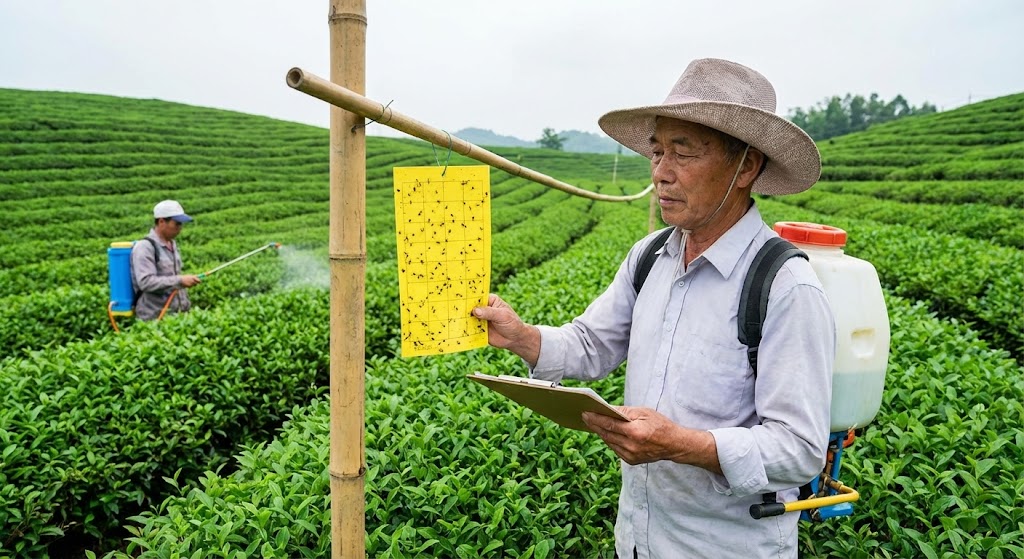
1. Monitoring and Thresholds. Don't spray on calendar schedule—spray only when pest density exceeds economic injury level (EIL = pest density where crop damage cost exceeds control cost). Requires regular field scouting (weekly leaf inspections, pheromone trap counts, yellow sticky card monitoring). Labor-intensive (2-4 hours/week per 10 hectares) but prevents unnecessary spraying.
2. Prevention via Cultural Practices. Design agroecosystem to minimize pest establishment: diverse shade trees attract predatory birds and insects, intercropping with pest-repellent plants (lemongrass, citronella between tea rows), pruning schedules that disrupt pest breeding cycles, optimal fertilization (avoid excess nitrogen that creates soft succulent growth attracting aphids/leafhoppers).
3. Biological Control. Conserve and augment natural enemies: predatory wasps (parasitize scale insects and caterpillars), ladybugs (consume aphids), spiders (generalist predators), parasitic flies (target leaf miners). Methods: (a) Conservation biological control—preserve existing beneficials by reducing broad-spectrum insecticides (use selective biopesticides like Bt that kill target pests but spare beneficials), (b) Augmentative biological control—release commercially-reared beneficial insects when populations are low (e.g., Trichogramma wasp releases).
4. Selective Chemical Use as Last Resort. When monitoring indicates pest density exceeds threshold AND biological controls are insufficient, use selective low-toxicity chemicals: biopesticides (Bt, spinosad, azadirachtin from neem), insect growth regulators (disrupt molting—target-specific), narrow-spectrum synthetics (pyrethrins—degrade rapidly). Avoid broad-spectrum organophosphates, neonicotinoids, and carbamates that kill beneficials along with pests.
This table quantifies the IPM value proposition: Higher upfront investment ($430-830/ha in year 1 for monitoring labor + biocontrol + biopesticides + habitat) but lower ongoing costs ($400-700/ha years 3-10 vs. $600-1200/ha conventional). Payback period: 2-4 years. After that, IPM is both cheaper AND produces cleaner tea commanding 10-30% price premium.
Why "Eradication" Fails and "Management" Succeeds
Conventional pest control targets 100% elimination—"spray until we see zero pests." This is ecologically futile and economically wasteful. Why futile: (1) Pest resistance—intensive spraying drives rapid evolution of pesticide resistance (tea leafhoppers develop imidacloprid resistance after 3-5 years continuous use), (2) Beneficial extermination—zero pests also means zero predators (they depend on prey to survive). When spraying stops, pests rebound faster than predators (pest reproduction rate 5-10x faster), creating secondary outbreaks, (3) Treadmill acceleration—need progressively more and stronger chemicals to achieve same suppression. IPM accepts 5-15% pest presence—enough to sustain predator populations but below economic damage. Result: stable equilibrium where predators control pests naturally, chemical inputs minimal.
Biological Control: The Living Pesticides
Key Pest-Predator Systems in Tea:
Tea Leafhopper (Empoasca flavescens) vs. Parasitoid Wasps (Anagrus spp.): Leafhoppers are tea's primary pest—suck phloem sap, causing leaf yellowing and curl ("hopper burn"), yield losses 15-40% in severe infestations. Conventional control: neonicotinoid or pyrethroid sprays every 14-21 days. IPM approach: Anagrus wasps parasitize leafhopper eggs—female wasp lays egg inside leafhopper egg, wasp larva consumes leafhopper embryo. One Anagrus can parasitize 50-100 leafhopper eggs in lifetime. Augmentation: Release commercially-reared Anagrus at 2,000-5,000 wasps/ha (cost $80-120/ha) when leafhopper density exceeds 10 nymphs per 100 leaves. Wasp populations establish, providing season-long suppression. Efficacy: 60-75% leafhopper reduction within 3-4 weeks, maintained for 8-12 weeks (one generation). Requires 2-3 releases per season in high-pressure areas. Outcome: Synthetic spray reduction from 6-8 applications to 1-2 applications per season.
Tea Scale Insects (Coccus spp.) vs. Ladybugs (Chilocorus spp.): Scale insects attach to stems, secrete protective wax coating, suck sap—causing dieback and sooty mold growth. Conventional control: organophosphates or oils. IPM approach: Chilocorus ladybugs (predatory, not the aphid-eating species) consume 5-10 scale insects per day as adults, 20-30 as larvae. Conservation: Avoid broad-spectrum sprays that kill ladybugs. Plant flowering hedgerows (provide nectar for adult ladybugs). Augmentation: Release 500-1,000 Chilocorus adults/ha if scale density exceeds 3-5 per branch. Efficacy: 70-85% scale reduction in 6-8 weeks. Ladybugs overwinter in leaf litter—maintain population year-round with minimal re-introduction.
Tea Looper Caterpillars (Hyposidra spp.) vs. Tachinid Flies + Bt: Loopers defoliate tea—can consume 50-100 cm² leaf area per larva. Conventional control: synthetic pyrethroids. IPM approach: Tachinid flies parasitize looper larvae—fly deposits eggs on caterpillar, maggots burrow inside, consume caterpillar from within. Augmentation: Tachinids are difficult to rear commercially—instead, conserve them by using Bt (Bacillus thuringiensis, naturally-occurring bacteria producing insecticidal protein) instead of synthetic sprays. Bt kills only caterpillars (lepidoptera), spares tachinid flies and all other beneficials. Efficacy: Bt alone provides 80-90% looper control. With tachinid conservation, long-term suppression improves to 90-95%.
Generalist Predators (Spiders, Green Lacewings, Hoverflies): These consume broad range of pests—aphids, mites, small caterpillars, leafhopper nymphs. IPM support: Provide habitat (unmowed strips, flowering cover crops between rows) and avoid broad-spectrum chemicals. Spiders alone can suppress 30-50% of soft-bodied pests in biodiverse tea gardens. Cost: zero (natural colonization). Benefit: continuous background pest suppression.
Why Organic ≠ IPM (And IPM Can Outperform Organic)
Common misconception: "IPM is the same as organic farming." Reality: They're different approaches with some overlap. Organic = regulatory certification prohibiting synthetic inputs (must use approved biopesticides/cultural controls). IPM = management philosophy minimizing inputs via thresholds and biocontrol (can include synthetic chemicals if used selectively and as last resort). Key difference: Organic farmer facing severe pest outbreak must use approved biopesticide (e.g., pyrethrin spray) even if ineffective, because certification forbids synthetics. IPM manager facing same outbreak uses threshold analysis—if damage will exceed control cost, uses most effective selective chemical (might be synthetic like spinosad), but only when/where needed. Result: IPM can achieve lower residues than organic (fewer total sprays, better-targeted) while maintaining higher yields (strategic synthetic use prevents crop loss). See organic reality for certification details. IPM is chemical-minimizing pragmatism; organic is input-restricting dogma. Both have value—organic for market access/certification premium, IPM for environmental efficiency.
Pheromone Mating Disruption: Confusion Tactics
Pheromones are chemical signals insects use to find mates. Females release sex pheromones (typically species-specific blend of volatile compounds), males detect via antennae, males locate females for mating. Mating disruption: Saturate field with synthetic sex pheromone—males can't locate real females amid pheromone cloud, mating fails, next generation population crashes.
Tea Leafhopper Mating Disruption: Deploy pheromone dispensers (small plastic tubes containing synthetic leafhopper pheromone blend) at 400-800 dispensers/ha, attached to bamboo stakes 50-80 cm above ground (optimal height for pheromone plume diffusion). Pheromone slowly releases over 60-90 days. Effect: Male leafhoppers fly continuously searching for females, become exhausted, mating success drops 70-90%. Population crashes in 2-3 generations (6-9 weeks). Cost: $150-300/ha per season (dispensers + labor). Efficacy: 60-80% leafhopper suppression as standalone tactic, 85-95% when combined with parasitoid wasp releases. Advantage: Species-specific (only disrupts target pest, zero effect on beneficials), no residues, worker-safe.
Tea Looper Pheromone Traps (Monitoring, Not Disruption): Looper moths are too mobile for effective mating disruption in tea (they fly 1-5 km, pheromone plume coverage would require impractical dispenser density). Instead, pheromone traps are used for monitoring: Traps with virgin female pheromone lure males, sticky surface captures them. Count trapped males weekly—when count exceeds 15-20 moths per trap per week, it signals population spike requiring intervention (Bt spray). Cost: $30-50/ha (traps replaced monthly). Benefit: Precise timing of control measures—spray only when needed, not on calendar.
Yellow Sticky Cards (Non-Pheromone Physical Trap): Bright yellow attracts many flying pests (whiteflies, aphids, fungus gnats). Cards coated with non-drying adhesive trap insects. Deploy 20-40 cards/ha. Purpose: Monitoring (count trapped insects weekly to track population trends) + light suppression (removes some adults, reducing reproduction). Cost: $20-40/ha. Efficacy: 5-15% pest reduction (minor direct effect) but valuable data for threshold-based decision making.
Combined IPM program using 3-4 of these tactics achieves 85-95% overall pest suppression—equivalent to conventional programs using 8-12 synthetic spray applications, but at 40-60% lower cost and near-zero residues.
Case Study: Taiwan High-Mountain Oolong IPM Success
Background: Alishan oolong region (1,200-2,000m elevation), 500 small estates averaging 3-8 hectares, premium tea market (retail $30-80/100g). 1995-2005: Conventional pest control—prophylactic spraying 10-15x per season, pesticide costs $800-1,400/ha, residue detections in 15-25% of export shipments (EU/Japan rejections).
IPM Implementation (2006-2010): Taiwan Tea Research and Extension Station developed mountain-adapted IPM protocol: (1) Pest monitoring network—20 pheromone traps per 5 hectares, weekly inspection routes, smartphone app for data entry and threshold alerts, (2) Biological controls—Trichogramma wasp releases 3x per season (targeting tea tortrix moth and looper eggs), conservation of endemic spider populations via reduced mowing, (3) Biopesticide program—Bt for caterpillars, spinosad (fermentation-derived insecticide, low toxicity) for leafhoppers when threshold exceeded, neem oil for mites, (4) Habitat management—native tree hedgerows every 50-100m (windbreaks + predator habitat), flowering ground cover (white clover) between rows.
Adoption Incentive: Taiwan government subsidized 50% of IPM infrastructure cost (traps, wasp releases) in years 1-3 to accelerate adoption. By 2010, 60% of Alishan estates enrolled.
Results (2010-2020 Average):
- Pest suppression: 88-94% (equivalent to conventional at 90-95%—no statistically significant yield difference)
- Pesticide applications: Reduced from 10-15 to 2-4 per season (73-80% reduction)
- Cost savings: $500-900/ha annually (pesticide + labor reduction exceeded IPM costs after year 3)
- Residue compliance: EU/Japan rejection rate dropped from 15-25% to <2% (2018-2020 data)
- Tea quality: Sensory panels detected less "chemical off-flavor," improved clarity in high-elevation oolongs
- Price premium: IPM-certified tea commanded 15-25% premium in Taiwan domestic market, 10-18% in export markets
- Biodiversity recovery: Bird species richness increased 40% on IPM estates (2008-2018 ecological surveys), pollinator abundance up 60%
Economic Conclusion: IPM payback period was 2.5-3.5 years. After payback, IPM estates earned $800-1,500/ha more than conventional (cost savings + quality premium). Scaling: By 2020, 75% of Taiwan high-mountain tea used IPM. Success factors: government subsidy (reduced risk), technical support (extension agents trained in IPM), market premium (buyers rewarded clean tea).
Why Small Estates Adopt IPM Faster Than Large Plantations
Taiwan (3-8 ha average), Japan (5-15 ha), and Korean tea farms (2-6 ha) show 50-80% IPM adoption. India/Sri Lanka large estates (100-500 ha) show 5-15% adoption. Reasons: (1) Management intensity—IPM requires close monitoring and rapid decision-making. Small estates with owner-operators can inspect daily and respond immediately. Large estates with hired managers and multi-tier bureaucracy struggle with agility, (2) Labor availability—IPM is labor-intensive (monitoring, beneficial insect handling). Small Asian estates have family labor; large estates face labor shortages and high wage costs, (3) Market positioning—Small estates target premium markets ($15-80/100g) where clean tea commands significant premium. Large estates produce commodity tea ($3-8/kg) where price pressure makes IPM investment hard to justify, (4) Risk tolerance—Small owner bears risk personally, can make long-term decisions. Large corporate estates optimize quarterly profits, avoid 2-3 year IPM transition risk. Implication: If you want IPM tea, buy from small/medium estates in Japan, Taiwan, Korea, or boutique Indian gardens—not commodity CTC from large plantations.
IPM Implementation Roadmap for Estates
Year 1: Assessment and Planning ($1,000-3,000 investment).
- Hire IPM consultant or extension agent to conduct pest inventory and economic threshold analysis for your region/climate
- Establish baseline monitoring system—install 10-20 pheromone traps and 20-40 yellow sticky cards per 10 hectares
- Train 2-3 staff in pest identification, monitoring protocols, and data recording
- Identify beneficial insect suppliers (wasp/ladybug providers) and biopesticide sources
- Map estate for habitat enhancement opportunities (where to plant hedgerows, flowering borders)
Year 2: Transition Phase ($3,000-6,000 investment, partial cost recovery).
- Implement threshold-based spraying—reduce synthetic applications by 30-50% (spray only when monitoring indicates EIL exceeded)
- Switch from broad-spectrum to selective chemicals (replace chlorpyrifos/imidacloprid with Bt/spinosad/neem)
- Release beneficial insects 2-3x during pest pressure peaks (don't rely fully on biocontrol yet—maintain chemical backup)
- Plant initial hedgerows and cover crops (habitat establishment takes 1-2 years to mature)
- Document all interventions and outcomes—build knowledge base for year 3 optimization
- Expected result: 40-60% pesticide reduction, 10-20% cost savings (partial offset by IPM investments), 2-5% yield variability (some losses as you learn thresholds, some gains from reduced phytotoxicity)
Year 3: Optimization Phase ($2,000-4,000 investment, net profitable).
- Fine-tune thresholds based on year 2 data—you now know site-specific EILs
- Increase biological control reliance—biocontrol populations are establishing, reduce wasp/ladybug purchases as natural reproduction takes over
- Reduce synthetic sprays to 1-3 applications per season (emergency use only)
- Seek IPM certification or market IPM practices to buyers for premium pricing
- Expected result: 70-85% pesticide reduction vs. baseline, 30-50% cost savings, yields stabilize at 95-100% of conventional (you've mastered IPM), quality improvements measurable in cupping/testing
Year 4+: Mature IPM System ($1,500-3,000 annual maintenance).
- Routine monitoring and threshold-based interventions—IPM is now "standard practice," not "experiment"
- Beneficial populations self-sustaining with minimal augmentation (1-2 releases per season vs. 3-5 in year 2)
- Habitat established and productive—free ecosystem services from birds, spiders, wasps
- Cost structure: $400-700/ha total pest management (down from $600-1,200 conventional)
- Revenue structure: $200-500/ha premium for clean tea + $200-500/ha cost savings = $400-1,000/ha net IPM advantage
Challenges and Limitations
Climate Sensitivity: IPM works best in temperate/subtropical climates with distinct seasons (Japan, Taiwan, Korea, Darjeeling). Tropical lowlands (Assam, Sri Lankan low-elevation, Kenya) have year-round pest pressure and rapid pest reproduction—biological control struggles to keep pace. Requires more intensive management and higher biopesticide use. Adaptation: Focus on cultural controls (shade trees to moderate microclimate, optimal pruning to disrupt pest cycles) and selective chemistry rather than full biocontrol reliance.
Scale Constraints: IPM is labor-intensive. Small estates (5-20 ha) can implement with 1-2 dedicated IPM technicians. Large estates (200-500 ha) need proportionally larger teams (10-20 trained scouts). Labor cost can exceed IPM savings if wages are high. Solution: Mechanize monitoring (drone-based pest imaging, AI-assisted trap counting—emerging technology, not yet widely available).
Knowledge Barriers: IPM requires ecological understanding beyond conventional "calendar spray" simplicity. Managers trained in conventional agriculture resist IPM due to perceived complexity. Solution: Government extension services, NGO training programs (Rainforest Alliance, Sustainable Agriculture Network provide IPM curricula), estate-to-estate knowledge sharing (farmer field schools—successful in Kenya tea sector).
Market Access: IPM doesn't have certification standard like "organic." Buyers must trust estate claims or commission independent verification. Solution: Third-party IPM certification emerging (Rainforest Alliance includes IPM requirements, some estates pursue ISO 14001 environmental management + IPM documentation). Transparent COA sharing provides evidence of low residues even without IPM label.
Consumer Power: How Buyers Drive IPM Adoption
Current reality: 80-85% of global tea uses conventional pest control because most buyers prioritize price over purity. Change mechanism: When 20-30% of buyers consistently demand IPM/low-residue tea and pay premium ($2-5/kg extra for verified clean tea), economic incentive shifts. Estates see: Option A (conventional) = sell at $8/kg, Option B (IPM transition) = 2-year learning curve + investment, then sell at $11-13/kg to premium buyers. Tipping point analysis: If IPM premium ($ extra per kg) × volume certainty (% chance of selling full harvest to premium buyers) > conventional profit, estates switch. Your role: Request IPM tea from sellers. Ask: "Do your suppliers use IPM or biological controls?" If seller doesn't know, that's your answer—they're sourcing commodity tea with zero supply chain visibility. Find sellers who CAN answer (Rishi, Arbor Teas, Mountain Rose Herbs—transparent about sourcing). Pay the premium—it's $2-4 per 100g = $0.15-0.30 per cup. That $0.20 premium funds IPM adoption globally.
IPM is not utopian fantasy—it's proven agricultural technology delivering measurable environmental and economic benefits. The barrier is not technical—it's economic inertia and information asymmetry. When buyers signal willingness to pay for clean tea via COA demands and premium pricing, estates respond by adopting IPM. When buyers optimize only for lowest price, estates optimize for lowest cost—which means calendar-based synthetic spraying and resulting ecological damage. Markets are conversations. Make your purchasing voice heard.
For related sustainable agriculture topics: Organic certification (different approach to clean tea), wild harvest (zero-input alternative), nitrogen management (preventing soft growth that attracts pests), and regulatory compliance (IPM helps meet strict MRLs).
Comments