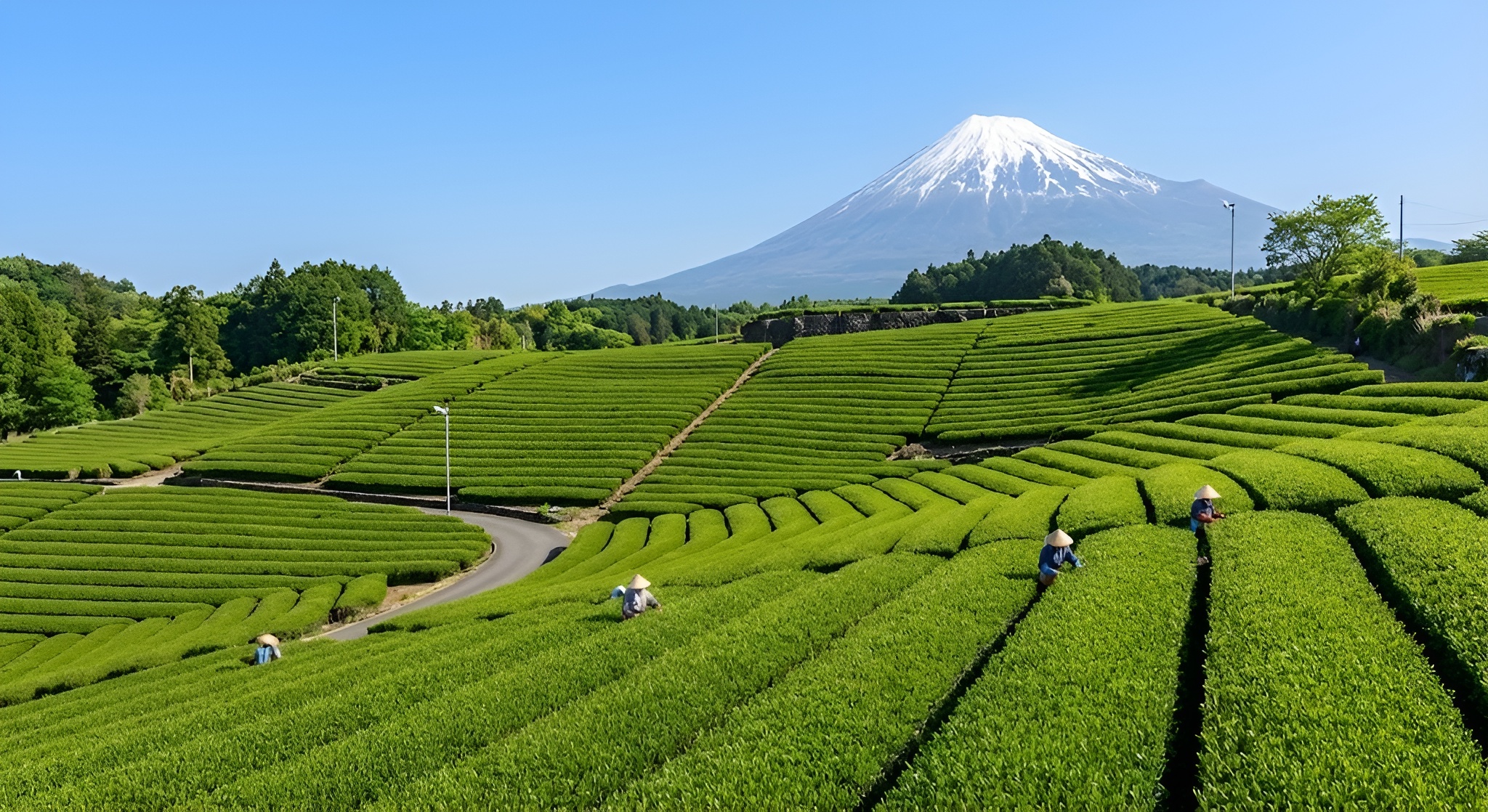
1. History: From Swords to Plowshares
Shizuoka's dominance was not an accident; it was a desperate socio-economic project born from the fall of an empire. In 1869, following the Meiji Restoration, the Tokugawa Shogunate collapsed. Thousands of elite Samurai, who had served the Shogun in Edo (Tokyo), found themselves unemployed and stripped of their status.
Led by the last Shogun's retainer, Sekiguchi Takayoshi, these warriors traded their swords for hoes. They migrated to the Makinohara Plateau, a vast, flat, but arid wasteland that was considered unfarmable due to lack of water. Through immense physical labor, they cleared the forests, tilled the hard earth, and planted tea seeds. Their military discipline laid the foundation for the massive, orderly tea plantations we see today. This history gives Shizuoka tea a legacy of resilience and innovation that separates it from the ancient, aristocratic traditions of Kyoto.
The Port of Shimizu
The success of Shizuoka tea was cemented by logistics. The opening of the Port of Shimizu in 1899 allowed for direct export to the United States. At one point in the early 20th century, nearly all "Japan Green Tea" consumed in America came from Shizuoka. The port remains the primary exit point for Japanese tea exports today.
2. The Terroir: Two Worlds in One Prefecture
Shizuoka is unique because it contains two completely contradictory terroirs within a few miles of each other. This allows the region to produce a diverse portfolio of flavors.
The Mountains (Honyama, Kawane, Tenryu)
Located along the Abe, Oi, and Tenryu rivers, these areas are steep, misty, and cool. The steep slopes make mechanical harvesting difficult, preserving hand-picking traditions.
The Micro-Climate: The natural river mist (kawa-giri) acts as a UV filter, blocking harsh sunlight and boosting amino acids (Umami) naturally. The large temperature difference between day and night causes the leaves to store more carbohydrates.
The Profile: Mountain tea (Yama-cha) is typically processed as Asamushi (Light Steamed). It creates a clear, golden-yellow liquor with a sophisticated floral aroma ("mountain scent") and a crisp, refreshing finish. This is the tea favored by the Shoguns.
The Plains (Makinohara)
A vast, flat plateau bathed in full sunlight with long daylight hours.
The Micro-Climate: The high sun exposure means the leaves grow thick, fleshy, and rich in polyphenols-glossary.html" class="internal-link">Catechins (antioxidants). While healthy, catechins are bitter.
The Profile: To combat this natural bitterness, farmers here invented Fukamushi (Deep Steaming). This creates a cloudy, dark green liquor with a rich, soupy body and mild sweetness. This is the everyday tea of modern Japan.
3. The Fukamushi Revolution
Fukamushi is Shizuoka's signature style and its greatest contribution to tea science. In the 1950s, farmers in Makinohara struggled to sell their tea because the sun-grown leaves were too astringent compared to Kyoto teas.
The Innovation: They increased the steaming time from the standard 30-40 seconds (Asamushi) to 60-120 seconds (Fukamushi).
The Physics: The prolonged heat breaks down the pectin and cellulose in the cell walls of the leaf completely. When brewed, the leaf structure disintegrates.
The Suspension Effect: Unlike normal tea, which is an infusion (extracting solubles), Fukamushi is a Colloidal Suspension. Microscopic leaf particles float in the water, turning it opaque green. Because you are consuming the actual leaf fiber, you get a fuller body, reduced bitterness, and higher nutrient intake (including non-soluble Vitamin E and Beta-carotene).
Want the full story? This history is fascinating. Read our deep dive on how the samurai transformed a wasteland into a tea empire: How Samurai & Science Created Fukamushi →
Brewing Fukamushi: The Clog Hazard
Because the leaves are broken down into fine flakes, Fukamushi brews fast. You only need to steep it for 30-45 seconds. Any longer, and it becomes sludge. Crucially, you need a teapot with a fine mesh filter (often called a Fukamushi-ami or obi-ami) that wraps around the inside of the pot. A standard spout strainer will clog instantly. See our recommended Fukamushi Teapots.
4. Cultivars: The Birthplace of Yabukita
Shizuoka is the genetic home of Yabukita, the cultivar that makes up 75% of all tea in Japan. It was selected by a Shizuoka breeder, Hikosaburo Sugiyama, in 1908. It is prized for its frost resistance, high yield, and distinct "refreshing" aroma that defines the taste of "Sencha" for most people.
However, modern Shizuoka farmers are diversifying to combat climate change and offer new flavors:
- Saemidori: An early-harvest cultivar with brilliant green color and low astringency.
- Koushun: A Shizuoka-native cultivar known for a unique herbal, cherry-blossom scent that is gaining popularity in the West.
- Tsuyuhikari: A rare cultivar that produces a bright emerald liquor and intense umami, often used for premium matcha blends.
5. Other Styles: Guricha and Powders
While Sencha is king, Shizuoka produces other unique styles that are often overlooked.
- Guricha (Tamaryokucha): Instead of being rolled into straight needles (the standard Sencha shape), the leaves are left in a curled, comma shape (similar to Chinese Gunpowder). This style is popular in the Izu peninsula. It has a tangy, berry-like sweetness and less astringency.
- Edible Green Tea Powder: Not to be confused with Matcha (which is shade-grown Tencha), Shizuoka produces vast amounts of powdered Sencha (Funmatsucha). This is made from full-sun leaves and is used for cooking, baking, and the "conveyor belt sushi" tea you find in restaurants.
- Kukicha (Twig Tea): The stems from the high-quality Sencha production are sorted out to make Kukicha. Shizuoka Kukicha (often called Karigane) is exceptionally sweet and creamy due to the high L-Theanine content in the stems.
The Water Matters
Shizuoka water is generally soft. If you are brewing delicate Honyama Sencha in a hard water area (like London), the calcium will bind with the tea polyphenols and kill the floral notes. Always use filtered water or bottled spring water with a neutral pH to taste what the farmer intended. Read our Water Quality Guide.
Want to try Shizuoka Tea?
We've curated a list of the top-rated Shizuoka Senchas for 2025, from deep-steamed Fukamushi to refined mountain Honyama.
Read: Best Shizuoka Teas of 2025
Comments