The History and Science of the 5th Taste
The concept of Umami was officially identified in 1908 by a Japanese chemist named Kikunae Ikeda. While eating a bowl of dashi broth made from kombu (kelp), he realized the dominant flavor was distinct from the four known tastes. It wasn't salty, it wasn't sweet, and it certainly wasn't bitter. He isolated the compound responsible—Glutamate—and named the taste "Umami."
It took decades for Western science to accept this, but we now know that human tongues possess specific receptors (T1R1 and T1R3) evolved specifically to detect glutamate. Biologically, this receptor exists to help humans identify protein-rich foods, which are essential for survival. This is why we crave cheese, meat, and soy sauce.
In the world of tea, however, we are not dealing with animal protein. The savory sensation in tea comes from a unique cocktail of three specific amino acids:
- L-Theanine: An amino acid unique to the tea plant (and some mushrooms). It provides a sweet/savory profile and constitutes nearly 50% of the total amino acids in high-quality green tea.
- Glutamic Acid: The same compound found in parmesan cheese and tomatoes. It provides the "meaty" depth.
- Aspartic Acid: Adds a subtle tartness that rounds out the flavor profile.
When these amino acids hit your tongue, they signal to your brain that you are consuming something rich and nourishing. This is why a cup of thick Koicha (thick Matcha) can feel almost like drinking soup. It has "body," viscosity, and a lingering mouthfeel that water simply lacks.
The Nitrogen Cycle
Umami starts in the soil. To produce high levels of amino acids, the tea plant requires immense amounts of Nitrogen. Farmers in Uji and Shizuoka use nitrogen-rich fertilizers like oil cake (rapeseed residue) or fish meal. The roots absorb this nitrogen and synthesize it into Theanine, which is stored in the leaves. Without heavy fertilization, the Umami flavor would be weak, resulting in a thin, flat tea.
The Biology of Shading: Why Japanese Tea is Different
You may notice that Chinese Green Teas (like Dragon Well) are nutty, toasted, and sweet, while Japanese Green Teas (like Gyokuro) are grassy, oceanic, and savory. This difference is not accidental; it is the result of agricultural engineering known as Shading (Oishita).
About 3 to 4 weeks before the spring harvest, Japanese farmers cover the tea bushes. Traditionally, this was done with straw mats (Hon-zu) and bamboo structures, but today, synthetic black mesh (Kanreisha) is commonly used. This covering blocks between 70% to 90% of sunlight from reaching the leaves.
The Photosynthesis Blockade
In a normal tea plant exposed to the sun, photosynthesis converts the savory L-Theanine (stored in the roots and transported to the leaves) into Catechins. Catechins are the polyphenols responsible for bitterness and astringency (see our Polyphenols Glossary for more).
By blocking the sun, the farmer essentially "starves" the plant of light. This forces a biological change:
- Theanine Retention: The plant cannot convert the L-Theanine into Catechins. The savory amino acids remain high, and the bitter tannins remain low.
- Chlorophyll Boost: In a desperate attempt to catch what little light is available, the plant overproduces chlorophyll. This turns the leaves a deep, intense neon green, which gives Matcha its vibrant color.
- Diminethyl Sulfide: The shading process promotes the development of dimethyl sulfide, a compound that contributes to the "nori" or seaweed aroma associated with high-end Japanese tea.
The result is a leaf that is chemically engineered by nature to be packed with savory amino acids and low in bitter tannins. Learn more about the difference between Sencha and Gyokuro here.
Food Pairing with Umami
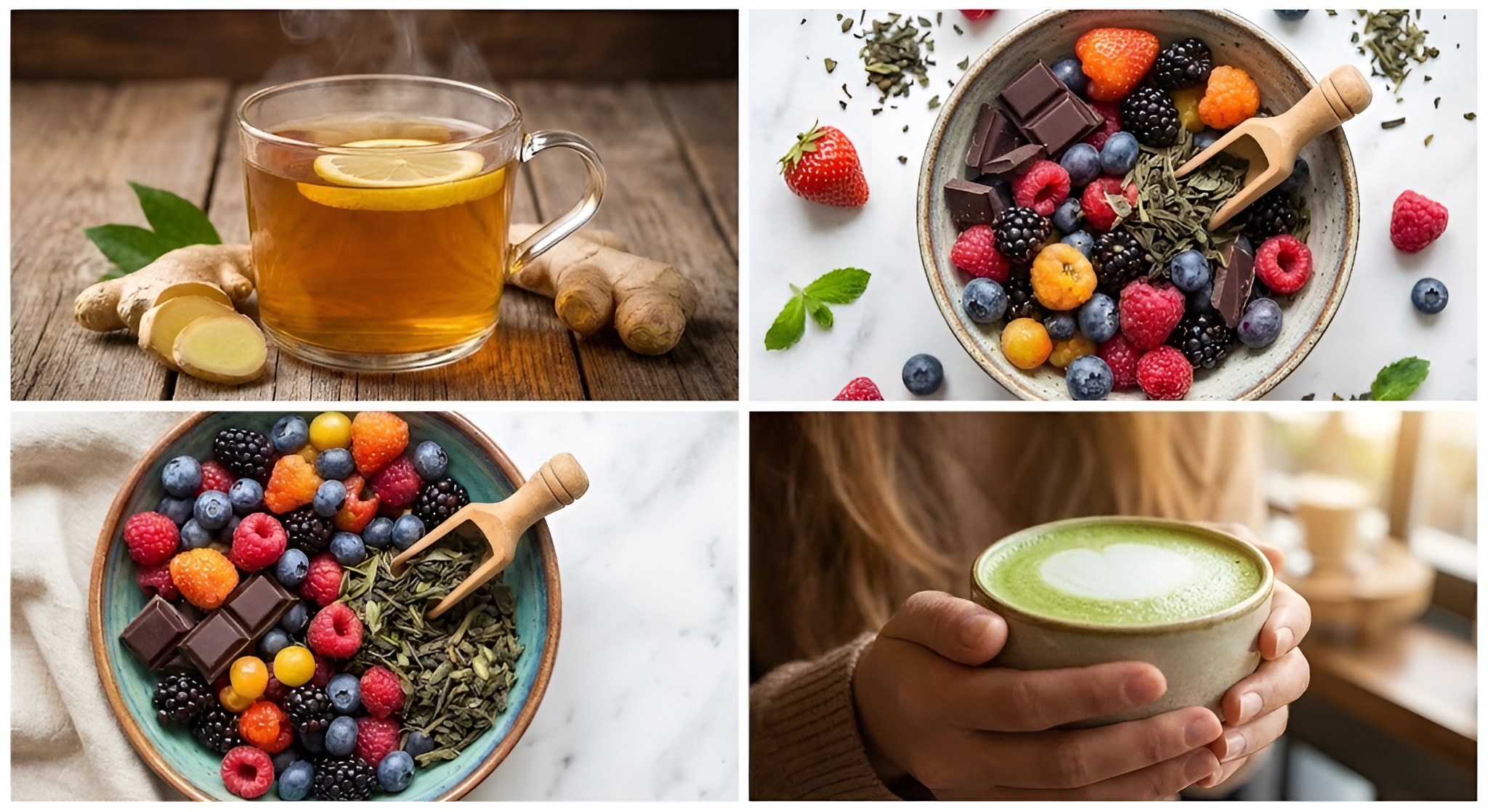
Because these teas are so savory, they pair poorly with traditional English tea snacks like scones or cake. The sweetness clashes with the vegetal brothiness. Instead, pair Gyokuro or Matcha with dark chocolate, seafood (sushi), or salty snacks like rice crackers. The salt enhances the Umami, while the richness of chocolate complements the vegetal notes.
How to Brew for Maximum Umami: The Physics of Extraction
You can buy the most expensive Ceremonial Matcha or Gyokuro in the world, but if you brew it with boiling water, you will ruin it. Understanding the solubility of tea compounds is critical for extracting Umami.
Tea chemistry is dictated by temperature:
- Amino Acids (Savory): Highly soluble. They extract easily at low temperatures (50°C and above).
- Catechins (Bitter): Less soluble. They require high temperatures (80°C+) to extract rapidly.
- caffeine (Bitter): Extracts moderately at all temperatures but increases significantly with heat.
Therefore, to maximize Umami and minimize bitterness, you must brew low and slow. If you use boiling water, the catechins will extract instantly, overwhelming the delicate savory notes of the amino acids.
The Golden Rules for Gyokuro
- Temperature: 50°C - 60°C (122°F - 140°F). This feels lukewarm to the touch. It feels wrong if you are used to black tea, but it is necessary.
- Time: 2 minutes. This long steep allows the thick, viscous compounds to release.
- Ratio: Use a lot of leaf (5g) for a small amount of water (60ml). This concentration is key to achieving the syrup-like texture.
The resulting liquor will be thick, viscous, and exploding with savory flavor. It might even remind you of chicken broth or seaweed soup rather than tea.
The Cold Brew Hack (Kouridashi)
The ultimate way to extract Umami is Ice Brewing (Kouridashi). Place high-quality tea leaves in a glass and cover them with ice cubes. Let the ice melt naturally over the leaves (this can take hours). The freezing water extracts almost zero caffeine or bitterness, leaving a syrup-like elixir of pure Umami sweetness. Read more about Cold Brew Science here.
Cultivars: The Genetics of Flavor
Just like wine grapes (Merlot vs. Pinot Noir), different tea cultivars have different genetic flavor profiles. While the Yabukita cultivar is the standard for balance (accounting for 75% of all Japanese tea fields), farmers use specific breeds when they want to create high-umami teas:
- Saemidori: A cross between Yabukita and Asatsuyu. Known for its brilliant green color and low astringency. It is an early budder and is prized for high-end Sencha and Gyokuro.
- Okumidori: A late-budding cultivar that is exceptionally tolerant to frost. It produces a deep, rich, broth-like finish and is a favorite for Matcha production in Uji.
- Gokou: A Kyoto favorite with a unique creamy, milky, herbal aroma that is distinctively savory. It is almost exclusively used for Gyokuro and Matcha.
- Asatsuyu: Known as "Natural Gyokuro" because it has high amino acid levels even without shading.
The Aftertaste (Hui Gan)
High-quality Umami tea leaves a lingering sweetness in the throat known as Hui Gan (Returning Sweetness). After swallowing, wait for 30 seconds. You should feel a cooling sensation and a returning sweetness that coats the mouth, distinct from the initial savory hit. If the tea is low quality, the flavor will disappear instantly.
The "Umami High"
Because shaded teas are so rich in L-Theanine, they often produce a potent psychoactive effect. L-Theanine crosses the blood-brain barrier and increases alpha brain wave activity, leading to a state of "relaxed alertness." Drinking a strong cup of Gyokuro can make you feel calm yet hyper-focused, a sensation often called "Tea Drunk" or the "Umami High." Learn more about L-Theanine here.
Comments