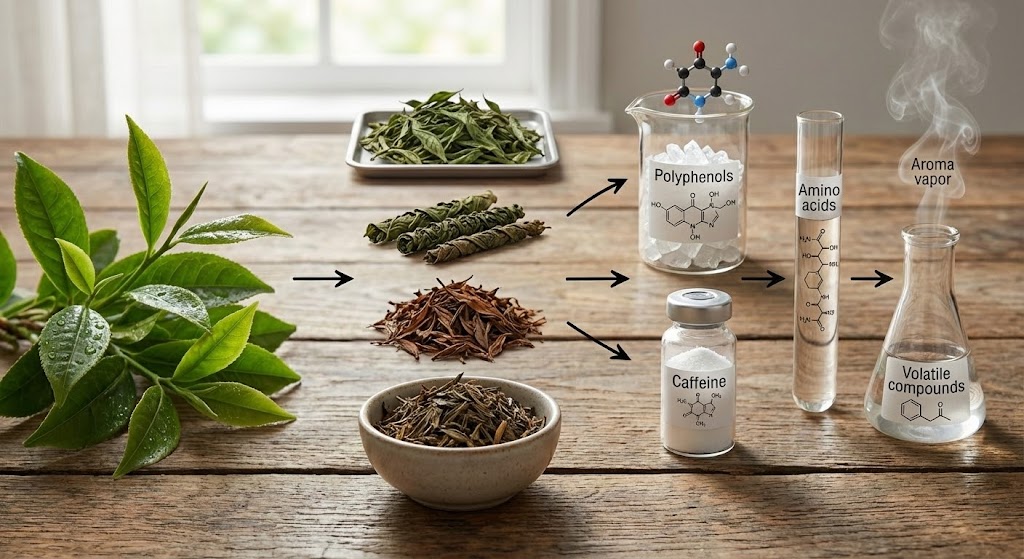
1. The Big Umbrella: polyphenols
Polyphenols are the largest category. They are a massive group of over 8,000 phytochemicals found in plants. If you eat a vegetable, fruit, or drink tea, you are consuming polyphenols. They act as the plant's defense system against UV radiation and pathogens.
In the context of tea (Camellia Sinensis), polyphenols make up about 30-40% of the dry weight of a fresh leaf. They are the primary source of the "antioxidant" activity often cited in health studies. However, the term "polyphenol" is too broad to be useful on its own. It includes everything from the tannins in red wine to the anthocyanins in blueberries.
Seasonality Matters
Not all tea leaves are equal. Leaves harvested in the spring (First Flush) generally have slightly lower polyphenol counts but higher amino acids (sweetness). Leaves harvested in summer, which are exposed to intense UV radiation, produce significantly more polyphenols as a defense mechanism. This makes summer teas healthier in terms of antioxidants, but also much more bitter.
2. The Sub-Group: Flavonoids
Inside the Polyphenol group, there is a specific family called Flavonoids. These are responsible for the vivid colors in fruits and vegetables (like the red in strawberries or blue in blueberries). They are a diverse group of phytonutrients found in almost all fruits and vegetables.
In tea, the main type of Flavonoids are Flavanols (note the 'o'). This distinction is crucial. While onions and apples contain flavonols like Quercetin, tea is unique because it is exceptionally rich in Flavan-3-ols. This is where things get interesting for tea drinkers, because Flavan-3-ols are better known by their common name: Catechins.
3. The Green Tea Warriors: Catechins
Catechins are the superstars of Green Tea and White Tea. Because these teas are not oxidized (see our Oxidation Guide), the catechins remain intact. They are colorless, water-soluble compounds that impart bitterness and astringency to the brew.
There are four main catechins in tea:
- Epicatechin (EC): The basic building block.
- Epicatechin-3-gallate (ECG): A more complex ester.
- Epigallocatechin (EGC): A potent antioxidant.
- Epigallocatechin-3-gallate (EGCG): The "Master Molecule."
EGCG is the most abundant and potent. It accounts for 50-80% of the total catechin content in Green Tea. It is the compound linked to most of the weight loss and cancer-prevention studies. To dive deeper into this specific molecule, read our EGCG Expert Guide.
Why is Green Tea Bitter?
Catechins are bitter. This is a biological defense mechanism to stop insects from eating the leaves. If you brew green tea with boiling water, you extract too many catechins too quickly, resulting in a harsh, astringent cup. This is why we recommend cooler water (80°C) for Green Tea—it slows down the extraction of these bitter compounds while allowing the sweet amino acids to shine.
Extraction Dynamics
Catechins are large molecules. They take time to migrate from the leaf into the water. In the first minute of brewing, you extract mostly caffeine and amino acids. The catechins really start to release in minutes 2-3. If you want a sweeter cup, do a short brew. If you want maximum health benefits, brew longer (but be prepared for bitterness).
4. The Black Tea Transformation: Theaflavins & Thearubigins
If Green Tea has Catechins, does Black Tea have none? Not quite. They just change form.
During the production of Black Tea, the leaves are crushed and exposed to oxygen. Enzymes in the leaf (specifically polyphenol oxidase and peroxidase) cause the Catechins to oxidize and bond together (polymerize) into larger, heavier molecules. This is a chemical condensation reaction.
- Theaflavins (TF): These are dimers (two catechins joined together). They give black tea its briskness, astringency, and bright gold/orange color. They are highly valued in quality assessment.
- Thearubigins (TR): These are even larger polymers (many catechins joined). They give black tea its deep red/brown body, richness, and mouthfeel. They make up the majority of the color weight in a cup of Assam or Darjeeling.
While they are chemically different from EGCG, studies show they still possess powerful antioxidant properties, particularly for heart health and cholesterol management. This is why Black Tea is still a healthy choice, despite having lower EGCG levels.
The "Cream Down" Effect
Have you ever noticed your iced tea turning cloudy? This is caused by the interaction between Caffeine and Theaflavins. As the tea cools, these molecules bind together and precipitate out of solution, forming a milky haze known as "Cream Down." While unsightly, it is actually a sign of high-quality, polyphenol-rich tea. Learn more in our Cold Brew Science guide.
5. The Outlier: L-Theanine
It is important to note that L-Theanine is NOT a polyphenol. It is an amino acid. While polyphenols (catechins) provide the bitterness/astringency, L-Theanine provides the savory, umami sweetness.
In high-quality shade-grown teas like Matcha or Gyokuro, the plant produces more L-Theanine. This creates a chemical balance: the sweetness of the amino acid masks the bitterness of the polyphenols. Read our full L-Theanine Guide here.
Bioavailability: Getting It Into Your Body
Drinking tea is one thing; absorbing the nutrients is another. Polyphenols are notoriously unstable and have low bioavailability. When you ingest EGCG, much of it is broken down by your digestive system before it enters your bloodstream.
How to boost absorption:
- Add Vitamin C: Adding lemon juice to green tea creates an acidic environment that stabilizes catechins, helping more of them survive the journey through your gut.
- Don't Add Milk (Maybe): Some studies suggest that the casein protein in dairy milk binds to polyphenols, potentially reducing their absorption. While the effect isn't total blocking, drinking tea black (or with lemon) is likely better for maximum antioxidant uptake.
Taste the Chemistry
To really understand the difference between Catechins and Theaflavins, do a side-by-side tasting. Brew a White Tea (pure catechins) next to a strong Assam (theaflavins). You will feel the difference in the texture on your tongue immediately. White tea feels drying but clean; Assam feels thick and brisk. Learn how to identify these notes in our Tea Tasting 101 Guide.
Summary Table
| Compound | Type | Found Mostly In | Taste Profile |
|---|---|---|---|
| EGCG | Catechin | Green, White Tea | Bitter, Astringent |
| Theaflavins | Polymerized Catechin | Black, Oolong Tea | Brisk, Sharp |
| L-Theanine | Amino Acid | Matcha, Gyokuro | Savory, Sweet (Umami) |
Tannins vs. Polyphenols
You will often hear people talk about "Tannins" in tea. Technically, the catechins and theaflavins ARE tannins (specifically, hydrolyzable tannins). The word is used to describe the astringency—that dry, puckering sensation on the gums similar to red wine or unripe persimmons.
Comments