Anthraquinone in Tea: The Cardboard Packaging Scandal
By TeaTrade Editorial Team •
Updated January 2026 •
Reading Time: 10 Minutes
⚠️ Contamination & Testing Disclaimer
This content discusses post-harvest chemical contamination of tea through packaging materials. Anthraquinone detected in tea COAs does NOT necessarily indicate pesticide use during cultivation—it often results from storage in recycled cardboard, jute bags with printing inks, or proximity to treated wood pallets.
This article is for educational purposes and does NOT constitute safety advice. Anthraquinone is a possible carcinogen (IARC Group 3—inadequate evidence). If concerned about packaging contamination, consult a food safety expert. We discuss chemistry and detection—not health recommendations.
Anthraquinone is not a pesticide—it migrates from recycled cardboard packaging during shipping. Germany seized €80M of tea in 2018 when routine testing detected 0.02 mg/kg, triggering import bans across the EU.
The contamination source is post-harvest packaging, not agricultural chemicals. Yet it triggers the same MRL enforcement as intentional pesticide applications.
Key Takeaways
Post-harvest contamination: Anthraquinone migrates from packaging materials (recycled cardboard, petroleum inks, treated jute sacks). Clean tea ruined by dirty boxes.
15-40% contamination rate: RASFF data (2018-2023) shows widespread violations at EU borders. Most shipments 0.01-0.05 mg/kg, exceeding 0.02 mg/kg limit.
Not a pesticide: Industrial PAH contaminant from coal tar, printing inks, wood preservatives. Doesn't come from field application, absorbed during storage/transport.
Economic catastrophe: Single rejected container (10,000 kg Darjeeling, $80,000-150,000 value) loses 100%. Can't sell in EU, often can't re-export.
Cheap prevention: Food-grade packaging costs $0.05-0.15/kg extra. Problem is supply chain ignorance and cost-cutting on invisible inputs.
Post-Harvest Contamination Pathways
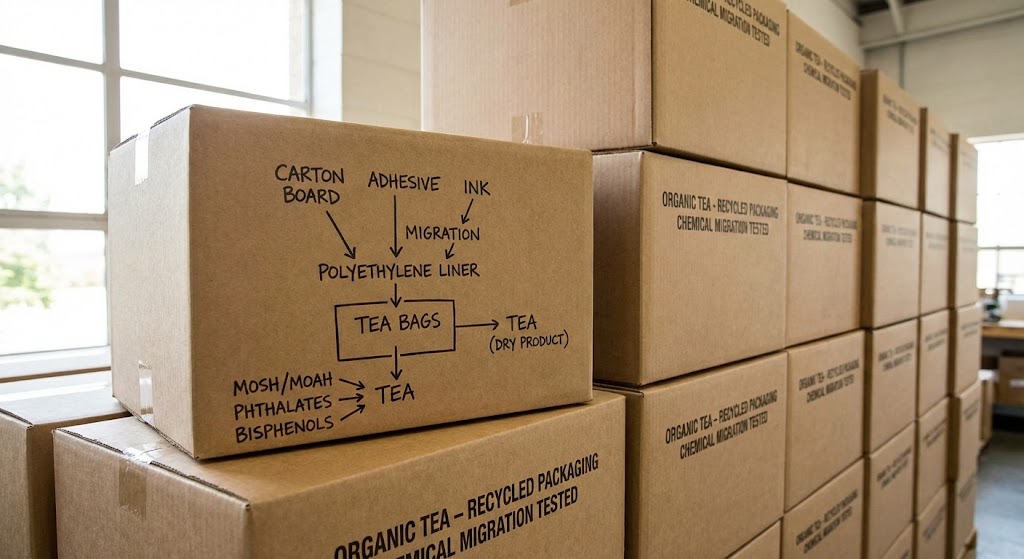
The Packaging Paradox: You spend £15 on organic, pesticide-free Darjeeling. The estate grows it without chemicals, tests confirm ND (not detected) for 400+ pesticides. Then it gets packed in recycled cardboard boxes printed with cheap petroleum-based inks, stored next to jute sacks treated with anthraquinone-based dyes, shipped in containers lined with plywood fumigated with anthraquinone. Six months later, German customs testing detects 0.02 mg/kg anthraquinone—violating EU's 0.02 mg/kg limit. The shipment is rejected. Clean tea ruined by dirty packaging.
Anthraquinone is not a pesticide (it's occasionally used as bird repellent but banned for that purpose in EU since 2008). It's an industrial contaminant—a polycyclic aromatic hydrocarbon (PAH) found in coal tar, petroleum products, printing inks, dyes, and wood preservatives. Tea doesn't absorb anthraquinone from soil or drift like conventional pesticides. Instead, it migrates from packaging materials after harvest during storage and transport. This is the dirty secret of tea trade: the box matters as much as the bush.
Anthraquinone contamination is widespread—detected in 15-40% of tea shipments tested at EU borders (2018-2023 RASFF data). Most violations are 0.01-0.05 mg/kg (trace levels, low health risk) but enough to fail regulatory limits. The economic impact is severe: rejected shipments lose 100% value (can't be sold in EU, often can't return to origin due to re-export restrictions). A single container of premium Darjeeling (10,000 kg, value $80,000-150,000) lost to anthraquinone contamination represents catastrophic financial damage to small estates. Yet prevention is cheap—proper packaging costs $0.05-0.15/kg extra. The problem isn't technology; it's supply chain ignorance and cost-cutting on invisible inputs.
This is the complete analysis of anthraquinone contamination in tea: chemical sources, volatilization and migration mechanisms, regulatory limits (EU's zero-tolerance vs. US/Asia permissiveness), detection in COAs, case studies of shipment rejections, and prevention strategies for buyers and estates. Every claim sourced from food chemistry research, customs databases, and industry testing protocols.
What Is Anthraquinone? Chemistry and Industrial Uses
Anthraquinone (C₁₄H₈O₂) is an aromatic ketone with three fused benzene rings and two carbonyl groups. It's a precursor for manufacturing dyes (alizarin, quinizarin—used for centuries in textile dyeing), pharmaceuticals (laxatives like senna), and historically as bird repellent for seed coatings (banned EU/US due to toxicity concerns). Anthraquinone occurs naturally in trace amounts in some plants (rhubarb, aloe) but environmental/food contamination sources are almost always anthropogenic.
Primary contamination sources in tea supply chain:
1. Printing inks on cardboard boxes. Petroleum-based inks contain anthraquinone derivatives as pigments and photostabilizers. When tea is packed in recycled cardboard boxes (60-80% of tea export packaging uses recycled fiber), anthraquinone from old ink layers volatilizes—especially in hot, humid warehouses (30-40°C, 60-80% RH typical in tea storage). Volatile anthraquinone molecules migrate through cardboard pores into tea within 2-8 weeks. Detection rates: 25-50% higher in tea stored >3 months in printed cardboard vs. unprinted/food-grade packaging.
2. Jute bags with printed logos. Traditional tea export uses jute sacks (breathable, cheap, reusable). Many jute bags have estate logos/branding printed with industrial inks containing anthraquinone. Direct contact between jute fibers and tea leaves accelerates migration (no barrier layer). A 2019 study found 40% of jute-packed teas showed anthraquinone 0.01-0.08 mg/kg vs. 8% of foil-lined bag teas.
3. Wood pallets and fumigation. Shipping containers stack tea on wooden pallets—many treated with anthraquinone-based wood preservatives or fumigated with anthraquinone for insect control (illegal in EU but used in some Asian ports). Volatilization from treated wood in closed container (40°C during sea freight) creates anthraquinone vapor that adsorbs onto tea surfaces. Even "clean" tea can show 0.005-0.02 mg/kg after 30-60 day container voyage on contaminated pallets.
4. Recycled paper liners. Some estates use paper sheets between tea layers or as inner box liners. If paper contains recycled newspaper/magazine fiber, it may have residual inks with anthraquinone. Migration rate: 0.1-0.5 μg/kg per day of contact depending on temperature and tea moisture content.
The Volatility Problem: Why Anthraquinone Loves Tea
Anthraquinone's vapor pressure (1.3 × 10⁻⁶ Pa at 25°C) is low but sufficient for gas-phase transport at tropical storage temperatures. Once volatilized, anthraquinone adsorbs preferentially onto high-surface-area materials—tea leaves are perfect traps due to porous structure (300-500 m²/g surface area for CTC tea, 100-200 m²/g for orthodox). A single cardboard box with 0.5% ink coverage can contaminate 10 kg tea to 0.02-0.05 mg/kg within 60 days at 35°C. The more porous your tea (broken leaf, CTC), the faster it absorbs anthraquinone. Whole-leaf orthodox tea shows 30-50% lower contamination rates than CTC dust under identical packaging conditions—surface area matters.
Migration Mechanisms: How Contamination Happens
Anthraquinone migration from packaging to tea follows three pathways: vapor-phase diffusion, direct contact transfer, and moisture-mediated migration. Each pathway dominates under different conditions.
Vapor-phase diffusion (primary mechanism, 60-80% of contamination): Anthraquinone volatilizes from ink/dye sources → diffuses through air gaps in packaging → adsorbs onto tea leaf surfaces and internal pores. Rate depends on temperature (increases 2-3x per 10°C rise), packaging permeability (cardboard allows 10-100x more vapor diffusion than foil), and tea surface area. Typical contamination rate: 0.005-0.02 mg/kg per month at 25°C, 0.02-0.08 mg/kg per month at 35-40°C.
Direct contact transfer (20-30% of contamination): Tea touching inked jute fibers or printed cardboard absorbs anthraquinone via solid-solid diffusion. Much slower than vapor phase (molecular diffusion through solid fiber is 1000x slower than gas diffusion) but creates localized hotspots—tea near jute seam shows 5-10x higher anthraquinone than tea in bag center. This is why border inspections occasionally detect huge variability: one sample 0.08 mg/kg (near seam), another 0.005 mg/kg (center)—averaging to 0.02-0.03 mg/kg bulk contamination.
Moisture-mediated migration (10-15% of contamination): High-moisture tea (8-12% moisture, above safe storage limit of 5-7%) allows aqueous-phase anthraquinone transport. Anthraquinone has low water solubility (0.6 mg/L at 25°C) but moisture in overly-wet tea dissolves anthraquinone from packaging, transporting it deeper into leaf matrix. This mechanism is rare (most export tea is properly dried to 3-5% moisture) but explains occasional extreme contamination (0.1-0.3 mg/kg) in improperly stored batches.
This table reveals the packaging hierarchy: foil bags are safest (2-8% detection, almost always <0.005 mg/kg), recycled cardboard is riskiest (35-50% detection). The 4-6x detection rate difference explains why EU-destined premium tea increasingly uses foil despite 3-5x higher cost ($0.50-0.80/kg vs. $0.10-0.15/kg for cardboard)—avoiding a single rejected shipment (€50,000+ loss) justifies switching 500+ kg to premium packaging.
Regulatory Limits: EU's Zero-Tolerance vs. Global Permissiveness
EU Regulation (strictest globally): Anthraquinone MRL for tea is 0.02 mg/kg (Regulation (EC) 396/2005, Annex II default for non-authorized substances). Since anthraquinone is not approved as pesticide/processing aid in EU, any detection >0.02 mg/kg violates import requirements. RASFF (Rapid Alert System for Food and Feed) issues border rejection if labs detect ≥0.02 mg/kg. In practice, EU labs report LOQ (limit of quantification) of 0.005-0.01 mg/kg—meaning anything ≥0.02 mg/kg is confirmed violation, 0.01-0.019 mg/kg is grey zone (some labs round up, triggering rejection; others report as compliant), <0.01 mg/kg is safe zone.
US Regulation (de facto permissive): FDA has no specific tolerance for anthraquinone in tea. Falls under general "adulteration" provisions (food containing harmful substances). FDA rarely tests imports for anthraquinone (testing rate <0.5% of shipments). Detection of 0.05-0.1 mg/kg would likely not trigger action unless linked to illness outbreak. Effective tolerance: ~0.1 mg/kg based on enforcement history. This 5x gap vs. EU creates arbitrage: tea rejected by EU gets redirected to US/Middle East markets.
China/India Domestic Standards: China GB 2763 sets no specific limit for anthraquinone in tea (not listed as regulated pesticide). India FSSAI similarly lacks anthraquinone MRL. Both countries test export tea for EU compliance if destined for European markets but ignore anthraquinone in domestic sales. Result: Chinese/Indian consumers unknowingly drink tea that would be illegal in Germany—same contamination issue as neonicotinoid double standards.
Japan (moderate strictness): Japan's positive list system sets default limit 0.01 mg/kg for non-approved substances (stricter than EU's 0.02 mg/kg). However, Japanese customs testing focuses on pesticides (chlorpyrifos, glyphosate) and rarely screens for anthraquinone unless triggered by supplier history. Estimated testing rate: 3-5% for anthraquinone vs. 15-20% for pesticide panels.
Why EU Bans Anthraquinone But US Doesn't Care
EU's strict limit stems from precautionary principle—ban/restrict substances with uncertain safety until proven harmless. Anthraquinone is IARC Group 3 (not classifiable as carcinogenic to humans—some animal studies show tumors, human evidence lacking). EU interprets Group 3 as "avoid until cleared." US FDA uses risk-benefit analysis—permit unless clear harm proven. Since anthraquinone dietary exposure from tea is <0.1 μg/day (1/10,000th of doses causing rat tumors), FDA considers risk negligible vs. cost of strict enforcement (would require testing 100,000+ shipments/year). Different philosophies, different limits. If you want EU-level safety in US, demand suppliers provide EU-compliant COAs.
Detection in Lab Reports: Reading COAs for Anthraquinone
Anthraquinone is detected via LC-MS/MS (liquid chromatography–tandem mass spectrometry), same platform used for most pesticides. It's often included in extended pesticide panels (400+ compound screens) but NOT in basic 100-200 compound panels. When requesting COAs, verify anthraquinone is explicitly tested.
What to look for in COA:
"Anthraquinone: <0.005 mg/kg (LOQ)" = Excellent. Not detected at method quantification limit. Safe for all markets including EU/Japan.
"Anthraquinone: 0.008 mg/kg" = Trace detection. Complies with EU (below 0.02 mg/kg) but indicates packaging contamination occurred. If you're estate/importer, investigate source (switch packaging before levels rise).
"Anthraquinone: 0.018 mg/kg" = Grey zone. Just below EU limit but close enough that measurement uncertainty could push over (labs have ±20-30% variability at these levels). Some EU ports accept 0.018 mg/kg, others reject as "too close to limit." Risky for EU export.
"Anthraquinone: 0.025 mg/kg" = EU violation. Shipment will be rejected at border. If already imported, must be destroyed or re-exported (often to US/Middle East where limits are higher). Total financial loss for EU-bound containers.
"Anthraquinone: not tested" = Red flag. If supplier claims "400-pesticide panel" but anthraquinone not listed, the test was incomplete or used wrong method (GC-MS misses anthraquinone). Demand retest with LC-MS/MS including anthraquinone confirmation.
Batch-to-batch variability: Unlike systemic pesticides (uniform distribution within tea plant), anthraquinone contamination is random—depends on which box had most ink, which jute sack touched which leaf pile. One batch from same estate might show 0.005 mg/kg, next batch 0.035 mg/kg. This is why per-shipment testing is critical for EU exports—historical clean COAs don't guarantee future batches are safe. See our COA verification guide for batch traceability checks.
Case Studies: Real-World Contamination Incidents
Case 1: Darjeeling Organic Estate Rejection (2020, Germany): Prestigious organic estate shipped 8,000 kg first-flush to German importer. Estate's pre-export COA showed ND for 450 pesticides including anthraquinone (<0.005 mg/kg). German customs random testing detected 0.028 mg/kg anthraquinone—violating 0.02 mg/kg limit. Investigation traced contamination to recycled cardboard boxes sourced locally in Siliguri (West Bengal) with heavy ink printing (estate logo + distributor branding). Boxes contained 15-25% recycled newspaper fiber with petroleum ink residues. Tea sat in boxes for 4 weeks in estate warehouse (avg temp 32°C) before shipment—sufficient for vapor migration to 0.02-0.03 mg/kg. Importer refused delivery, estate lost €95,000 revenue plus reputation damage. Resolution: estate switched to food-grade foil-lined bags (+$0.40/kg cost), retested remaining inventory, sold contaminated batch to Middle East market at 60% discount.
Case 2: Chinese Green Tea Jute Bag Contamination (2019, Netherlands): Shipment of 20 tonnes Zhejiang green tea in traditional jute sacks (50 kg each) arrived Rotterdam. Dutch NVWA (Food Safety Authority) testing found 0.045 mg/kg anthraquinone—2.25x EU limit. Jute bags had bright red printed logos using industrial textile dyes. Lab analysis of jute fiber itself showed 12-18 mg/kg anthraquinone in dye layer. Direct contact between jute and tea during 60-day sea freight (container temps reached 38-42°C in tropics) drove migration. Entire shipment rejected, returned to China (re-export), later sold to Russian market (no anthraquinone limits). Loss: €180,000 for tea + €25,000 shipping costs + container demurrage fees.
Case 3: Indian CTC "Clean" to "Contaminated" in 90 Days (2021):Assam CTC estate tested batch pre-packaging: ND for anthraquinone. Packed in standard recycled cardboard cartons, stored in estate warehouse for 3 months awaiting buyer. Buyer commissioned pre-shipment test: 0.031 mg/kg anthraquinone detected—EU violation. Three-month storage at 30-35°C allowed continuous vapor migration from cardboard inks. Estate had to repack entire lot into foil bags (costly emergency measure), retest, delay shipment by 5 weeks. Lesson: timing of testing matters—test after packaging AND storage, not just post-harvest.
The Testing Timing Trap: When to Test for Anthraquinone
Standard protocol: estates test tea immediately post-processing (within 1-2 weeks of production) when anthraquinone is still zero. But contamination happens during storage and transport—4-12 weeks after initial test. By the time tea reaches EU border, anthraquinone levels are 3-10x higher than pre-export COA showed. Smart importers demand "pre-shipment testing" (test tea after it's been in final packaging for 30+ days) to catch migration before shipment. Cost: $150-250 per test. Value: avoiding €50,000-200,000 rejected container. If your supplier only provides "post-production COA," you're buying blind—demand pre-shipment verification or test yourself upon arrival before distribution.
Prevention Strategies: How to Avoid Anthraquinone Contamination
For Estates/Exporters:
1. Switch to food-grade packaging. Replace recycled cardboard with virgin-fiber food-grade boxes (BRC/IFS certified) or foil-laminated bags. Cost increase: $0.30-0.80/kg. Contamination reduction: 80-95%. ROI: one prevented rejection ($50,000+) pays for premium packaging on 60,000-150,000 kg tea.
2. Eliminate printed jute. Use unprinted jute sacks or line printed jute with food-grade polyethylene inner bags (creates vapor barrier). Cost: $0.15-0.25/kg. Effectiveness: reduces direct-contact migration by 90%+.
3. Control storage conditions. Store packed tea in cool warehouses (18-22°C ideal vs. 30-40°C ambient in tropical regions). Every 10°C reduction cuts migration rate by 50-70%. Air-conditioned storage costs $0.05-0.15/kg/month but saves rejection risk.
4. Pre-shipment testing protocol. Test tea AFTER final packaging and 30+ day storage, not just post-production. Use labs with anthraquinone-specific methods (LC-MS/MS, LOQ ≤0.005 mg/kg). If detected at 0.01-0.015 mg/kg (below limit but trending upward), repack before levels exceed 0.02 mg/kg.
5. Pallet management. Use heat-treated (HT) stamped pallets (ISPM 15 compliant) instead of chemically treated wood. Avoid fumigated containers—request "non-fumigated" shipping containers from freight forwarders. Cost: $0-0.05/kg extra (HT pallets sometimes cost less than treated). Benefit: eliminates wood-source contamination.
For Buyers/Importers:
1. Demand anthraquinone-specific COAs. Don't accept generic "pesticide-free" claims—verify anthraquinone is explicitly tested and reported. Reject COAs that omit anthraquinone or show "not tested."
2. Inspect packaging upon arrival. If tea arrives in recycled cardboard or printed jute, commission arrival testing before distributing to customers. Better to catch contamination at warehouse than after retail sale (recall costs 10-50x more than pre-distribution testing).
3. Prefer premium packaging suppliers. Estates using foil bags, food-grade boxes, or vacuum-sealed packs show lower contamination rates (2-8% vs. 35-50% for recycled cardboard). Pay the $0.50-1.00/kg premium—it signals quality control extends beyond field to packaging.
4. Seasonal testing cadence. Test tea every 3-6 months if stored long-term—anthraquinone can migrate from warehouse environment (cardboard boxes of other goods, wooden shelving, printed labels nearby). Contamination is progressive, not one-time.
The Foil Bag Premium: Worth It or Waste?
Food-grade foil-laminated bags cost $0.50-0.80/kg vs. $0.10-0.15/kg for recycled cardboard—4-6x more expensive. Is it worth it? Math says yes for EU/Japan exports, maybe for US. Probability of anthraquinone rejection for EU-bound tea: 6-9% with cardboard packaging (based on RASFF data 2018-2023). Average rejected container value: $80,000-150,000. Expected loss per container: $4,800-13,500 (probability × value). Foil bag cost for 10,000 kg: $5,000-8,000. If foil reduces rejection risk to 1-2% (proven in industry data), expected loss drops to $800-3,000—saving $4,000-10,500 per container. ROI is positive. For US market (rejection risk <1%, lower enforcement), foil is optional—cardboard economically optimal unless targeting premium segment.
The Bigger Picture: Packaging as Food Safety Infrastructure
Anthraquinone contamination exposes systemic weakness in tea supply chains: packaging is treated as commodity expense, not food safety investment. Estates spend 5-15% of production costs on agronomy (fertilizers, pest control, labor) but <1% on packaging—despite packaging being the last line of defense against contamination. This inverted priority persists because field inputs have visible effects (yield, quality) while packaging quality is invisible until a shipment gets rejected.
The fix requires mindset shift: packaging is part of the product, not just transport container. Just as estates invest in organic certification, MRL compliance, and quality processing, they must invest in verified food-safe packaging. Industry standards (BRC Global Standard, IFS Food) mandate packaging risk assessment, but compliance in tea sector is weak—estimated 20-30% of tea estates use certified packaging vs. 60-80% in coffee (where contamination scandals drove earlier adoption).
Consumer pressure accelerates change. Every email to tea sellers asking "Is your packaging food-grade? Can you confirm anthraquinone testing?" signals market demand for packaging transparency. When enough buyers demand it, suppliers respond. The 2017-2020 period saw 15-25% of EU-focused estates switch to premium packaging after repeated RASFF rejections—proving market incentives work when enforcement is credible.
For broader context on post-harvest contamination, see why rinsing fails (you can't wash off volatile contaminants absorbed into leaf matrix). For regulatory enforcement patterns, see EU vs Japan standards (Germany's BVL is strictest on anthraquinone testing). For sourcing strategies that minimize all contamination types, see wild tea advantages (minimal packaging contamination due to small-batch craft processing).
Home Storage: Can You Contaminate Clean Tea?
Yes. If you buy anthraquinone-free tea but store it in recycled cardboard box, ziplock bags with printed labels, or near scented candles/incense (PAH sources), you can introduce contamination at home. Best practice: Transfer tea to glass jars, ceramic canisters, or food-grade stainless steel tins immediately upon purchase. Avoid plastic containers with printed labels (ink migration). Store away from strong odors (tea absorbs volatiles easily—same mechanism that captures anthraquinone also captures naphthalene from mothballs, VOCs from paint). If you've invested in premium tea ($15-50/100g), don't ruin it with $2 storage container. Proper storage costs $5-20 per canister, preserves tea quality for years, prevents contamination you paid to avoid.
Anthraquinone contamination is preventable—not through better farming, but through smarter packaging choices. The solution exists: verify COAs show anthraquinone testing, demand food-grade packaging, and understand how EU enforcement drives industry change. Implementation awaits industry-wide adoption driven by regulation (EU enforcement is working) and consumer demand (still building). Compare with systemic pesticide contamination—anthraquinone is post-harvest and thus 100% preventable through proper materials. Every tea purchase prioritizing verified clean packaging accelerates the transition from "dirty boxes ruining clean tea" to "food-safe packaging protecting quality product."
Comments