1. The Kluntje Phenomenon: Rock Sugar Acoustic Engineering
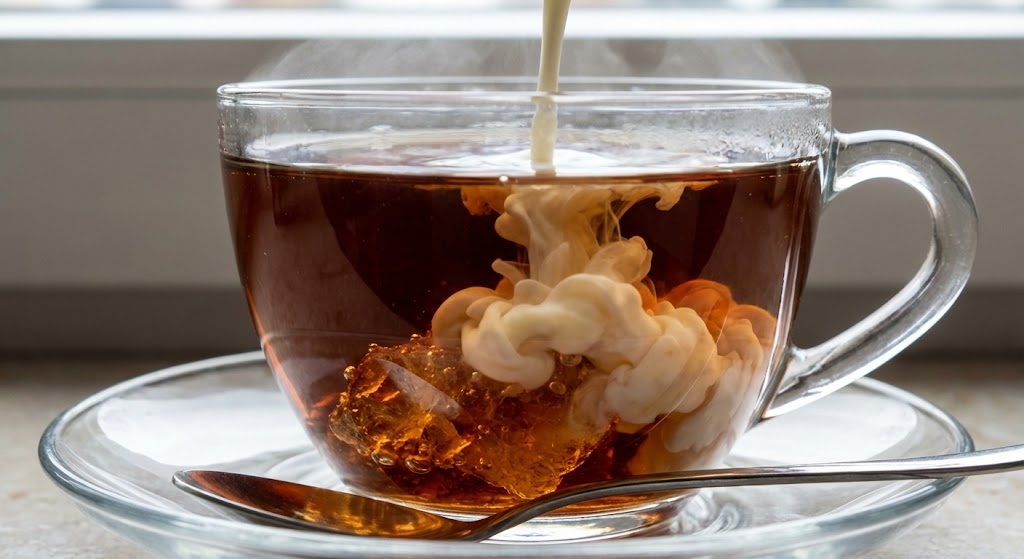
Kluntje isn't ordinary sugarit's white rock candy formed through slow crystallization of beet sugar. The crystals are significantly larger than granulated sugar (5-15mm vs. 0.5mm), creating a distinctive acoustic signature when hot tea makes contact. The thermal shock causes microstructural fractures in the crystal lattice, producing an audible "crack" that signals hospitality.
The sound physics involves thermal expansion coefficient differentials. When 90C tea hits room-temperature sugar (20C), the outer crystal layer expands rapidly while the core remains solid. This differential stress exceeds the yield strength of the crystalline structure, causing spontaneous fracture. The frequency spectrum of the crack (200-800 Hz) is remarkably consistent across different Kluntje batchesaudible proof of proper brewing temperature.
Compare this to Persian ghand pahlou where compressed cubes dissolve slowly through teeth, or Southern sweet tea's supersaturated solution requiring hot dissolution. East Frisian rock sugar is theater: the crack announces tea time.
| Sugar Type | Crystal Size | Dissolution Rate | Cultural Function |
|---|---|---|---|
| Kluntje (Rock Candy) | 5-15mm chunks | Slow (5-7 minutes per cup) | Acoustic signal + gradual sweetness progression |
| Granulated White | 0.5mm grains | Fast (30-60 seconds) | Immediate uniform sweetness (standard Western) |
| Demerara/Turbinado | 1-3mm crystals | Medium (2-3 minutes) | Molasses notes, British preference |
| Persian Ghand Cubes | Compressed 15-20mm | Very slow (held in teeth, 10-15 min) | Economic rationing + class signaling |
2. Wulkje Cloud Formation: The Fluid Dynamics of Cream Stratification
Wulkje (pronounced "vool-kye") translates to "little cloud"an apt description for the cream stratification pattern that forms when heavy cream is drizzled from a spoon into hot tea. The phenomenon relies on density stratification and minimal convection disruption.
Fresh cream has lower density (1.005 g/mL) than hot tea (0.998 g/mL at 90C), but higher viscosity (10-20 cP vs. 0.3 cP). When dropped from a spoon held close to the surface, cream spreads laterally before sinkingcreating a suspended cloud layer. The key is minimal kinetic energy: pour from too high and turbulence destroys stratification (similar to why teh tarik uses high-velocity pulling for opposite effect).
Expert Tip: The Spoon Height Rule
Hold the cream spoon 1-2cm above tea surface, not at the rim. Tilt spoon gently to let cream flow in continuous stream rather than droplets. The goal: laminar flow, not turbulent splashing. East Frisian tea masters can create a cloud that persists for 3-5 minutes before convection currents mix it. Practice with cold tea and cream firsthot tea is unforgiving of mistakes.
| Cream Parameter | Specification | Effect on Cloud Formation |
|---|---|---|
| Fat Content | 30-40% (heavy/double cream) | Higher fat = better density contrast, more stable cloud |
| Temperature | 10-1°C (refrigerated) | Cold cream sinks slower, maintains stratification longer |
| Pour Velocity | Low (laminar flow, <5 cm/s) | High velocity = turbulence = destroyed cloud |
| Volume | 1-2 tsp per cup (150mL) | Too much cream overwhelms tea, too little disappears quickly |
3. The 3-Cup Minimum: Social Contract Encoded in Ritual
East Frisian tea etiquette mandates a minimum of three cups when visiting. Refusing the third cup is social offense equivalent to walking out mid-conversation. The rule has historical roots in 18th-century maritime hospitality culture when tea was expensive and offering three full servings demonstrated genuine welcome rather than performative politeness.
Each cup serves distinct function: First cup = thirst quenching (drunk quickly, restores hydration). Second cup = taste appreciation (slower sipping, conversation begins). Third cup = hospitality confirmation (signals guest intends to stay, relationship is valued). This mirrors Argentine mate circle rules where "gracias" signals exit from rotation.
Declining the third cup signals departure readinessacceptable only when visitor has legitimate time constraint. Unlike Japanese tea ceremony's rigid choreography or Victorian afternoon tea's class hierarchies, the 3-cup rule is egalitarian: all guests receive identical treatment regardless of status.
Expert Tip: The Spoon Placement Signal
To politely decline further cups after the third, place your spoon across the top of the empty cupthis is the universal East Frisian "I'm finished" signal. Never verbally refusesimply position the spoon horizontally as barrier. The host will understand and not offer a fourth cup. This allows graceful exit without explicit rejection of hospitality.
4. The Geography of German Tea Exceptionalism
East Frisia (Ostfriesland) is cultural outlier within coffee-dominant Germany. The region consumes 300 liters per capita annually12x the German national average (25L) and rivals Ireland (297L) and Turkey (309L) for highest global consumption. This anomaly traces to 17th-century maritime trade: East Frisian ports (Emden, Leer) were direct import points for Dutch East India Company tea, bypassing expensive overland routes.
Geography created cultural identity. While inland Germany adopted coffee (easier overland transport from Middle East via Vienna), coastal East Frisia maintained tea supremacy. Similar to how Sri Lankan Ceylon tea defined British colonial preferences or Darjeeling became "champagne of tea," East Frisian Blends became protected regional identity.
| Region/Country | Annual Per Capita | Cultural Driver |
|---|---|---|
| East Frisia (Germany) | 300 liters | Maritime trade access + regional identity resistance |
| Turkey | 309 liters | National beverage,çaydanlık ubiquity (see Turkish tea culture) |
| Ireland | 297 liters | British colonial influence + working-class builder's tea tradition |
| UK Average | 193 liters | Imperial tea culture + afternoon tea ritual |
| Germany (excluding East Frisia) | 25 liters | Coffee dominance, tea as minority beverage |
5. The Assam Connection: Why Malty CTC Survives Cream
East Frisian blends are almost exclusively Assam CTC (Crush, Tear, Curl) black teachosen not for subtlety but for structural integrity under cream assault. The tea must maintain color and flavor when diluted with 20-30% cream by volume, a challenge that would destroy delicate Darjeeling first flush or Dragon Well.
Assam CTC processing creates small, dense particles with high surface areaenabling rapid, aggressive extraction. When brewed strong (1 tbsp per 150mL, 4-5 min steep at 95-10°C), the resulting liquor has sufficient tannin concentration (800-1200 mg/L) to maintain tea character even after cream addition. Compare to cold brew methods which extract minimal tannins and would become insipid with cream.
Expert Tip: The "Gray Tea" Problem
Weak tea + cream = unappetizing gray color. East Frisians call this "sloot water" (ditch water)a terminal insult. The tea must be strong enough to maintain reddish-brown hue even after cream. Test: if tea + cream looks gray or beige, your base tea is too weak. Increase leaf ratio or steep time. Proper East Frisian tea with cream should resemble mahogany wood color, never gray concrete.
6. Never Stir: The Architectural Integrity of Layers
The cardinal rule: never stir East Frisian tea. Stirring destroys the tripartite flavor architecture: bottom (sweet Kluntje layer), middle (tea), top (cream cloud). Each sip delivers changing ratio as you drink from top to bottombeginning cream-forward and ending sugar-sweet.
This layered consumption philosophy contrasts sharply with homogenized tea cultures. Hong Kong milk tea is vigorously mixed for uniform creaminess. Indian chai is stirred during boiling. Bubble tea requires shaking for emulsification. East Frisian tea is anti-homogenization: stratification as aesthetic principle.
The unstirred approach has chemical logic. Stirring accelerates sugar dissolution and cream emulsification, making first cup too sweet and subsequent cups bland (dissolved sugar depletes). Maintaining layers ensures consistent experience across all three mandatory cups.
7. Porcelain and Cultural Preservation: The "Rose" Pattern
Traditional East Frisian tea service uses porcelain decorated with rose patternsnot arbitrary aesthetics but cultural preservation. The "Ostfriesen Rose" design dates to 18th-century Chinese export porcelain imitations (itself copying Ming Dynasty motifs). The rose became regional symbol of tea culture resistance against German coffee dominance.
Modern East Frisian porcelain manufacturers (particularly in Jever) maintain historical patterns despite shifting global tastes. This mirrors Chaozhou red clay preservation or Banko ware Japanese potteryregional identity encoded in ceramic.
| Cultural Tea Vessel | Material Significance | Identity Function |
|---|---|---|
| East Frisian Rose Porcelain | White porcelain shows cream cloud clearly | Anti-coffee regional pride symbol |
| Moroccan Silver Teapots | Heat conductive, ornate hospitality display | Wealth signaling + mint tea tradition |
| Turkish Tulip Glasses | Narrow top retains heat (see ) | National beverage visual identity |
| Japanese Raku Bowls | Hand-formed, wabi-sabi imperfection | Zen philosophy materialized |
| British Bone China Cups | Translucent, delicate = refinement | Class distinction from working-class mugs |
8. Modern Preservation: UNESCO and Tea Tourism
In 2016, East Frisian tea culture was added to Germany's national intangible cultural heritage listrecognition of endangered tradition in globalized coffee culture. Tea rooms (Teestuben) in towns like Norden and Leer function as living museums, maintaining historical service methods while adapting to tourism demands.
The preservation challenge mirrors broader tea culture trends: Senchado overshadowed by Matcha, Tang soup tea extinct except in scholarship, Song whisked tea surviving only in Japan. East Frisia's advantage: active daily practice by local population, not just tourist performance.
Tea tourism now generates significant regional incomevisitors paying premium for "authentic" Kluntje cracking and Wulkje pouring demonstrations. This commodification parallels tea clipper nostalgia and Da Hong Pao mythologyhistorical practice becoming economic asset through heritage branding.
Comments