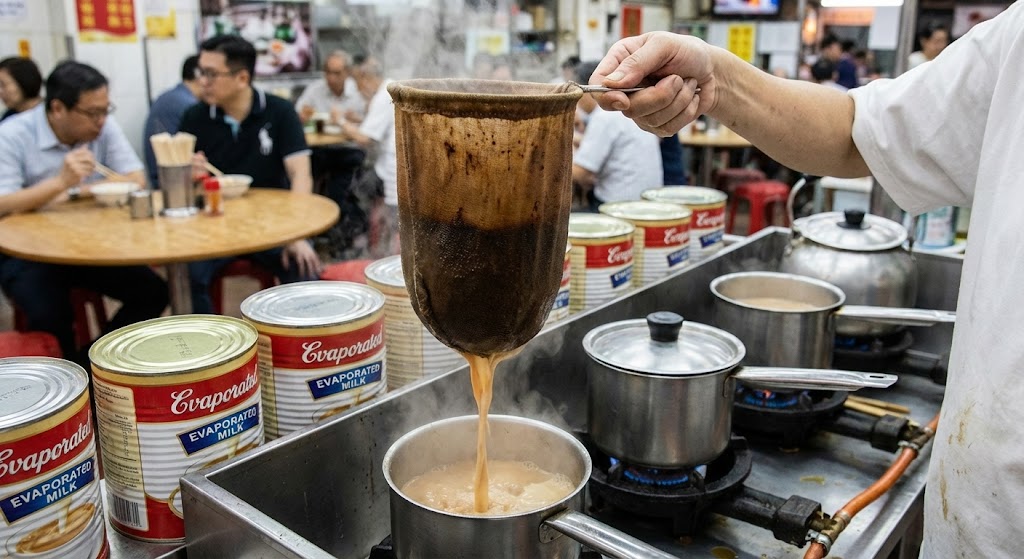
1. The Pantyhose Filter: Physics of the Silk Stocking
Hong Kong milk tea's (奶茶 naai chaa, "milk tea") defining technique is pantyhose filtrationtea strained through nylon hosiery stretched over wire frame. The name "silk stocking tea" (絲襪奶茶 si mat naai chaa) references the original silk stockings used in 1950s, though modern versions use nylon. The pantyhose material creates ultra-fine mesh (100-200 micron pore size) that removes tea particles while allowing dissolved solids and oils to passproducing exceptionally smooth texture with zero grit.
The physics is depth filtration: tea passes through multiple layers of twisted nylon fiber, creating tortuous path that traps particles via mechanical sieving (large particles blocked by pore size) and adhesion (fine particles stick to fiber surface). Each pour through pantyhose removes progressively smaller particlesfirst pass catches leaf chunks, subsequent passes remove tannin sediment. After months of use, tannins stain pantyhose dark brown (legendary "seasoned" filters supposedly add flavor, though evidence is anecdotal).
The technique evolved from British tea straining tradition (silver tea strainers, 18th-19th century), adapted by Hong Kong cha chaan teng (???, "tea restaurant") workers who needed durable, washable, fine-mesh filters for high-volume service. Pantyhose provided cheap, effective solutionironic repurposing of women's garment for working-class male beverage labor. Today, dedicated "tea socks" (cotton or nylon bags) are sold for milk tea, but traditional establishments use actual pantyhose as cultural badge.
| Filter Method | Pore Size | Filtration Efficiency | Texture Outcome |
|---|---|---|---|
| No Filter (direct pour) | N/A | 0% (all particles present) | Gritty, sediment settles, undrinkable by HK standards |
| Metal Mesh Strainer | 500-1000 microns | 60-70% (large particles only) | Slight grittiness, visible tannin cloudiness |
| Paper Filter | 20-50 microns | 95-99% (over-filtration) | Too cleanremoves flavor oils, flat taste |
| Pantyhose/Silk Stocking | 100-200 microns | 85-90% (optimal balance) | Silky smooth, retains oils/body, zero gritIDEAL |
| Cotton Tea Sock | 150-300 microns | 75-85% | Good alternative, slightly less smooth than nylon |
2. The Ceylon-Assam Blend: Tannin Engineering
Hong Kong milk tea uses specific black tea blend: 60-70% Ceylon (Sri Lankan) + 30-40% Assam (Indian). Ceylon contributes bright, citrus-floral notes and clean finish. Assam provides malty depth, full body, and high tannin content that stands up to milk without disappearing. The blend ratio is trade secret among cha chaan tengeach shop tweaks proportions claiming superior balance.
The chemistry targets tannin concentration of 15-20% dry weight in final brew (compared to 10-12% in typical British tea). High tannins create astringency that's mellowed by milk fat, but without milk would be unpalatably bitter. This is intentional: milk tea is designed product, not black tea with milk addedthe tea is over-extracted to create base that requires milk to become drinkable. The tradition parallels Turkish tea's concentration approach (strong brew diluted to taste), Persian samovar's concentrate method, or Gongfu's extreme leaf ratios versus British builder's tea (moderate strength + milk) or grandpa style's simplicity.
Expert Tip: The Tea Sock Break-In Period
New pantyhose filters make weak tea initiallynylon fibers haven't absorbed tannins yet. Brew 10-15 pots of tea (discard first batches or drink weak) before pantyhose is properly "seasoned." The staining is micro-layer of polymerized tannins that fills pore spaces, creating optimal filtration. Never wash seasoned pantyhose with detergent (strips tannins)rinse with hot water only. Replace when fabric develops holes or loses elasticity (every 3-6 months in commercial use).
3. Evaporated Milk vs. Condensed Milk Chemistry
Authentic Hong Kong milk tea uses evaporated milk (淡奶 daam naai, "light milk")not condensed milk, not fresh milk, not cream. Evaporated milk is cow's milk with 60% water removed via heating under vacuum, then sterilized and canned. The result: creamy consistency (12-15% fat vs. 3-4% in whole milk), caramelized flavor (Maillard reactions during heating), shelf-stable (canned, no refrigeration needed), and neutral sweetness (no added sugar, unlike condensed milk).
The chemistry advantage: evaporated milk's concentrated proteins stabilize tea-milk emulsion, preventing separation that occurs with fresh milk (tea tannins coagulate milk proteins, creating curds). Heat treatment denatures proteins into more stable structuressimilar to why heated milk froths better for cappuccino. The caramelized notes from Maillard browning add complexity complementing tea's malt-roasted character. Fat content creates luxurious mouthfeel without cloying sweetness of condensed milk.
The cultural context: evaporated milk became Hong Kong standard in 1950s-60s when refrigeration was scarce and canned goods dominated food supply (post-war British colonial influence + Cantonese adaptation). Fresh milk spoiled quickly in tropical humidity, condensed milk was too sweet for all-day consumption. Evaporated milk hit sweet spot: convenient, affordable, perfect flavor-texture balance. Today, despite ubiquitous refrigeration, HK milk tea maintains evaporated milk tradition as identity markerusing fresh milk is seen as inauthentic "Western-style" tea.
| Milk Type | Fat Content | Sugar Content | Effect in Tea |
|---|---|---|---|
| Whole Fresh Milk | 3-4% | ~5% (lactose, natural) | Thin body, separates easily, "Western" stylenot authentic HK |
| Evaporated Milk | 7-8% (reduced fat) 12-15% (full fat) |
~9-10% (lactose, concentrated) | Creamy, stable, caramel notesAUTHENTIC HK standard |
| Condensed Milk | 8-10% | 40-45% (added sugar) | Too sweet, dessert-likeused in Thai tea, not HK style |
| Heavy Cream | 36-40% | ~3% (lactose) | Overly rich, masks tea flavor, too heavy for all-day drinking |
| Plant Milk (soy, oat) | 2-5% | 0-7% (varies) | Thin, separates badly, off-flavorsincompatible with HK tradition |
4. The "Pull" Technique: Thermal Cycling for Smoothness
Hong Kong milk tea masters perform "pulling" (撞茶 jeung chaa, "crashing tea")pouring tea back and forth between two large metal containers from height (30-50cm). This isn't showmanship like Malaysian teh tarik (which creates foam) or Song Dynasty whisking competitionsHK pulling has practical function: aeration, cooling, and mixing. Each pull introduces oxygen (mellows tannin astringency via oxidation, similar to sencha's water cooling techniques), drops temperature slightly (prevents burning milk when added), and homogenizes tea strength (mixes strong bottom layer with weaker top).
The thermal physics: tea brewed at 100C needs cooling to 70-8°C before adding milk (prevents milk protein coagulation/"curdling"). Pulling accelerates cooling via increased surface area exposure to air and evaporative cooling. Pouring from height creates thin stream with maximum air contacteach pour drops temperature by ~2-3C. Typical pulling: 6-8 pours brings tea from boiling to ideal milk-adding temperature in 2-3 minutes (faster than passive cooling, which takes 10-15 minutes).
Expert Tip: The 30-Minute Rule
Fresh-brewed milk tea served immediately is amateur mistake. Professionals brew tea, pull it, then let sit 30 minutes before adding milk and serving. This "aging" allows tannins to polymerize (link into larger molecules), reducing perceived astringency while maintaining flavor strength. The chemistry is similar to letting red wine breatheoxygen exposure triggers chemical changes that improve smoothness. Rushed milk tea tastes harsh; aged milk tea tastes velvety. Budget time accordingly if making at home.
5. Cha Chaan Teng Culture: The Tea Restaurant Ecosystem
Cha chaan teng (茶餐廳) emerged in 1950s Hong Kong as hybrid Western-Chinese casual diningfusing British colonial tea culture with Cantonese food stalls. Menu features milk tea alongside French toast, egg sandwiches, baked pork chop rice, macaroni soup (?? "strange" fusion dishes). The restaurants served working-class clientele who couldn't afford traditional Cantonese dim sum restaurants or British hotels, creating democratic food space where everyone from laborers to businesspeople gathered.
Milk tea became cha chaan teng signature drinkserved hot or iced (冰奶茶 bing naai chaa, iced milk tea), often in tall glass with straw. The drink culture parallels Argentine mate (class-neutral social beverage), British builder's tea (working-class energy drink), Turkish ay's ubiquity, and Indian chai's street presence. Milk tea is all-day drink: breakfast (with egg sandwich), lunch (with instant noodles), afternoon break (solo or with pineapple bun, echoing afternoon tea timing), late-night snack (with toast). Per capita consumption in HK: estimated 2.5 cups/day among adultshuge cultural penetration.
Modern challenges: cha chaan teng declining as HK rents soar, young people prefer chain coffee shops (Starbucks, Pacific Coffee), and traditional tea masters retire without apprentices. UNESCO Intangible Cultural Heritage application pending (2022 submission)advocates argue milk tea represents unique HK identity distinct from British/Chinese origins. The drink is cultural time capsulepreserving 1950s post-war Hong Kong in every sip.
6. Temperature Serving Standards: The Hot vs. Iced Divide
Hot milk tea (熱奶茶 yit naai chaa): served at 60-7°C (drinkable immediately without burning mouth), never boiling. Cooler than Turkish tea (75-8°C, sipped cautiously), noon chai's scalding heat, or Persian tea's very hot service, but hotter than lukewarm Western standards or sencha's delicate 60-7°C range. The temperature preserves flavor volatiles while allowing immediate consumptioncha chaan teng service is fast, customers don't wait for cooling (unlike Gongfu's patient ritual).
Iced milk tea (冰奶茶 bing naai chaa): brewed double-strength (concentrated), then poured over ice to dilute to proper strength while chilling to 5-1°C. The technique prevents weak, watery iced teamelting ice adds ~30% water, so initial brew must be 30% stronger. Iced milk tea popularity exploded with air conditioning adoption (1970s-80s HK)tropical heat made hot beverages uncomfortable, iced milk tea became year-round drink rather than summer novelty. Today, iced outsells hot 60:40 in summer, 40:60 in winter.
| Serving Style | Tea Concentration | Milk Ratio | Serving Temp |
|---|---|---|---|
| Hot Milk Tea (???) | Standard strength | 3:1 (tea:milk) | 60-7°C |
| Iced Milk Tea (???) | 1.3x strength (compensates for ice dilution) | 3:1 (tea:milk), then add ice | 5-1°C |
| Yuenyeung (鴛鴦) | Standard strength | 3:2:1 (tea:coffee:milk hybrid drink) | 60-7°C (or iced variant) |
| Tea Without Milk (??) | Reduced strength (less tannin without milk balance) | 0 (condensed milk substitute sometimes used for sweetness) | 60-7°C |
7. Regional Variants: HK vs. Macau vs. Guangdong
Hong Kong: Evaporated milk, Ceylon-Assam blend, pantyhose filter, minimal sugar (customer adds), served in thick glass/porcelain mug. Emphasis on smooth texture and strong tea flavor.
Macau: Portuguese colonial influence adds twistsometimes uses condensed milk (sweeter than HK), may include coffee beans brewed with tea (proto-yuenyeung), served in smaller cups (espresso-sized). Macau style is transitional between HK and Southeast Asian sweetened teas.
Guangdong (Canton): Mainland version uses fresh milk often (evaporated milk harder to source pre-economic reform), less elaborate filtration (metal strainers, not pantyhose), slightly weaker brew (less tannin). Guangdong milk tea lacks HK's silky smoothnessgrittier texture, more rustic.
The variations reflect colonialism's impact: HK absorbed British techniques filtered through Cantonese labor; Macau mixed Portuguese-British influences; Guangdong maintained Chinese tea culture with minimal Western adaptation. Modern globalization blurs distinctionsHK-style chains opening in Guangdong, Macau adopting HK techniques. But traditionalists insist authentic milk tea requires HK pantyhose, HK water (mineral content matters), HK cha chaan teng atmosphere (gritty tiles, rude waiters, packed tablespart of flavor profile).
Expert Tip: Water Mineral Content Matters
HK tap water (chlorinated, moderately hard, ~50-100 ppm TDS) produces specific flavor profilechlorine adds slight sharpness, calcium/magnesium enhance tannin extraction. Using distilled water makes flat-tasting milk tea; very hard water makes overly bitter tea. If replicating HK milk tea elsewhere, test local water first. Too soft? Add pinch of calcium carbonate (chalk). Too hard? Cut with 30% distilled water. Ideal TDS: 60-120 ppm. This parallels specialty coffee water chemistryignored by amateurs, obsessed over by professionals.
8. Yuenyeung: The Coffee-Tea Hybrid
Yuenyeung (??, literally "mandarin ducks"symbol of paired lovers) is HK invention: coffee + milk tea mixed. Ratio typically 40% coffee : 60% milk tea, or varies by shop. The drink combines coffee's richness with tea's brightness, creating complex flavor that's neither coffee nor teathird beverage entirely. Caffeine content is extreme (60-80mg from tea + 40-60mg from coffee = 100-140mg total per cup, approaching espresso levels).
Origins unclear: likely emerged 1950s-60s as cha chaan teng experiment. Practicality: shops already brewed coffee and milk tea separately, mixing them requires zero new ingredients. Symbolic meaning: fusion drink representing HK identity (neither purely British nor Chinese, but hybrid creation). Yuenyeung popularity peaked 1980s-90s, declined with specialty coffee rise (2000s), now experiencing nostalgic revival among young HK people reclaiming "old HK" culture.
The beverage parallels Somali shaah's extreme concentration (survival beverage for harsh conditionsHK's fast-paced work culture creates similar demand for hyper-caffeinated drinks). Modern variants: iced yuenyeung, yuenyeung with condensed milk (extra sweet), even yuenyeung bubble tea (tapioca pearls added). Each iteration pushes further from origincultural evolution in real-time.
9. How to Make Hong Kong Milk Tea at Home
Ingredients: Ceylon black tea (15g) + Assam black tea (10g), 1L water (filtered, moderate hardness), 200mL evaporated milk (full-fat), white sugar (optional, to taste).
Equipment: Large pot (1.5L capacity), fine-mesh strainer or clean nylon stocking/tea sock (never used for feet!), two large heat-proof containers for pulling, thermometer.
Step 1 - Brew concentrated tea: Boil 1L water. Add 25g mixed tea leaves (Ceylon + Assam). Return to gentle boil, reduce heat, simmer 5-7 minutes. Tea should be dark reddish-brown, opaquemuch stronger than normal tea.
Step 2 - First filtration: Pour tea through pantyhose/strainer into container. Tea will be hot (~90-9°C). Discard leaves (or save for second weaker brew if desiredsome shops do this for "weak tea" option).
Step 3 - Pull tea: Pour tea from height (30-50cm) between two containers, back and forth, 6-8 times. Watch temperaturetarget 70-8°C after pulling. If too hot, continue pulling or wait 2-3 minutes.
Step 4 - Rest (optional but recommended): Let pulled tea sit 20-30 minutes. This "aging" mellows tannins. Tea will cool to 60-7°Cperfect temperature for adding milk.
Step 5 - Add evaporated milk: Pour 200mL evaporated milk into tea (creates ~3:1 tea to milk ratio). Stir gently. Color should be caramel-brown, lighter than pure tea but darker than Western milky tea.
Step 6 - Final filtration: Pour milk tea through pantyhose/strainer one final time (removes any milk clumps, ensures silky texture). Serve immediately in preheated mugs, or refrigerate for iced version (pour over ice when serving).
Tasting notes: Authentic HK milk tea is smooth (zero grittiness), full-bodied (thick mouthfeel from evaporated milk), balanced (tea flavor strong but not bitter, milk creamy but not cloying), with caramel/malt undertones. If tea is weak, increase leaf amount or brewing time next batch. If bitter, reduce brewing time or add more milk. If gritty, strain more thoroughly. The drink rewards iterationperfect milk tea takes practice.
Comments