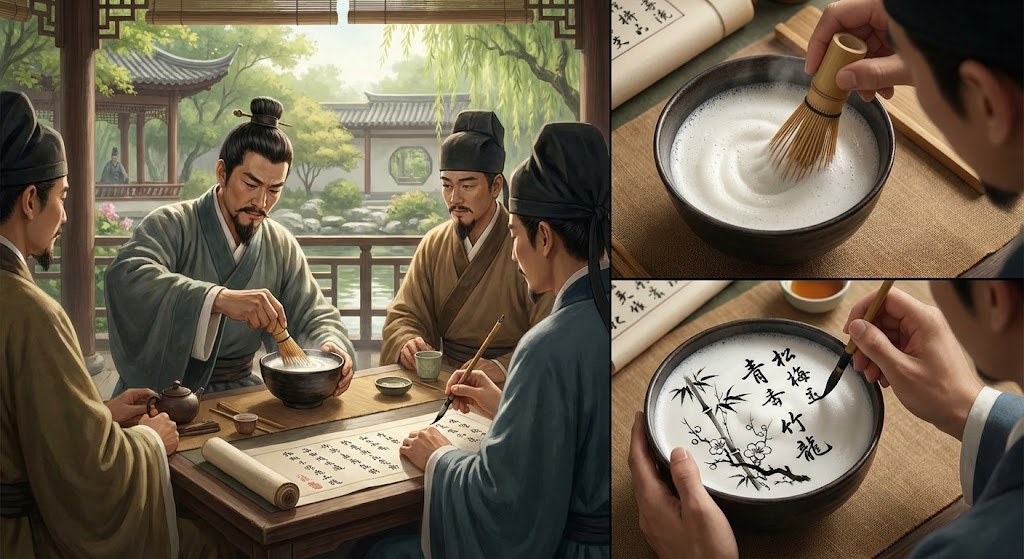
1. The Song Tea Revolution: From Boiling to Whisking
Song Dynasty (960-1279°CE) transformed Chinese tea culture from Tang Dynasty boiling to whisking powdered tea (點茶 diǎnchá, "point tea")—radical method shift driven by imperial patronage and competition culture. Emperor Huizong (徽宗, reigned 1100-1126) was tea fanatic: wrote Treatise on Tea (大觀茶論, 1107 CE), personally judged tea competitions, demanded finest tribute teas from imperial gardens, and elevated tea to supreme art form. The court 's obsession cascaded: officials competed through tea skill (career advancement tied to tea knowledge), literati wrote tea treatises (dozens survive—tea became scholarly subject), and tea competitions became national sport (鬥茶 dòuchá, "tea battles," public spectacles with wagering, rankings, prestige).
The whisking innovation emerged from competitive pressure: boiled tea's foam was inconsistent (large bubbles, short-lived, unpredictable), but whisked powdered tea created superior froth (fine stable bubbles, long duration, controllable texture). Competition judges ranked teas by foam quality—color (white best, greenish acceptable, yellowish poor), texture (creamy smooth ideal, coarse bubbles inferior), duration (foam lasting 5+ minutes won over 2-minute foam). These criteria demanded whisking: only vigorous whisking created tournament-winning foam. The method spread from competition to daily practice—within 100 years, whisking became dominant Chinese tea method (Tang boiling forgotten, considered primitive by Song standards).
The modern parallel: Song whisked tea is direct ancestor of Japanese matcha. Zen monk Eisai (榮西, 1141-1215) studied in Song China, brought tea seeds and whisking technique to Japan (1191 CE). Japanese tea ceremony (chanoyu 茶の湯) preserved Song method after it died in China—matcha today is living fossil of 12th-century Chinese practice. The ironic geography: most "Japanese" tea element (whisked matcha) is actually Chinese import, while most "Chinese" tea method (steeped loose-leaf) is later innovation. Cultural memory is faulty—practices migrate, origins blur, credit misattributes.
| Comparison Factor | Tang Boiled Tea (800s CE) | Song Whisked Tea (1000s-1200s CE) | Modern Matcha (Japanese Preservation) |
|---|---|---|---|
| Tea Form | Compressed cake (steamed, pounded, dried), roasted before use | Fine powder (stone-ground from steamed tea leaves) | Fine powder (granite-stone ground, ceremonial grade <20 micron particle) |
| Preparation Method | Grind roasted cake → boil with water + salt (3-5 min simmer) | Whisk powder into hot water (70-80°C) until frothy (no boiling together) | Whisk powder into hot water (70-80°C), identical to Song method |
| Aesthetic Focus | Flavor robustness, social gathering, literary context (poetry, conversation) | Foam quality (color, texture, duration)—visual perfection, competition | Meditative process, spiritual practice, foam secondary (inherited Song technique) |
| Salt Addition | Mandatory (Lu Yu specified ~1g/L water) | Rejected (salt interferes with foam, considered vulgar adulteration) | Never (pure tea philosophy from Song, Japanese reinforced purity) |
| Social Context | Elite literati gatherings (monks, scholars, officials), private/semi-public | Public competitions (audiences, betting, rankings), plus elite practice | Intimate ceremony (host + few guests), spiritual/aesthetic focus, no competition |
| Historical Status | Extinct in China (Song Dynasty replaced it), survived only in Tibet/Mongolia variants | Extinct in China (Ming Dynasty banned it, ~1391 CE), survived in Japan as matcha | Thriving in Japan (global export), now re-imported to China (historical irony) |
2. The Powder Production: Stone-Ground Perfection
Song tea powder required extraordinary fineness: Processing steps: (1) Steam fresh tea leaves (halts oxidation, preserves green color—same as Tang, but higher quality leaves). (2) Dry steamed leaves completely (moisture <5%). (3) Remove stems and veins (only pure leaf tissue used—labor-intensive hand-picking). (4) Grind dried leaves in stone mill (two grinding stones, slow rotation, produces ultra-fine powder). Grinding duration: 40-60 minutes per 30-40g powder (incredibly slow—prevents heat buildup that would damage delicate aromatics). Particle size: <20 microns ideal (modern matcha ceremonial grade standard—particles invisible to naked eye, silky texture when whisked).
The physics of stone grinding: granite wheels (high hardness, abrasive surface) rotate at <100 RPM (slow speed minimizes friction heat). Upper stone is stationary, lower stone rotates (tea leaves fed through central hole, gradually ground between stones, powder expelled from perimeter). Heat generation follows $ Q = \\mu F v $, where $ Q $ is heat, $ \\mu $ is friction coefficient, $ F $ is normal force, $ v $ is velocity—slow rotation keeps $ v $ low, minimizing heat damage to tea compounds (chlorophyll, amino acids, vitamins degrade rapidly above 40°C). Modern ball-mill grinding (fast, industrial) generates 60-80°C heat (destroys flavor), stone grinding stays <30°C (preserves quality)—why ceremonial matcha still uses stone grinders 800+ years later.
The economic impact: fine powder production was expensive (labor-intensive stem removal, slow grinding, skilled workers, quality control). Song Dynasty imperial tea gardens (北苑 Bei Yuan, Fujian Province, similar to virgin picker mythology's exclusive gardens or Da Hong Pao's cliff harvesting) employed hundreds of workers (seasonal harvest processing, year-round maintenance), produced tribute tea worth more than gold by weight (Emperor Huizong recorded single tribute tea cake costing 40,000 coins—equivalent to several years' peasant income, rivaling Da Hong Pao's modern auction prices or Victorian luxury tea's cost). The tea-industrial complex: government monopoly controlled production (private tea gardens illegal, paralleling British East India Company's trade monopoly), taxation revenue (tea tax funded imperial projects), and social control (tea access = imperial favor, withholding tea = punishment). This parallels modern luxury goods (champagne, truffles, saffron—value derived from scarcity, process complexity, cultural prestige multiplication).
Expert Tip: Modern Stone-Ground Matcha vs. Cheaper Alternatives
Matcha quality correlates with grinding method: Ceremonial grade (stone-ground): Slow granite grinding (<50g/hour production), vibrant green color, sweet/umami flavor, fine texture (clump-free when whisked), smooth finish (no bitterness). Price: $25-40 per 30g (~$0.80-1.30 per serving). Culinary grade (ball-milled): High-speed industrial grinding (kg/hour), duller olive-green, bitter/astringent flavor, coarser texture (some clumps), harsh finish. Price: $10-20 per 100g (~$0.10-0.20 per serving). The quality difference is detectable: ceremonial dissolves instantly (vigorous whisking 30 seconds), culinary requires longer whisking (2+ minutes, still has grit). For drinking straight: ceremonial grade only. For lattes/baking: culinary acceptable (milk/sugar mask defects). Don't waste ceremonial grade on cooking—heat destroys what you paid premium for.
3. The Tea Competition Culture: Dòuchá (鬥茶)
Song tea battles were formalized sport: Competition structure: Two competitors face off (head-to-head matches, tournament brackets for large events), each prepares tea using identical procedure (standardized to isolate tea quality from technique variation), judges taste and evaluate (foam appearance, color, duration, flavor). Judging criteria (descending importance): (1) Foam color: pure white (乳白 rǔbái) = best (indicates finest tea, perfect processing, optimal whisking), slight green acceptable, yellow tint = poor quality. (2) Foam texture: creamy smooth, no visible bubbles (indicates fine powder, skilled whisking), coarse = inferior. (3) Foam duration: stable 5+ minutes (tea quality + technique), disappearing rapidly = failure. (4) Flavor: secondary consideration (foam aesthetics dominated Song culture, taste almost afterthought by late Song period).
The social stakes: winning competitions brought: Official advancement (Emperor Huizong personally judged major competitions, champions received government positions—tea skill = career path). Wealth (prize purses, plus ability to sell "champion tea" at premium prices). Prestige (literary fame, invitations to elite gatherings, social climbing opportunities for non-aristocrats). Access to tribute tea (winners granted imperial tea allocations, otherwise unavailable to commoners—creating feedback loop where champions got better tea, enabling continued winning). The competitive escalation: as stakes rose, methods became more extreme—participants sought rarest teas (wild-harvested from cliffs, pre-Qingming first-flush, single-tree productions), custom-made whisks (perfect bamboo selection, skilled craftsmen), secret techniques (water temperature precision, whisking rhythms, even meditation practices to calm nerves).
The gambling dimension: dòuchá attracted betting (spectators wagered on favorites, creating entertainment economy around tea). Street-level competitions (informal neighborhood matches) co-existed with imperial contests (palace spectacles). The social spectrum: poor urbanites competed with cheap tea (proving skill matters more than ingredients), wealthy merchants competed with exotic teas (proving money buys advantage), officials competed with political implications (factional alliances, rivalry expressions). The tea-battle culture paralleled modern sports (competitive intensity, spectatorship, hero worship, commercial exploitation)—but focused on aesthetic refinement instead of physical prowess. The cerebral combat: minds and taste buds, not muscles.
4. The Bamboo Whisk: Engineering Foam Creation
Song whisking demanded specialized tool (茶筅 cháxiǎn, "tea whisk")—prototype of modern matcha whisk (茶筅 chasen in Japanese): Construction: Single piece of bamboo (3-5cm diameter, 10-12cm length), split into 80-120 fine tines (1mm thick each), bent outward to create bulb shape (tines curl, increasing surface area for whisking), tied with thread to maintain shape (prevents tines splaying further). Function: Rapid whisking (100-120 strokes per minute, wrist-powered circular motion) creates shear forces that: (1) Suspend tea particles (prevents settling, keeps powder mixed with water), (2) Incorporate air (whisking entrains bubbles, mixing gas phase into liquid), (3) Denature proteins (tea proteins partially unfold under shear stress, creating foam stabilization—similar to egg-white whisking for meringue).
The foam physics: tea foam is protein-stabilized bubble structure. Tea contains proteins (~20-30% of dry weight, mostly storage proteins and enzymes), which are amphiphilic molecules (hydrophobic regions + hydrophilic regions). During whisking: (1) Mechanical agitation creates air bubbles (kinetic energy overcomes surface tension, introduces gas). (2) Proteins migrate to air-water interface (hydrophobic parts face air, hydrophilic parts face water—minimizes free energy). (3) Protein shell stabilizes bubbles (prevents coalescence—bubbles can't merge because protein barrier keeps them separate). (4) Result: stable foam (bubbles persist 5-10 minutes instead of seconds). This chemistry explains Song's foam obsession: stable foam = high protein content = quality tea (young tender leaves have more protein than old leaves—foam quality became proxy for harvest timing, processing skill).
The whisk material science: bamboo is ideal because: Flexibility (tines bend without breaking, survive thousands of whisking cycles), smoothness (bamboo surface doesn't scratch ceramic bowls, unlike metal whisks), thermal resistance (doesn't conduct heat, comfortable to grip even in hot water), natural antibacterial properties (bamboo contains antimicrobial compounds, resists mold despite constant water exposure). Modern plastic whisks exist (cheaper, mass-produced), but traditional bamboo remains standard for serious matcha—material affects foam quality subtly (bamboo's flexibility creates optimal shear rate, plastic stiffness changes fluid dynamics slightly, detectable by expert whiskers). The craft persistence: 800-year-old tool design unimproved by modern materials science—original was already optimal.
| Whisk Quality | Number of Tines | Price Range | Foam Quality |
|---|---|---|---|
| Basic/Student Grade | 60-80 tines (thicker, less flexible, mass-produced) | $8-15 | Adequate (creates foam, but coarser bubbles, less stable, requires more effort) |
| Standard Ceremonial | 80-100 tines (medium thickness, good flexibility, handmade) | $20-35 | Good (fine bubbles, stable 3-5 min, smooth texture, standard for daily practice) |
| Master/Competition Grade | 100-120 tines (ultra-fine, highly flexible, artisan-crafted from select bamboo) | $50-150+ | Exceptional (micro-foam, stable 10+ min, velvety texture, tournament standard) |
Expert Tip: Whisk Care and Lifespan Extension
Bamboo whisks degrade (tines break, curl loses shape, foam quality declines). Extend lifespan: (1) Pre-soak before use: Rinse whisk in hot water 30 seconds before whisking (hydrates bamboo, makes tines flexible—dry brittle tines snap easily). (2) Whisk holder: Store on kusenaoshi (whisk holder, bamboo form that maintains tine shape, ~$8-15)—prevents tines compressing, keeps bulb shape. Don't store in drawer (tines crush flat, permanent deformation). (3) Rinse immediately after use: Hot water rinse (removes matcha residue), air dry completely (don't leave wet—mold growth). Never dishwasher (heat/detergent destroys bamboo). (4) Gentle whisking: Don't press whisk against bowl bottom (breaks tines)—lift slightly while whisking, minimize contact pressure. Proper care: whisk lasts 6-12 months (daily use) vs. 1-2 months (neglect/abuse). When 5+ tines broken or foam quality noticeably poor, replace—worn whisk can't create proper foam (defeats entire purpose).
5. Water Temperature and Whisking Technique
Song whisking demanded precise temperature control (unlike Tang boiling's 100°C but similar to sencha's delicate range): Optimal temperature: 70-80°C (158-176°F)—hot enough to extract flavors, cool enough to preserve delicate compounds (L-theanine, chlorophyll, vitamins degrade above 85°C, same concern as Gongfu green tea or mate's non-boiling water). Temperature test (pre-thermometer era): Pour hot water over wrist—should feel hot but not painful (pain threshold ~45°C, desired water feels distinctly hot but tolerable for 2-3 seconds). Alternative: drop water on bamboo—if water dances/beads (Leidenfrost effect, >100°C) = too hot, if water spreads/soaks immediately (<60°C) = too cool, if water briefly beads then spreads (70-80°C) = perfect.
Whisking technique (Song method, preserved in Japanese matcha): Step 1 - Add powder: Sift 2g powder into bowl (removes clumps, ensures smooth dispersion). Step 2 - Add water: Pour ~60mL hot water (70-80°C) over powder, creating thin paste (initial water amount critical—too much = weak tea, too little = clumps form). Step 3 - Initial whisking: Whisk vigorously in W or M pattern (not circular—linear back-and-forth creates more turbulence, better foam), 80-120 strokes, 30-45 seconds duration. Wrist motion only (not arm—wrist provides rapid oscillation, arm motion too slow). Step 4 - Evaluate: Lift whisk slowly—foam should coat tines, bubbles should be tiny (micro-foam, almost invisible individual bubbles), color should be uniform pale green-white.
Advanced whisking variables: Speed: Faster whisking (120+ strokes/min) = finer bubbles but requires more skill (sloppy fast whisking creates splashing, inconsistent foam). Depth: Whisk tines should penetrate halfway into liquid (too shallow = surface-only mixing, too deep = inefficient air incorporation). Pattern: W/M pattern most effective (creates shear vortices at direction-change points, maximizes protein denaturation). Circular whisking less effective (smooth flow, less turbulence). Duration: 30-60 seconds optimal (longer whisking doesn't improve foam quality, may overheat tea from friction, causes arm fatigue). The embodied skill: experienced whiskers judge by sound (pitch changes as foam develops—high tinkling = watery start, deeper muted tone = foam forming), texture (resistance increases as foam thickens—hand feels drag), and visual (color transition from dark green liquid → pale green cream).
6. The Emperor's Tea Obsession: Huizong's Treatise on Tea
Emperor Huizong (徽宗, 1082-1135) was Song Dynasty's tea authority: accomplished painter (surviving artworks include tea-themed scrolls), poet (tea verses), calligrapher (inscriptions on tea implements), and tea theorist. His Treatise on Tea (大觀茶論, Daguan Chalun, 1107 CE) codified Song tea culture: Tea selection criteria: Color (white powder = supreme, yellow-green = inferior), aroma (fresh and清雅 qingyǎ, "clear and elegant," not rank/fishy), foam quality (white like snow, lasting like clouds), flavor (甘鮮 gān xiān, "sweet and fresh," not bitter). Preparation specifications: Water temperature (just below boiling, "crab eye" stage—small bubbles forming), powder-to-water ratio (varies by tea quality, typically 2g per 60mL), whisking technique (fast, brief, vigorous—60 seconds maximum). Serving philosophy: Simplicity is refinement (minimal tools, pure focus on tea-water interaction, no additives—rejected Tang salt tradition).
Huizong's political downfall: obsession with tea (and painting, poetry, art collecting) distracted from governance. Neglected military (northern borders undefended), ignored corruption (court officials embezzled, regional governors rebelled), and exhausted treasury (tribute tea gardens, palace renovations, art acquisitions). In 1127, Jin Dynasty invaded (northern conquest), captured Kaifeng (capital city), took Emperor Huizong prisoner (died in captivity 1135, age 53). The historical irony: greatest tea emperor's legacy is tea treatise (survived 900+ years, still studied), while his empire collapsed (Song retreated south, lost half territory, never recovered northern lands). The cautionary tale: aesthetic achievement doesn't guarantee political success—art and governance require different skills, obsession with one endangers the other.
But Huizong's tea culture outlasted his dynasty: Song method spread to Japan (became matcha ceremony and chabana aesthetics), influenced Korean tea culture (powdered tea tradition), and established aesthetic principles (simplicity, purity, seasonal awareness) still dominant in East Asian tea philosophy—even affecting Gongfu's minimalist focus and Senchado's literati elegance. The paradox: failed emperor, successful cultural arbiter. His political incompetence enabled artistic focus—had he been better ruler (time spent on military/governance, like Victorian empire builders or Atatürk's tea industry development), might not have revolutionized tea culture. The trade-off: historical significance vs. contemporary effectiveness. Huizong chose art, lost empire, gained immortality through tea. Different kind of victory.
7. Why Song Whisked Tea Disappeared from China
Ming Dynasty (1368-1644) deliberately destroyed Song tea culture: Zhu Yuanzhang's decree (1391 CE): Ming founder banned tribute tea cakes (ordered switch to loose-leaf), ended imperial tea competitions (considered frivolous waste), simplified tea processing (no more powdered tea production for imperial use). The political motivation: Ming legitimacy built on反对 (oppose) Song corruption—Song tea culture represented everything Ming rejected (aristocratic extravagance, resource waste, social inequality). By banning compressed/powdered tea, Ming signaled ideological break (new dynasty, new values, anti-elite populism).
Economic factors: Song tea production was expensive (powder grinding, quality control, imperial garden maintenance—huge government expenditure). Ming faced fiscal crisis (war costs, rebuilding after Mongol Yuan Dynasty collapse), needed austerity. Loose-leaf tea cost less (simpler processing, no grinding, faster production), reduced government tea monopoly overhead. The decree was budget cut disguised as ideology—practical economics driving cultural transformation. Social access: Powdered tea required specialized equipment (stone grinder, bamboo whisk, proper bowls—expensive, inaccessible to peasants). Loose-leaf tea democratized brewing (just teapot + hot water—anyone could participate). Ming portrayed loose-leaf as egalitarian reform (breaking aristocratic tea monopoly), though reality was more complex (finest loose-leaf teas still expensive, beyond poor people's reach—more accessible than Song powder, but not truly democratic).
The survival in Japan: Zen monk Eisai brought Song whisking to Japan (1191 CE), 200 years before Ming ban. By 1391, matcha was established in Japanese tea culture (Buddhist monasteries, samurai class, beginning of tea ceremony formalization). When Chinese method died (1400s), Japanese practice continued independently—preserving Song technique Ming destroyed. The geographic irony: most "Chinese" cultural practice (whisked powdered tea) survived in Japan, while China adopted "foreign" method (steeping loose-leaf was Mongol influence from Yuan Dynasty, not purely Chinese). Cultural ownership is fiction—practices migrate, transform, get claimed by whoever preserves them. Matcha is Japanese now, despite Chinese origin—culture belongs to who maintains it, not who invented it.
8. Modern Song Tea Recreation: Matcha as Living Archive
Japanese matcha ceremony preserves Song method with modifications: Continuities (Same as Song): Powdered tea (ultra-fine stone-ground), whisking technique (bamboo whisk, W/M pattern, 30-60 seconds—similar precision as teh tarik's pulling or Hong Kong's pantyhose filtration), water temperature (70-80°C, avoiding boiling, like sencha or mate), foam creation (visual aesthetic, micro-bubble texture), ceremonial context (formal preparation, mindful practice). Divergences (Japanese innovations): Spiritual emphasis (Zen Buddhist influence—tea as meditation, not competition), architectural setting (dedicated tea room, wabi-sabi aesthetic—Song used general-purpose rooms like Persian or Turkish tea houses), seasonal awareness (flower arrangements, scroll selection, wagashi sweets pairing—more elaborate than Song), and removal of competitive element (Japanese rejected tea battles, emphasized contemplation over contest).
The emotional tenor shift: Song tea was yang (陽—active, competitive, public display, masculine energy). Japanese matcha is yin (陰—passive, contemplative, private intimacy, feminized space). Same technique, opposite philosophy—whisking as sport vs. whisking as prayer. The cultural adaptation: Japan took Chinese method, infused Buddhist spirituality (Song Buddhism existed but wasn't tea's primary context), added Japanese aesthetic sensibilities (imperfection appreciation, quiet restraint), created something new while preserving core technique. This pattern repeats: Hong Kong milk tea (British tea + Cantonese adaptation), bubble tea (Taiwanese innovation from Chinese tea base), Southern sweet tea (British tea + American South). Cultural borrowing is transformation—purity is myth, fusion is norm.
Expert Tip: Song-Style Matcha Tasting Comparison
Experience Song tea culture through modern matcha comparison: Buy two matcha grades (ceremonial + culinary, ~$30 total), prepare both identically (2g powder, 60mL water at 75°C, whisk 45 seconds). Observe Song judging criteria: (1) Foam color: Ceremonial = bright pale green-white (pure color), culinary = dull olive-yellow (oxidation/lower quality). (2) Foam texture: Ceremonial = micro-foam (nearly invisible bubbles, creamy), culinary = coarse bubbles (visible, quickly separating). (3) Foam duration: Ceremonial = stable 5-10 minutes, culinary = collapsing within 2-3 minutes. (4) Flavor: Ceremonial = sweet/umami (L-theanine, low bitterness), culinary = bitter/astringent (oxidized polyphenols, harsh). This exercise reveals Song sophistication—foam quality directly correlates with tea quality (what seems arbitrary aesthetic obsession is actually reliable quality indicator). Song judges weren't crazy—foam reading was empirical tea science.
9. Practicing Song-Style Tea Today
Equipment (Budget: $40-90): Matcha bowl (chawan 茶碗, wide shallow ceramic bowl, $15-40—allows room for whisking). Bamboo whisk (chasen 茶筅, 80-100 tines, $20-35 for quality). Bamboo scoop (chashaku 茶杓, for measuring powder, $8-15—optional, can use small spoon). Sifter (fine mesh, $5-10—removes powder clumps). Tea: Ceremonial-grade matcha (30g, $25-40—lasts ~15 servings). Total: $73-140 for complete setup, but buy incrementally (start with matcha + bowl + whisk + regular spoon = $60, add specialty tools later).
Simplified Song method: 1. Heat water (3 min): Boil water, let cool 2-3 minutes (reaches ~75°C). Test: pour small amount on wrist—hot but not painful. 2. Prepare powder (1 min): Sift 2g matcha into bowl (removes clumps). 3. Add water (30 sec): Pour 60mL hot water over powder. 4. Whisk vigorously (45 sec): Rapid W or M pattern, wrist motion only, 100-120 strokes. Should feel arm fatigue (proper intensity). 5. Evaluate foam (30 sec): Lift whisk slowly—foam should coat tines. Bubbles should be tiny (micro-foam), color pale green-white. Drink immediately. Total time: ~5 minutes preparation, 30-second consumption (Song tea drunk quickly while foam fresh).
Advanced practices: Competition simulation: Prepare two bowls side-by-side (same powder, same technique), compare foam quality (which develops finer bubbles? which lasts longer?). Track improvement over weeks (foam duration extends as skill increases—objective measure of technique mastery). Temperature experimentation: Try same powder at 65°C, 75°C, 85°C—notice flavor differences (cooler = sweeter/less astringent, hotter = stronger/more bitter). Find personal preference. Powder-to-water ratios: Thick tea (濃茶 koicha—3-4g powder per 60mL water, paste-like consistency, intense flavor) vs. thin tea (薄茶 usucha—2g per 60mL, standard preparation). Song practiced both—thick for intimate gatherings (2-3 people sharing bowl), thin for larger groups (individual servings). Experiment with both styles, experience concentration spectrum.
Comments